Unknown's avatar

About lsstuhler

Linda Stuhler is a Genealogy Geek from Rochester, New York, who loves to find out the facts. She has been researching her family tree for over twenty years and has accumulated an abundance of information on various subjects that she enjoys sharing on her blog at: https://inmatesofwillard.com/. She was responsible for the creation of the New York State Senate Bill S840, initiated in August 2011, which allows for the release of the names, dates of birth and death, of former patients who were buried in anonymous graves in New York State Custodial Institutions. The bill was changed from the original draft to S840A and does not work the way it was intended. It became a law on August 18, 2016, but it did not include provisions for a searchable database available to the public as New York State attorneys and the Office of Mental Health believed that if they did so, they would be sued. She is the author of "THE INMATES OF WILLARD 1870 TO 1900, A GENEALOGY RESOURCE."

1864 Chautauqua County Poor House

Chautauqua county poor house has one hundred and twenty inmates, twenty-seven of which are insane. They have been admitted at various periods since 1848. Two of these cases have been treated in an asylum. Sixteen of the cases are mild, two are violent, and five are filthy. Ten are confined to the house. Four males and five females are capable of doing some labor. No amusement is provided for any who do not labor. In dry weather the supply of water is insufficient and is brought about a half a mile by teams.

The insane are kept in two buildings; one building is of brick, and the bedsteads in the rooms of this building are of iron, and fastened to the floor. Only one sleeps in a bed, except in one bed, which is occupied by two persons. One sleeps on straw without any bed. The beds are filled with straw, except such as are occupied by the sick, which are of cotton or feathers. The mild cases are kept in one building, and the excitable or violent in another. A man and his wife are jointly employed in the care of the violent cases. The rooms are all heated by a box stove, with wood, from the lower floor, the pipes encased passing through the floor above, it is believed by the overseer that no inmates suffer with cold in the winter.

Paupers arc employed to take care of the mild cases. The rooms are clean and the atmosphere in them is not bad. All are furnished with shoes in the winter, only one would not wear them. The building is designed to accommodate twenty-two, but thirty have at times been confined there. There is no regular medical attendance, nor is ultimate recovery held in view. The duties of the keeper appear to be discharged in a kind manner, and as well as could be done by any one not experienced in the management of the insane. Dr. Barrett observes and justly, “The attendants ought not to be all paupers.” The deficiency in water must be a great drawback to the comfort of the inmates, and the question might properly be raised whether the system of heating is sufficient to warm the building in winter.”

1864 Cattaraugus County Poor House

Cattaraugus county house has forty-nine inmates, seventeen of whom are insane. The lunatics have been admitted at several periods since 1838. Thirteen are of American birth. Thirteen are likewise mild cases; seven are of filthy habits. None have ever been treated in an asylum. Two cases were admitted in 1864, previous to August 12th. Five males and six females are capable of doing some labor. The others have no form of occupation. The violent are restrained by locking them up in a dark room. The house has no bathing tub. Some of the bedsteads are of iron and a part are fastened to the floor. In some of the beds two persons sleep. Straw is used for bedding and is changed as often as it becomes foul. The food is distributed in dishes to each one. No attention is given to free ventilation, nor to uniformity of heat in the winter. When indoors the sexes are kept separately; the keeper and his wife having a general superintendence over them. They have clean clothing once a week and oftener if necessary. One had no shoes during the winter. The building is designed to confine twenty lunatics, but nineteen is the highest in confinement at any one time. The insane are visited by a physician every week, and oftener if they are ill, but circumstances do not allow of any treatment with reference to recovery. They are as clean and comfortable as the system of management is calculated to make them.”

SOURCE: Documents of the Assembly Of The State Of New York, Eighty-Eighth Session, 1865, Volume 6, Nos. 199 to 112 Inclusive, Albany: C. Wendell, Legislative Printer, 1865, Pages 183-184.

New York State County Poor Houses.

Pages 183-184.

1864 Broome County Poor House

“In the Broome county poor house there are eighty-five inmates, twenty-one of whom, or one in four are lunatics. Ten are males, and eleven are females. Only four are of foreign birth. One has been in confinement since 1834. Nine of these cases are mild, seven are violent. Seven have been treated in an asylum. Eight of these insane are capable of labor. Four males and two females are destructive to their clothing, and four males and one female are in constant restraint, by hand-cuffs or otherwise. The other forms of restraint are persuasion and confinement. Whipping is seldom resorted to. The house has a full supply of water, but no bath tub. All but three are required to wash hands and face daily. Three are confined in cells above ground, without the privilege of coming daily to the open air. There are wood bedsteads in all the rooms but one. Six sleep on straw without beds or bedsteads; the straw is changed once a week. Part are fed in cells, others at a common table. The building is heated by a coal and wood stove. All the rooms are heated, without observation by a thermometer; it is intended to keep them all comfortable. The sexes are entirely separated at night. None other than paupers arc employed uniformly to administer to the daily wants of the insane. The cleanliness of the rooms is commendable, though they are badly ventilated. Vermin were observed. Recent cases are received; one had neither shoes or stockings during the winter, because he would not wear them. The institution is designed to accommodate only five lunatics. They receive medical attendance only when sick. Each case does not receive care with reference to its ultimate recovery. The buildings of the Broome county poor house are insufficient to meet the wants of the insane, but such as they are, are kept in good order, and the keeper and his family are attentive and humane.”

SOURCE: Documents of the Assembly Of The State Of New York, Eighty-Eighth Session, 1865, Volume 6, Nos. 199 to 112 Inclusive, Albany: C. Wendell, Legislative Printer, 1865, Page 183.

New York State County Poor Houses.

1864 Allegany County Poor House

“Of the poor house and its insane inmates in the county of Allegany, Dr. John Norton remarks: “The old block house in which some insane are confined, occupied in part by idiots, is in very bad condition, with no ventilation, old, rotten and filthy, and entirely inadequate for the purposes for which it is used. All the buildings are poorly arranged and badly constructed. Most of the inmates are idiotic, and few are even competent to care for others. With so little help, spite the efforts of the keeper, many must be at times neglected. I found much suffering for want of medical care, as the surgeon employed so seldom visits the institution, and I learned, by those who were competent to speak for themselves, that he gives each case very little attention. I do not think the aged and sick receive proper nourishment. There is but one back yard in which to amuse themselves and get open air, which is entirely insufficient for the variety of cases there represented.” These remarks are based on the facts that the poor house has in it eighty-nine paupers, twenty-one of whom are lunatics or idiots. They have been admitted to the poor house at various periods since 1842. Fifteen are females; six are males; fifteen are natives and sixteen of foreign birth. Eight cases are mild; one has been in State prison; three have been treated in the State asylum; seven are capable of doing some labor. Those who cannot labor have no form of amusement. The house has no bathing tub, and in dry weather the supply of water is insufficient. Thorough ablution is not one of the virtues of the institution. There is no arrangement for uniformity of heat in winter and ventilation. None are without the privilege of coming to the open air every day, unless the keeper is absent. There are rooms without a window opening out of doors. All the looms have bedsteads; one and two sleep in a bed. The beds are ticks filled with straw, which is changed about once a month. There are large stoves in the hall, which are considered sufficient to heat the cells, but no attention is paid to its uniformity or sufficiency. The sexes are partly separated. The keeper has charge of the female insane, and pauper care is the only kind bestowed, beside that of the keeper on the males. As to cleanliness, “some of the cells are quite bad,” and the atmosphere in them “very bad.” Vermin were found in some of the beds. The insane are only partially separated from other paupers. Eight were removed during the year by their friends. A county physician averages a visit to the lunatics about once a month.”

Allegany County Poorhouse – The Art Of Abandonment / Photography by Walter Arnold.

Allegany – Linda Crannell, The Poorhouse Lady.

Allegany County Home Angelica – Louis Q Photography.

Allegany County, NY, Poor House Records.

Angelica, NY, Historical Research Links.

Allegany County NY GenWeb.

SOURCE: Documents of the Assembly Of The State Of New York, Eighty-Eighth Session, 1865, Volume 6, Nos. 199 to 112 Inclusive, Albany: C. Wendell, Legislative Printer, 1865, Pages 182-183.

New York State County Poor Houses.

1864 Albany County Poor House

“The year embraced in the report of the Alms House Insane Asylum is for September 1, 1863, to September 1, 1864. The number of paupers varies from four hundred and twenty-five in summer to six hundred and fifty in winter. There have been during the fiscal year one hundred and fifty-five lunatics in the poor house asylum. The ratio of insane is about one in four. Fourteen have died; twenty-eight have been discharged. Ninety-nine of the whole number were mild cases; twenty-one were filthy; sixty-two were males and seventy-three were females; fifty-seven were native and eighty-eight of foreign birth. All have been admitted since 1848. Of the whole number only nine had been treated in the State asylum. Twelve males and twenty females were capable of labor. The large number who were unable to work had no amusement or employment. Only six were destructive to their clothing, and required the straight jacket restraint, or locking in cells. The house has two bath tubs, one for each department, and a full supply of water from the city water works. The insane are required to bathe weekly, and to wash hands and face daily. The rooms are supplied with iron bedsteads, and straw in ticks for bedding. The diet is intended to be ample, and all who are able go to a common table to eat. The change of clothing is made every week. The rooms in summer are well ventilated. All have shoes in winter. Twelve escaped during the year who were not returned; three were removed by friends. The asylum was built to accomodate thirty-one lunatics. There are in confinement at the present time in this space, designed only for thirty-one, One Hundred And Three. The greatest number in confinement at any one time was ONE HUNDRED AND TWENTY, designed to accomodate thirty-one!—the alms house asylum of the capital! of Albany!! Dr. W.H. Bailey, who made the inspection, remarks: “The asylum is a modest two-story and basement brick structure, entirely separated from the other buildings in which are the county poor. There is a small yard for the males and another for the females, into which those who are able may go at pleasure, but the yards are too small and too barren either for the health or amusement of the inmates; that for the males is 53×90, and that for the females 84×102 feet. In them there is neither a tree or a shrub to shield them from the scorching sun in summer, nor a bench or a seat on which to rest. They are inclosed by a close board fence about twelve feet high, over which the inmates cannot see, and they stretch themselves on the ground like animals, or creep under the shade of the prison-like enclosure. The sexes are separated; the males occupy the first and the females the second story, the dining room for each sex being in the basement. The sleeping rooms open on each side from a hall extending through the centre of the building. Each of these rooms is lighted by a window. The halls are heated by hot air from two furnaces in the basement, and the rooms receive heat through the doors from the hall. Unless the weather is severe, the heat is ordinarily sufficient, and the unfortunate inmates are comfortable. All who are able are compelled to leave their rooms and occupy the halls during the day time. I regard it as unfortunate that some arrangement was not made in the construction of this building for the weak and feeble. When a lunatic is sick or feeble the heat from the hall is often insufficient, unless the door is constantly open, which is to expose the patient to the noise and gibberish of fifty insane and demented, who are congregated in a single room, making it resound with their vacant laughs and shouts. In summer the windows are a ready and effectual means of ventilation, but in winter the furnaces are not of sufficient capacity to permit a flow of cold fresh air sufficient for the requirements for health. The basement rooms have no means of being warmed or ventilated. In these the boisterous, the vicious and the violent, are confined. None are confined here continually; but every new patient is placed here for two or three days “for the purpose of becoming acquainted with his habits.”

Dr. J.R. Boulware, the present efficient alms house physician, in his recent report to the common council, says:

“The insane asylum was built originally to accomodate seventeen females and fourteen males. There are thirty lodging rooms intended for the inmates, and each room was made of the smallest dimensions, compatible with the physical health of a single occupant, nor was it ever intended that more than one should be put into a room. We are now compelled to crowd from three to five of these creatures, who are in the greatest state of helplessness and dependence, into one room, also obliged to use some of the small, damp, air-tight cells, which are below ground, as lodging rooms, whose aerial capacity was never more than barely sufficient to sustain the health of one individual, thus making it appear that the Alms House physician, or those responsible for the management of this important and most sacred of all trusts, are not only willing to leave them in the unfortunate condition of insanity which simply makes them suitable for entrance into an Insane Asylum, but add to it the greater misery which results from the loss of bodily health. This loss of health is but the natural and inevitable result of such abuse. To realize more fully the important bearing of this subject, every individual should make a practical application of it to himself, and imagine a kind relative or dear friend as one of the one hundred and three who are compelled in cold or stormy weather, to crowd into a mere hall or passage way, whose cubic dimensions are such that the air, in twenty minutes, becomes vitiated and rendered unfit to support health, and in the course of the day becomes in the highest degree deleterious and loathsome.

Think of the effect, mentally, physically and morally of promiscuously huddling together so large a number of individuals, of all grades of insanity, from mere partial mental derangement, to that complete idiotcy, where nothing is left of that intellectual force by which man is characterized and distinguished from the lower order of animals. Many of them obeying the calls of nature without reference to time or place, some perhaps in convulsions, others roaming whilst the timid and retreating are trying to escape from the screams and vociferations of the more turbulent. There being no provision for their proper classification, the noisy, the violent, and the filthy; the quiet, the timid, and the convalescent, have to remain in this hall together during the long weary hours of the day.

The standing committee of the Association of Medical Superintendents, in their report on the construction of hospitals for the insane, say that apartments provided for the confinement of the violent insane, should be entirely above ground, and when used for a single patient, should contain not less than 960 cubic feet of air, nor should the ceiling be less than twelve feet in height, with a window communicating directly with the external atmosphere, and well ventilated. Now I find on measurement that these cells instead of containing 960 cubic feet of air, contain about 760 cubic feet, instead of the ceiling being twelve feet in height, it is but seven feet, instead of being entirely above ground they are nearly entirely below ground, and instead of being well ventilated, they are made air-tight. In these cells the violent insane, whose insanity is manifested paroxysmally, are temporarily confined until their paroxysms of excitement have subsided. Frequently they have to be confined in these damp, air-tight cells twenty-four hours, when the air becomes vitiated by the offensive exhalations and excrementitious matter. The ingress of air shut off, the effluvia in the cell prevented from escaping, the helpless inmate is thus compelled to breathe into the system this poisoned air, twenty-four or perhaps forty-eight hours, and the effect is not only ill health and a stupid mind, but the prostration of all the powers of the individual, both physical and mental, is the unavoidable and inevitable consequence; and this dreaded cell becomes the alembic, in which is double distilled their most bitter cup of affliction.

This picture sad as it is, falls short of presenting this matter in all of its unpleasant features, but enough has been said to make it apparent that this building is entirely inadequate to afford that relief to those for whose aid this department was designed.

Were your honorable body fully aware of this matter as it really exists, I cannot but suppose that the warmest sympathies of your nature would be aroused to respond to the urgent necessities of these insane poor, for surely no affliction appeals more strongly to our sympathy and generosity than this fearful malady.

The improvements deemed most essential, are a building whose relative dimensions to the number of patients, are such that each inmate will be supplied with enough of atmospheric air to support health, and the building so constructed as to admit of their proper classification. Indeed the importance of having enough of pure air to breathe, and the necessity of having the quiet, the timid and the convalescent separated from the noisy and turbulent, so as not to be affected by their screams and vociferations, are so palpable, that they need only to be mentioned to be properly appreciated.

I also wish to mention that there is much credit due the alms house superintendent and the attendants of this institution for the cleanliness of the different apartments of this building. When we take into consideration the great disadvantage of having to keep the turbulent, the destructive and the filthy in the same apartments with the other inmates, this Insane Asylum, in point of cleanliness, will compare advantageously with the best in the State. As far as the patients themselves are concerned, although somewhat ragged, each rag is kept clean.

In this case the physician, no matter how diligent and attentive, or how well he understands the subject, is nearly or quite powerless. He can order no healthful exercise nor any system of profitable amusement. He can only prescribe for the absolutely sick. The keeper has done his duty when he turns the key and locked the unhappy inmates fast, or gone in and by intimidation, threats or blows quieted some turbulent demented incurable. The superintendent of the alms house has done his duty when he has provided for their daily living, at the cheapest possible rate, and supplied the wants that keep them from perishing more rapidly, or from a more speedy recovery. The alms house committee look at the figures and the quarterly expenses of the Institution, and if they have not exceeded the preceding quarter, they have done their duty, or passing speedily through the hall of the Institution they see the inmates neat and clean and do not stop to think that crazy people need anything more —or if one more benevolent, humane and thoughtful than the rest suggests an improvement, it fails to meet anything more than the discouragement of the board, and nothing is the result. The board of common council still leave all to the committee, and the people leave all to the common council. The police justice is obliged nearly every week to relieve the jail of a lunatic; he must be disposed of; the superintendent of the alms house has no discretion, he must receive him, and another deranged person is thrust in the overcrowded apartments and left to his own gloomy hopeless condition to become a confirmed lunatic. The humane and philanthropic learn these facts and lament them, but can do nothing. The time has come when calm judicious legislation is demanded, to interpose and prevent these alarming evils.”

SOURCE: Documents of the Assembly Of The State Of New York, Eighty-Eighth Session, 1865, Volume 6, Nos. 199 to 112 Inclusive, Albany: C. Wendell, Legislative Printer, 1865, Pages 178-182.

New York State County Poor Houses.

Psychiatric Drugs & Violence

I am not an expert on Psychiatric DrugsSSRIs, Mental Illness, Gun Violence or Mass Murders, but after reading the articles presented below, I feel compelled to share them with you. After the horrible, senseless tragedy at the U.S. Navy Yard in Washington, D.C., the media and politicians alike were very quick to tell us that gun laws need to be stricter with better background checks, and that they need to be red flagging people who have “mental issues.” But no one ever mentions, in what appears to be a fact in a considerable amount of cases, that people who have “snapped” and have committed these terrible acts of violence, murder, and mass murder, were actually on prescription drugs prescribed to them by their physician at the time that they committed these crimes. Everyone knows that the Mental Health Care System in the United States is broken but I’m not sure that everyone is aware of the huge influence that the Pharmaceutical Companies have on our health care providers. I am not stating that prescription drugs are bad or that they don’t help people in need. I am presenting the following articles as a possible alternative answer as to what is happening in the U.S., and as food for thought.

60 Minutes: Stop The Lies! by Dorothy Dundas.

Did Antidepressant Play a Role in Navy Yard Massacre? by John Horgan.

Nearly Every Mass Shooting In The Last 20 Years Shares One Thing In Common, & It’s NOT Weapons by Dan Roberts.

Study Shows 31 Prescription Drugs (Mostly Psychiatric) Associated With Reports Of Violence Towards Others by Monica Cassani.

SSRI Stories – Antidepressant Nightmares.

Prescription Drugs Kill Over 100,000 People Each Year, Are You Being Medicated Incorrectly? by Shelley M. White.

The New Epidemic Sweeping Across America (and it’s Not a Disease) by Dr. Joseph Mercola.

FDA Approved Prescription Drugs Kill Hundreds of Thousands of People Annually by Matt Hall.

2013 The Hart Island Project

This is another great project that concerns unmarked, anonymous graves. For some time now, I have heard the same talking points from the New York State Office of Mental Health about how the release of patient names of those who have been dead for over a hundred years may be offensive to some families, especially those “who live in small towns.” This is the dumbest statement I have ever heard considering that close to half of all the inmates who were incarcerated in insane asylums during the nineteenth century were newly arrived immigrants. Hopefully bill S2514-2013 will be become a law soon and will include provisions for a searchable database similar to those at The Hart Island Project. Maybe the Inmates of Willard, and the former patients of all New York State Hospitals and Custodial Institutions will finally be next

“A nonprofit charitable organization assisting families across the globe to relocate a diverse, international community of people who disappeared in the greater New York areaThe City Cemetery occupies 101 acres in the Long Island Sound on the eastern edge of New York City. It is the largest tax funded cemetery in the world. Prison labor is used to perform the daily mass burials that number over 850,000. Citizens must contact the prison system to visit Hart Island. There is no map of the burials and no one is permitted to visit a specific grave. The Department of Correction restricts visitation to every third Thursday of the month and only to visit a gazebo near the ferry dock. Records at this location consist of intact mass graves since 1980. Many older records were destroyed in a fire on Hart Island in 1977. Some surviving records are available on microfilm at the Municipal Archives. The mission of the Hart Island Project is to make the largest cemetery in the United States visible and accessible so that no one is omitted from history. On September 27, 2012, The Hart Island Project testified before the New York City Council concerning updating the administrative code for operations on Hart Island.”

PLEASE CHECK OUT The Hart Island Project.
Digging Hart Island, New York’s 850,000-Corpse Potter’s Field.
Piercing the Mystery of Potter’s Field by Francis X. Clines.

I always wondered where the patients of the New York City Asylums / Manhattan State Hospital were buried. I now believe that they were buried on Hart Island. 

1893 New York State Asylum Directory

CHAPTER 32.
ASYLUM DIRECTORY.

STATE HOSPITAL SYSTEM.

UTICA STATE HOSPITAL – Utica, Oneida County.
G. Alder Blumer, M. D., Medical Superintendent.
One mile from the New York Central, the Rome, Watertown and Ogdensburg, the Delaware, Lackawanna and Western, and the Ontario and Western railway stations. Accessible, every fifteen minutes, by New York Mills or Whitesboro electric cars. Stop at Cross or Jason streets. Telephone, No. 118.

WILLARD STATE HOSPITAL – Willard, Seneca County. 
Theodore H. Kellogg, M. D., Medical Superintendent.
Accessible, from the east, by New York Central and Hudson River railway (Auburn branch from Syracuse to Geneva); from the west, via New York Central and Hudson River railway, from Rochester (Auburn branch) to Geneva, or via Philadelphia and Reading railway (Lehigh Valley division); from the north, Lyons to Geneva, via Philadelphia and Reading railway (Lehigh Valley division) and Fall Brook railway, from Geneva, via steamers of the Seneca Lake Steam Navigation Company, or by Philadelphia and Reading railway (Lehigh Valley division); from the south, via the Philadelphia and Reading railway (Lehigh Valley division), or by Seneca Lake Steam Navigation Company. Local telephone.

HUDSON RIVER STATE HOSPITAL – Poughkeepsie, Dutchess County.
C. W. Pilgrim, M. D., Medical Superintendent.
The hospital is located two miles north of the New York Central railway station at Poughkeepsie. Carriages may be procured at the station, and a public conveyance runs regularly to and from the hospital, connecting with the principal trains. The hospital may also be reached by the West Shore railway ferry from Highland station to Poughkeepsie, and by the Philadelphia, Reading and New England railway (Poughkeepsie Bridge route). Conveyances may be procured from Parker avenue station. Telephone call, “Hudson River State Hospital.”

MIDDLETOWN STATE HOMEOPATHIC HOSPITAL – Middletown, Orange County.
Selden H. Talcott, M. D., Medical Superintendent.
Middletown is sixty-six miles from New York city, and may be reached by the following railways: New York, Lake Erie and Western; New York, Ontario and Western, and New York, Susquehanna and Western. The hospital is reached by several omnibus lines. Public carriages may also be had at the station. Telephone No. 41.

BUFFALO STATE HOSPITAL – Buffalo, Erie County. 
J. B. Andrews, M. D., Medical Superintendent.
The institution is three and a half miles from the New York Central railway station, and is accessible by street cars, namely trolley line on Niagara street, trolley line on Main street, of horse cars through Elmwood avenue. Telephone No. 1235 D.

BINGHAMTON STATE HOSPITAL – Binghamton, Broome County.
Charles G. Wagner, M. D., Medical Superintendent.
Located on the lines of the Erie, Delaware, Lackawanna and Western, and Delaware and Hudson railways. Electric cars leave corner of Court and Washington streets, near all railway stations, every fifteen minutes, between 6 A. M. and 10 P. M. Telephone No. 553.

ST. LAWRENCE STATE HOSPITAL – Ogdensburg, St. Lawrence County. 
P. M. Wise, M. D., Medical Superintendent.
Located three and one-half miles from center of Ogdensburg, on the Rome, Watertown and Ogdensburg and Central Vermont railways. Accessible by omnibus from Seymour house, four times daily. Public carriages may also be obtained at railway stations. Telephone call, ” State Hospital.”

ROCHESTER STATE HOSPITAL – Rochester, Monroe County. 
E. H. Howard, M. D., Medical Superintendent.
Two miles from railway stations. Accessible by electric cars of the South and Lake avenue line. Telephone No. 124 I.

MATTEAWAN STATE HOSPITAL – Matteawan, Dutchess County.
(For insane criminals only.)
Post-office and railroad station, Fiskill-on-the-Hudson.
H. E. Allison, M. D., Medical Superintendent.
Fifty-eight miles from New York city, on the New York Central and Hudson River railway. It is also accessible by the West Shore railway and the Erie, to Newburg; thence by ferry to Fiskill-on-the-Hudson. The institution may be reached by an electric railway, which runs within three-quarters of a mile from the Hudson River railway station; also public conveyances at the station. Telephone call, “State Asylum.”

EXEMPTED COUNTY SYSTEM.

NEW YORK CITY ASYLUMS FOR THE INSANE.
A. E. MacDonald, M. D., General Superintendent New York City Asylums.
Post-office address, Station F, New York city.
All official communication with regard to the New York City Asylums for the Insane, should be addressed to the general superintendent. Ferry tickets and railroad tickets (at reduced rates, to those entitled to same) and permits for admission can be obtained only at the office of the Department of Public Charities and Correction, 66 Third Avenue, cor. Eleventh street.

WARD’S ISLAND ASYLUM.
W. A. Macy, M. D., Medical Superintendent.
Accessible by department boats, from foot of East Twenty-sixth street, 10.30 A. M.; also by steam ferry, on even hours, from foot of 115th street. Telephone, 420-18.

BLACKWELL’S ISLAND ASYLUM.
E. C. Dent, M. D., Medical Superintendent.
Accessible by department boat from foot of East Twenty-sixth street 10.30 A. M.; also by ferries from foot of Fifty-second and Seventy-eighth streets, running hourly. Telephone 1028-18.

HART’S ISLAND ASYLUM.
Geo. A. Smith, M. D., Acting Medical Superintendent.
Accessible by department boats from foot of East Twenty-sixth street 11.30 A. M.

CENTRAL ISLIP ASYLUM – Central Islip, Long Island.
(Branch of New York city asylums.)
H. C. Evarts, M. D., Medical Superintendent.
Accessible by trains on the Long Island railway; surface and elevated roads from Grand Central station to Thirty-fourth street ferry, connecting with Long Island City station of Long Island railway. No telephone. Telegraph Central Islip, L. I.

KINGS COUNTY LUNATIC ASYLUM – Flatbush, Long Island.
W. E. Sylvester, M. D., General Superintendent.
Three miles from Brooklyn; accessible by street car from East Twenty-third street and Fulton ferries. Telephone No. 68, Flatbush. All official communications with regard to the Kings County Asylums should be addressed to W. E. Sylvester, M. D., General Superintendent, Flatbush, L. I.

KINGS COUNTY FARM – Kings Park, Long Island.
(Branch of Kings County Lunatic Asylum).
Oliver M. Dewing, M. D., Medical Superintendent.
Forty-five miles from New York city; accessible by trains on the Long Island railway; surface and elevated roads from Grand Central station, New York, to Thirty-fourth street ferry, connecting with Long Island City station of the Long Island railway; also from Flatbush avenue station, via Jamaica, Long Island railway. No telephone. Telegraph, Kings Park, one mile distant.

LICENSED PRIVATE ASYLUM SYSTEM.

BLOOMINGDALE ASYLUM – One Hundred And Seventeenth Street, New York City. Between Amsterdam avenue and Boulevard.
S. B. Lyon, M. D., Medical Superintendent.
Accessible by Boulevard cars, or Elevated railway, to One Hundred and Fourth street and Amsterdam avenue cars. Number of patients 300. This institution receives and treats, gratuitously, a small number of indigent insane of New York city, and receives a considerable number of acute and hopeful cases, which pay only part of their expenses. It will be removed to “White Plains before October, 1894. Telephone No. 714, Harlem, New York City.

PROVIDENCE RETREAT – Buffalo, Erie County.
Under the charge of the Sisters of Charity.
Floyd S. Crego, M. D., Consulting Physician.
Harry A. Wood, M. D., Physician in Charge.
Located on Main street, corner of Steele. Distance from Union railway station, four miles. Accessible by electric street car line. Number of patients limited to 125. Minimum rate for care and treatment of private patients, six dollars per week. Telephone No. 791, M.

MARSHALL INFIRMARY – Troy, Rensselaer County.
J. D. Lomax, M. D., Physician in Charge.
One mile from Union Railway station. Accessible by electric street car, from Congress street. Number of patients limited to 130. Minimum rate for care and treatment of private patients, five dollars per week. Telephone call, “Marshall Infirmary.”

LONG ISLAND HOME – Amityville, Long Island.
O. J. Wilsey, M. D., Physician in Charge.
Thirty-two miles from New York. Accessible by Montauk division of Long Island railway; ferry from East Thirty-fourth street, New York. Only a short distance from railway station. Number of patients limited to 114. Minimum rate ten dollars per week. No telephone.

BRIGHAM HALL HOSPITAL – Canandaigua, Ontario County.
D. R. Burrell, M. D., Physician in Charge.
Situated on Bristol street, one mile from the New York Central and Northern Central railway station. Accessible by public carriages, always to be found at the station. Number of patients limited to seventy-eight. Minimum rate, ten dollars per week. Telephone No. 35, or “Brigham Hall.”

ST. VINCENT’S RETREAT – Harrison, Westchester County.
H. Ernst Schmid, M. D., Attending Physician, White Plains.
John J. Lewis, M. D., Physician in Charge.
Under management of the Sisters of Charity; for women only. Fifty minutes from New York on the New York and New Haven railway. Trains leave the Grand Central station, New York city, for Harrison, every hour from 9 A. M. to 7 P. M. Number of patients limited to sixty. Minimum rate, $10 per week. All official communications should be addressed to the physician in charge. Telephone No. 30, White Plains.

WALDEMERE – Mamaroneck, Westchester County.
E. N. Carpenter, M. D., Physician in Charge.
Forty minutes from New York on the New York, New Haven and Hartford railway. Trains leave Grand Central station, New York, every hoar for Mamaroneck. Waldemere is one mile from station, where public carriages may be found. Number of patients limited to eighteen. Minimum rate, $25 per week. No telephone.

SANFORD HALL – Flushing, Long Island.
J. W. Barstow, M. D., Physician in Charge.
Willett S. Brown, M. D., Assistant Physician.
Institution situated about one-half mile from Long Island railway station and accessible by public carriage. Going from Brooklyn, take Greenpoint or crosstown street car to Long Island City, thence on Long Island railway. Number of patients limited to thirty-six. Minimum rate, $25 per week. Telephone, Flushing 17 A.

BREEZEHURST TERRACE – Whitestone, Long Island.
D. A. Harrison, M. D., Physician in Charge.
John A. Arnold, M. D., Assistant Physician.
Accessible from New York city from East Thirty-fourth street ferry, via Long Island railway. Trains run every hour to Whitestone; time, thirty minutes. May also be reached by driving, via East Ninety-ninth street ferry to College Point, from which place it is about one and one-half miles. Going from Brooklyn, take the Greenpoint or crosstown street car to Long Island City. In taking patients from Brooklyn it is better to drive, as it only requires a little more than one hour via Grand street to Newtown, thence through Flushing to Whitestone. Number of patients limited to nineteen. Minimum rate, $20 per week. No telephone.

DR. WELLS’ SANITARIUM FOR MENTAL DISEASES.
945 St. Maek’s Avenue, Brooklyn.
Between Kingston and Albany avenues.
T. L. Wells, M. D., Physician in Charge.
The Sanitarium may be reached by the Bergen street car line, the Atlantic avenue railway or elevated railway from Brooklyn bridge. Stop at Albany avenue station of elevated road. Number limited to sixteen women patients. Minimum rate $10 per week. Telephone No. 69, Bedford.

DR. PARSONS’ HOME.
Sing Sing, Westchester County.
R. L. Parsons, M. D., Physician in Charge.
Location, one mile from New York Central station. Public carriages may be hired at the station. Number limited to twelve. Minimum rate, $75 per week, which includes all extras. No telephone.

DR. CHOATE’S HOME.
Pleasantville, Westchester County.
G. C. S. Choate, M. D., Physician in Charge.
One mile from Pleasantville station on Harlem railway, and two miles from Whitsons station of New York and Northern railway. New York Central trains stop at Tarrytown, six miles distant. Pleasantville is thirty miles north of New York city. Number limited to ten. Minimum rate, $75 per week, including all extras. No telephone communication.

DR. COMBES’ SANITARIUM.
Wood Haven, Long Island.
H. Elliott, M. D., Physician in Charge.
Best reached by Brooklyn elevated trains, from Brooklyn bridge, or East Twenty-third street ferry to Ridgewood, thence by Richmond Hill surface car to Flushing avenue, Wood Haven. Sanitarium two minutes walk to the right. Also easily accessible from Brooklyn, by carriage, via Myrtle avenue, to Flushing avenue, Wood Haven. One mile from Wood Haven Junction station, on the Long Island Railway. Number of patients limited to thirty-four. Minimum rate $10 per week. Telephone No. 7,1, East New York.

GLENMARY – Owego, Tioga County.
(Homeopathic.)
J. T. Greenleaf, M. D., Physician in Charge.
E. E. Snyder, M. D., Consulting Physician.
Three-fourths of a mile from railway stations, where public carriages may be obtained. Accessible by New York, Lake Erie and Western and by Delaware, Lackawanna and Western railways, and Southern Central Division, Lehigh Valley railway. Number of patients limited to fifty. Minimum rate, ten dollars per week. Telephone call, ” Glenmary.”

FALKIRK – Central Valley, Orange County.
James F. Ferguson, M. D., Physician in Charge.
David H. Sprague, M. D., Associate Physician.
One mile from Central Valley station, on Newburg branch of New York, Lake Erie and Western railway, forty-seven miles from New York city. Number of patients limited to thirty-four. Minimum rate, twenty dollars per week. Telephone, “Falkirk.”

VERNON HOUSE – Bronxville, Westchester County.
William D. Granger, M. D., Physician in Charge.
Post-office and telegraph, Bronxville. Accessible by the New Haven railway, to Mt. Vernon, or by Harlem railroad to Bronxville. Public carriages may be obtained at railway station. Number of patients limited to sixteen. Minimum rate, thirty-five dollars per week. No telephone.

THE PINES – Auburn, Cayuga County.
Frederick Sefton, M. D., Physician in Charge.
Accessible by the Auburn branch of the New York Central and Hudson River railway, and the Southern Central division of the Lehigh Valley railway. A little over three hours by rail from Rochester, four from Albany and Buffalo, seven from New York city. Number of patients limited to twelve. Minimum rate, twenty dollars per week. Telephone No. 261.

SOURCE: Annual Report of the Department of Mental Hygiene, State Commission In Lunacy, Fifth Annual Report, October 1, 1892, to September 30, 1893, Transmitted To The Legislature April 27, 1894, Volume 5, Part VII., Chapter 32, Asylum Directory, Albany: James B. Lyon, State Printer 1894, Pages 675 – 685.

1887 Ten Days In A Madhouse by Nellie Bly

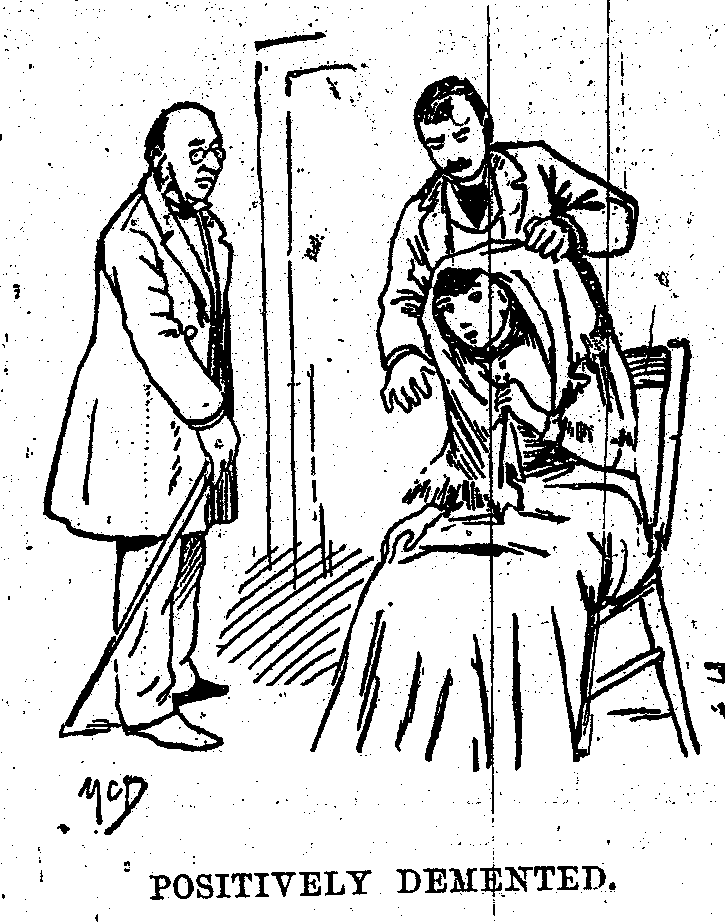
Positively Demented

Positively Demented

“It started as a dare. “New York World” managing editor John Cockerill suggested an outlandish stunt designed to attract readers, while testing the journalistic mettle of the intrepid Nellie Bly. Bly would pose as an insane woman and allow herself to be committed to Blackwell’s Island — New York City’s notorious asylum. What resulted was a searing exposé that got the attention of reformers and readers alike.” (2)

Ten Days In A Madhouse

Ten Days In A Madhouse

American journalist Elizabeth Jane Cochran, born in Pennsylvania on May 5, 1864, and died in New York City on January 27, 1922, used the pen name Nellie Bly. Prior to 1887, she feigned insanity in order to go undercover and investigate first hand the treatment of the women in the Insane Asylum on Blackwell’s Island. What is most amazing to me is how quickly she ended up there. Miss Cochran, alias Nellie Brown, never showed any displays of violence or agitation and only stated that she lost her trunks, didn’t know how to work, and that people looked crazy to her. One doctor stated that she was a hopeless case. This is a true story about how penniless women, with no support and nowhere to go, many of whom were not insane, were treated during the nineteenth century. The link to the full text is located below as source 1. 

Nellie Bly - Elizabeth Jane Cochrane

Nellie Bly – Elizabeth Jane Cochran

TEN DAYS IN A MADHOUSE. CHAPTER XI. IN THE BATH.

“A few more songs and we were told to go with Miss Grupe. We were taken into a cold, wet bathroom, and I was ordered to undress. Did I protest? Well, I never grew so earnest in my life as when I tried to beg off. They said if I did not they would use force and that it would not be very gentle. At this I noticed one of the craziest women in the ward standing by the filled bathtub with a large, discolored rag in her hands. She was chattering away to herself and chuckling in a manner which seemed to me fiendish. I knew now what was to be done with me. I shivered. They began to undress me, and one by one they pulled off my clothes. At last everything was gone excepting one garment. ‘I will not remove it,’ I said vehemently, but they took it off. I gave one glance at the group of patients gathered at the door watching the scene, and I jumped into the bathtub with more energy than grace.

The water was ice-cold, and I again began to protest. How useless it all was! I begged, at least, that the patients be made to go away, but was ordered to shut up. The crazy woman began to scrub me. I can find no other word that will express it but scrubbing. From a small tin pan she took some soft soap and rubbed it all over me, even all over my face and my pretty hair. I was at last past seeing or speaking, although I had begged that my hair be left untouched. Rub, rub, rub, went the old woman, chattering to herself. My teeth chattered and my limbs were goose-fleshed and blue with cold. Suddenly I got, one after the other, three buckets of water over my head–ice-cold water, too–into my eyes, my ears, my nose and my mouth. I think I experienced some of the sensations of a drowning person as they dragged me, gasping, shivering and quaking, from the tub. For once I did look insane. I caught a glance of the indescribable look on the faces of my companions, who had witnessed my fate and knew theirs was surely following. Unable to control myself at the absurd picture I presented, I burst into roars of laughter. They put me, dripping wet, into a short canton flannel slip, labeled across the extreme end in large black letters, ‘Lunatic Asylum, B. I., H. 6.’ The letters meant Blackwell’s Island, Hall 6.” (1)

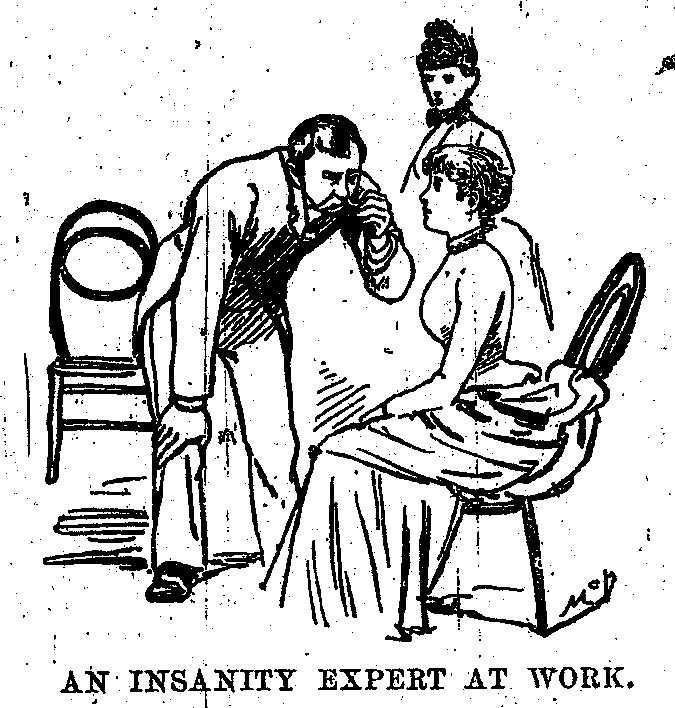
An Insanity Expert At Work

An Insanity Expert At Work

Her Bedroom

Her Bedroom

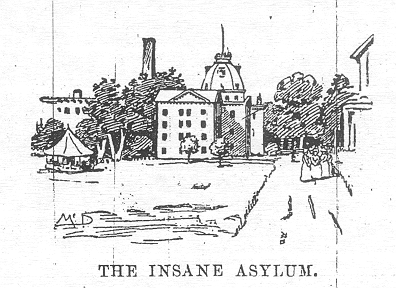
The Insane Asylum

The Insane Asylum

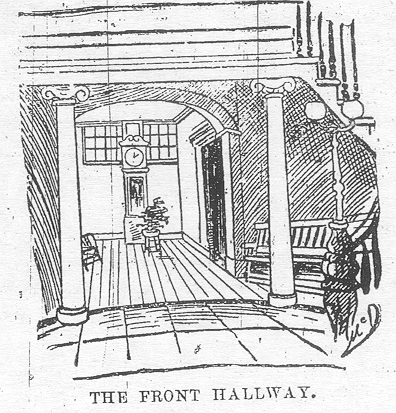
The Front Hallway

The Front Hallway

SOURCES:
1. Ten Days In A Madhouse by Nellie Bly at A Celebration Of Women WritersTen Days in a Mad-House, Published with “Miscellaneous Sketches: Trying to be a Servant,” and “Nellie Bly as a White Slave.” by Nellie Bly [Elizabeth Jane Cochran Seaman] (1864-1922) New York: Ian L. Munro, Publisher, n.d.

2. PBS American Experience – Nellie’s Madhouse Memoir.

3. National Women’s Hall Of Fame – Elizabeth Jane Cochran (Nellie Bly).

FURTHER READING:
State of New York, State Board of Charities, In the Matter of the Investigation of the New York City Asylum for the Insane, Report, August 12, 1887.

Manhattan State Hospital & Cemetery.

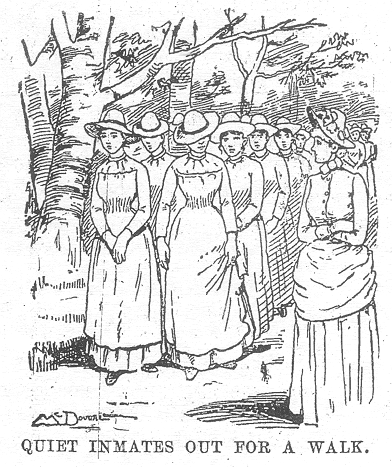
Quiet Inmates Out For A Walk

Quiet Inmates Out For A Walk

1893 Shocking Desecration Charged, Flatbush Insane Asylum

Shocking Desecration Charged.
Flatbush Insane Asylum Doctors Said to Have Profaned a Dead Woman’s Body.

“I heard something the other day,” said a Brooklyn woman to a reporter for The New-York Times, “which I think should be made public. It was the story of what a certain doctor did who is employed in the Asylum for the Insane at Flatbush. My informant’s name I withhold for the reason that if I should give it to you a person related to him who is now employed in the asylum would certainly lose his place.

“My informant tells me that about a week ago an aged woman died at the hospital who had been there for a long time. According to the regulations of the institution, the doctor referred to, in company with others of the medical staff, viewed the corpse.

“The doctors were in a merry mood and made quite a lark of the inspection by cracking jokes about the body, and altogether behaving in an unseemly manner. Finally, as I am informed, one of the doctors took a cigarette out of his case and, approaching the bedside, said: ‘Let’s give the old lady a smoke.’

“Immediately thereafter he pried open the lips of the corpse and placed the cigarette between them. ” ‘How’s that, old gal?’ he exclaimed, and then all hands gathered about and made sport of what they saw.”

Dr. Tracey, physician in charge at the Kings County Insane Asylum at Flatbush, was seen by a reporter for The New-York Times and the foregoing statement was laid before him. At first his face flushed and then he gasped out: “It’s false – a malicious falsehood!”

“Doctor, I would like to know before we go any further what deaths occurred Friday, Saturday, and Sunday of last week of old women who had been inmates here for a long time.” said the reporter.

“How ling do you call a ling time?” the doctor asked; then added, “I cannot give you any information upon this subject. It is an imputation upon the whole staff of the asylum, and until the matter in complaint is laid before the Commissioners of Charities and Correction, I refuse to open my mouth.”

“Why do you refuse me the information which I seek?” asked the reporter. “Because I don’t choose to give it,” he replied. As the reporter was leaving him Dr. Tracey said: I haven’t said anything, you know.” Dr. Sylvester, the Superintendent, was away and could not be seen.

The reporter then visited the rooms of the Commissioners of Charities and Correction at Elm Place and Livingston Street, Brooklyn, where he saw Col. Gott, President of the board, and Commissioner Murphy. He learned there that Mary Hamilton; a woman sixty years of age and friendless, had died at the asylum a week ago yesterday, and that Elizabeth F. Meyer, seventy years of age, also friendless, had died there the next afternoon. One of these, doubtless Mary Hamilton, is the subject whose inanimate remains were so grossly maltreated.

On hearing the story, Commissioner Murphy at once expressed his absolute disbelief in its truthfulness. President Gott, however, thought that it might not be entirely without foundation, although he said his inclination was to regard it as he had come to regard all anonymous communications, “very gingerly.”

In speaking of the matter he said: “A thing of that kind might occur, but it is highly improbable. I do not think Dr. Sylvester, the Superintendent, would retain a doctor one minute when he learned of it. You know that the under help and staff at the asylum are beyond our reach, as we have no power to remove or appoint anyone except the Superintendent. We are constantly receiving many anonymous communications similar to this one, and when investigated they prove groundless, as I believe this one also will.”
SOURCE: The New York Times. Published: September 11, 1893. Copyright @ The New York Times.