“In the Broome county poor house there are eighty-five inmates, twenty-one of whom, or one in four are lunatics. Ten are males, and eleven are females. Only four are of foreign birth. One has been in confinement since 1834. Nine of these cases are mild, seven are violent. Seven have been treated in an asylum. Eight of these insane are capable of labor. Four males and two females are destructive to their clothing, and four males and one female are in constant restraint, by hand-cuffs or otherwise. The other forms of restraint are persuasion and confinement. Whipping is seldom resorted to. The house has a full supply of water, but no bath tub. All but three are required to wash hands and face daily. Three are confined in cells above ground, without the privilege of coming daily to the open air. There are wood bedsteads in all the rooms but one. Six sleep on straw without beds or bedsteads; the straw is changed once a week. Part are fed in cells, others at a common table. The building is heated by a coal and wood stove. All the rooms are heated, without observation by a thermometer; it is intended to keep them all comfortable. The sexes are entirely separated at night. None other than paupers arc employed uniformly to administer to the daily wants of the insane. The cleanliness of the rooms is commendable, though they are badly ventilated. Vermin were observed. Recent cases are received; one had neither shoes or stockings during the winter, because he would not wear them. The institution is designed to accommodate only five lunatics. They receive medical attendance only when sick. Each case does not receive care with reference to its ultimate recovery. The buildings of the Broome county poor house are insufficient to meet the wants of the insane, but such as they are, are kept in good order, and the keeper and his family are attentive and humane.”
Category Archives: The Inmates Of Willard Blog
1864 Allegany County Poor House
“Of the poor house and its insane inmates in the county of Allegany, Dr. John Norton remarks: “The old block house in which some insane are confined, occupied in part by idiots, is in very bad condition, with no ventilation, old, rotten and filthy, and entirely inadequate for the purposes for which it is used. All the buildings are poorly arranged and badly constructed. Most of the inmates are idiotic, and few are even competent to care for others. With so little help, spite the efforts of the keeper, many must be at times neglected. I found much suffering for want of medical care, as the surgeon employed so seldom visits the institution, and I learned, by those who were competent to speak for themselves, that he gives each case very little attention. I do not think the aged and sick receive proper nourishment. There is but one back yard in which to amuse themselves and get open air, which is entirely insufficient for the variety of cases there represented.” These remarks are based on the facts that the poor house has in it eighty-nine paupers, twenty-one of whom are lunatics or idiots. They have been admitted to the poor house at various periods since 1842. Fifteen are females; six are males; fifteen are natives and sixteen of foreign birth. Eight cases are mild; one has been in State prison; three have been treated in the State asylum; seven are capable of doing some labor. Those who cannot labor have no form of amusement. The house has no bathing tub, and in dry weather the supply of water is insufficient. Thorough ablution is not one of the virtues of the institution. There is no arrangement for uniformity of heat in winter and ventilation. None are without the privilege of coming to the open air every day, unless the keeper is absent. There are rooms without a window opening out of doors. All the looms have bedsteads; one and two sleep in a bed. The beds are ticks filled with straw, which is changed about once a month. There are large stoves in the hall, which are considered sufficient to heat the cells, but no attention is paid to its uniformity or sufficiency. The sexes are partly separated. The keeper has charge of the female insane, and pauper care is the only kind bestowed, beside that of the keeper on the males. As to cleanliness, “some of the cells are quite bad,” and the atmosphere in them “very bad.” Vermin were found in some of the beds. The insane are only partially separated from other paupers. Eight were removed during the year by their friends. A county physician averages a visit to the lunatics about once a month.”
Allegany County Poorhouse – The Art Of Abandonment / Photography by Walter Arnold.
Allegany – Linda Crannell, The Poorhouse Lady.
Allegany County Home Angelica – Louis Q Photography.
Allegany County, NY, Poor House Records.
1864 Albany County Poor House
“The year embraced in the report of the Alms House Insane Asylum is for September 1, 1863, to September 1, 1864. The number of paupers varies from four hundred and twenty-five in summer to six hundred and fifty in winter. There have been during the fiscal year one hundred and fifty-five lunatics in the poor house asylum. The ratio of insane is about one in four. Fourteen have died; twenty-eight have been discharged. Ninety-nine of the whole number were mild cases; twenty-one were filthy; sixty-two were males and seventy-three were females; fifty-seven were native and eighty-eight of foreign birth. All have been admitted since 1848. Of the whole number only nine had been treated in the State asylum. Twelve males and twenty females were capable of labor. The large number who were unable to work had no amusement or employment. Only six were destructive to their clothing, and required the straight jacket restraint, or locking in cells. The house has two bath tubs, one for each department, and a full supply of water from the city water works. The insane are required to bathe weekly, and to wash hands and face daily. The rooms are supplied with iron bedsteads, and straw in ticks for bedding. The diet is intended to be ample, and all who are able go to a common table to eat. The change of clothing is made every week. The rooms in summer are well ventilated. All have shoes in winter. Twelve escaped during the year who were not returned; three were removed by friends. The asylum was built to accomodate thirty-one lunatics. There are in confinement at the present time in this space, designed only for thirty-one, One Hundred And Three. The greatest number in confinement at any one time was ONE HUNDRED AND TWENTY, designed to accomodate thirty-one!—the alms house asylum of the capital! of Albany!! Dr. W.H. Bailey, who made the inspection, remarks: “The asylum is a modest two-story and basement brick structure, entirely separated from the other buildings in which are the county poor. There is a small yard for the males and another for the females, into which those who are able may go at pleasure, but the yards are too small and too barren either for the health or amusement of the inmates; that for the males is 53×90, and that for the females 84×102 feet. In them there is neither a tree or a shrub to shield them from the scorching sun in summer, nor a bench or a seat on which to rest. They are inclosed by a close board fence about twelve feet high, over which the inmates cannot see, and they stretch themselves on the ground like animals, or creep under the shade of the prison-like enclosure. The sexes are separated; the males occupy the first and the females the second story, the dining room for each sex being in the basement. The sleeping rooms open on each side from a hall extending through the centre of the building. Each of these rooms is lighted by a window. The halls are heated by hot air from two furnaces in the basement, and the rooms receive heat through the doors from the hall. Unless the weather is severe, the heat is ordinarily sufficient, and the unfortunate inmates are comfortable. All who are able are compelled to leave their rooms and occupy the halls during the day time. I regard it as unfortunate that some arrangement was not made in the construction of this building for the weak and feeble. When a lunatic is sick or feeble the heat from the hall is often insufficient, unless the door is constantly open, which is to expose the patient to the noise and gibberish of fifty insane and demented, who are congregated in a single room, making it resound with their vacant laughs and shouts. In summer the windows are a ready and effectual means of ventilation, but in winter the furnaces are not of sufficient capacity to permit a flow of cold fresh air sufficient for the requirements for health. The basement rooms have no means of being warmed or ventilated. In these the boisterous, the vicious and the violent, are confined. None are confined here continually; but every new patient is placed here for two or three days “for the purpose of becoming acquainted with his habits.”
Dr. J.R. Boulware, the present efficient alms house physician, in his recent report to the common council, says:
“The insane asylum was built originally to accomodate seventeen females and fourteen males. There are thirty lodging rooms intended for the inmates, and each room was made of the smallest dimensions, compatible with the physical health of a single occupant, nor was it ever intended that more than one should be put into a room. We are now compelled to crowd from three to five of these creatures, who are in the greatest state of helplessness and dependence, into one room, also obliged to use some of the small, damp, air-tight cells, which are below ground, as lodging rooms, whose aerial capacity was never more than barely sufficient to sustain the health of one individual, thus making it appear that the Alms House physician, or those responsible for the management of this important and most sacred of all trusts, are not only willing to leave them in the unfortunate condition of insanity which simply makes them suitable for entrance into an Insane Asylum, but add to it the greater misery which results from the loss of bodily health. This loss of health is but the natural and inevitable result of such abuse. To realize more fully the important bearing of this subject, every individual should make a practical application of it to himself, and imagine a kind relative or dear friend as one of the one hundred and three who are compelled in cold or stormy weather, to crowd into a mere hall or passage way, whose cubic dimensions are such that the air, in twenty minutes, becomes vitiated and rendered unfit to support health, and in the course of the day becomes in the highest degree deleterious and loathsome.
Think of the effect, mentally, physically and morally of promiscuously huddling together so large a number of individuals, of all grades of insanity, from mere partial mental derangement, to that complete idiotcy, where nothing is left of that intellectual force by which man is characterized and distinguished from the lower order of animals. Many of them obeying the calls of nature without reference to time or place, some perhaps in convulsions, others roaming whilst the timid and retreating are trying to escape from the screams and vociferations of the more turbulent. There being no provision for their proper classification, the noisy, the violent, and the filthy; the quiet, the timid, and the convalescent, have to remain in this hall together during the long weary hours of the day.
The standing committee of the Association of Medical Superintendents, in their report on the construction of hospitals for the insane, say that apartments provided for the confinement of the violent insane, should be entirely above ground, and when used for a single patient, should contain not less than 960 cubic feet of air, nor should the ceiling be less than twelve feet in height, with a window communicating directly with the external atmosphere, and well ventilated. Now I find on measurement that these cells instead of containing 960 cubic feet of air, contain about 760 cubic feet, instead of the ceiling being twelve feet in height, it is but seven feet, instead of being entirely above ground they are nearly entirely below ground, and instead of being well ventilated, they are made air-tight. In these cells the violent insane, whose insanity is manifested paroxysmally, are temporarily confined until their paroxysms of excitement have subsided. Frequently they have to be confined in these damp, air-tight cells twenty-four hours, when the air becomes vitiated by the offensive exhalations and excrementitious matter. The ingress of air shut off, the effluvia in the cell prevented from escaping, the helpless inmate is thus compelled to breathe into the system this poisoned air, twenty-four or perhaps forty-eight hours, and the effect is not only ill health and a stupid mind, but the prostration of all the powers of the individual, both physical and mental, is the unavoidable and inevitable consequence; and this dreaded cell becomes the alembic, in which is double distilled their most bitter cup of affliction.
This picture sad as it is, falls short of presenting this matter in all of its unpleasant features, but enough has been said to make it apparent that this building is entirely inadequate to afford that relief to those for whose aid this department was designed.
Were your honorable body fully aware of this matter as it really exists, I cannot but suppose that the warmest sympathies of your nature would be aroused to respond to the urgent necessities of these insane poor, for surely no affliction appeals more strongly to our sympathy and generosity than this fearful malady.
The improvements deemed most essential, are a building whose relative dimensions to the number of patients, are such that each inmate will be supplied with enough of atmospheric air to support health, and the building so constructed as to admit of their proper classification. Indeed the importance of having enough of pure air to breathe, and the necessity of having the quiet, the timid and the convalescent separated from the noisy and turbulent, so as not to be affected by their screams and vociferations, are so palpable, that they need only to be mentioned to be properly appreciated.
I also wish to mention that there is much credit due the alms house superintendent and the attendants of this institution for the cleanliness of the different apartments of this building. When we take into consideration the great disadvantage of having to keep the turbulent, the destructive and the filthy in the same apartments with the other inmates, this Insane Asylum, in point of cleanliness, will compare advantageously with the best in the State. As far as the patients themselves are concerned, although somewhat ragged, each rag is kept clean.
In this case the physician, no matter how diligent and attentive, or how well he understands the subject, is nearly or quite powerless. He can order no healthful exercise nor any system of profitable amusement. He can only prescribe for the absolutely sick. The keeper has done his duty when he turns the key and locked the unhappy inmates fast, or gone in and by intimidation, threats or blows quieted some turbulent demented incurable. The superintendent of the alms house has done his duty when he has provided for their daily living, at the cheapest possible rate, and supplied the wants that keep them from perishing more rapidly, or from a more speedy recovery. The alms house committee look at the figures and the quarterly expenses of the Institution, and if they have not exceeded the preceding quarter, they have done their duty, or passing speedily through the hall of the Institution they see the inmates neat and clean and do not stop to think that crazy people need anything more —or if one more benevolent, humane and thoughtful than the rest suggests an improvement, it fails to meet anything more than the discouragement of the board, and nothing is the result. The board of common council still leave all to the committee, and the people leave all to the common council. The police justice is obliged nearly every week to relieve the jail of a lunatic; he must be disposed of; the superintendent of the alms house has no discretion, he must receive him, and another deranged person is thrust in the overcrowded apartments and left to his own gloomy hopeless condition to become a confirmed lunatic. The humane and philanthropic learn these facts and lament them, but can do nothing. The time has come when calm judicious legislation is demanded, to interpose and prevent these alarming evils.”
Creedmoor State Hospital & Cemetery
Creedmoor State Hospital, Long Island, New York
The Lost World Of Creedmoor Hospital – New York Times.
Fear And Brutality In A Creedmoor Ward – New York Times.
Inside Creedmoor State Hospital’s Building 25 – AbandonedNYC.
Creedmoor Psychiatric Center – Wikipedia.
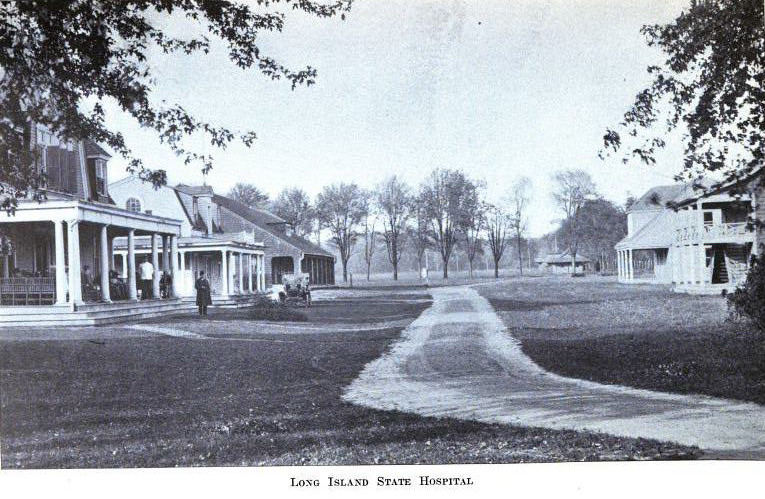
“REPORT OF THE BOARD OF MANAGERS, October 30, 1912.
To the State Hospital Commission, Albany, N. Y.:
Gentlemen. – We respectfully present the annual report of the Board of Managers of the Long Island State Hospital for the year ending September 30, 1912. The operations of the hospital during the year have been described in sufficient detail in the report of the Superintendent, which we adopt and present as part of our own…..The beginnings of the development of the Creedmoor property have been made with some success and a promise of much larger achievement. The report of the Superintendent gives details. Plans for an institution with a capacity of over 2,000 have been presented to the Board by the State Architect, discussed at length and finally adopted. It is earnestly hoped that definite action to carry them out may be made possible by legislative appropriation. The necessity for such provision is apparent to all who have given even slight study to the problem of the metropolitan insane. We are gratified that the need of thorough rehabilitation of the present hospital has been recognized by the Commission to the extent that the report of the Superintendent shows; and that in addition, appropriations are being considered for further alterations in the buildings and the erection of several new ones.
Respectfully submitted, A. E. ORR, President, Board of Managers of the Long Island State Hospital.
CREEDMOOR – The land and premises situated at Creedmoor in the town of Queens, thirteen miles distant from the main hospital, acquired by legislative act of 1908, have continued subject to the control of the Commission and the board of managers of the Long Island State Hospital. This property originally comprised 192 (200) acres, but at a time when it was decided to sell this land and acquire a new site, nearly seven acres for roadway purposes were sold to the Long Island Motor Parkway, Incorporated, for $18,942. This money was reappropriated by the Legislature for the alteration of the existing buildings and for new construction generally. The roadway passes through the grounds diagonally in a northeasterly direction, and for the most part through the wooded, upland portion of the premises. It is below grade and properly protected by a fence and an overhead crossing. The parkway would not seriously interfere with the erection of new buildings for hospital purposes in the level area southeast therefrom, and some preliminary steps have been taken and are still under way to plan for such buildings, since the difficulty of acquiring a new site on Long Island is fully recognized by the Commission and the Managers. In April, 1912, the Governor signed, among other items in the Omnibus Bill, an appropriation of $50,000 for the commencement of the erection of buildings, including a railroad switch, power house and farm cottages.
As soon as a suitable block plan for a hospital is approved, the expenditure of moneys already appropriated will be made, since it is necessary to first decide upon a general hospital scheme before the installation of a railway, system of sewage disposal and other initial steps can be properly gotten under way. In the meantime, however, the property has been put to use to the extent of colonizing it with thirty-two patients. This was done early in the summer. The patients have been located in one of the twelve regimental buildings, and the necessary money to put this building in order was taken from the special legislative appropriation as a result of the sale of the strip of land. Patients have been employed daily at farm work, and the area of farm land under cultivation has been somewhat over forty acres. Care has been observed in the selection of the patients who have resided at Creedmoor, and no complaint has resulted from their presence in the neighborhood. There is no reason why the colony system cannot be enlarged. There are sufficient buildings to accommodate two hundred or more patients conveniently. On the following page is shown a view of the building at Creedmoor which is occupied by patients.”
“Creedmoor. A tract of land in east central Queens, one mile (1.6 kilometers) north of Queens Village and centered on Braddock Avenue and old Rocky Hill Road (now Braddock Avenue), named for the family that farmed there. The name is used only locally and does not refer to any village or settlement, past or present. Conrad Poppenhusen of College Point ran a railroad through the area parallel to Braddock Avenue in 1871 and donated some of the surplus land to the National Rifle Association for use by the National Guard, which opened firing ranges in 1873. The growth of Queens Village from the 1890s and the hazards connected with the firing ranges led to the eviction of the National Guard in 1908. In 1910 the tract became the site of a large state mental hospital.”
“Creedmoor Psychiatric Center. State mental hospital on Winchester Boulevard near Queens Village, built on land originally owned by the Creed family. It opened in 1912 as a “farm colony” for the Brooklyn Psychiatric Center in facilities formerly used as barracks for the National Guard. With the construction of new buildings in 1926, 1929, and 1933 Creedmoor became a separate state hospital. Although its nominal capacity was 3,300 patients, there were 6,000 patients by the 1940s, and overcrowding was exacerbated by staff shortages and limited funds. During these years various new treatments for mental illness were introduced at Creedmoor, including hydrotherapy, insulin therapy, electroshock therapy, and in a few cases lobotomy. A more important innovation was the introduction of antidepressant and tranquilizing drugs, which became widely used in the state mental health system in 1955. At Creedmoor the new drugs meant quieter wards, fewer injuries to staff members and patients, and a dramatic increase in the number of patients who could manage daily life in the community. As a result the number of inpatients at the hospital declined to 1,100 by 1991, while outpatient services and residential placements were expanded in keeping with the new policy of deinstitutionalization. When it became clear during the late 1980s that many of the homeless in New York City had urgent psychiatric needs, Creedmoor established a special impatient program of psychiatric rehabilitation intended specifically for the homeless. The Living Museum, presenting art by patients, was founded by Bolek Greczynski in 1984 in the hospital. In 2001 the city sold part of the mental hospital to residential developers and used another portion to develop three schools and athletic fields.”
SOURCE: The Encyclopedia of New York City: Second Edition, Kenneth T. Jackson, Lisa Keller, Nancy Flood, Yale University Press, 2010.
Brooklyn State Hospital, Brooklyn.
The institution is very greatly overcrowded, but it is hoped to obtain relief at an early date. There is under construction, and to be soon completed, a reception hospital and a building for the care of the chronic type of patients. The reception hospital will accommodate about 150 patients, while the building for the chronic type will accommodate 450.
Foundations for a new store house and cold storage building have been laid. A large number of repairs have been accomplished during the last year. The domes of the main building have been renewed and painted. A large quantity of flooring has been laid and a number of the wards have been repainted.
A number of cottages at Creedmoor are being remodelled and made ready for occupancy, and it is expected shortly to house at least 150 patients at this branch.
This hospital has been visited during the year by the State Finance Committee, the State Hospital Development Commission and the State Hospital Commission, and it is the concensus of opinion that the present old building should be razed and new ones built. There is planned a new and modern psychopathic hospital that will accommodate the needs of this portion of Greater New York.
When plans have been consummated, this site will accommodate about 2,100 patients, while at Creedmoor plans are in contemplation for about 2,500 patients.
The medical service is very active at this institution. At least 51 per cent of the cases admitted are of the feeble and exhausted type, or of the very acute maniacal type, and are brought in on stretchers. Those who are physically able are sent to Kings Park. The admissions here during the year were 626. Beginning July 1st, we organized a school for male patients and a male instructor was appointed. It is hoped to obtain very beneficial results from the re-education of certain cases.
In August, 1916, a social worker was appointed who has been of great benefit to the institution and to the paroled patients. She visits all patients who are paroled, attends the clinics, inspects environmental conditions, obtains positions for recovered patients, and assists in obtaining proper histories for the physicians. Three outdoor clinics are held weekly, one at the Brooklyn State Hospital, one at the Williamsburg Hospital on Saturdays; and one at the Long Island College Hospital on Fridays. These clinics are of great value, as it is through them that information is spread that is of great use to the general public. The present census is 925; the certified capacity is 637, and 70 patients are on parole.
At the east of the institution there is an old potters’ field which has been used for years for the burial of the poor of Kings County. This land was turned over to the state two years ago, and it is now proposed to construct buildings on this area. Therefore the Charities Department of the City of New York was requested to remove the bodies buried there by that department during the last two years, and several hundred bodies were taken away during the summer.
SOURCE: The American Journal of Insanity, Volume 74, 1917, Pages 353-354.
BROOKLYN (Brooklyn State Hospital)
An investigation of the sanitary conditions of the Brooklyn State Hospital at Brooklyn was made by Mr. C. A. Howland, assistant engineer in this Department on August 15, 1919. Previous examinations of the sanitary condition of this institution were made by this Department in 1915, (see page 906 of the 36th Annual Eeport) and in 1917 (see page 642 of the 38th Annual Report).
Location: The main institution is situated in the borough of Brooklyn, New York City, while Creedmoor Farm is located north of the village of Creedmoor close to the eastern boundary of Queens borough.
Site of institution: The hospital is situated in Brooklyn on Clarkson avenue just east of the Kings County Hospital. Although the grounds of the institution in Brooklyn are somewhat flat they are apparently well drained. At Creedmoor the farm land, much of which is under cultivation, is also flat but appears to be well drained.
Area of grounds: 25 acres in Brooklyn; 195 acres at Creedmoor; total, 220 acres.
Number of occupied buildings: 14 (2 practically complete but not occupied, one in course of construction).
Capacity: 343 men, 457 women, 305 employees; total, 1,105.
Present population: 441 men, 603 women, 206 employees; total, 1,252.
Class of inmates: All classes of insane except the criminal insane.
Water supply: The water supply for the main institution in Brooklyn is obtained from the Flatbush Water Company while the water supply for the Creedmoor farm is obtained from the Jamaica Water Supply Company.
Milk supply: The milk for the main institution in Brooklyn, which amounts to about 400 quarts of fluid milk, grade B, pasteurized, and 40 quarts condensed milk, are purchased per day from the Delancy Milk and Cream Company of Brooklyn. At Creedmoor farm the milk supply is obtained from a herd of five cows. The cow barn in which the milking is done is an old wooden structure which was not in a satisfactory sanitary condition at the time of the inspection.
Sewerage and sewage disposal: The sewage and storm water of the institution in Brooklyn is discharged through combined tile and brick sewers ranging in size from 6 to 18 inches into the sewerage system of the city of Brooklyn. At Creedmoor the sewage is at present discharged into two large cesspools located about 300 feet northwest of the building. A sewage disposal plant which will treat the sewage from the hospital to be ultimately constructed at Creedmoor is in the course of construction. This disposal plant will consist of Imhoff tanks, siphon chamber and sand filters, of which the inlet chamber, Imhoff tank and siphon chamber have been completed.
Refuse disposal: The garbage of the institution is fed to pigs at the Creedmoor farm. The garbage not suitable for feeding is disposed of in the institution incinerator. At the time of the inspection it was found that the piggery was not in a satisfactory condition and the engineer was informed that a new piggery is to be constructed. It was found that the barrels in which the garbage is stored at the institution were in some cases without covers. Rubbish, such as broken crockery, etc., is removed by the city street cleaning department. Waste paper is baled and sold and similar disposal is made of the rags. Combustible refuse is collected twice daily and burned in an incinerator of the Morse-Boulger Destructor type.
As a result of this examination the following recommendations were made in regard to the improvement of certain insanitary conditions found at the institution.
Recommendations:
1. That the garbage receptacles be kept covered at all times.
2. That a modern piggery of proper design and construction be built as soon as possible.
3. That every precaution be taken in the handling of the milk at the Creedmoor farm in order to prevent the communication of disease by this means and that a plant for the pasteurization of the milk be installed as soon as practicable.
4. That the sewage disposal plant for Creedmoor be completed according to the plans approved by this Department and be put in operation as soon as possible.
SOURCE: State of New York, Fortieth Annual Report of the State Department of Health for the Year Ending December 31, 1919, Volume II, Report of Division of Sanitary Engineering, Albany: J.B.Lyon Company, Printers, 1920, Pages 421-422.
I’m not sure if Creedmoor State Hospital had a cemetery, they may have used a public cemetery.
CLICK HERE TO VIEW THE VIDEO They’re Buried Where? by Seth Voorhees
1864 The Willard Asylum and Provisions For The Insane – County Poor House Investigation
“THE WILLARD ASYLUM, AND PROVISION FOR THE INSANE.
By an Act of the New York Legislature, passed on the 30th day of April, 1864, the Secretary of the State Medical Society was authorized to investigate the condition of the insane poor in the various poor-houses, alms-houses, insane asylums, and other institutions, where the insane poor are kept, not including, however, such institutions as are now required by law to report to the Legislature of the State.
The law directed the Secretary to arrange a series of questions, such as in his judgment would be likely to elicit the greatest amount of information on this subject, procure them printed, and transmit them to each county judge in the State. It directed the county judge, on the reception thereof, to appoint a competent physician, a resident of the county, to visit the county poor-house, or institution where the insane poor are kept, and to examine into the condition and treatment of the insane inmates, and to transmit the result of the investigation to the Secretary, who was thereupon directed to condense the information so received and report the same to the Legislature.
Dr. Willard, the Secretary of the Medical Society, entered at once upon the service assigned him, and the following January his report was presented to the Legislature. This document bears ample testimony to the earnestness, fidelity, and zeal with which the author executed the duties of his commission; and although he died, prematurely and lamented, before the passage of the law creating a new institution for the insane, a grateful commonwealth has perpetuated his memory and name in the Willard Asylum for the Insane.
The leading features of the law, passed by the last Legislature, authorizing the establishment of a State Asylum for the chronic insane, and for the better care of the insane poor, are as follows:
It provides for the appointment, by the Governor, of three Commissioners to select, contract for, and purchase a suitable site for the building, -said site to be first sought for in any property owned by the State, or upon which it has a lien; the construction, by the Commissioners, of suitable asylum buildings, or the modification of buildings already erected and not occupied for other State purposes; the appointment by the Governor of seven trustees, who shall have power to appoint a medical superintendent, one assistant physician, a steward and a matron, and adopt the necessary by-laws for the government of the asylum, and fix the rate per week, not exceeding two dollars, for the board of patients, and, with the approbation of the Governor, designate the counties from which the chronic pauper insane shall be sent to the said asylum.
The chronic pauper insane from the poor-houses of the counties thus designated, shall be sent to the said asylum by the county superintendents of the poor, and all chronic insane pauper patients who may be discharged, not recovered, from the State Lunatic Asylum at Utica, and who continue a public charge, shall be sent to the asylum for the insane hereby created.
The county judges and superintendents of the poor in every county of the State, except those counties having asylums for the insane, to which they are now authorized to send such insane patients by special legislative enactments, are hereby required to send all indigent or pauper insane coming under their jurisdiction, who shall have been insane less than one year, to the State Lunatic Asylum at Utica.
Seventy-five thousand dollars are hereby appropriated for the purpose of carrying into execution the provisions of this act. The asylum hereby created shall be known as the Willard Asylum for the Insane.”
SOURCE: American Journal Of Insanity, October 1865, Pages 1-5.
New York State County Poor Houses.
Cemetery Restoration – People Inc. & The Museum of disABILITY History
In Remembrance by David Mack-Hardiman, Director of Training, People Inc.
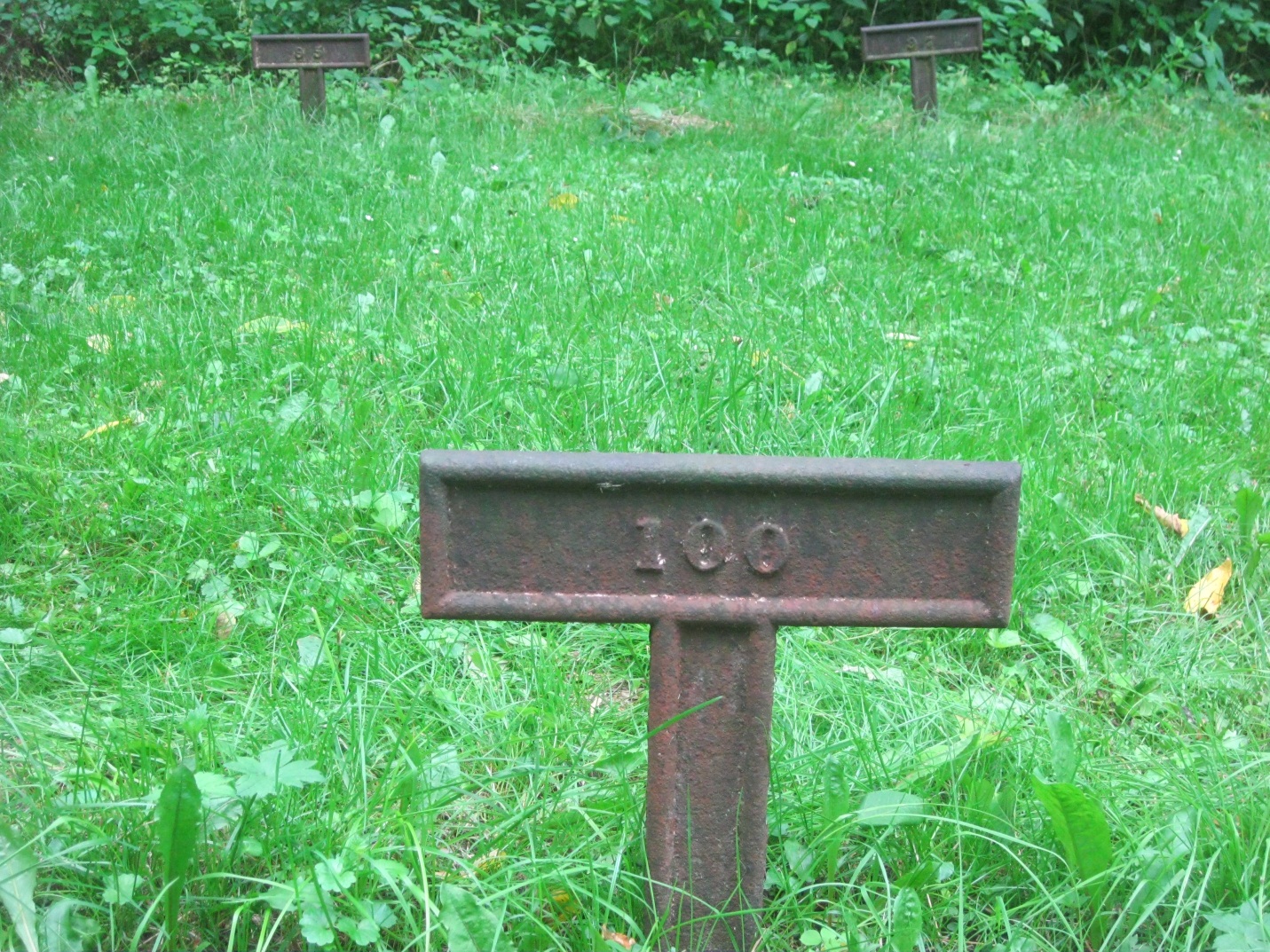
More than one million Americans are buried in institutional cemeteries. Many institutions which served people who had mental illness or developmental disabilities are now closed. Upon their closure, the cemeteries have been abandoned or passed on to the current owner of the property. Because the monuments were made more cheaply than traditional gravestones, time and neglect have taken their toll. Some grave markers are broken, leaning, tipped over, sunken under the ground, or tossed off into the weeds. Many of them are just numbers with no further clue as to the identity of the person. (TO VOLUNTEER, PLEASE CONTACT DAVID MACK-HARDIMAN at dmack@people-inc.org.)
Seven years ago, People Inc. and the Museum of disABILITY History aligned with the statewide 1033 Group and the nationwide Operation Dignity movement to embark upon the restoration of some local institutional cemeteries.
In 2006, a monument was placed in the Jolls Road Cemetery in Perrysburg. On a hillside in the cemetery, the graves of nearly four hundred residents of various state institutions were discovered. Some had small headstones but for many, there is no permanent marker. Self-Advocacy groups from Western New York planned the Ceremony of Remembrance during which the monument was unveiled.
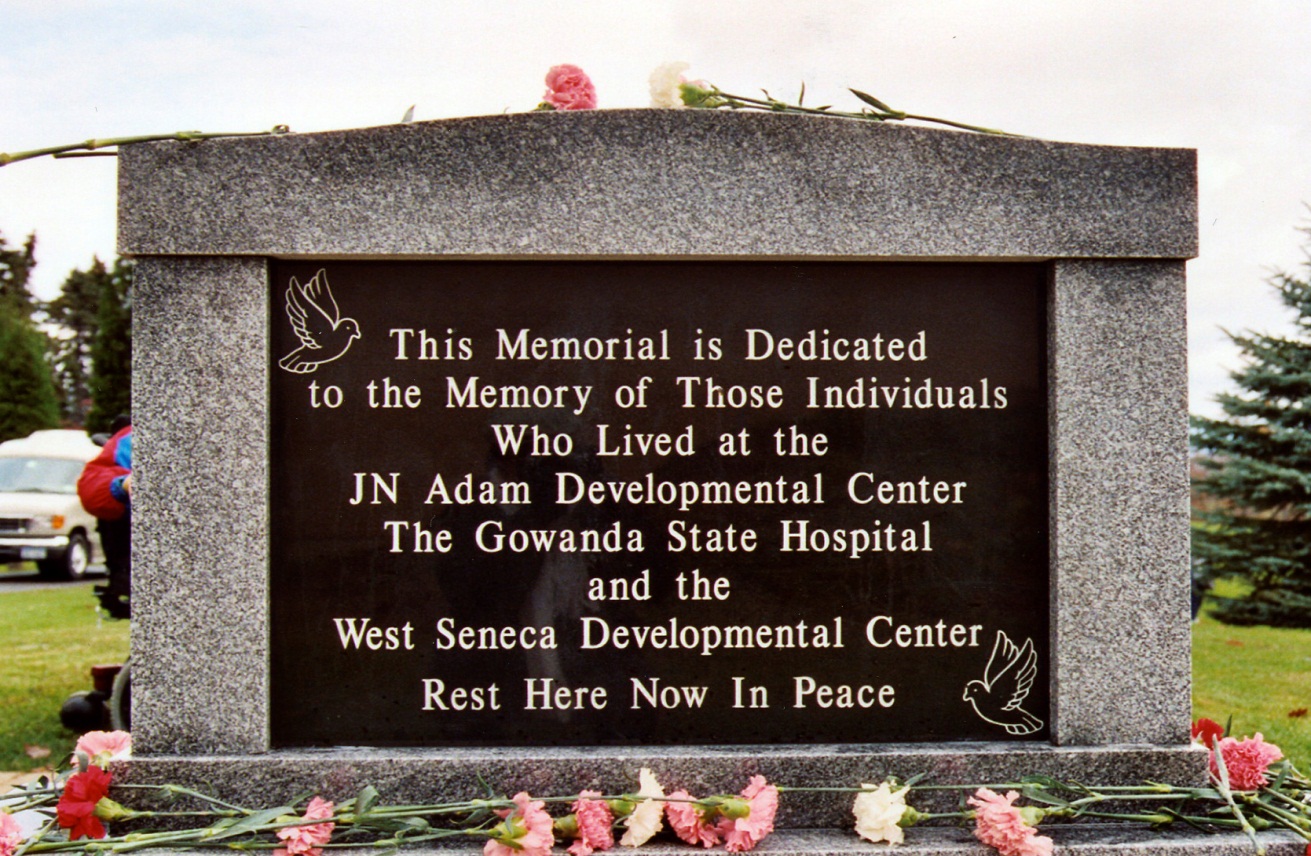
In 2007, work began at the Gowanda Psychiatric Center Cemetery on Route 62 in Gowanda. More than five hundred grave markers were photographed and documented. They were dusted, edged, and cleaned. Community businesses provided support and officials of the Collins Correctional Facility assisted the project in numerous ways. Many markers had sunken under the ground including an entire Jewish section which contained more than thirty graves marked with the Star of David. Once all stones were accounted for and placed again on the surface, a Ceremony of Remembrance was held on a warm, breezy day. Former patients and employees of the facility joined Self-Advocacy groups, State officials, numerous People Inc. volunteers and the Superintendents of the Correctional Facility for a memorable event. The names of all those buried there were given to the Museum of disABILITY History.
In a grassy hollow along the banks of Clear Creek in Collins, volunteers spent the next three summers restoring the Wheater Road Cemetery. More than five hundred headstones were unearthed in an area which was about the size of a football field. Taking the utmost care not to damage the long buried markers, volunteers tapped the earth until they felt resistance, carefully dug around the stones and lifted them to the surface. They were washed with water and placed back on the surface. In addition, more than five hundred other grave markers were straightened and reinforced with shims or gravel. Hundreds of red tulips were planted throughout the cemetery and a heart shaped garden was constructed. A Remembrance Ceremony was held at this location as well, including a release of doves by Self-Advocates. Media attention led some families to contact the Museum of disABILITY History, which assisted them in finding the final resting places for their ancestors.
In 2012, the volunteers shifted focus to Niagara County and the site of the former Niagara County Almshouse. Virtually undisturbed for ninety-six years, this cemetery had just a few stones which appeared to be marking graves. Nature had literally taken over the site with thick overgrowth of grape vines, wild roses, Hawthorne trees, and poison ivy. Initially, it was very difficult to determine the boundaries of the cemetery. With community assistance and volunteer labor, the site gradually began to take shape. The volunteers cut back the vines, trimmed trees, weeded, and created a beautiful corner space in which a memorial bench was installed. In a beautiful ceremony, the names of many of those buried there were read, including the foundlings and those whose names were, “unknown.” After the ceremony, several family members inquired about their ancestors and have been provided information from the almshouse registers.
This summer, volunteers will assist with cleaning the marble headstones at Craig Colony Cemetery in Sonyea. People Inc. and the Museum of disABILITY History will join with Self-Advocates from the Finger Lakes area, town historians, and, the employees of the Groveland Correctional Facility to complete yet another, fulfilling cemetery restoration.
New York State Hospitals and Custodial Institutions & Cemetery Projects.
Edgewood State Hospital & Cemetery
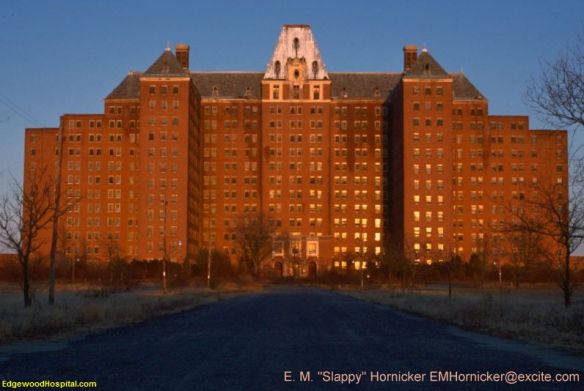
Edgewood State Hospital (Deer Park, Long Island) & Cemetery

Syracuse Psychiatric Hospital & Cemetery
“Having a separate psychiatric hospital in Syracuse was the idea of Herman G. Weiskotten, M.D., Dean of the Syracuse University College of Medicine. At his urging, in 1926 the New York State legislature authorized the creation of Syracuse Psychopathic Hospital on land donated by Syracuse University at the corner of Irving Avenue and Adams Street. The first patient was admitted in 1930; the first clinic was held in 1931. name changed to Syracuse Psychiatric Hospital.”
A Short History of Selected Hospitals in Syracuse
CLICK HERE TO VIEW THE VIDEO They’re Buried Where? by Seth Voorhees
Matteawan State Hospital for Insane Criminals & Cemetery
Matteawan State Hospital for Insane Criminals – Men & Women.
1916 Matteawan State Hospital.
Beacon, Dutchess County, New York.
Matteawan State Hospital 7 Names – Find A Grave.
Twenty-Third Annual Report Of The Medical Superintendent Of The State Asylum For Insane Criminals, Matteawan, N.Y., For the Year Ending September 30, 1892.
[Post-Office, Fishkill-On-The-Hudson.]
OFFICERS OF THE ASYLUM 1892.
Manager:
Hon. AUSTIN LATHROP, Superintendent Of State Prisons.
Resident Officers:
H.E. ALLISON, M.D., Medical Superintendent.
J. ELVIN COURTNEY, M.D., First Assistant Physician.
LUTHER C. JONES, M.D., Second Assistant Physician.
JAMES F. HOWELL, Steward.
R.B. LAMB, M.D., Resident Clinical Assistant.
REPORT.
Hon. Austin Lathrop, Superintendent of State Prisons:
Sir.— The following pages which, in accordance with the statute, I have the honor to submit, constitute the first annual report issued from this new institution, which was created by act of the Legislature for the relief of the overcrowded asylum at Auburn, and is the thirty-third of a series presented annually since the original establishment of the State Asylum for Insane Criminals.
This new hospital structure of modern architecture, commandingly situated and furnished with every convenience for the care of its inmates, was occupied during the latter part of April of the present year; the first patients having been received by transfer from Auburn on the twenty-fifth of that month. The entire population of the Auburn asylum, a total of 261 patients, were moved into their present quarters and the new asylum organized and put in operation within a period of five days. Fortunately the transfer was made safely, without the slightest accident or any attempt at escape. The buildings and grounds at Auburn, which were occupied for more than thirty years, are now entirely relinquished, and the oldest of asylums for insane criminals is domiciled in these new quarters as its permanent abode.
Owing to the increased accommodations afforded by the opening of these new buildings, we have been able to provide for those patients who had, up to this time, been retained in the various State hospitals awaiting transfer to our custody, and who had previously been refused admission to Auburn for the lack of room. Because of this large and rapid influx the total number of admissions has more than doubled that of any previous year. During the year the various courts of the State have also, to a larger extent than heretofore, committed patients to this asylum directly. The practice, however, still exists of sending patients charged with crime to the general hospitals of the insane, where their presence is objectionable, and whence they are transferred to us under the provisions of chapter 515, Laws of 1884; the superintendents of the various State hospitals applying under this law to justices of the Supreme Court for orders permitting such transfers. We hope, when the scope and character of this institution become more widely known, that commitments in the future will be made to us directly in all cases where the plea of insanity prevails as a defense for criminal acts. It is the purpose of this hospital to care for all insane persons competed or unconvicted, who are charged with crime, whether the disease of insanity is known to exist at the time of arraignment or trial, or subsequently develops while undergoing sentence.”
SOURCE: Documents of the Assembly of the State of New York, One Hundred and Sixteenth Session, 1893, Volume I, Nos. 1 to 6, Inclusive, Albany: James B. Lyon, State Printer, 1893. Pages 203-208.
CLICK HERE TO VIEW THE VIDEO They’re Buried Where? by Seth Voorhees
Dannemora State Hospital / Prison & Cemetery
Dannemora State Hospital was a state hospital prison.
1916 Dannemora State Hospital.
Dannemora State Hospital Cemetery – Find A Grave.
Photos Of Dannemora – Zach Babbie.
The Village Of Dannemora.
It appears that Dannemora State Hospital Cemetery (Clinton Prison) had inscribed headstones. The following link may be an incomplete list.
Dannemora State Hospital Cemetery – Find A Grave.
CLICK HERE TO VIEW THE VIDEO They’re Buried Where? by Seth Voorhees
THE BAD NEWS: Thousands Remain Nameless! 6.15.2015.
THE GOOD NEWS: One Man Is Remembered! 6.14.2015.