1809-1883 Thomas Story Kirkbride

In 1854, Thomas Story Kirkbride published his widely read book, On The Construction, Organization and General Arrangements Of Hospitals For The Insane. If you’ve ever done any research on historical insane asylums, you have probably heard the term, “Kirkbride Buildings.” This book or manual, was used as the blueprint on how to correctly construct and arrange hospitals for the mentally ill during the nineteenth century. Dr. Kirkbride was a visionary leader in the early, formative years of psychiatry who advocated for “Moral Treatment,” which was the belief that patients should be treated with kindness and sympathetic care. He encouraged the use of the term “hospital” and discouraged the use of the terms “asylum” and “lunatic.” New York State did not adopt the term “hospital” for all its asylums for the insane until 1890, 36 years after the book was published. Dr. Kirkbride also recommended that hospitals for the insane should not exceed 250 patients, which, as we all know, was never followed and is probably the reason why they failed so miserably. The following two excerpts will give you some insight into the man and his accomplishments. To read the books in their entirety, click on the RED links below.

“During the last four years of his life he was an invalid, and, at the early part of that period, death seemed so near that all preparations were made in anticipation of that event, but he was permitted to enjoy a period of nearly three years of comparative health, but not with the return of his physical strength, and about nine months before the end came he was taken down, and was so reduced that only for a short period was he able to go about without assistance.

Thomas Story Kirkbride

Thomas Story Kirkbride – July 31, 1809 to December 16, 1883.

He continued to manifest the same earnest interest in all matters pertaining to the care of the insane, and his mind continued clear and free until the closing time which came shortly before midnight of December 16, 1883. His mortal part was laid to rest in Laurel Hill Cemetery on a bleak December day, but his spirit had entered into the ” rest that remaineth.”

At a special meeting of the Board of Managers of the Pennsylvania Hospital, held December 17, 1883, the following was unanimously adopted:

This Board, having received with sincere sorrow, the intelligence of the death of Dr. Thomas S. Kirkbride, Physician-in-chief and Superintendent of the Insane Department of this Hospital, desire to place on their records some fitting and grateful tribute to his memory, both for his great services to the institution over which he so long and ably presided, and for his high character and worth as a man. Dr. Kirkbride’s first connection with our Hospital was in 1833, when he was elected as a Resident Physician in the Pine Street Hospital, in which capacity he served most acceptably until 1835. When the Insane Department of our Hospital was removed to its present site in West Philadelphia, in 1841, Dr. Kirkbride was elected the first Physician-in-chief and Superintendent of that Institution. At this date there was but one hospital building for both male and female patients. In 1859, a new Hospital was constructed for male patients only, female patients being retained in the Hospital first erected, and from thenceforth both were under his care.

From his election to the post above designated, until his death, Dr. Kirkbride has been continuously elected to office as the head of the Department for the Insane, without suggestion or thought, either on the part of the Managers of the Hospital or the public, that a more efficient or faithful administrator of the duties of this important place could be found.

Dr. Kirkbride possessed in a remarkable degree the characteristics and qualities, intellectual and moral, to fit him for the position he so long held. To excellent medical training, and a great aptitude for that branch or specialty to which he devoted so much of his life, he added a nature full of sympathy for human suffering and affliction, great natural benevolence and kindness, rare administrative ability and great rectitude and moral worth. Possessed of those endowments, and with a heart full of zeal in his great work, and a keen insight into the needs of the patients brought under his care, his success in his professional work has been pre-eminent, and his usefulness to the community hard to estimate. It is, therefore,

Resolved, That by the death of Dr. Kirkbride, this Institution has lost a most faithful and efficient officer, whose untiring and welldirected labors for some forty years, have not only met with the cordial approval and co-operation of this Board, but have wrought a high and enduring reputation for him, and for our Hospital for the Insane, over which he so long and ably presided.

Resolved, That Dr. Kirkbride’s works for the relief of the insane both in the administration of his office in our Institution, and by his contributions to medical literature upon the subject of insanity, and its proper treatment, entitle him to rank very high among the benefactors of his race.

Resolved, That by the death of Dr. Kirkbride we lose a friend, bound to us by uncommon ties of affection and esteem. No one could come within the range of his influence, without being made to feel that his rare endowments of head and heart were such as to attract the love and confidence of his fellow-men; and throughout his life he well deserved that love and confidence.

Resolved, That the Board will attend his funeral in a body, and that a copy of these resolutions, attested by the President and Secretary, be forwarded to the family of our departed friend.

William Biddle, President.
B. H. Shoemaker, Secretary.”

Memoir of Thomas S. Kirkbride, M.D. LL. D.

SOURCE: Memoir of Thomas S. Kirkbride, M.D., LL. D., Prepared by Direction of lthe Association of Medical Superintendents of American Institutions for the Insane by John Curwen, M.D., Charles H. Nichols, M.D., John H. Callender, M.D., Warren, PA.: E. Cowan & Co., Printers, 1885, Pages 35-37.

Importance Of A Correct Nomenclature.

“The erroneous views of insanity formerly entertained, and the unfortunate modes of treatment which resulted from them, led to the adoption of terms which are now without meaning, and the continued use of which has an unfavorable influence on the best interests of the insane.

It seems especially desirable that this malady, now so much better appreciated by the whole civilized community than formerly, and the importance of the proper treatment of which is so generally admitted, should have every advantage that can result from a correct nomenclature. It is seldom that a disease so well recognized, so important and so prevalent, has had the misfortune to be called by so many ill-selected names, that have themselves tended to produce errors and confirm wrong impressions in the community.

Without any inclination to be hypercritical, it is proposed briefly to allude to some of these misnomers, which custom alone seems to have retained amongst us.

It must seem singular to any one who reflects on the subject, that the term “lunacy,” as applied to this disease, should still be retained as generally as it is by the community, by the medical profession, and even by some of the latter whose labors in this specialty have done so much to promote the best interests of a large class of sufferers. “Lunacy” and “lunatic” are terms which have no meaning in reference to the diseases of the mind, and originated from a popular belief in influences that have long since been shown to have no existence.

Both these terms are particularly objectionable from their very derivation, tending to give wrong impressions of the disease and to perpetuate popular errors. Prevalent as the idea may have been with our ancestors, that the insane were specially under the influence of the moon, it is hardly to be supposed that such a sentiment is now seriously entertained by any considerable number in or out of the medical profession. If such are to be found, they would scarcely claim so decided an effect from lunar influence as to make it a ground for giving a name to one of the most important diseases to which man is subject. “Lunatic” is put down, in one of our best modern medical dictionaries, as “moonstruck,” and such a term applied to a sick man or connected with an institution for the treatment of diseases of the brain, is certainly not in character with an age which puts forward so many just claims to be called one of progress. The fact that these terms are still used in law writings is no reason why they should be continued by the medical profession. If universally discarded by physicians, it is not unreasonable to suppose that the bar, with all its fondness for ancient terms, would ultimately reject names which, beyond their antiquity, have not a single claim for retention. As applied to individuals, they have become offensive from their ancient associations. The term “insanity,” which I conceive is the only proper name to apply to the disease under notice, is a correct one; it simply means unsoundness, is sufficiently common, and its import generally understood.

With all its distinguishing features, insanity has nothing about it to prevent its being ranked with other diseases. A functional disorder of the brain, it belongs to the same category as those of other organs. Prevailing at all ages, among all classes of civilized men, without regard to talent, fortune or profession, there would seem to be no sound reason why the institutions specially provided for its treatment should have names different from those that are prepared for the relief of the sick suffering from other maladies. It is of great importance to a correct appreciation of insanity by the community, that it should be generally understood, that, treated properly from its commencement, it is commonly a curable disease, and that when patients are sent from home to an institution, it is only that they may have advantages and chances for a restoration nowhere else to be obtained. It should also be impressed upon all, that cases of insanity, however chronic they may be, or however discouraging their symptoms, should still be regarded as worthy of attention, and demanding treatment, if we can do no more, to promote their comfort and happiness, and to keep active, as far and as long as we can, their mental and physical powers.

Institutions for the treatment of other diseases, even if incurable, are called Hospitals; no other term is so common or so well understood, and there is none so appropriate in every respect to those devoted exclusively to the treatment and care of the insane, and, in my estimation, they should be known by no other name.

The titles often applied to institutions for the insane have no appropriateness, even if they do not have a mischievous tendency. The object of their original introduction would seem to have been to give an impression that those who entered them were not sick, or did not come for treatment, or, if ill, that they suffered from some malady which bore no relation to the other diseases which affect our race, but rather that they came as to a place of refuge or security, as though they had committed some crime, or been banished from the sympathies as well as the presence of society. It is quite true that, appropriate as the name of Hospital is for the institutions provided for the treatment of the insane at the present day, it could hardly have been proper to have so called the receptacles into which they were often thrown, much less than a century ago, where those who had the strongest claims for the sympathy and kindly attentions of their fellow men, were chained and flogged and treated with a cruelty far beyond the lot of most criminals.

The term “Asylum,” still so common amongst us, seems to me to be open to all the objections that have been referred to, and ought to be abolished as having an undesirable influence, while its derivation and true meaning certainly do not offer any reason for its retention by any curative institution. It would be about as reasonable to have an Asylum for small pox, or fever, or dyspepsia, or any other disease, as for insanity. Ludicrous as it would appear to have an institution called a Febrile Asylum or a Rheumatic Asylum, it would really be as proper as to have what custom alone has familiarized us to—an Insane Asylum.

The arrangements of a Hospital for the Insane—which is a more euphonious, if not a more correct term than an Insanity Hospital—it is true, are different in many respects from those of ordinary hospitals; but that is no reason why the same name should not be applied to all. The details of a hospital for children, for fever, for contagious diseases, or diseases of the skin, may also vary in their character, without requiring a change in their principal title.

The term “Retreat,” is not less exceptionable than that of Asylum, and for the same reasons. They both originated from the best of motives, and have done good in their day, as helping to banish that awful name, “the Mad House,” which, of old, had so many real horrors connected with it, and the truthful pictures of which in England and on the Continent have made such an enduring impression on the minds of men, that most of the popular prejudices existing in reference to modern Hospitals for the Insane, although they have no single feature of resemblance, will be found to have originated from this source.

The names of “cells” and “keepers,” as applied to the chambers of the insane, and to their attendants, originated at a time when those who were suffering from insanity were often worse treated than convicted felons, and when those who had charge of them exhibited much less humanity than common jailers. Both terms belong to prisons, and no argument is needed to show that they ought never to be heard within the walls of buildings devoted to the relief of the afflicted.

If every one connected with the various establishments provided for the treatment of those suffering from mental disease, would on all occasions discard not only the terms “cells” and “keepers,” and “lunacy” and “lunatic,” but also those of “Asylums,” “Retreats,” and whatever other titles fancy may have suggested, and would call their institutions what they really are, Hospitals for the Insane, and let the disease treated in them be spoken of only as Insanity, the public would soon see the propriety of abandoning the terms to which exception has been taken, and that are in so many respects objectionable.

Few, if any, of those who have the immediate charge of the institutions for the insane in America, whose titles are deemed inappropriate, have had any agency in originating their names, and cannot, therefore, be held at all responsible for these unfortunate misnomers. Most of the new institutions commenced within the last few years in the United States are styled “Hospitals for the Insane,” and it is well worthy of consideration by those interested, whether it would not be worth an effort to induce those who have the power to change the titles of those previously established, so as to secure accuracy and uniformity among American institutions.

APPENDIX.

At a meeting of “The Association Of Medical Superintendents of American Institutions For The Insane,” held at Philadelphia, in May, 1851, the following series of propositions relative to the construction of Hospitals for the Insane, was unanimously adopted as the sentiments of that body on the subjects referred to; and, in like manner, at the meeting held in Baltimore, in 1852, the succeeding series of propositions in reference to the organization of these institutions was also adopted, and, with the former, directed to be published in the “American Journal of Insanity,” and to be appended to the annual reports of the different institutions:

 Propositions Relative To The Construction Of Hospitals For The Insane.

I. Every hospital for the insane should be in the country, not within less than two miles of a large town, and easily accessible at all seasons.

II. No hospital for the insane, however limited its capacity, should have less than fifty acres of land, devoted to gardens and pleasure grounds for its patients. At least one hundred acres should be possessed by every State hospital, or other institution for two hundred patients, to which number these propositions apply, unless otherwise mentioned.

III. Means should be provided to raise ten thousand gallons of water, daily, to reservoirs that will supply the highest parts of the building.

IV. No hospital for the insane should be built without the plan having been first submitted to some physician or physicians who have had charge of a similar establishment, or are practically acquainted with all the details of their arrangements, and received his or their full approbation.

V. The highest number that can with propriety be treated in one building is two hundred and fifty, while two hundred is a preferable maximum.

VI. All such buildings should be constructed of stone or brick, have slate or metallic roofs, and, as far as possible, be made secure from accidents by fire.

VII. Every hospital, having provision for two hundred or more patients, should have in it at least eight distinct wards for each sex, making sixteen classes in the entire establishment.

VIII. Each ward should have in it a parlor, a corridor, single lodging-rooms for patients, an associated dormitory, communicating with a chamber for two attendants; a clothes-room, a bath-room, a water-closet, a dining-room, a dumb-waiter, and a speaking-tube leading to the kitchen or other central part of the building.

IX. No apartments should ever be provided for the confinement of patients, or as their lodging-rooms, that are not entirely above ground.

X. No class of rooms should ever be constructed without some kind of window in each, communicating directly with the external atmosphere.

XI. No chamber for the use of a single patient should ever be less than eight by ten feet, nor should the ceiling of any story occupied by patients be less than twelve feet in height.

XII. The floors of patients’ apartments should always be of wood.

XIII. The stairways should always be of iron, stone, or other indestructible material, ample in size and number, and easy of ascent, to afford convenient egress in case of accident from fire.

XIV. A large hospital should consist of a main central building with wings.

XV. The main central building should contain the offices, receiving rooms for company, and apartments, entirely private, for the superintending physician and his family, in case that officer resides in the hospital building.

XVI. The wings should be so arranged that, if rooms are placed on both sides of a corridor, the corridors should be furnished at both ends with movable glazed sashes, for the free admission of both light and air.

XVII. The lighting should be by gas, on account of its convenience, cleanliness, safety, and economy.

XVIII. The apartments for washing clothing, &c., should be detached from the hospital building.

XIX. The drainage should be under ground, and all the inlets to the sewers should be properly secured to prevent offensive emanations.

XX. All hospitals should be warmed by passing an abundance of pure, fresh air from the external atmosphere, over pipes or plates, containing steam under low pressure, or hot water, the temperature of which at the boiler does not exceed 212° F., and placed in the basement or cellar of the building to be heated.

XXI. A complete system of forced ventilation, in connection with the heating, is indispensable to give purity to the air of a hospital for the insane; and no expense that is required to effect this object thoroughly can be deemed either misplaced or injudicious.

XXII. The boilers for generating steam for warming the building should be in a detached structure, connected with which may be the engine for pumping water, driving the washing apparatus, and other machinery.

XXIII. All water-closets should, as far as possible, be made of indestructible materials, be simple in their arrangements, and have a strong downward ventilation connected with them.

XXIV. The floors of bath-rooms, water-closets, and basement stories, should, as far as possible, be made of materials that will not absorb moisture.

XXV. The wards for the most excited class should be constructed with rooms on but one side of a corridor, not less than ten feet wide, the external windows of which should be large, and have pleasant views from them.

XXVI. Wherever practicable, the pleasure-grounds of a hospital for the insane, should be surrounded by a substantial wall, so placed as not to be unpleasantly visible from the building.”

On The Construction, Organization and General Arrangements of Hospitals For The Insane by Thomas S. Kirkbride, M.D.

SOURCE: On The Construction, Organization and General Arrangements of Hospitals For The Insane by Thomas S. Kirkbride, M.D., Physician to the Pennsylvania Hospital for the Insane, Philadelphia, 1854, Pages 72-78.

1893 Wayne County Poor House

Wayne County Poor-house, was visited by Commissioner Craig, accompanied by the superintendent of the poor and Rev. A. Parke Burgess, D. D., of Newark, the chairman of the county visitors of the State Charities Aid Association, and also in company with the matron, Mrs. Albert Shepard, and in part with the keeper Mr. Shepard, July 7, 1893.

Census.
The population of the poor-house, on the day of the visit, was 85; of which 52 were men and 32 were women, and one was a baby under 2 years old; three males and two females, were idiots or feeble-minded; one man and two women were epileptics; and 12 inmates were insane; but none were children between 2 and 16 years of age.

The inmates were housed as follows: In old building 14 women and 6 men; in new building, lately used for the insane exclusively, 31 men, and 18 women, and the one child, making 49 inmates, including the 12 insane.

Of the insane, 7 were men and 5 were women, and their names are given as follows: Stephen D. Howell, Charles E. Bender, William Everson, William Codman, Byron Jones, Jacob Legner, John Merrigan; Hannah Crisby, Alice Pulver, Caroline C. Lyman, Lucy Goldsmith, Elsie A. Van Epps.

With the exception of John Merrigan, who was released from the State hospital on bond, all of the said insane persons were inmates of the insane department of this poor-house, under the exemption granted by the State Board of Charities prior to the passage of the State Care Act; but were not included among the patients who were transferred to the Willard State Hospital, May 13, 1892.

After the objection made by Dr. Hoyt, the secretary of the State board, to such exception of the eleven inmates from such transfer to the State hospital, the overseers of the poor of their respective towns were appointed committees of the persons of these insane inmates, respectively on one and the same day, to wit., on the 28th day of November, 1892.

These 12 insane inmates are kept on the same wards with sane paupers, in the building formerly used for the insane department; but there are no paid attendants or employes on any of these wards, except one woman attendant. The man in charge of the bath-tub and the bathing, and of the cleaning of the ward of the insane men with sane paupers is one of the said insane inmates, though the keeper states that all of the same is under his own supervision. But the facts remain that no person other than this insane man is in immediate charge of this ward having insane men, and the keeper resides in another building.

Among the insane inmates Charles Bender is, sometimes, disturbed and violent, according to the statement of the keeper.

Buildings.
There are no proper systems of water supply or plumbing or sewers. The sewage is conducted into the Erie canal.

The building formerly occupied for the insane department is now devoted to paupers and the said twelve insane inmates, the total census of which, was fifty on the day of inspection. The lack of proper water supply is here felt, in the bathing arrangements; where, in the male ward, six persons are bathed successively, in one tub and the same water.

The buildings of the old poor-house proper have no facilities for bathing, and are filled in winter to overcrowding with paupers, the population of which, on the day of the visit was 20. One of its dormitories is occupied by old women. Another dormitory without proper ventilation, is occupied by beds, which are twenty-six in number, and double the normal capacity of the room, which are, the matron states, all used in winter. This is a great abuse.

The hospital is a detached building, being an old structure, the walls of which harbor bed bugs and cock roaches. The bedsteads in the hospital are wooden, and with the straw beds, covered with old comforters or quilts, invite the bugs from the walls, but prevent thorough measures for their extermination. The sink in the hospital empties through a pipe directly into the privy vault immediately outside, and is without trap or ventilation, converting the hospital into a chimney for the vault, especially in winter when, as Silva Parmenter, the pauper inmate in charge, states, the consequent odor is very repulsive. There is no bath-room or bath tub or other facility for bathing in the hospital. There is no attendant or paid employe in this hospital. Its census on the day of visitation was fifteen men.

Diet.
The food prepared for the different tables on the day of inspection was examined. It appeared to be of good quality and sufficient, consisting of fried pork, potatoes, green peas, bread and tea or milk. It was stated that each patient could choose between tea and milk. The dietary reported by the matron is as follows:

Sunday.
Breakfast – Pork, potatoes and bread with tea, coffee and milk, quite often beef instead of pork.
Dinner – Roast or corned beef, potatoes and some other vegetables besides, bread and butter, pie or pudding, tea and milk.

Monday.
Breakfast – Same as Sunday.
Dinner – Soup, meat and potatoes, bread, tea and milk.
Supper – Fried potatoes and meat, bread and butter, tea and milk and occasionally cottage cheese.

Tuesday.
Breakfast – Same as Sunday.
Dinner – Bean soup, baked beans and pork, potatoes and bread, tea and milk.
Supper – Cold beans and pork, fried potatoes, bread and butter and cookies, tea and milk.

Wednesday.
Breakfast – Same as Sunday.
Dinner – Meat pie or potpie, potatoes and some other vegetables bread and tea and milk.
Supper – Cold meat and fried potatoes, bread and butter tea and milk, raw onions.

Thursday.
Breakfast – Same as Sunday.
Dinner – Fried pork, potatoes and some other vegetables, bread and tea, milk.
Supper – Fried potatoes, cold meat, bread and butter, cookies, raw onions, tea and milk.

Friday.
Breakfast – Same as Sunday.
Dinner – Boiled or baked potatoes, fried pork and fish, and some vegetables as side dish, bread, tea and milk.
Supper – Fried potatoes, cold meat, boiled rice, with sugar, bread and butter, tea and milk.

Saturday.
Breakfast – Same as Sunday.
Dinner – Usually have some kind of “boiled dinner,” using the different vegetables, in their seasons, bread, tea and milk.
Supper – Baked potatoes, cold meat, bread and butter, and occasionally milk toast or cottage cheese, etc., tea and milk.

Remarks.
In their seasons, all the different vegetables are supplied to the inmates in abundance, without restriction. The same is true in regard to cherries, strawberries, raspberries, and all fruits.

Administration.
The redeeming feature of this institution is its matron, who is energetic, devoted to the welfare of its inmates and self-sacrificing in their behalf.

There is no resident physician, but Dr. John W. Robinson of Lyons, is the regular visiting physician, and makes stated calls as often as three times a week and special calls when needed.

The only paid attendant or employe on the wards or in the dormitories is one in the women’s department of the old asylum building; and there is but one cook or paid employe in the kitchen which provides for the inmates.

Cost.
Annual salary of keeper $ 1,000, and of physician $400, exclusive of cost of medicines, for which $270 was expended last year. Weekly cost of keeping inmates, per capita, one dollar and forty-six cents, exclusive of farm products.

Conclusions and Recommendations.
I. The buildings of the old poor-house should be destroyed or radically renovated.

II. A proper system for an abundant supply of pure water should be established.

III. The system of plumbing and sewers should be examined by a competent and trustworthy plumber whose reputation is established, and all defects supplied and sanitary and adequate construction and appliances secured.

IV. The pollution of the waters of the Erie canal should be stopped and prohibited by the proper authorities; and following the example of Livingston county, some approved system for the disposal of sewage adopted by the board of supervisors.

V. The insane should be removed to the Willard State Hospital.

VI. Until an abundant supply of water shall be secured, the bath tubs should be replenished for each inmate bathed with fresh water from the adjacent Erie canal, if no better source is sufficient.

VII. The old bedsteads and beds should give place to iron bedsteads and wire mattresses, in order to secure freedom from bedbugs, and to insure proper cleanliness.

VIII. The care already exercised to separate the worthy poor from the vicious pauper, should be carried still further, and so far as practicable.

IX. It is evident that the building formerly used for the insane department, is, with the old poor-house buildings, inadequate for the inmates of this county institution; and, therefore, that there is no occasion for the appraisal of the same under chapter 461 of the Laws of 1890.

X. The superintendent of the poor and the keeper and matron at the poor-house, as well as the chairman of the local visitors, should be invited to co-operate in all practicable measures for reforms and remedies of abuses and evils suggested in the foregoing findings of fact and general conclusions.”

SOURCE: Annual Report of the State Board of Charities for the Year 1893, Transmitted to the Legislature February 1, 1894, Albany: James B. Lyon, State Printer, 1894, Pages 480-485. 

1824 New York State Poor House Law

1824 – An Act To Provide For The Establishment Of County Poorhouses.   Chapter 331, Laws of 1824, Passed 27th November 1824.   

“I. Be it enacted by the People of the State of New York, represented in Senate and Assembly, That it shall be the duty of the board of supervisors of each county in this State (the counties of Genesee, Yates, Greene, Washington, Rensselaer, Queens, Essex, New York, Montgomery, Suffolk, Schoharie, Chautauqua, Cortland, Dutchess, Orange, Allegany, Richmond, Monroe, Sullivan, Cattaraugus, Kings, Putnam, Delaware, Franklin, Oswego, Otsego, Columbia, St. Lawrence, Rockland, Albany, Tompkins, Tioga, Schenectady, Seneca, Madison, Onondaga, Oneida and Ulster, excepted), at their next meeting after the passing of this act, to direct the purchase of one or more tracts of land, not exceeding the quantity of two hundred acres, and thereon build and erect for the accommodation, employment and use of the said county, one or more suitable buildings, to be denominated the poorhouse of the county of _____ and to defray the expense of such purchase and building, raise by tax on estates real and personal, of the freeholders and inhabitants of the same county, a sum not exceeding the sum of seven thousand dollars, by such installments and at such times as may be ordered by the board of supervisors, to be assessed and collected in the same manner as the other county charges are assessed and collected, which money, when collected, shall be paid over by the treasurer of said county to said supervisors, or such persons as they shall for that purpose designate, to be applied to defraying the expenses aforesaid. II. And be it further enacted, That it shall be the duty of the supervisors of said county, at their meeting on the first Tuesday of October, annually, to choose and appoint, by plurality of votes, not less than five persons, who shall be denominated superintendents of the poorhouse of the county of who shall, until the first Tuesday of October next thereafter, take upon themselves, and have the exclusive charge, management, direction and superintendence of said poorhouse, and of everything relating to the same: and shall and may, from time to time, with the approbation and consent of a majority of the judges of the county courts of such county, make, ordain and establish such prudential rules, regulations and by-laws, for the well ordering of the same, and the employment, relief, management and government of the persons therein placed, and the officers and servants therein employed, and the correction of the refractory, disobedient and disorderly, by solitary confinement therein, and feeding them on bread and water only, as they shall deem expedient for the good government of the same; and shall and may, from time to time, appoint and employ a suitable person to be keeper of the same house, and necessary servants under him, and the same keeper and servants remove at pleasure, or otherwise, if they shall deem it more advisable; and it shall be lawful for the said superintendents to contract with some suitable person for the support of those persons who are placed in said poor house, who shall give a bond to said superintendents, with sufficient sureties, for the faithful performance of his contract, and who shall and may be authorized to employ the persons so committed to his charge, in like manner as if he was appointed keeper of said poorhouse. III. And be it further enacted, That whenever, after the said poorhouse shall be completed, any poor person in any city or town of the same county shall apply for relief, the said overseer of the poor of such city or town shall make application to a justice of the peace of said county, which said justice and overseer shall enquire into the state and circumstances of the person so applying for relief as aforesaid; and if it shall appear to the said justice and overseer of the poor, that such person is in such indigent circumstances as to require relief, it shall be their duty (unless the sickness of the pauper prevent) instead of ordering relief in the manner directed in and by the twenty-fifth section of the act entitled “An act for the relief and settlement of the poor,” to issue his warrant under his hand, directed to any constable of such city or town, whose duty it shall be to execute the same, thereby requiring said constable forthwith to take such poor person so applying for relief, and remove him or her to said poorhouse, and there deliver him or her to the care of the keeper of the same house, to be relieved and provided for as his or her necessities shall require; and he or she shall be discharged therefrom by order of the superintendents of the same house, or some one of them. And further, That in case the said superintendent, by a resolution to be passed by a majority of the board, shall give permission, and so long and no longer, as such permission shall be continued, it shall and may be lawful for any justice of the peace of said county, whenever a disorderly person, under or within the meaning of the act entitled “An act for apprehending and punishing disorderly persons,” instead of the punishment directed by the same act, by warrant under his hand and seal, to commit such disorderly person or persons to said poorhouse, into the custody of the keeper thereof, there to be kept at hard labor for any time not exceeding six months, unless sooner discharged therefrom by order of such superintendents or a majority of them; in which warrant it shall be sufficient to state and set forth generally, that such person has been duly convicted of being a disorderly person, without more particular specification of the offence. IV. And be it further enacted, That it shall and may be lawful for the overseers of the poor of any town or city in said county, to take up any child under the age of fifteen years, who shall be permitted to beg or solicit charity from door to door, or in any street or highway of such city or town, and carry or send him or her to said poorhouse, there to be kept and employed, and instructed in such useful labor as he or she shall be able to perform, and supported until discharged therefrom by order of said superintendents, whose duty it shall be to discharge such child as soon as he or she shall be able to provide for himself or herself. V. And be it further enacted, That it shall be lawful for the keeper of said poorhouse, to require and compel all persons committed to his care or custody in the same by virtue of this act, to perform such work, labor and service, towards defraying the expense of their maintenance and support, as they shall severally be able to perform, or said superintendent shall from time to time direct; and in case any such person shall neglect or refuse to perform the work, labor and service required of him or her, or shall at any time refuse or neglect any rule, regulation or by-law which, shall as aforesaid be made and established by said superintendents, for the well ordering and government of the persons committed or placed in said poorhouse, or shall at any time depart therefrom, until he or she shall be regularly and duly dismissed and discharged therefrom; in each and every such case, it shall and may be lawful for the keeper of the same house, to place and keep each and every such person in solitary confinement in some part of the same house, and feed him, her or them, with bread and water only, until he or she shall submit to perform the same labor, work and service, and obey, conform and observe the rules, regulations and by-laws aforesaid; or for such time as said keeper shall judge proportioned to his or her respective offence or offences: Provided however, That every such person who shall think himself or herself aggrieved by the conduct of such keeper towards them, may and shall be permitted to make his or her complaint to said superintendents, or any one of them, who shall immediately examine into the grounds of such complaint, and make such order and direction in the case as to him or them shall appear fit and proper; which order shall be final and conclusive in the case. VI. And be it further enacted, That the expense of supporting and maintaining such persons as shall or may be sent to or placed in said poorhouse pursuant to the provisions of this act, and all expenses incident to keeping, maintaining and governing said poorhouse, shall be a charge upon said county; and it shall and may be lawful for the supervisors of said county, to cause such sum as shall remain unpaid at the end of each year, and may be necessary to defray the same expenses, to be annually assessed and collected by a tax on the estates, real and personal, of the freeholders and inhabitants of the same county, in the proportion to the number and expenses of paupers the several towns respectively shall have in the said poorhouse; which monies, when collected, shall be paid by the collectors of the several cities and towns in the said county, into the hands of the treasurer of such county, subject to the orders of said superintendents, to be by them applied to the paying and defraying of the same expenses. VII. And be it further enacted, That the said superintendent may, at the expense of said county, from time to time, purchase and procure such raw materials to be wrought and manufactured by the persons in said poorhouse; and shall and may at all times sell and dispose of the produce of the labor of the same persons, in such manner as they shall judge conducive to the interests of said county; and it shall be the duty of the said superintendents annually, at the meeting of the supervisors of said county, on the first Tuesday of October in each year, to account with the board of supervisors of the said county, for all monies by them received and expended as such superintendents, and pay over any such monies remaining in their hands, as such superintendents, unexpended, to the superintendents who shall then be chosen and appointed in their stead. VIII. And be it further enacted, That no person shall be removed as a pauper, out of any city or town, to any other city, town or county, by any order of removal and settlement; but the county where such person shall become sick, infirm and poor, shall support him; and if he be in sufficient health to gain a livelihood, and still become a beggar or vagrant, then he shall be treated as a disorderly person: Provided, That nothing herein contained shall prevent the removal of any pauper from one city or town to any other city or town in the same county. IX. And be it further enacted, That if any person or persons shall hereafter send, carry or transport, or cause to be sent, carried or transported, any pauper or paupers, or other poor and indigent person or persons, from and out of any town in any county of this State, into any town in any other county, with intent to charge such other town or county with the maintenance and support of such pauper or paupers, poor and indigent persons, such offense shall be deemed and adjudged a misdemeanor; and such person or persons so offending, on conviction thereof before any court of competent jurisdiction, be punished, by fine in a sum not exceeding one hundred dollars, or imprisonment for a term not exceeding six months, or both, in the discretion of said court. X. And be it further enacted, That if any board of supervisors, or a majority of them, in any of those counties heretofore excepted, shall, at any of their annual meetings hereafter, determine that it will be beneficial to their county to erect a county poorhouse, that by filing such determination with the clerk of said county, they shall be at liberty to avail themselves of the provisions of this act.”

SOURCE: An Act To Provide For The Establishment Of County Poorhouses. Documents of The Senate of the State of New York, One Hundred and Twenty Seventh Session, 1904, Vol. XIV. No. 22, Part 4, Annual Report of the State Board of Charities for the Year 1903, In Three Volumes with Statistical Appendix to Volume One bound separately. Volume Three Charity Legislation in New York 1609 to 1900. Transmitted to the Legislature February 1, 1904, Pages 241-245. 

Jon Crispin – Willard Suitcases

Here is the link to Jon Crispin’s beautiful new website, Willard Suitcases.

Jon Crispin Suitcase 6 - http://joncrispin.wordpress.com/

Jon Crispin Suitcase 6 – http://joncrispin.wordpress.com/

Jon Crispin Suitcase 2 - http://joncrispin.wordpress.com/

Jon Crispin Suitcase 2 – http://joncrispin.wordpress.com/

1864 Steuben County Poor House

“The county house of Steuben has ninety-five inmates, of whom eighteen are insane. Three others had been confined during the year, but had escaped without being returned. Nineteen were of American and three of foreign birth. One was admitted in 1839; all the rest since 1850. Ten of the number had at some time been treated in an asylum, so that the dates of admission do not show conclusively the full period of lunacy. Twelve are capable of labor. The others are provided with neither employment or amusement. The mechanical restraint employed is a close room and hand-cuffs. The house is supplied with water by three wells and two cisterns, but it has no bathing tub, and it is doubtful if the insane are required to wash daily. No arrangement is made for cleanliness, ventilation, or uniformity of heat in winter. The material used for bedding is straw, in ticks, not frequently changed. The cells are warmed only through the hand-holes in the doors of the cells from the heat in the common hall. In the house the sexes are separated, but not so when they go into the yard. Paupers give them what care they receive. The rooms are far from clean, and the air in them more or less foetid. Recent cases are received at this institution, which is designed to accommodate thirty or forty. Its whole condition may best be set forth in the language of Dr. A.H. Cruttenden, who made the investigation:

“But few remarks can be offered in this connection without entering upon an elaborate criticism of the house, grounds, and management of the institution in extended detail. Enough that the institution comes far short of the standard to which an enlightened community, with abundant recourse, should aspire. The grounds, though ample and possessing many natural advantages and surroundings for a true home of charity, are really destitute of an attractive feature— chilling to every sense of refinement or charitable sentiment.

“The buildings pertaining to the poor-house proper are old, comfortless, illy constructed, and never suited to the purposes for which they were designed. The insane house, though new built, of brick, and sufficiently large for the accommodation of its present number of inmates, is badly arranged. The cells are too small, with no provisions for ventilation. The air even now, in summer, when doors and windows are open, is burdened with noxious vapors and effluvia inconsistent with health or comfort to the inmates. The facilities for warming are very imperfect, so much so that patients confined in cells must suffer in extreme weather. The common hall is warmed by registers from a furnace in the basement, and the cells only through hand-holes in the doors, 6 x 8 inches square. The building is two stories. First, occupied by males; the second, by females. The brick walls are unplastered, coarse, and repelling, the partitions made of 1 1/2 to 2 inch plank unmatched, and now shrunken so that large fissures are exposed for the harboring of chinch and other vermin. Close stools constitute a portion of the fixtures of the cells, connecting with the vaults below (though these are now closed against use.) The idea is repelling, though the fact in part has been superceded. The bed-ticks, by their collapsed condition, indicate a short supply of straw, and that, old and well worn. Bed clothing, blankets and sheets (when existing), are worn with age, and have suffered long for soap and water; and even the patients throughout the house, in person and clothing, indicate most clearly that the institution is far from being hydropathic in its tendencies. The rooms are, many of them, lumbered up with old trumpery, old cloths, rags, bottles, old tobacco pipes, &c., &c., in a most untidy condition, save in two or three instances where the patients had a very healthy impulse towards cleanliness, be it sane or otherwise.

“One of the most evident evils connected with the institution is the want of systematic classification of its inmates. Male and female, old and young, sick and well, sane or otherwise, the vicious, profane and unclean with the virtuous, gentle and religious, are massed together in a common herd. In fact, the house is a sort of store room, where are thrown in together the odds and ends of a depraved and degenerated humanity—a hot-bed for the rearing and nurture of paupers, without an effort to reclaim from vice, folly, or disease.

“No especial provisions are made for the medical treatment of the insane. A physician is employed by contract, who is required to visit the house twice a week (a ride of two miles), subject to all accidental calls, and furnish his own medicine, for some years past; awarded to the lowest bidder at $50 a year. These facts taken in connection with the population of the house, ranging from one to two hundred—a proportionate large number of children and infirm persons—very little at best can be expected from the medical service rendered the institution towards alleviating the condition of these unfortunate creatures. Indeed, it is little use to write or talk; the half cannot be told.

“The county house of Steuben is and has been since I have known it a bye-word, a shame and disgrace to the county, and yet much credit is due to the keeper, and not a little to the respective superintendents for doing all they can perhaps in their respective positions, and the circumstances under which they are compelled to act. But, true it is, all have a responsibility in the premises; it is an institution of the people, for the people, and is an honor or otherwise, as it nears the full meaning of its lofty and Christian purpose.”

SOURCE: Documents of the Assembly Of The State Of New York, Eighty-Eighth Session, 1865, Volume 6, Nos. 199 to 112 Inclusive, Albany: C. Wendell, Legislative Printer, 1865, Pages 216-217.

New York State County Poor Houses.

1864 Cattaraugus County Poor House

Cattaraugus county house has forty-nine inmates, seventeen of whom are insane. The lunatics have been admitted at several periods since 1838. Thirteen are of American birth. Thirteen are likewise mild cases; seven are of filthy habits. None have ever been treated in an asylum. Two cases were admitted in 1864, previous to August 12th. Five males and six females are capable of doing some labor. The others have no form of occupation. The violent are restrained by locking them up in a dark room. The house has no bathing tub. Some of the bedsteads are of iron and a part are fastened to the floor. In some of the beds two persons sleep. Straw is used for bedding and is changed as often as it becomes foul. The food is distributed in dishes to each one. No attention is given to free ventilation, nor to uniformity of heat in the winter. When indoors the sexes are kept separately; the keeper and his wife having a general superintendence over them. They have clean clothing once a week and oftener if necessary. One had no shoes during the winter. The building is designed to confine twenty lunatics, but nineteen is the highest in confinement at any one time. The insane are visited by a physician every week, and oftener if they are ill, but circumstances do not allow of any treatment with reference to recovery. They are as clean and comfortable as the system of management is calculated to make them.”

SOURCE: Documents of the Assembly Of The State Of New York, Eighty-Eighth Session, 1865, Volume 6, Nos. 199 to 112 Inclusive, Albany: C. Wendell, Legislative Printer, 1865, Pages 183-184.

New York State County Poor Houses.

Pages 183-184.

1893 New York State Asylum Directory

CHAPTER 32.
ASYLUM DIRECTORY.

STATE HOSPITAL SYSTEM.

UTICA STATE HOSPITAL – Utica, Oneida County.
G. Alder Blumer, M. D., Medical Superintendent.
One mile from the New York Central, the Rome, Watertown and Ogdensburg, the Delaware, Lackawanna and Western, and the Ontario and Western railway stations. Accessible, every fifteen minutes, by New York Mills or Whitesboro electric cars. Stop at Cross or Jason streets. Telephone, No. 118.

WILLARD STATE HOSPITAL – Willard, Seneca County. 
Theodore H. Kellogg, M. D., Medical Superintendent.
Accessible, from the east, by New York Central and Hudson River railway (Auburn branch from Syracuse to Geneva); from the west, via New York Central and Hudson River railway, from Rochester (Auburn branch) to Geneva, or via Philadelphia and Reading railway (Lehigh Valley division); from the north, Lyons to Geneva, via Philadelphia and Reading railway (Lehigh Valley division) and Fall Brook railway, from Geneva, via steamers of the Seneca Lake Steam Navigation Company, or by Philadelphia and Reading railway (Lehigh Valley division); from the south, via the Philadelphia and Reading railway (Lehigh Valley division), or by Seneca Lake Steam Navigation Company. Local telephone.

HUDSON RIVER STATE HOSPITAL – Poughkeepsie, Dutchess County.
C. W. Pilgrim, M. D., Medical Superintendent.
The hospital is located two miles north of the New York Central railway station at Poughkeepsie. Carriages may be procured at the station, and a public conveyance runs regularly to and from the hospital, connecting with the principal trains. The hospital may also be reached by the West Shore railway ferry from Highland station to Poughkeepsie, and by the Philadelphia, Reading and New England railway (Poughkeepsie Bridge route). Conveyances may be procured from Parker avenue station. Telephone call, “Hudson River State Hospital.”

MIDDLETOWN STATE HOMEOPATHIC HOSPITAL – Middletown, Orange County.
Selden H. Talcott, M. D., Medical Superintendent.
Middletown is sixty-six miles from New York city, and may be reached by the following railways: New York, Lake Erie and Western; New York, Ontario and Western, and New York, Susquehanna and Western. The hospital is reached by several omnibus lines. Public carriages may also be had at the station. Telephone No. 41.

BUFFALO STATE HOSPITAL – Buffalo, Erie County. 
J. B. Andrews, M. D., Medical Superintendent.
The institution is three and a half miles from the New York Central railway station, and is accessible by street cars, namely trolley line on Niagara street, trolley line on Main street, of horse cars through Elmwood avenue. Telephone No. 1235 D.

BINGHAMTON STATE HOSPITAL – Binghamton, Broome County.
Charles G. Wagner, M. D., Medical Superintendent.
Located on the lines of the Erie, Delaware, Lackawanna and Western, and Delaware and Hudson railways. Electric cars leave corner of Court and Washington streets, near all railway stations, every fifteen minutes, between 6 A. M. and 10 P. M. Telephone No. 553.

ST. LAWRENCE STATE HOSPITAL – Ogdensburg, St. Lawrence County. 
P. M. Wise, M. D., Medical Superintendent.
Located three and one-half miles from center of Ogdensburg, on the Rome, Watertown and Ogdensburg and Central Vermont railways. Accessible by omnibus from Seymour house, four times daily. Public carriages may also be obtained at railway stations. Telephone call, ” State Hospital.”

ROCHESTER STATE HOSPITAL – Rochester, Monroe County. 
E. H. Howard, M. D., Medical Superintendent.
Two miles from railway stations. Accessible by electric cars of the South and Lake avenue line. Telephone No. 124 I.

MATTEAWAN STATE HOSPITAL – Matteawan, Dutchess County.
(For insane criminals only.)
Post-office and railroad station, Fiskill-on-the-Hudson.
H. E. Allison, M. D., Medical Superintendent.
Fifty-eight miles from New York city, on the New York Central and Hudson River railway. It is also accessible by the West Shore railway and the Erie, to Newburg; thence by ferry to Fiskill-on-the-Hudson. The institution may be reached by an electric railway, which runs within three-quarters of a mile from the Hudson River railway station; also public conveyances at the station. Telephone call, “State Asylum.”

EXEMPTED COUNTY SYSTEM.

NEW YORK CITY ASYLUMS FOR THE INSANE.
A. E. MacDonald, M. D., General Superintendent New York City Asylums.
Post-office address, Station F, New York city.
All official communication with regard to the New York City Asylums for the Insane, should be addressed to the general superintendent. Ferry tickets and railroad tickets (at reduced rates, to those entitled to same) and permits for admission can be obtained only at the office of the Department of Public Charities and Correction, 66 Third Avenue, cor. Eleventh street.

WARD’S ISLAND ASYLUM.
W. A. Macy, M. D., Medical Superintendent.
Accessible by department boats, from foot of East Twenty-sixth street, 10.30 A. M.; also by steam ferry, on even hours, from foot of 115th street. Telephone, 420-18.

BLACKWELL’S ISLAND ASYLUM.
E. C. Dent, M. D., Medical Superintendent.
Accessible by department boat from foot of East Twenty-sixth street 10.30 A. M.; also by ferries from foot of Fifty-second and Seventy-eighth streets, running hourly. Telephone 1028-18.

HART’S ISLAND ASYLUM.
Geo. A. Smith, M. D., Acting Medical Superintendent.
Accessible by department boats from foot of East Twenty-sixth street 11.30 A. M.

CENTRAL ISLIP ASYLUM – Central Islip, Long Island.
(Branch of New York city asylums.)
H. C. Evarts, M. D., Medical Superintendent.
Accessible by trains on the Long Island railway; surface and elevated roads from Grand Central station to Thirty-fourth street ferry, connecting with Long Island City station of Long Island railway. No telephone. Telegraph Central Islip, L. I.

KINGS COUNTY LUNATIC ASYLUM – Flatbush, Long Island.
W. E. Sylvester, M. D., General Superintendent.
Three miles from Brooklyn; accessible by street car from East Twenty-third street and Fulton ferries. Telephone No. 68, Flatbush. All official communications with regard to the Kings County Asylums should be addressed to W. E. Sylvester, M. D., General Superintendent, Flatbush, L. I.

KINGS COUNTY FARM – Kings Park, Long Island.
(Branch of Kings County Lunatic Asylum).
Oliver M. Dewing, M. D., Medical Superintendent.
Forty-five miles from New York city; accessible by trains on the Long Island railway; surface and elevated roads from Grand Central station, New York, to Thirty-fourth street ferry, connecting with Long Island City station of the Long Island railway; also from Flatbush avenue station, via Jamaica, Long Island railway. No telephone. Telegraph, Kings Park, one mile distant.

LICENSED PRIVATE ASYLUM SYSTEM.

BLOOMINGDALE ASYLUM – One Hundred And Seventeenth Street, New York City. Between Amsterdam avenue and Boulevard.
S. B. Lyon, M. D., Medical Superintendent.
Accessible by Boulevard cars, or Elevated railway, to One Hundred and Fourth street and Amsterdam avenue cars. Number of patients 300. This institution receives and treats, gratuitously, a small number of indigent insane of New York city, and receives a considerable number of acute and hopeful cases, which pay only part of their expenses. It will be removed to “White Plains before October, 1894. Telephone No. 714, Harlem, New York City.

PROVIDENCE RETREAT – Buffalo, Erie County.
Under the charge of the Sisters of Charity.
Floyd S. Crego, M. D., Consulting Physician.
Harry A. Wood, M. D., Physician in Charge.
Located on Main street, corner of Steele. Distance from Union railway station, four miles. Accessible by electric street car line. Number of patients limited to 125. Minimum rate for care and treatment of private patients, six dollars per week. Telephone No. 791, M.

MARSHALL INFIRMARY – Troy, Rensselaer County.
J. D. Lomax, M. D., Physician in Charge.
One mile from Union Railway station. Accessible by electric street car, from Congress street. Number of patients limited to 130. Minimum rate for care and treatment of private patients, five dollars per week. Telephone call, “Marshall Infirmary.”

LONG ISLAND HOME – Amityville, Long Island.
O. J. Wilsey, M. D., Physician in Charge.
Thirty-two miles from New York. Accessible by Montauk division of Long Island railway; ferry from East Thirty-fourth street, New York. Only a short distance from railway station. Number of patients limited to 114. Minimum rate ten dollars per week. No telephone.

BRIGHAM HALL HOSPITAL – Canandaigua, Ontario County.
D. R. Burrell, M. D., Physician in Charge.
Situated on Bristol street, one mile from the New York Central and Northern Central railway station. Accessible by public carriages, always to be found at the station. Number of patients limited to seventy-eight. Minimum rate, ten dollars per week. Telephone No. 35, or “Brigham Hall.”

ST. VINCENT’S RETREAT – Harrison, Westchester County.
H. Ernst Schmid, M. D., Attending Physician, White Plains.
John J. Lewis, M. D., Physician in Charge.
Under management of the Sisters of Charity; for women only. Fifty minutes from New York on the New York and New Haven railway. Trains leave the Grand Central station, New York city, for Harrison, every hour from 9 A. M. to 7 P. M. Number of patients limited to sixty. Minimum rate, $10 per week. All official communications should be addressed to the physician in charge. Telephone No. 30, White Plains.

WALDEMERE – Mamaroneck, Westchester County.
E. N. Carpenter, M. D., Physician in Charge.
Forty minutes from New York on the New York, New Haven and Hartford railway. Trains leave Grand Central station, New York, every hoar for Mamaroneck. Waldemere is one mile from station, where public carriages may be found. Number of patients limited to eighteen. Minimum rate, $25 per week. No telephone.

SANFORD HALL – Flushing, Long Island.
J. W. Barstow, M. D., Physician in Charge.
Willett S. Brown, M. D., Assistant Physician.
Institution situated about one-half mile from Long Island railway station and accessible by public carriage. Going from Brooklyn, take Greenpoint or crosstown street car to Long Island City, thence on Long Island railway. Number of patients limited to thirty-six. Minimum rate, $25 per week. Telephone, Flushing 17 A.

BREEZEHURST TERRACE – Whitestone, Long Island.
D. A. Harrison, M. D., Physician in Charge.
John A. Arnold, M. D., Assistant Physician.
Accessible from New York city from East Thirty-fourth street ferry, via Long Island railway. Trains run every hour to Whitestone; time, thirty minutes. May also be reached by driving, via East Ninety-ninth street ferry to College Point, from which place it is about one and one-half miles. Going from Brooklyn, take the Greenpoint or crosstown street car to Long Island City. In taking patients from Brooklyn it is better to drive, as it only requires a little more than one hour via Grand street to Newtown, thence through Flushing to Whitestone. Number of patients limited to nineteen. Minimum rate, $20 per week. No telephone.

DR. WELLS’ SANITARIUM FOR MENTAL DISEASES.
945 St. Maek’s Avenue, Brooklyn.
Between Kingston and Albany avenues.
T. L. Wells, M. D., Physician in Charge.
The Sanitarium may be reached by the Bergen street car line, the Atlantic avenue railway or elevated railway from Brooklyn bridge. Stop at Albany avenue station of elevated road. Number limited to sixteen women patients. Minimum rate $10 per week. Telephone No. 69, Bedford.

DR. PARSONS’ HOME.
Sing Sing, Westchester County.
R. L. Parsons, M. D., Physician in Charge.
Location, one mile from New York Central station. Public carriages may be hired at the station. Number limited to twelve. Minimum rate, $75 per week, which includes all extras. No telephone.

DR. CHOATE’S HOME.
Pleasantville, Westchester County.
G. C. S. Choate, M. D., Physician in Charge.
One mile from Pleasantville station on Harlem railway, and two miles from Whitsons station of New York and Northern railway. New York Central trains stop at Tarrytown, six miles distant. Pleasantville is thirty miles north of New York city. Number limited to ten. Minimum rate, $75 per week, including all extras. No telephone communication.

DR. COMBES’ SANITARIUM.
Wood Haven, Long Island.
H. Elliott, M. D., Physician in Charge.
Best reached by Brooklyn elevated trains, from Brooklyn bridge, or East Twenty-third street ferry to Ridgewood, thence by Richmond Hill surface car to Flushing avenue, Wood Haven. Sanitarium two minutes walk to the right. Also easily accessible from Brooklyn, by carriage, via Myrtle avenue, to Flushing avenue, Wood Haven. One mile from Wood Haven Junction station, on the Long Island Railway. Number of patients limited to thirty-four. Minimum rate $10 per week. Telephone No. 7,1, East New York.

GLENMARY – Owego, Tioga County.
(Homeopathic.)
J. T. Greenleaf, M. D., Physician in Charge.
E. E. Snyder, M. D., Consulting Physician.
Three-fourths of a mile from railway stations, where public carriages may be obtained. Accessible by New York, Lake Erie and Western and by Delaware, Lackawanna and Western railways, and Southern Central Division, Lehigh Valley railway. Number of patients limited to fifty. Minimum rate, ten dollars per week. Telephone call, ” Glenmary.”

FALKIRK – Central Valley, Orange County.
James F. Ferguson, M. D., Physician in Charge.
David H. Sprague, M. D., Associate Physician.
One mile from Central Valley station, on Newburg branch of New York, Lake Erie and Western railway, forty-seven miles from New York city. Number of patients limited to thirty-four. Minimum rate, twenty dollars per week. Telephone, “Falkirk.”

VERNON HOUSE – Bronxville, Westchester County.
William D. Granger, M. D., Physician in Charge.
Post-office and telegraph, Bronxville. Accessible by the New Haven railway, to Mt. Vernon, or by Harlem railroad to Bronxville. Public carriages may be obtained at railway station. Number of patients limited to sixteen. Minimum rate, thirty-five dollars per week. No telephone.

THE PINES – Auburn, Cayuga County.
Frederick Sefton, M. D., Physician in Charge.
Accessible by the Auburn branch of the New York Central and Hudson River railway, and the Southern Central division of the Lehigh Valley railway. A little over three hours by rail from Rochester, four from Albany and Buffalo, seven from New York city. Number of patients limited to twelve. Minimum rate, twenty dollars per week. Telephone No. 261.

SOURCE: Annual Report of the Department of Mental Hygiene, State Commission In Lunacy, Fifth Annual Report, October 1, 1892, to September 30, 1893, Transmitted To The Legislature April 27, 1894, Volume 5, Part VII., Chapter 32, Asylum Directory, Albany: James B. Lyon, State Printer 1894, Pages 675 – 685.

1887 Ten Days In A Madhouse by Nellie Bly

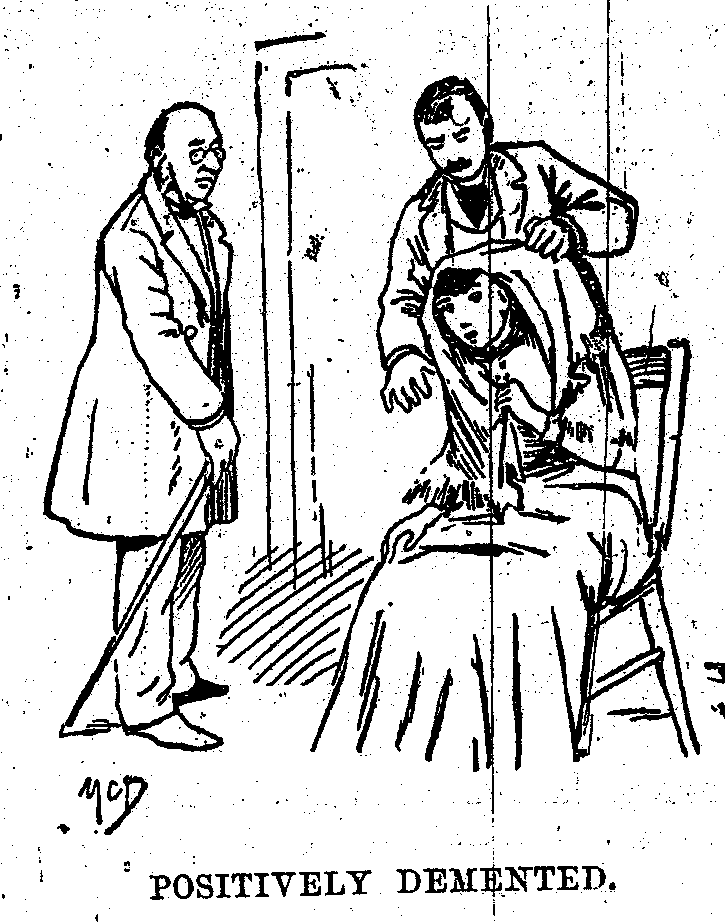
Positively Demented

Positively Demented

“It started as a dare. “New York World” managing editor John Cockerill suggested an outlandish stunt designed to attract readers, while testing the journalistic mettle of the intrepid Nellie Bly. Bly would pose as an insane woman and allow herself to be committed to Blackwell’s Island — New York City’s notorious asylum. What resulted was a searing exposé that got the attention of reformers and readers alike.” (2)

Ten Days In A Madhouse

Ten Days In A Madhouse

American journalist Elizabeth Jane Cochran, born in Pennsylvania on May 5, 1864, and died in New York City on January 27, 1922, used the pen name Nellie Bly. Prior to 1887, she feigned insanity in order to go undercover and investigate first hand the treatment of the women in the Insane Asylum on Blackwell’s Island. What is most amazing to me is how quickly she ended up there. Miss Cochran, alias Nellie Brown, never showed any displays of violence or agitation and only stated that she lost her trunks, didn’t know how to work, and that people looked crazy to her. One doctor stated that she was a hopeless case. This is a true story about how penniless women, with no support and nowhere to go, many of whom were not insane, were treated during the nineteenth century. The link to the full text is located below as source 1. 

Nellie Bly - Elizabeth Jane Cochrane

Nellie Bly – Elizabeth Jane Cochran

TEN DAYS IN A MADHOUSE. CHAPTER XI. IN THE BATH.

“A few more songs and we were told to go with Miss Grupe. We were taken into a cold, wet bathroom, and I was ordered to undress. Did I protest? Well, I never grew so earnest in my life as when I tried to beg off. They said if I did not they would use force and that it would not be very gentle. At this I noticed one of the craziest women in the ward standing by the filled bathtub with a large, discolored rag in her hands. She was chattering away to herself and chuckling in a manner which seemed to me fiendish. I knew now what was to be done with me. I shivered. They began to undress me, and one by one they pulled off my clothes. At last everything was gone excepting one garment. ‘I will not remove it,’ I said vehemently, but they took it off. I gave one glance at the group of patients gathered at the door watching the scene, and I jumped into the bathtub with more energy than grace.

The water was ice-cold, and I again began to protest. How useless it all was! I begged, at least, that the patients be made to go away, but was ordered to shut up. The crazy woman began to scrub me. I can find no other word that will express it but scrubbing. From a small tin pan she took some soft soap and rubbed it all over me, even all over my face and my pretty hair. I was at last past seeing or speaking, although I had begged that my hair be left untouched. Rub, rub, rub, went the old woman, chattering to herself. My teeth chattered and my limbs were goose-fleshed and blue with cold. Suddenly I got, one after the other, three buckets of water over my head–ice-cold water, too–into my eyes, my ears, my nose and my mouth. I think I experienced some of the sensations of a drowning person as they dragged me, gasping, shivering and quaking, from the tub. For once I did look insane. I caught a glance of the indescribable look on the faces of my companions, who had witnessed my fate and knew theirs was surely following. Unable to control myself at the absurd picture I presented, I burst into roars of laughter. They put me, dripping wet, into a short canton flannel slip, labeled across the extreme end in large black letters, ‘Lunatic Asylum, B. I., H. 6.’ The letters meant Blackwell’s Island, Hall 6.” (1)

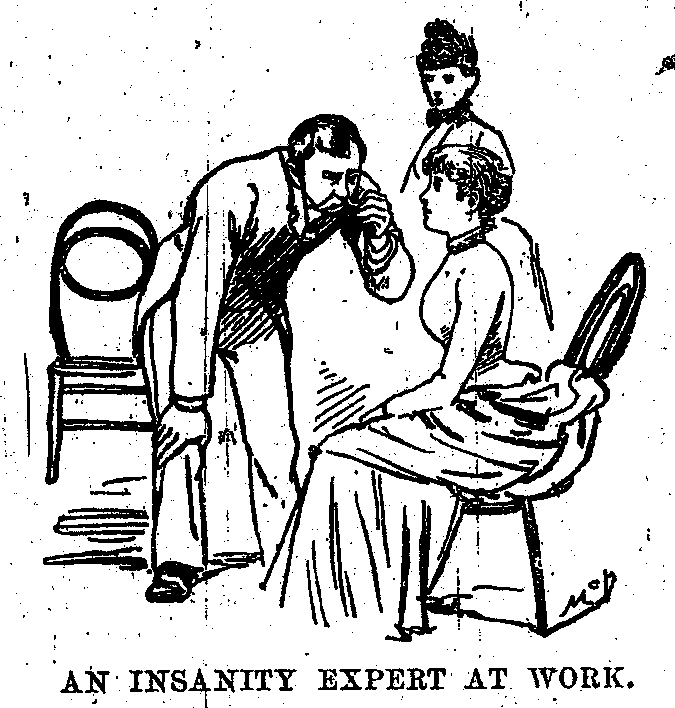
An Insanity Expert At Work

An Insanity Expert At Work

Her Bedroom

Her Bedroom

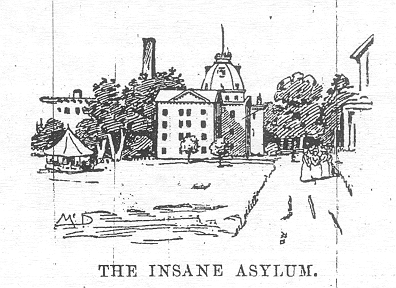
The Insane Asylum

The Insane Asylum

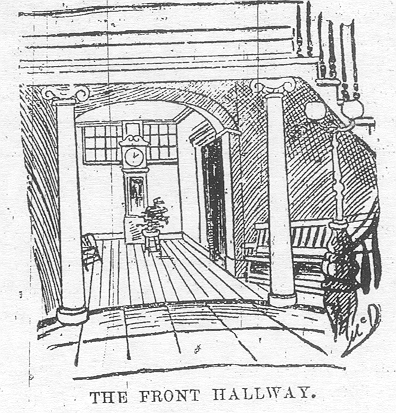
The Front Hallway

The Front Hallway

SOURCES:
1. Ten Days In A Madhouse by Nellie Bly at A Celebration Of Women WritersTen Days in a Mad-House, Published with “Miscellaneous Sketches: Trying to be a Servant,” and “Nellie Bly as a White Slave.” by Nellie Bly [Elizabeth Jane Cochran Seaman] (1864-1922) New York: Ian L. Munro, Publisher, n.d.

2. PBS American Experience – Nellie’s Madhouse Memoir.

3. National Women’s Hall Of Fame – Elizabeth Jane Cochran (Nellie Bly).

FURTHER READING:
State of New York, State Board of Charities, In the Matter of the Investigation of the New York City Asylum for the Insane, Report, August 12, 1887.

Manhattan State Hospital & Cemetery.

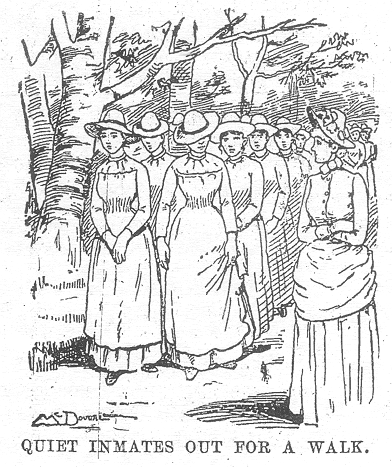
Quiet Inmates Out For A Walk

Quiet Inmates Out For A Walk

Creedmoor State Hospital & Cemetery

Creedmoor State Hospital, Long Island, New York

The Lost World Of Creedmoor Hospital – New York Times.
Fear And Brutality In A Creedmoor Ward – New York Times.
Inside Creedmoor State Hospital’s Building 25 – AbandonedNYC.
Creedmoor Psychiatric Center – Wikipedia.

“REPORT OF THE BOARD OF MANAGERS, October 30, 1912.
To the State Hospital Commission, Albany, N. Y.:

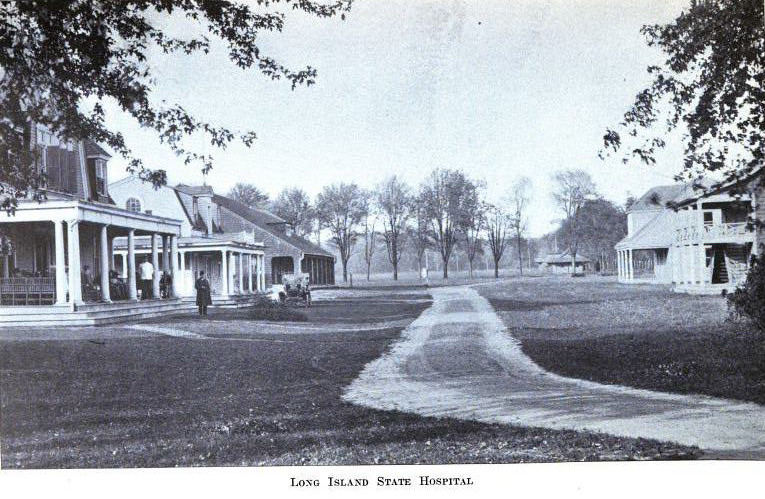
Gentlemen. – We respectfully present the annual report of the Board of Managers of the Long Island State Hospital for the year ending September 30, 1912. The operations of the hospital during the year have been described in sufficient detail in the report of the Superintendent, which we adopt and present as part of our own…..The beginnings of the development of the Creedmoor property have been made with some success and a promise of much larger achievement. The report of the Superintendent gives details. Plans for an institution with a capacity of over 2,000 have been presented to the Board by the State Architect, discussed at length and finally adopted. It is earnestly hoped that definite action to carry them out may be made possible by legislative appropriation. The necessity for such provision is apparent to all who have given even slight study to the problem of the metropolitan insane. We are gratified that the need of thorough rehabilitation of the present hospital has been recognized by the Commission to the extent that the report of the Superintendent shows; and that in addition, appropriations are being considered for further alterations in the buildings and the erection of several new ones.

Respectfully submitted, A. E. ORR, President, Board of Managers of the Long Island State Hospital.

CREEDMOOR – The land and premises situated at Creedmoor in the town of Queens, thirteen miles distant from the main hospital, acquired by legislative act of 1908, have continued subject to the control of the Commission and the board of managers of the Long Island State Hospital. This property originally comprised 192 (200) acres, but at a time when it was decided to sell this land and acquire a new site, nearly seven acres for roadway purposes were sold to the Long Island Motor Parkway, Incorporated, for $18,942. This money was reappropriated by the Legislature for the alteration of the existing buildings and for new construction generally. The roadway passes through the grounds diagonally in a northeasterly direction, and for the most part through the wooded, upland portion of the premises. It is below grade and properly protected by a fence and an overhead crossing. The parkway would not seriously interfere with the erection of new buildings for hospital purposes in the level area southeast therefrom, and some preliminary steps have been taken and are still under way to plan for such buildings, since the difficulty of acquiring a new site on Long Island is fully recognized by the Commission and the Managers. In April, 1912, the Governor signed, among other items in the Omnibus Bill, an appropriation of $50,000 for the commencement of the erection of buildings, including a railroad switch, power house and farm cottages.

As soon as a suitable block plan for a hospital is approved, the expenditure of moneys already appropriated will be made, since it is necessary to first decide upon a general hospital scheme before the installation of a railway, system of sewage disposal and other initial steps can be properly gotten under way. In the meantime, however, the property has been put to use to the extent of colonizing it with thirty-two patients. This was done early in the summer. The patients have been located in one of the twelve regimental buildings, and the necessary money to put this building in order was taken from the special legislative appropriation as a result of the sale of the strip of land. Patients have been employed daily at farm work, and the area of farm land under cultivation has been somewhat over forty acres. Care has been observed in the selection of the patients who have resided at Creedmoor, and no complaint has resulted from their presence in the neighborhood. There is no reason why the colony system cannot be enlarged. There are sufficient buildings to accommodate two hundred or more patients conveniently. On the following page is shown a view of the building at Creedmoor which is occupied by patients.”

Long Island State Hospital - Creedmoor

Long Island State Hospital – Creedmoor

SOURCE: Annual Report of the Long Island State Hospital to the State Hospital Commission For the Year Ending September 30, 1912, Albany, J.B. Lyon Company, Printers, 1913, Pages 6, 16, 17.

Creedmoor. A tract of land in east central Queens, one mile (1.6 kilometers) north of Queens Village and centered on Braddock Avenue and old Rocky Hill Road (now Braddock Avenue), named for the family that farmed there. The name is used only locally and does not refer to any village or settlement, past or present. Conrad Poppenhusen of College Point ran a railroad through the area parallel to Braddock Avenue in 1871 and donated some of the surplus land to the National Rifle Association for use by the National Guard, which opened firing ranges in 1873. The growth of Queens Village from the 1890s and the hazards connected with the firing ranges led to the eviction of the National Guard in 1908. In 1910 the tract became the site of a large state mental hospital.”

Creedmoor Psychiatric Center. State mental hospital on Winchester Boulevard near Queens Village, built on land originally owned by the Creed family. It opened in 1912 as a “farm colony” for the Brooklyn Psychiatric Center in facilities formerly used as barracks for the National Guard. With the construction of new buildings in 1926, 1929, and 1933 Creedmoor became a separate state hospital. Although its nominal capacity was 3,300 patients, there were 6,000 patients by the 1940s, and overcrowding was exacerbated by staff shortages and limited funds. During these years various new treatments for mental illness were introduced at Creedmoor, including hydrotherapy, insulin therapy, electroshock therapy, and in a few cases lobotomy. A more important innovation was the introduction of antidepressant and tranquilizing drugs, which became widely used in the state mental health system in 1955. At Creedmoor the new drugs meant quieter wards, fewer injuries to staff members and patients, and a dramatic increase in the number of patients who could manage daily life in the community. As a result the number of inpatients at the hospital declined to 1,100 by 1991, while outpatient services and residential placements were expanded in keeping with the new policy of deinstitutionalization. When it became clear during the late 1980s that many of the homeless in New York City had urgent psychiatric needs, Creedmoor established a special impatient program of psychiatric rehabilitation intended specifically for the homeless. The Living Museum, presenting art by patients, was founded by Bolek Greczynski in 1984 in the hospital. In 2001 the city sold part of the mental hospital to residential developers and used another portion to develop three schools and athletic fields.”
SOURCE: The Encyclopedia of New York City: Second Edition, Kenneth T. Jackson, Lisa Keller, Nancy Flood, Yale University Press, 2010.

Brooklyn State Hospital, Brooklyn.
The institution is very greatly overcrowded, but it is hoped to obtain relief at an early date. There is under construction, and to be soon completed, a reception hospital and a building for the care of the chronic type of patients. The reception hospital will accommodate about 150 patients, while the building for the chronic type will accommodate 450.

Foundations for a new store house and cold storage building have been laid. A large number of repairs have been accomplished during the last year. The domes of the main building have been renewed and painted. A large quantity of flooring has been laid and a number of the wards have been repainted.

A number of cottages at Creedmoor are being remodelled and made ready for occupancy, and it is expected shortly to house at least 150 patients at this branch.

This hospital has been visited during the year by the State Finance Committee, the State Hospital Development Commission and the State Hospital Commission, and it is the concensus of opinion that the present old building should be razed and new ones built. There is planned a new and modern psychopathic hospital that will accommodate the needs of this portion of Greater New York.

When plans have been consummated, this site will accommodate about 2,100 patients, while at Creedmoor plans are in contemplation for about 2,500 patients.

The medical service is very active at this institution. At least 51 per cent of the cases admitted are of the feeble and exhausted type, or of the very acute maniacal type, and are brought in on stretchers. Those who are physically able are sent to Kings Park. The admissions here during the year were 626. Beginning July 1st, we organized a school for male patients and a male instructor was appointed. It is hoped to obtain very beneficial results from the re-education of certain cases.

In August, 1916, a social worker was appointed who has been of great benefit to the institution and to the paroled patients. She visits all patients who are paroled, attends the clinics, inspects environmental conditions, obtains positions for recovered patients, and assists in obtaining proper histories for the physicians. Three outdoor clinics are held weekly, one at the Brooklyn State Hospital, one at the Williamsburg Hospital on Saturdays; and one at the Long Island College Hospital on Fridays. These clinics are of great value, as it is through them that information is spread that is of great use to the general public. The present census is 925; the certified capacity is 637, and 70 patients are on parole.

At the east of the institution there is an old potters’ field which has been used for years for the burial of the poor of Kings County. This land was turned over to the state two years ago, and it is now proposed to construct buildings on this area. Therefore the Charities Department of the City of New York was requested to remove the bodies buried there by that department during the last two years, and several hundred bodies were taken away during the summer.
SOURCE: The American Journal of Insanity, Volume 74, 1917, Pages 353-354.

BROOKLYN (Brooklyn State Hospital)
An investigation of the sanitary conditions of the Brooklyn State Hospital at Brooklyn was made by Mr. C. A. Howland, assistant engineer in this Department on August 15, 1919. Previous examinations of the sanitary condition of this institution were made by this Department in 1915, (see page 906 of the 36th Annual Eeport) and in 1917 (see page 642 of the 38th Annual Report).

Location: The main institution is situated in the borough of Brooklyn, New York City, while Creedmoor Farm is located north of the village of Creedmoor close to the eastern boundary of Queens borough.

Site of institution: The hospital is situated in Brooklyn on Clarkson avenue just east of the Kings County Hospital. Although the grounds of the institution in Brooklyn are somewhat flat they are apparently well drained. At Creedmoor the farm land, much of which is under cultivation, is also flat but appears to be well drained.

Area of grounds: 25 acres in Brooklyn; 195 acres at Creedmoor; total, 220 acres.

Number of occupied buildings: 14 (2 practically complete but not occupied, one in course of construction).

Capacity: 343 men, 457 women, 305 employees; total, 1,105.

Present population: 441 men, 603 women, 206 employees; total, 1,252.

Class of inmates: All classes of insane except the criminal insane.

Water supply: The water supply for the main institution in Brooklyn is obtained from the Flatbush Water Company while the water supply for the Creedmoor farm is obtained from the Jamaica Water Supply Company.

Milk supply: The milk for the main institution in Brooklyn, which amounts to about 400 quarts of fluid milk, grade B, pasteurized, and 40 quarts condensed milk, are purchased per day from the Delancy Milk and Cream Company of Brooklyn. At Creedmoor farm the milk supply is obtained from a herd of five cows. The cow barn in which the milking is done is an old wooden structure which was not in a satisfactory sanitary condition at the time of the inspection.

Sewerage and sewage disposal: The sewage and storm water of the institution in Brooklyn is discharged through combined tile and brick sewers ranging in size from 6 to 18 inches into the sewerage system of the city of Brooklyn. At Creedmoor the sewage is at present discharged into two large cesspools located about 300 feet northwest of the building. A sewage disposal plant which will treat the sewage from the hospital to be ultimately constructed at Creedmoor is in the course of construction. This disposal plant will consist of Imhoff tanks, siphon chamber and sand filters, of which the inlet chamber, Imhoff tank and siphon chamber have been completed.

Refuse disposal: The garbage of the institution is fed to pigs at the Creedmoor farm. The garbage not suitable for feeding is disposed of in the institution incinerator. At the time of the inspection it was found that the piggery was not in a satisfactory condition and the engineer was informed that a new piggery is to be constructed. It was found that the barrels in which the garbage is stored at the institution were in some cases without covers. Rubbish, such as broken crockery, etc., is removed by the city street cleaning department. Waste paper is baled and sold and similar disposal is made of the rags. Combustible refuse is collected twice daily and burned in an incinerator of the Morse-Boulger Destructor type.

As a result of this examination the following recommendations were made in regard to the improvement of certain insanitary conditions found at the institution.

Recommendations:
1. That the garbage receptacles be kept covered at all times.
2. That a modern piggery of proper design and construction be built as soon as possible.
3. That every precaution be taken in the handling of the milk at the Creedmoor farm in order to prevent the communication of disease by this means and that a plant for the pasteurization of the milk be installed as soon as practicable.
4. That the sewage disposal plant for Creedmoor be completed according to the plans approved by this Department and be put in operation as soon as possible.
SOURCE: State of New York, Fortieth Annual Report of the State Department of Health for the Year Ending December 31, 1919, Volume II, Report of Division of Sanitary Engineering, Albany: J.B.Lyon Company, Printers, 1920, Pages 421-422.

I’m not sure if Creedmoor State Hospital had a cemetery, they may have used a public cemetery.

CLICK HERE TO VIEW THE VIDEO They’re Buried Where? by Seth Voorhees

THE BAD NEWS: Thousands Remain Nameless! 6.15.2015.

THE GOOD NEWS: One Man Is Remembered! 6.14.2015.

Lin Stuhler’s Willard Cemetery Project

Thanks, Jon!

joncrispin's avatarJon Crispin's Notebook

Central stairway, Chapin House, Willard Asylum

There are a lot of great and interesting people working on New York State asylum issues.  I have been following Lin Stuhler’s work on the Willard cemetery for a while, but only had the chance to meet her a few months ago.  We keep in touch, and she just emailed me with a link to her recent blog post about the recent open house, and the bill she has been pushing in the state legislature to name the people buried at the graveyard.  There is also a link to a really great video that was made by her local cable company.  It is an interesting post and there is some nice video footage of some of the buildings and the cemetery.  She has a real passion for this issue and should be commended for all the hard work she has done in the name…

View original post 3 more words