Unknown's avatar

About lsstuhler

Linda Stuhler is a Genealogy Geek from Rochester, New York, who loves to find out the facts. She has been researching her family tree for over twenty years and has accumulated an abundance of information on various subjects that she enjoys sharing on her blog at: https://inmatesofwillard.com/. She was responsible for the creation of the New York State Senate Bill S840, initiated in August 2011, which allows for the release of the names, dates of birth and death, of former patients who were buried in anonymous graves in New York State Custodial Institutions. The bill was changed from the original draft to S840A and does not work the way it was intended. It became a law on August 18, 2016, but it did not include provisions for a searchable database available to the public as New York State attorneys and the Office of Mental Health believed that if they did so, they would be sued. She is the author of "THE INMATES OF WILLARD 1870 TO 1900, A GENEALOGY RESOURCE."

Rochester State Hospital – Rochester, NY

Rochester State Hospital, formerly Monroe County Insane Asylum
Rochester, Monroe County, New York
1600 South Avenue

The history of the Rochester State Hospital is a little confusing because the lines blur between the Alms House and the Insane Asylum which would later be known as the Rochester State Hospital. Four structures stood on the same tract of land, facing South Avenue, between Elmwood and Highland Avenues, in the Town of Brighton. None of these structures remain. The original Monroe County Poor House or Alms House was built in 1826. The Work House was built in 1853 at the cost of $22,707.60 and contained ninety-two cells for men, women, and occasionally children. In 1865 and again in 1868, fires broke out and the buildings were replaced. In 1869, new brick buildings were constructed. At some point the Work House was renamed, the Penitentiary. Before county “Insane Asylums” the “insane” were kept in jails and county poor houses, separated from the other inmates and usually in chains or handcuffs. The first buildings of the Monroe County Insane Asylum were opened in the spring of 1857. It is at this point that the lines become blurred because the official year of the opening of the asylum is 1863.

According to W.H. McIntosh: In 1856, “there were thirty-seven insane confined in thirteen cells [in the alms house]. These cells were low, unventilated, and unwholesome, and in dimensions but four and a half by seven feet. In this small space were crowded as many as four persons, some of whom, wild and raving, were chained and handcuffed. There was no out-yard, and no guards to stoves to prevent self-inflicted injury. It was resolved to erect a permanent and convenient building especially for the insane. It was constructed at a cost of somewhat over three thousand dollars, during 1856 and 1857.” (1) The Monroe County Insane Asylum opened in the spring of 1857 to accommodate forty-eight people and was under the supervision of Colonel J.P. Wiggins and wife. An additional wing to house the superintendent and employees was completed in October 1859 at a cost of $26,791.57. Because of the lack of room, several patients still remained in the Poor House. In 1870, an additional wing was constructed to accommodate twenty-five more patients. In 1871, the number of inmates rose to one hundred. In 1872 an entirely new, main building was constructed with forty-one rooms at the cost of $18,000, and with various improvements close to $50,000. Dr. M.L. Lord was the warden and physician beginning in 1868.

According to the 1872 Proceedings of the Board of Supervisors of the County of Monroe: “Your Committee in tracing back the history of Monroe County Insane Asylum to 1863, when, by an act of the Legislature, it was made a separate institution from the County Alms House, find that the whole number of inmates supported at that institution during the year was sixty-three. The number of inmates now in that institution have increased to 137, and has more than doubled during the last nine years…” (3, page 18).

The Alms House – In 1860, a building, “was set apart for the infirm old men.” (1) George E. McGonigal was the Superintendent, and Dr. Azel Backus was the physician. On February 28, 1872, a building committee was appointed for a new almshouse to be built at the cost of $59,600. “The almshouse was located midway between the insane asylum and the penitentiary, and fifty feet south. The architect employed was J.R. Thomas. The entire cost of the work was $72,948.44.” (1) In late 1872, the new Monroe County Alms House was completed and opened. It was built in front of the old and at some point thereafter, the original poor house was torn down.

The Insane Asylum – The State of New York purchased the land and the buildings of the Monroe County Insane Asylum for $50,000 bringing it into the State Care system. On July 1, 1891, it was renamed, Rochester State Hospital. Dr. Eugene H. Howard was the first Superintendent and served in that position for several years. (2) The Rochester State Hospital was torn down in the 1960s to make way for The Al Sigl Center. Rochester State Hospital faced South Avenue, the address was 1600 South Avenue. The Al Sigl Center faces Elmwood Avenue, the address is 1000 Elmwood Avenue.

So it appears that in 1857 a separate building was constructed for the sole purpose of becoming the Monroe County Insane Asylum. In 1863, by an act of the New York State Legislature, the asylum was officially separated from the alms house. In late 1872, the NEW Alms House was opened. In that same year, an entirely NEW main building was constructed for the Insane Asylum complete with a Mansard Roof. If you look at the sketch of these three buildings (W.H. McIntosh’s book of 1877), you can see that all three are separate but they stand side by side, three in a row: Far left, Penitentiary; Center, Alms House; Far right, Insane Asylum.

Work House, County Infirmary, Insane Asylum 1877

Work House, County Infirmary, Insane Asylum 1877

There is an interesting map that was drawn in 1984 during an excavation of Highland Park that shows the footprints of the original wood frame and brick buildings. At this time, the remains of approximately 900 people were discovered. (4) In April 2013, while researching the history of the poor house and the asylum, I came across the “Chaplain’s Report” from 1872 which stated that the unmarked cemetery, “familiarly known as the ‘bone yard,” was “an enclosed lot of the public farm in the rear of the penitentiary.” (3) This cemetery was located behind the old Penitentiary and was used to bury the inmates of the Penitentiary, Alms House, and Insane Asylum from 1826 until January 8, 1873 when the County Board of Supervisors directed the Superintendents of the Penitentiary and of the County Poor, “to discontinue the burial of paupers or criminals in the old burying ground attached to the penitentiary, and to have the remains of all such interred in Mount Hope cemetery.” (3) The county board of supervisors of 1872 were well aware that this cemetery existed but apparently, it was never recorded. Perhaps the document concerning this cemetery hasn’t been discovered yet. The Remember Garden in Highland Park marks the location of this long forgotten cemetery.

Map of Penitentiary, Poorhouse, Asylum

Map of Penitentiary, Poorhouse, Asylum

305 bodies were interred at Mount Hope Cemetery in 1985. The remaining bodies (approximately 600) (4) were left in the ground at Highland Park. The picture below shows a man preparing the ground for the monument that was or will be placed in memory of these original inmates. There is NO monument in Mount Hope Cemetery for the inmates of The Monroe County Insane Asylum / Rochester State Hospital, most of whom were buried in anonymous, unmarked graves in Section Y. If bill S2514-2013, which was introduced to the New York State Legislature by Senator Joseph Robach, becomes a law, then these people will no longer be anonymous.

Mount Hope Cemetery 11.2011

Mount Hope Cemetery 11.2011

“Work is now underway to install a monument in memory of the 305 Rochester poor house remains now interred in Mount Hope Cemetery. From the picture you can determine that the monument is in Section Y at the far west end. Note the Civil War plot, the Fireman’s monument and the Steam Gauge and Lantern Co. monument in the background. In July, 1984 when terracing land for a Highland Park addition, a bulldozer unearthed some human remains near the SE corner of Highland and South Ave. Investigation proved these burials were very old. It is believed they are from the Rochester poor house. The burials were not marked and the people were interred in the most simple wooden coffins. These remains underwent an examination prior to their reburial in Mount Hope Cemetery.” 11/2011

I have transcribed the earliest records: Names: Monroe County Poorhouse, Asylum, Penitentiary, Other Charities 1838 to 1860. If you believe that your ancestor was an inmate who lived and died at The Monroe County Insane Asylum / Rochester State Hospital you can search for them at the Rochester – Mt. Hope Cemetery Records online. Here is a brief description of what you will see if you decide to search the records for yourself: Under the heading “Residence,” a street name will be given with no specific address; or it will list the place where the person died such as: Insane Asylum, Asylum, County House, Jail, etc. (Be aware that there was an Asylum Street in the City of Rochester that as far as I know, had no connection with the Monroe County Insane Asylum). About 1891, you will start to see the words “Rochester State Hospital” under “Residence.” At some point in the 1900s, instead of listing the place of death as Rochester State Hospital the address has been given instead as “1600 South Avenue.” In some instances, the family of the deceased claimed the body and buried them in the family plot. In the case of pauper and indigent insane, the hospital buried them in unmarked, anonymous graves at Mount Hope Cemetery. Some unclaimed bodies were donated by state hospitals to state medical colleges for the advancement of medical science in which case no grave will be found.

SOURCES:

1 – McIntosh, W.H., History of Monroe County, New York; With Illustrations Descriptive Of Its Scenery, Palatial Residences, Public Buildings, Fine Blocks, and Important Manufactories, From Original Sketches By Artists Of The Highest Ability. Philadelphia: Everts, Ensign & Everts, 1877, Pages 45-47, Transcribed by L.S. Stuhler.

2 – Hurd, Henry Mills; Drewry, William Francis; Dewey, Richard; Pilgrim, Charles Winfield; Blumer, George Adler, The Institutional Care of the Insane in the United States and Canada, The John Hopkins Press, Baltimore, Maryland, 1916, Pages 199-200, Transcribed by L.S. Stuhler.

3. – Proceedings of the Board of Supervisors of the County of Monroe, for 1872, Rochester, N.Y., Steam Press of Curtis, Morey & Co., Union And Advertiser Office, 1872, Pages 18, 211, 212.

4. – Steckel, Richard H. and Rose, Jerome C., The Backbone of History: Health and Nurtrition in the Western Hemisphere, Cambridge University Press, 2002, Page 162.

Friends of Mt. Hope Cemetery – The Friends of Mount Hope Cemetery are a wonderful group of knowledgeable volunteers who will help you locate your loved one and provide you with all the information you need to locate the grave.

Facebook – Friends of Mt. Hope

USGenWeb Monroe County, NY – Mt. Hope Cemetery Tombstone Transcriptions

Records of the Rochester State Hospital

Photographs of Memorial to Residents of Almshouse, Insane Asylum & Penitentiary by L.S. Stuhler

History of Mount Hope Cemetery – McIntosh 1877

Rochester History – Life and Death in Nineteenth Century Rochester by Ruth Rosenberg-Naparsteck, pages 12 – 22.

1872 “Bone Yard” – The Remember Garden – Rochester, NY by L.S. Stuhler

1873 Monroe County Poor House

The Willard and Rochester State Hospital Connection by L.S. Stuhler

CLICK HERE TO VIEW THE VIDEO They’re Buried Where? by Seth Voorhees

The Inmates Of Willard 1870 to 1900  A Genealogy Resource by L.S. Stuhler

Creedmoor State Hospital & Cemetery

Creedmoor State Hospital, Long Island, New York

The Lost World Of Creedmoor Hospital – New York Times.
Fear And Brutality In A Creedmoor Ward – New York Times.
Inside Creedmoor State Hospital’s Building 25 – AbandonedNYC.
Creedmoor Psychiatric Center – Wikipedia.

“REPORT OF THE BOARD OF MANAGERS, October 30, 1912.
To the State Hospital Commission, Albany, N. Y.:

Gentlemen. – We respectfully present the annual report of the Board of Managers of the Long Island State Hospital for the year ending September 30, 1912. The operations of the hospital during the year have been described in sufficient detail in the report of the Superintendent, which we adopt and present as part of our own…..The beginnings of the development of the Creedmoor property have been made with some success and a promise of much larger achievement. The report of the Superintendent gives details. Plans for an institution with a capacity of over 2,000 have been presented to the Board by the State Architect, discussed at length and finally adopted. It is earnestly hoped that definite action to carry them out may be made possible by legislative appropriation. The necessity for such provision is apparent to all who have given even slight study to the problem of the metropolitan insane. We are gratified that the need of thorough rehabilitation of the present hospital has been recognized by the Commission to the extent that the report of the Superintendent shows; and that in addition, appropriations are being considered for further alterations in the buildings and the erection of several new ones.

Respectfully submitted, A. E. ORR, President, Board of Managers of the Long Island State Hospital.

CREEDMOOR – The land and premises situated at Creedmoor in the town of Queens, thirteen miles distant from the main hospital, acquired by legislative act of 1908, have continued subject to the control of the Commission and the board of managers of the Long Island State Hospital. This property originally comprised 192 (200) acres, but at a time when it was decided to sell this land and acquire a new site, nearly seven acres for roadway purposes were sold to the Long Island Motor Parkway, Incorporated, for $18,942. This money was reappropriated by the Legislature for the alteration of the existing buildings and for new construction generally. The roadway passes through the grounds diagonally in a northeasterly direction, and for the most part through the wooded, upland portion of the premises. It is below grade and properly protected by a fence and an overhead crossing. The parkway would not seriously interfere with the erection of new buildings for hospital purposes in the level area southeast therefrom, and some preliminary steps have been taken and are still under way to plan for such buildings, since the difficulty of acquiring a new site on Long Island is fully recognized by the Commission and the Managers. In April, 1912, the Governor signed, among other items in the Omnibus Bill, an appropriation of $50,000 for the commencement of the erection of buildings, including a railroad switch, power house and farm cottages.

As soon as a suitable block plan for a hospital is approved, the expenditure of moneys already appropriated will be made, since it is necessary to first decide upon a general hospital scheme before the installation of a railway, system of sewage disposal and other initial steps can be properly gotten under way. In the meantime, however, the property has been put to use to the extent of colonizing it with thirty-two patients. This was done early in the summer. The patients have been located in one of the twelve regimental buildings, and the necessary money to put this building in order was taken from the special legislative appropriation as a result of the sale of the strip of land. Patients have been employed daily at farm work, and the area of farm land under cultivation has been somewhat over forty acres. Care has been observed in the selection of the patients who have resided at Creedmoor, and no complaint has resulted from their presence in the neighborhood. There is no reason why the colony system cannot be enlarged. There are sufficient buildings to accommodate two hundred or more patients conveniently. On the following page is shown a view of the building at Creedmoor which is occupied by patients.”

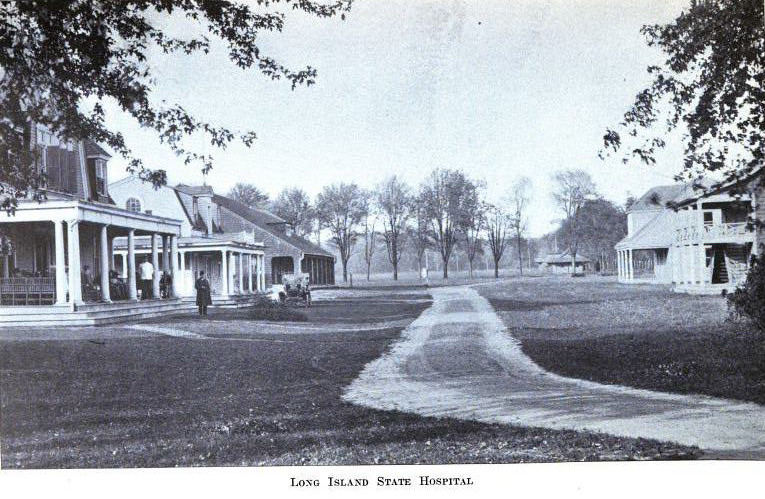
Long Island State Hospital - Creedmoor

Long Island State Hospital – Creedmoor

SOURCE: Annual Report of the Long Island State Hospital to the State Hospital Commission For the Year Ending September 30, 1912, Albany, J.B. Lyon Company, Printers, 1913, Pages 6, 16, 17.

Creedmoor. A tract of land in east central Queens, one mile (1.6 kilometers) north of Queens Village and centered on Braddock Avenue and old Rocky Hill Road (now Braddock Avenue), named for the family that farmed there. The name is used only locally and does not refer to any village or settlement, past or present. Conrad Poppenhusen of College Point ran a railroad through the area parallel to Braddock Avenue in 1871 and donated some of the surplus land to the National Rifle Association for use by the National Guard, which opened firing ranges in 1873. The growth of Queens Village from the 1890s and the hazards connected with the firing ranges led to the eviction of the National Guard in 1908. In 1910 the tract became the site of a large state mental hospital.”

Creedmoor Psychiatric Center. State mental hospital on Winchester Boulevard near Queens Village, built on land originally owned by the Creed family. It opened in 1912 as a “farm colony” for the Brooklyn Psychiatric Center in facilities formerly used as barracks for the National Guard. With the construction of new buildings in 1926, 1929, and 1933 Creedmoor became a separate state hospital. Although its nominal capacity was 3,300 patients, there were 6,000 patients by the 1940s, and overcrowding was exacerbated by staff shortages and limited funds. During these years various new treatments for mental illness were introduced at Creedmoor, including hydrotherapy, insulin therapy, electroshock therapy, and in a few cases lobotomy. A more important innovation was the introduction of antidepressant and tranquilizing drugs, which became widely used in the state mental health system in 1955. At Creedmoor the new drugs meant quieter wards, fewer injuries to staff members and patients, and a dramatic increase in the number of patients who could manage daily life in the community. As a result the number of inpatients at the hospital declined to 1,100 by 1991, while outpatient services and residential placements were expanded in keeping with the new policy of deinstitutionalization. When it became clear during the late 1980s that many of the homeless in New York City had urgent psychiatric needs, Creedmoor established a special impatient program of psychiatric rehabilitation intended specifically for the homeless. The Living Museum, presenting art by patients, was founded by Bolek Greczynski in 1984 in the hospital. In 2001 the city sold part of the mental hospital to residential developers and used another portion to develop three schools and athletic fields.”
SOURCE: The Encyclopedia of New York City: Second Edition, Kenneth T. Jackson, Lisa Keller, Nancy Flood, Yale University Press, 2010.

Brooklyn State Hospital, Brooklyn.
The institution is very greatly overcrowded, but it is hoped to obtain relief at an early date. There is under construction, and to be soon completed, a reception hospital and a building for the care of the chronic type of patients. The reception hospital will accommodate about 150 patients, while the building for the chronic type will accommodate 450.

Foundations for a new store house and cold storage building have been laid. A large number of repairs have been accomplished during the last year. The domes of the main building have been renewed and painted. A large quantity of flooring has been laid and a number of the wards have been repainted.

A number of cottages at Creedmoor are being remodelled and made ready for occupancy, and it is expected shortly to house at least 150 patients at this branch.

This hospital has been visited during the year by the State Finance Committee, the State Hospital Development Commission and the State Hospital Commission, and it is the concensus of opinion that the present old building should be razed and new ones built. There is planned a new and modern psychopathic hospital that will accommodate the needs of this portion of Greater New York.

When plans have been consummated, this site will accommodate about 2,100 patients, while at Creedmoor plans are in contemplation for about 2,500 patients.

The medical service is very active at this institution. At least 51 per cent of the cases admitted are of the feeble and exhausted type, or of the very acute maniacal type, and are brought in on stretchers. Those who are physically able are sent to Kings Park. The admissions here during the year were 626. Beginning July 1st, we organized a school for male patients and a male instructor was appointed. It is hoped to obtain very beneficial results from the re-education of certain cases.

In August, 1916, a social worker was appointed who has been of great benefit to the institution and to the paroled patients. She visits all patients who are paroled, attends the clinics, inspects environmental conditions, obtains positions for recovered patients, and assists in obtaining proper histories for the physicians. Three outdoor clinics are held weekly, one at the Brooklyn State Hospital, one at the Williamsburg Hospital on Saturdays; and one at the Long Island College Hospital on Fridays. These clinics are of great value, as it is through them that information is spread that is of great use to the general public. The present census is 925; the certified capacity is 637, and 70 patients are on parole.

At the east of the institution there is an old potters’ field which has been used for years for the burial of the poor of Kings County. This land was turned over to the state two years ago, and it is now proposed to construct buildings on this area. Therefore the Charities Department of the City of New York was requested to remove the bodies buried there by that department during the last two years, and several hundred bodies were taken away during the summer.
SOURCE: The American Journal of Insanity, Volume 74, 1917, Pages 353-354.

BROOKLYN (Brooklyn State Hospital)
An investigation of the sanitary conditions of the Brooklyn State Hospital at Brooklyn was made by Mr. C. A. Howland, assistant engineer in this Department on August 15, 1919. Previous examinations of the sanitary condition of this institution were made by this Department in 1915, (see page 906 of the 36th Annual Eeport) and in 1917 (see page 642 of the 38th Annual Report).

Location: The main institution is situated in the borough of Brooklyn, New York City, while Creedmoor Farm is located north of the village of Creedmoor close to the eastern boundary of Queens borough.

Site of institution: The hospital is situated in Brooklyn on Clarkson avenue just east of the Kings County Hospital. Although the grounds of the institution in Brooklyn are somewhat flat they are apparently well drained. At Creedmoor the farm land, much of which is under cultivation, is also flat but appears to be well drained.

Area of grounds: 25 acres in Brooklyn; 195 acres at Creedmoor; total, 220 acres.

Number of occupied buildings: 14 (2 practically complete but not occupied, one in course of construction).

Capacity: 343 men, 457 women, 305 employees; total, 1,105.

Present population: 441 men, 603 women, 206 employees; total, 1,252.

Class of inmates: All classes of insane except the criminal insane.

Water supply: The water supply for the main institution in Brooklyn is obtained from the Flatbush Water Company while the water supply for the Creedmoor farm is obtained from the Jamaica Water Supply Company.

Milk supply: The milk for the main institution in Brooklyn, which amounts to about 400 quarts of fluid milk, grade B, pasteurized, and 40 quarts condensed milk, are purchased per day from the Delancy Milk and Cream Company of Brooklyn. At Creedmoor farm the milk supply is obtained from a herd of five cows. The cow barn in which the milking is done is an old wooden structure which was not in a satisfactory sanitary condition at the time of the inspection.

Sewerage and sewage disposal: The sewage and storm water of the institution in Brooklyn is discharged through combined tile and brick sewers ranging in size from 6 to 18 inches into the sewerage system of the city of Brooklyn. At Creedmoor the sewage is at present discharged into two large cesspools located about 300 feet northwest of the building. A sewage disposal plant which will treat the sewage from the hospital to be ultimately constructed at Creedmoor is in the course of construction. This disposal plant will consist of Imhoff tanks, siphon chamber and sand filters, of which the inlet chamber, Imhoff tank and siphon chamber have been completed.

Refuse disposal: The garbage of the institution is fed to pigs at the Creedmoor farm. The garbage not suitable for feeding is disposed of in the institution incinerator. At the time of the inspection it was found that the piggery was not in a satisfactory condition and the engineer was informed that a new piggery is to be constructed. It was found that the barrels in which the garbage is stored at the institution were in some cases without covers. Rubbish, such as broken crockery, etc., is removed by the city street cleaning department. Waste paper is baled and sold and similar disposal is made of the rags. Combustible refuse is collected twice daily and burned in an incinerator of the Morse-Boulger Destructor type.

As a result of this examination the following recommendations were made in regard to the improvement of certain insanitary conditions found at the institution.

Recommendations:
1. That the garbage receptacles be kept covered at all times.
2. That a modern piggery of proper design and construction be built as soon as possible.
3. That every precaution be taken in the handling of the milk at the Creedmoor farm in order to prevent the communication of disease by this means and that a plant for the pasteurization of the milk be installed as soon as practicable.
4. That the sewage disposal plant for Creedmoor be completed according to the plans approved by this Department and be put in operation as soon as possible.
SOURCE: State of New York, Fortieth Annual Report of the State Department of Health for the Year Ending December 31, 1919, Volume II, Report of Division of Sanitary Engineering, Albany: J.B.Lyon Company, Printers, 1920, Pages 421-422.

I’m not sure if Creedmoor State Hospital had a cemetery, they may have used a public cemetery.

CLICK HERE TO VIEW THE VIDEO They’re Buried Where? by Seth Voorhees

THE BAD NEWS: Thousands Remain Nameless! 6.15.2015.

THE GOOD NEWS: One Man Is Remembered! 6.14.2015.

Lin Stuhler’s Willard Cemetery Project

Thanks, Jon!

joncrispin's avatarJon Crispin's Notebook

Central stairway, Chapin House, Willard Asylum

There are a lot of great and interesting people working on New York State asylum issues.  I have been following Lin Stuhler’s work on the Willard cemetery for a while, but only had the chance to meet her a few months ago.  We keep in touch, and she just emailed me with a link to her recent blog post about the recent open house, and the bill she has been pushing in the state legislature to name the people buried at the graveyard.  There is also a link to a really great video that was made by her local cable company.  It is an interesting post and there is some nice video footage of some of the buildings and the cemetery.  She has a real passion for this issue and should be commended for all the hard work she has done in the name…

View original post 3 more words

1876 The Case Of The Lunatic Boy – Part 2

The following is the testimony of Mary F. Ambrose, mother of Oliver D. Ambrose (the lunatic boy), transcribed from VAN KEUREN, Mary J., The government asylum. Horrible and extreme cruelty to the army and navy patients, Supplement only. 1876, pages 29-32. Several names are included in her document:

Mary J. Van Keuren, George W. Bontz, Sarah Bontz, Elizabeth Bontz, Jacob E. Bontz, John Bontz, Joseph Price, T.J. Gardner, Dr. C.H. Nichols, Alfred D. Nichols, Dr. Pliny Earle, Dr. W.B. Magruder, George R. Adams, Dr. Stone, Mrs. Sarah Adams, Mrs. Elizabeth Gludman, Judge Boone, Samuel E. Arnold, Mrs. Gladmon, Dr. Thompson, Dr. Benjamin F. Dexter, General Loomis, Dr. Morrell, Dr. Chase, B.G. Blakesley, Dr. Daly, J.W. Wallace, Hetterman, Mr. Tuft, Mrs. Taylor, Dr. Powell, Dr. Case, Dr. Toner, Dr. Hamlin, Mrs. Tobin, Dr. Walker, George M. Dow, General B.F. Butler, P.T. Woodfin, Eugene M. Wallace, Timothy Lynch, John Boyle, John E. Benson, O’Connell, Lieutenant Dannenhower, Jane Beatty, John A. Darling, Theodore F. Wilson, Mr. Mellish (Millish?), Dr. Thompson, Mr. O.W. Marsh, Henry Miller, Mr. Lyon, Mr. Baker, H.L. Weeks, Henry B. Taylor, Mr. Lane, Mary F. Ambrose, Oliver D. Ambrose, Dr. Eastman, Dr. Franklin, Senator Wade, Williams, C.F. Carter, Frank McAdams, Hetterman, General Barnes, William Edgar Van Keuren, Vice Admiral David D. Porter, H.H. Buck, William A. Knox, W.C. Lyman, G.O. Roker, J.A. Emmons, Secretary of the Navy George M. Robeson, Dr. C.H. Crane. 

Testimony of MARY F. AMBROSE. This witness had a son, Oliver D. Ambrose, who became insane from the effect of the assassination of President Lincoln, who happened to be sitting near the box in which Mr. Lincoln was killed. When Booth jumped out of the box Oliver shouted ‘Booth!’ ‘Booth!’

After a while Mrs. Ambrose placed her son in the Asylum, Dr. Eastman showing her a ward where her son would be cared for, which was satisfactory. The witness stated that she made efforts to see her son time and time again, and could never do so. She then took assistance with her, and was refused. The witness then said: ‘I will see my son this morning, or that door shall come down.’ ‘Well,’ said Dr. Eastman, ‘if you must see him, you can.’ Dr. Franklin then opened the door and I pressed in, and he took me through a long corridor where the patients were all seated on benches. He conducted me along until I got to the end of the corridor, and then took me down some steps, and brought me into a little corner of a place, not much larger than a man could lie down in – a little vestibule, it looked like, but they called it a ‘strong room.’  ‘Said I, What do you call this room? Said he, That is the ‘strong room.’ Why, there is no heat. It was cold as possible in there, and the poor boy was blue with cold. His skin seemed to be perfectly purple. He was cold and trembling all over, and had fallen away so much in flesh that I scarcely knew him. When the door was opened he screamed out, ‘Oh, my ma, are you going to take me home?’ My son ran up to me, and I put a shawl around him, and he said, ‘Ma, are you going to take me home? ‘Please take me home.’ I said, ‘I certainly shall,’ and I turned to Dr. Franklin and said, ‘Ain’t you ashamed of yourself, to treat a poor boy like that? How could you do such a thing?’ He was very cool, and said to me, in an off-handed way, ‘Madam, if your son is insane, here is the place for him.’ I took my son and carried him into the parlor. He was covered with vermin. His back was actually eaten away by vermin. they had eaten holes in his body. There were marks of violence on his body and arms. He did not show any violence. He was in the Asylum eight weeks. He weighed 155 pounds when I put him in, and 90 pounds when I took him out.

We forbear quoting all this witness stated, for the reason the case was so horrible and cruel that language fails to describe it.

Efforts were made at that time (1865) to investigate the management. Senator Wade moved in the matter, but nothing could be done. The power was safe; the neglect of duty was safe; the cruel and inhumane treatment was safe from the outside eye; the ignorant and beastly assisting physicians were safe in their conduct. Insane persons or any one within the walls complaining were not listened to. The brutish, cruel attendants could beat, bruise, kick, and ill-treat the patients without risk of a discharge, with a few exceptions.

Is it possible that in 1865, a few weeks after the boy Oliver D. Ambrose was placed in the Asylum, Dr. Franklin or Dr. Eastman could not discover whether the boy was insane or not?

The fact is plain that those assisting physicians (so-called) either did not know anything about insanity, or that they had not seen the boy for eight weeks, during the entire time the boy was there. We charge the fact to be that neither Eastman or Franklin had seen the boy. Take the testimony, which is not disputed. Mrs. Ambrose’s mother called, but could not see her grandson. No one but his mother could see him, was the answer. then his mother made efforts, and after a time she was admitted. Note the answer of Dr. Franklin: ‘Madam, if your son is insane, this is the place for him.’ This remark shows that Franklin did not know the boy’s case. No doubt whatever he had not seen him before. But it turned out that the boy was not insane, and if Franklin or Eastman had attended to their duty they would have found the boy weeks before well enough to go home. Not one item of proof did the defense show or attempt to show that the boy had been examined by any physician from the day he entered until he left, to show his case whether better or worse. This is one case, and if the graves could speak others of the like, only worse, could answer.

Why did not the defense call Dr. Franklin from New York city to show how this boy had been treated. We answer, because he was not a man like Eastman, who disgraced himself in the mind of every man who read his testimony, or who may read it hereafter.

Take the questions of counsel to Dr. Eastman and his answers, and it will plainly be seen that fraud and false-coloring was designed. How very ridiculous the pretense to discredit the testimony of Darling. Why did the Doctor not go and get the reports made to the Adjutant General, and show by the hand-writing? The pretense of a memoranda in his pocket was foolish, when he had the means within his power, if the witness had not stated truly; and besides, Dr. Nichols himself does not deny that Darling acted as clerk, and that every word he testified to was true.

How long will such sham be tolerated? There is altogether too much money to be used in the management by one man to expect justice and humanity to prevail without a struggle – a desperate struggle. Money is power, and it often crushes justice. The people will sooner or later put out such management.

These witnesses show extreme cruelty of one kind or another, more or less extending over many years, showing such neglect of duty on the part of the Superintendent as no man can excuse, and such as cannot be excused or suffered longer to exist. In fact the neglect on the part of the Superintendent shows such a disregard of duty, of official oath, that it comes clearly within high misdemeanor; the cruelty is revolting to all feelings of humanity.

The testimony shows that the Superintendent for several years has given but little attention to the patients; that he has trusted the inside of the asylum to assistants who the testimony shows to have been incompetent almost from the first, as the present attending physicians are. The neglect has been so great and the attendants so very incompetent that nothing short of a clean wiping out of every man in charge will answer the demand of the people.

If the reader of these pages will read but a tithe of the testimony, and then read the law of the asylum, he will say, as Boynton said, that if half is true hanging would be too good for every one of them. No man will say that the testimony against the management is not true and overwhelming. Comments cannot add to its force and convincing elements. There are such numbers, such quantity, giving particulars, acts, facts, and circumstances that all effort to explain, to excuse, becomes swamped at once, and no power to extricate.”

Discussing Public Charities – New York Times – June 11, 1879
On June 10, 1879, Dr. C.H. Nichols, President of The Association of Medical Superintendents of American Institutions for the Insane, resigned. It is unclear if he was forced out or if he was retiring. 

1876 The Case Of The Lunatic Boy – Part 1

1876 The Case Of The Lunatic Boy – Part 1

This is a very interesting article from The New York Times. It refers to an unnamed “lunatic boy” who was mistreated at the Government Hospital for the Insane in Washington, D.C. The Superintendent of the asylum was Dr. C.H. Nichols, formerly of the Bloomingdale and Utica Asylums for the Insane of New York State. The Government Hospital accepted veterans, pauper, and pay patients. The article speaks of the Testimony before a House Committee (of Congress), and alleges that veterans of the Civil War and pauper inmates, including women, were being beaten and whipped; starved; served rotten meat and butter; and were covered with vermin (hair and body lice), while the pay patients were treated humanely and were kept in good physical condition. The article speaks of the barbaric treatment in various insane asylums and county poor houses in the United States but gives praise to the Willard Asylum for its mild and humane treatment “of the wildest and most incurable cases from the county poor-houses.”

Back to the “lunatic boy. It is often difficult to figure out who people were from old newspaper articles because although the reporter knew who this boy was, he didn’t state his name. While trying to uncover the identity of the boy, I came across an old document/pamphlet entitled The government asylum. Horrible and extreme cruelty to the army and navy patients, Supplement only, July 1876, written by Mary J. Van Keuren. Mrs. Van Keuren’s son, William Edgar Van Keuren, a veteran, was horribly mistreated at the Government Asylum. She wrote the piece about the testimony given before Congress that included the cases of: OLIVER D. AMBROSE, THOMAS W. WHITE, GENERAL LOOMIS, and WILLIAM EDGAR VAN KEUREN (Edgar). After reading the account of the testimony, I believe that the unnamed “lunatic boy” was OLIVER D. AMBROSE, who “became insane from the effect of the assassination of President Lincoln, who happened to be sitting near the box in which Mr. Lincoln was killed. When Booth jumped out of the box Oliver shouted “Booth!” Booth!” Although I could not find any statement regarding Oliver’s age, the account suggests that he was a minor, was not insane, was beaten and starved, and was kept in the asylum for eight weeks without ever being seen or evaluated by a doctor.

The Case Of The Lunatic Boy.

“The testimony before the Committee on Expenditures, of the House, on Thursday, as to the management of the Government Hospital for the Insane, at Washington, was certainly painful enough. The institution evidently ought to be overhauled. But we wish some committee could examine various rural hospitals for the insane throughout the country, and especially the insane wards of the county poor-houses. Such treatment as the poor crazed boy received in Washington is mild and humane compared with that dealt to lunatics in these places in every State of the Union. Such a committee would discover in these “dark places of the earth,” lunatic women, often those who had seen better days, shut up in dark cells or cages, without clothing, cold, often hungry, devoured by vermin, besmeared by filth, chained, of, if loose, associating with vagabonds, paupers, and drunkards, and frequently debauched and ruined by them. The visitors of the insane wards in the poor-houses of the United States know that there is appearing in them what might be called a new and horrible human variety – a race, the offspring of the lunatic and the drunkard, of the crazed pauper and the vicious vagrant. In these “asylums” men are known who have been in chains and cages for years, some some confined as to be deformed for life; some scarred and marked by fetters and whips, without clothing, and treated during these long years worse than the brutes. Our readers have only to refer to the reports of such associations as the New-York Prison Association, the New-York and Pennsylvania State Boards of Charity, or the reports from every State of those experts and philanthropists who have visited and studied our county alms-houses where the insane have been cared for, to convince themselves that such facts as have been uncovered at Washington are common in every State of the Union.

The truth is that the condition of the insane poor in the United States is a disgrace to our humanity and civilization. The wonder is that it has continued as it has so long. Not a year has passed for fifty years, in which reports of experts have not exposed these abuses. Such philanthropists as Miss Dix, Dr. Willard, and others have spent their lives in seeking to reform them. Our own State Board of Charities, under Dr. Hoyt, have struggled incessantly with them. And it is only within a few years that in this State, Massachusetts, and Pennsylvania a few victories over stupidity and barbarism begin to crown the long contest. In the West and South, and a large part of the Middle States, the condition of the insane, where they have no money, is still discreditable to our civilization and Christianity.

It will be said that this occurrence in Washington is different from what happens in county poor-houses, in that the Washington Asylum receives pay patients. But it will be found that the management of many asylums in the country districts, for patients of means, is disgraced by the old punishment and restraint system. In England, the old barbaric methods of handling the insane have been given up. “Non-restraint” is the rule. The vigorous exertions of the Commissions of Lunacy throughout the Kingdom have cleansed the “dark places of cruelty” of their abominations. A new and violent patient is seldom confined, or at most with the camisole or shirt, but is placed between two attendants, or is put in a padded room, where he cannot injure himself. Chains and blows, cages and cells, hunger and cold, are given up as means of curing lunacy. The lunatic is considered a patient under a peculiar disease, who can be broken of bad habits by kind and wise treatment, even as a child is. No asylum in this country has carried out the non-restraint principles so far as the best English asylums; but what has been accomplished by a singularly mild and humane treatment at the Willard Asylum of this State of the wildest and most incurable cases from the county poor-houses, shows what can be done by humanity and science combined. Such a treatment as that of the poor boy in the Washington Asylum, which might occur in many others, ought to be as much a thing of the past as the pillory, or whipping, or ear-cropping of our colonial days. And yet many a reputable asylum resorts to it. It would be a happy result of this cruelty if Congress could appoint a Commission of Lunacy which might help to reform such abuses throughout all the States, until every lunatic in the country was treated – as he should be – as an unfortunate and diseased human being.”

SOURCE: The New York Times. Published: April 24, 1876. Copyright @ The New York Times

1876 The Case Of The Lunatic Boy – Part 2

1899 A Hospital Quarantined. Diphtheria Breaks Out at the Willard State Institution.

A Hospital Quarantined.
Diphtheria Breaks Out at the Willard State Institution.

Geneva, N.Y., July 5. – The Willard State Hospital, situated at Willard, N.Y., twenty miles south of Geneva, is more or less rigidly quarantined as a result of an epidemic of diphtheria, with which both patients and employes alike are afflicted. The authorities of the hospital state that, although it is a mild type of the disease, they deem it necessary to put the buildings and all those connected with the institution under quarantine.

Antitoxin has been freely used, and the authorities of the hospital now believe that they have the infection under control. No fatal cases have as yet been reported. Visitors are not allowed to visit patients, and will not be until conditions are considerably improved. It cannot be learned how many cases of the disease there are at the hospital. The cause of the breaking out of the disease cannot be accounted for as far as can be learned. The hospital is managed by a Board of Trustees of which ex-Senator S.H. Hammond of this city is the President.

SOURCE: The New York Times. Published: July 6, 1899, Copyright @ The New York Times

1886 An Insane Physician. Driven Crazy By The Loss Of His Books And Instruments.

An Insane Physician.
Driven Crazy By The Loss Of His Books And Instruments.

Elmira, N.Y., Jan 6. – Dr. Henry S. Dimock, for several years a physician at Grove Springs, a fashionable Summer resort on Keuka Lake, who for some time has been the medical adviser at Crystal Springs, and who will be remembered by many people of New-York, as well as those of Western cities, has become violently insane, and this evening was taken to Willard Asylum. On the 20th of last month he lost all his books and instruments by the burning of the hotel at Crystal Springs, and the loss so preyed on his mind that last Sunday night he stole a horse and carriage from Benson Smith, of Crystal Springs, and drove the animal to Penn Yan. He told the people that he was a Pinkerton detective and was after the man who set the hotel on fire. He insisted on making a clothier open his store and sell him a suit of clothes, and after putting them on refused to pay for them or take them off. He was persuaded to disrobe, however, and then ran through the streets. He is 53 years old, and has a wife. His condition is thought to be beyond recovery.

SOURCE: The New York Times. Published: January 7, 1886, Copyright @ The New York Times

1860 Rats At Bellevue Hospital

RATS AT BELLEVUE HOSPITAL.
THE CASE OF THE NEW-BORN CHILD GNAWED BY VERMIN–
INVESTIGATION BY THE COMMISSIONERS OF PUBLIC CHARITIES–
HOW THE HOSPITAL IS OVERRUN.

New York Times Rats

The Commissioners of the Department of Public Charities and Correction have promptly investigated the case of the infant of MARY CONNER, which was mutilated by rats at Bellevue Hospital, and the death of which is supposed to have resulted from that cause. Messrs. DEAPER, GRINNELL, BELL and NICHOLSON spent several hours at the Hospital, night before last; examined all who had anything to relate with regard to the occurrence, and had several of the alleged culprits, or members of their numerous family, before them, — for the rats at Bellevue are a bold and reckless race, and do not hesitate to come forth from their hiding-places, and scamper about even in the presence of men in high position. The evidence thus collated was arranged in due form, and presented before the Commissioners at their meeting yesterday afternoon. The details are uninteresting and unfit for publication. The leading points are as follows:

MARY CONNER went to the Hospital last Sunday afternoon, sent thither by the Superintendent of Out-Door Poor, Mr. KELLOCK. She was placed in the “Waiting Room,” where about twenty women slept, and by 9 o’clock all had retired. During the evening she had made no complaints, and gave no intimation of her coming confinement; in her testimony she declares that she did not expect it so soon. At 6 o’clock in the morning Dr. HADDEN, the House Physician, was summoned to attend her, and found the new-born infant lying partly under the body of the mother, dead and cold. “The nose of the child, upper lip and a portion of the cheeks seemed to be eaten off,” says Dr. HADDEN. “The toes of the left foot and a portion of the foot were eaten off, or apparently so. The lacerated portions were covered with sand and dirt.” He states that the abdomen of the child was flattened out by the weight of the mother. He is quite sure that the gnawing was done after the death of the child, and believes that it was done by rats. The mother was feeble and listless — hardly accountable, the doctor thinks, for anything she might say. She declared that it did not make any difference to her whether the child was dead or alive. From her testimony we learn that she is a servant girl, 31 years old, born in Dublin, has lived eight years in this country, and is unmarried. She perceived, on the night in question, that there was a cat or rat on the bed, but could not tell which. She was either asleep or in a fainting condition most of the night.

When these facts had been read, the President, Mr. DRAPER, said he had not received any communication from the Warden of the hospital in relation to the matter. Mr. NICHOLSON asked whether the President had taken any action in the case. The President answered that he had sent a letter to the Warden stating what he had heard, and telling him to see that a sufficient watch was kept in the various wards, to prevent any unfortunate occurrence in future which watchfulness could prevent. The Board confirmed the action of the President.

Mr. GRINNELL said he knew nothing of the occurrence until he read it in the newspapers. He had learned that there had not been any efforts for the extermination of rats made for some years. He had been so informed by Mr. DALY, the Warden. The President then presented propositions from several rat exterminators, offering to relieve Bellevue Hospital from rats. The propositions were referred to the Committee of the Whole, with power. After the passage of a resolution to meet every Thursday at 3 1/2 P.M., the Board adjourned.

Bellevue Hospital is completely overrun with rats. Our reporter, yesterday, made the acquaintance of several of them. They are large wharf-rats, and their presence there in such numbers is attributed to the contiguity of the East River. The Hospital, most of our readers are aware, was erected nearly fifty years ago, on a site which is bounded by First-avenue, Twenty-sixth and Twenty-eighth streets and the water. The main building stands on land of natural conformation, but the “new wing,” in which are the apartments for females, is supported on piles driven into “made land.” From the Hospital through this “made land” — everybody knows how it is “made,” by piling dirt on top of rubbish and loose stones — five sewers carry off all that is waste-worthy and empty it into the river, and by these sewers the vile, gregarious, amphibious and nomad vermin, swimming in crowds from place to place, have been induced to stop, to build their nests in the substratum of loose stones, or to burrow in the grassy banks near the water-side. It must be borne in mind that these creatures are not the common rats that infest private dwellings, but monsters that devour those lesser mischief-makers, inhabit about wharves and in storehouses and granaries, will, on occasions, dive into the water and glide swiftly through it, and of whose exploits we have heard more in “thrilling tales of the nineteenth century” than in sober, matter-of-fact narrative. In the vicinity of hospitals near the water, they are always found. Blackwell’s Island swarms with them, and they have been inmates of Bellevue since a period of which “the memory of man runneth not to the contrary.’ Unsuccessful efforts have, from time to time, been made to drive them out or destroy them. Six years ago, thousands of them were poisoned, and the place got in such bad order in consequence, that at one time it was almost determined to abandon it. The unsavory remains of the dead enemies of the institution were, however, removed; but the building was alive again, in a very brief period, with their successors. Since then, many attempts upon their lives, with arsenic, strychnia, terrier and grimalkin have been made with various success, but the water-rat is exceedingly prolific. A workman employed at the Hospital informed us that a day or two ago he found a nest in which there were two old rats, with a family of eighteen little ones; and at another time a litter of sixteen was turned up with his spade. Where one has fallen a dozen have sprung up in its place. Twelve dozen of traps awhile ago were sprung upon a host of them, but after two or three such experiments the survivors found out the trick of it, and the bait was left untouched. In the interior of the edifice you find rat-holes at every corner. In the female wards the rats in the night-time run about in swarms. There are fewer of them in the male wards, but there they are plentiful, and in the private apartments of the main building those employed in the institution go to bed with a broom-stick at hand, that they may repel them when they grow too familiar. This sounds like fiction, but we are assured that it is true. Myriads swarm at the water side after nightfall, crawl through the sewers and enter the houses. In a bath-tub, last Monday night, forty rats were caught. The vermin have full possession of the building, and if, without reconstructing its interior entirely, they are removed, it will be more than amazing.

 SOURCE: Published: April 27, 1860, The New York Times, Copyright @ The New York Times

1865 New York Times – Commissioners Of Public Charities And Corrections.

httpwww.nytimes.com20141014sciencerats-and-their-alarming-bugs.html_r=0


1901 Detained For 15 Years As “Feeble-Minded”

DETAINED FOR 15 YEARS AS “FEEBLE-MINDED”
Girl Then Pronounced Insane Is Declared to be of Sound Mind.
Now Under Commissioner Feeny’s Protection – Tells a Story of Ill-Treatment at Newark (N.Y.) Asylum.

Fifteen years a prisoner as feeble-minded, has apparently been the lot of Mary Lake, now an inmate of the Richmond Borough Almshouse, but about to be set at liberty. Commissioner of Charities James Feeny of Richmond Borough is largely responsible for justice being done the girl even now.

The young woman is a daughter of George Lake of New Dorp. Lake, on Dec. 5, 1883, was sentenced for a serious offense to ten years in State prison. Lake’s children were committed to the County Almshouse, and the records show that on Sep. 10, 1886, Mary, twelve years old, was committed to the State Institution for Feeble-Minded Children at Syracuse. She remained at that institution until she became of age on Jan. 4, 1896, when she was transferred to the New York Custodial Asylum for Feeble-Minded Women, at Newark, N.Y.

Commissioner Feeny on Sept. 19 last received a letter from C.W. Winspear, the Superintendent of that institution, stating that Mary Lake had become insane, and demanding that she be removed. The Commissioner found that she must be brought back to Richmond County, and preceedings were taken to have her legally declared before she could be committed to an insane asylum. Some correspondence ensued between Commissioner Feeny and Superintendent Winspear, and under date of Oct. 1 the latter sent a certificate made by the attending physician at the institution, which follows:

Mary Lake has had a number of attacks of excitement, but none so severe as the present attack, nor did they last as long. Has been very much worse the last two weeks. I have no doubt of her insanity. N.E. LANDO

Upon the receipt of this the Commissioner sent Superintendent of Almshouse Pierce with a nurse, and armed with straitjackets and other paraphernalia to bring the supposed insane and violent girl to her home county, and the Superintendent was surprised to have placed in his custody an attractive-looking young woman entirely docile, well-educated, bright, and intelligent. Miss Lake was brought to the almshouse on Oct. 2, and since that time she has been under careful inspection, and has undergone several severe examinations at the hands of Dr. Isaac L. Millspaugh and Dr. John T. Sprague, who finally certified to Commissioner Feeny that the young woman is not now insane, and perhaps never has been; that there is no evidence that she has ever been even feeble-minded, and, on the contrary, she is intelligent, well-educated, is willing to work, and is most competent in every respect.

Commissioner Feeny did not feel justified in turning the young woman out upon the world, for, while she had been educated and trained to household duties, she is unsophisticated, and with the aid of Mrs. George William Curtis and other ladies whom he has interested in the case, the Commissioner is attempting to find her a good home.

Miss Lake, when seen at the almshouse, talked freely of her life in the institutions, and told stories of ill-treatment at the hands of some of the assistants at the Newark institution. She says there are others at the institution who are sound-minded, and who desire to be and should be discharged from the asylum.

She claims the reason she was declared insane and sent back to Richmond is that she was charged with being the originator of a plan to appeal to Gov. Odell upon the occasion of his visit to the institution during his recent tour of State Institutions. The plan was not carried out by the inmates. While she was among the number who agreed to speak to the Governor, she was not, she says, the leader or the originator of the plan. She declared her determination to leave, however, and fearing that she would make some trouble, the authorities at the institution, she says, took the above-mentioned method to get rid of her.

Of the other Lake children, one son has been lost sight of, another is in an institution for the blind in Brooklyn, and one daughter is said to have been brought up in a private family in ignorance of her parentage, and to have been happily married very recently.

SOURCE: Reprinted from The New York Times, Published: October 26, 1901, Copyright @ The New York Times.

1914 Destroy Bad Food Of State Asylums

DESTROY BAD FOOD OF STATE ASYLUMS
Shocking Conditions Found by Federal Inspectors in a Sweeping Inquiry.
FIRE PERIL IN FLATBUSH
Condition “Bordering on Savagery” at Binghamton
Milk from Tubercular Cows at Poughkeepsie.
Special to The New York Times.

ALBANY, May 8. – For eighteen months, according to information received to-day by Commissioner John H. Delaney of the Department of Efficiency and Economy, the insane patients of the Hudson River State Hospital at Poughkeepsie were supplied with milk from tubercular cows belonging to the institution and purchased with the State’s money. Mr. Delaney learned that in that period twenty-three gravely afflicted milch cows of the hospital’s own herd were condemned.

An investigation at once will be made by Commissioner Delaney to ascertain whether the animals were suffering from tuberculosis when they were purchased or whether the disease developed among them after they became the property of the institution.

The State Hospital Commission, which is responsible for the management of the State Hospitals for the Insane, has as yet made no official answer to the accusations contained in the reports of Inspectors of the Department of Efficiency and Economy. It was learned to-day, however, that when an inspection of the food supply at the various institutions was made some weeks ago by experts from the Bureau of Animal Industry of the United States Department of Agriculture, the Hospital Commission started to make some inquiries about conditions at the fourteen institutions under its supervision.

According to information obtained to-day complaints were received from several institutions regarding the quality of the beef after the commission contracted for a three months’ supply of Argentine beef. Inspector Phillips then urged the commission to have an inquiry made by two Federal Inspectors, and his advice was followed.

The reports of these inspectors have been in the hands of the State Hospital Commission since early in April, but have not been made pubic. The inspectors reported deplorable conditions at nearly every institution they visited.

At the Utica State Hospital the Federal inspectors were compelled to order the destruction of a large quantity of lard used in the making of bread because it was rancid. The bakery at the institution, they said, was “unclean beyond belief.” The floor and walls they found “in a vile state.” Conditions, they said, were “a grave menace to employes and inmates of the institution.”

They found 500 pounds of pork and seven carcasses of mutton which were unfit for food. After discovering that forty dozen of eggs out of a total supply of seventy-five dozen were decayed, they were informed by the kitchen employes that it had been the practice to feed the patients with such eggs.

At the Buffalo State Hospital the Inspectors ordered the destruction of meat unfit for human consumption; at Central Islip they condemned eggs and 200 pounds of beef; at Willard a barrel of fat, intended, it was asserted, for cooking purposes, was condemned.

Similar conditions were reported at the Binghamton State Hospital. A condition described as “bordering on savagery” was found by the Federal Inspectors in the storeroom of the Mohansic State Hospital at Yorktown Heights. At the Rochester State Hospital the inspectors ordered the entire supply of eggs on hand, 320 dozen, destroyed as unfit for food. A supply of bacon and beef in the storeroom, the inspectors said, should not be used for food. Employees at the Middletown State Hospital told the inspectors most of the eggs used for the patients at the institution were decayed.

Commissioner Delaney said to-day that reports from investigators of this department who have been inquiring into conditions at the Long Island State Hospital in Flatbush show “dreadful” conditions at that institution. The investigation of the Efficiency and Economy Department thus far has been confined to the mechanical equipment of the hospital, but Federal Inspectors have made inquiries regarding the food.

The Federal Inspectors report that many of the eggs at this institution are classified in the trade as “rots” and “spots” and “weak and cloudy” eggs. Employes said that the grade of eggs furnished to the institution was extremely poor. The Federal Inspectors found 200 pounds of moldy bacon and two tubs of rancid lard.

An engineer employed by the Department of Efficiency and Economy found the floors and ceilings of the institution in a bad and dangerous condition. The menace to the inmates in case of fire, the engineer said, was very grave, owing to a defective fire alarm system and improperly marked stairways and exits. The sanitary conditions of the institution the expert called “a mockery” of conditions that should obtain.

SOURCE: The New York Times, Published: May 9, 1914, Copyright @ The New York Times