Unknown's avatar

About lsstuhler

Linda Stuhler is a Genealogy Geek from Rochester, New York, who loves to find out the facts. She has been researching her family tree for over twenty years and has accumulated an abundance of information on various subjects that she enjoys sharing on her blog at: https://inmatesofwillard.com/. She was responsible for the creation of the New York State Senate Bill S840, initiated in August 2011, which allows for the release of the names, dates of birth and death, of former patients who were buried in anonymous graves in New York State Custodial Institutions. The bill was changed from the original draft to S840A and does not work the way it was intended. It became a law on August 18, 2016, but it did not include provisions for a searchable database available to the public as New York State attorneys and the Office of Mental Health believed that if they did so, they would be sued. She is the author of "THE INMATES OF WILLARD 1870 TO 1900, A GENEALOGY RESOURCE."

1879 Dutchess County Alms-House – Poughkeepsie, NY

A DISGRACE TO DUTCHESS COUNTY. MISERABLE CONDITION OF THE ALMS-HOUSE-THE SUPERVISORS AND SUPERINTENDENT AT LOGGERHEADS.

POUGHKEEPSIE, N.Y., Dec. 14. – The Board of Supervisors visited the Dutchess County Alms-house on Friday, and found a good many things which common humanity and decency require should be at once remedied. every room and hall in the buildings was examined. A committee appointed by a previous Board of Supervisors spent $700 out of an appropriation of $1,000 in making certain improvements. but they only began a work which ought to be speedily finished. They put new floors in the hallways and 110 pairs of blinds on the windows. Friday’s inspection showed that the floors in every room are worn out, and have been for years. Strips of tin and zinc have been nailed over the cracks here and there to keep the cold out, and in some of the rooms and hallways portions of the walls have fallen. The window-panes are cracked and broken everywhere. The rooms are supplied with dilapidated wooden bedsteads of the commonest sort, which are so unclean that they are fit only to be thrown into a bonfire. Six of these beds are in one room. There are 25 new iron bedsteads stored in the building, with new mattresses, which have never been used. The kitchen is in the basement of the main building, and is so poorly ventilated that the odors from the cooking penetrate everywhere, and often make the atmosphere noisome. The garret of the main building is a miserable death-trap. Across the centre runs a partition, and 17 beds are under the low-peaked roof in the east end. A narrow, ill-contrived stairway furnishes the only exit from this man-hole. Let a fire once break out on the floors below, and the 25 or 30 paupers who usually huddle about the steam-pipes would stand very little chance of getting out alive. In the day-time this miserable room is lighted by one window in the east end. At night the light is furnished by a single candle fastened to the centre of an iron rod, which crosses the room over the heads of the occupants. The partition should be ripped out, three dormer windows should be built on each side, and substantial fire-escapes should be put up at the east and west ends. It is criminal recklessness to house the paupers in the garret as it is now.

Near the main building stands what is called the “insane building.” It needs a thorough overhauling. The “rooms” it contains are little better than wooden cells. Sliding doors separate these cells from a narrow corridor, and in each door is a small aperture through which food was formerly passed to the insane inmates. In some of these cells are two and three beds, and all the wood-work is impregnated with foul odors. New floors were put in the cells last season, but the whole affair needs to be rebuilt, and good rooms put where the cells now are. The chapel building is mainly occupied by the keeper and his family. It ought to be converted into a hospital and infirmary. The chapel could be left as it is, and at least 12 good rooms built for the use of the sick paupers. Another greatly needed improvement is a new boiler for the engine. The one now in use was put in 19 years ago, and it was only a second-hand boiler then. In its present condition it is liable to explode at any moment.

To this disgraceful condition of affairs is to be added the present commingling of the sexes. There is nothing to separate them in either the buildings or yards. They ought to be separated, and to do so need not be a difficult task. Proper fencing is all that is required in the yards. The keeper’s quarters should be removed from the chapel building to rooms in the centre of the main building. The male inmates could then be assigned to apartments in one end of the building, and the females placed in the other end. Proper partitions and doors could be easily built to divide the building in this way. The total expense in making all the necessary improvements is estimated at the very small sum of $1.500.

One thing that has helped to bring about the present disgusting state of affairs at the Alms-house is the lack of harmony between Superintendent Ladue and the Board of Supervisors. The committees of 1878 and of this year complain of the Superintendent for his refusal to carry out their suggestions, and say that had he done so many of the present evils would not exist. The committee of 1878 built an additional stairway at the west end of the building, but lath has been nailed across the exit and the stairway closed. The new iron bedsteads purchased this year have not been put in use by the Superintendent, nor have the new mattresses. Some of the latter still remain in the store where they were purchased. Other shortcomings of the same sort are charged against him by the Supervisors, and it is hoped that when the new Superintendent takes office he will make a beneficial change.

There are now 130 inmates in the Alms-house, but cold weather will probably increase the number to 150. At this time last year there were 180 inmates. Only one insane person is among the inmates, 10 incurable cases having been sent to the Willard Asylum during the past season.

SOURCE: The New York Times, Published: December 15, 1879, Copyright @ The New York Times.

1864 The Willard Asylum and Provisions For The Insane – County Poor House Investigation

THE WILLARD ASYLUM, AND PROVISION FOR THE INSANE. 

By an Act of the New York Legislature, passed on the 30th day of April, 1864, the Secretary of the State Medical Society was authorized to investigate the condition of the insane poor in the various poor-houses, alms-houses, insane asylums, and other institutions, where the insane poor are kept, not including, however, such institutions as are now required by law to report to the Legislature of the State.

The law directed the Secretary to arrange a series of questions, such as in his judgment would be likely to elicit the greatest amount of information on this subject, procure them printed, and transmit them to each county judge in the State. It directed the county judge, on the reception thereof, to appoint a competent physician, a resident of the county, to visit the county poor-house, or institution where the insane poor are kept, and to examine into the condition and treatment of the insane inmates, and to transmit the result of the investigation to the Secretary, who was thereupon directed to condense the information so received and report the same to the Legislature.

Dr. Willard, the Secretary of the Medical Society, entered at once upon the service assigned him, and the following January his report was presented to the Legislature. This document bears ample testimony to the earnestness, fidelity, and zeal with which the author executed the duties of his commission; and although he died, prematurely and lamented, before the passage of the law creating a new institution for the insane, a grateful commonwealth has perpetuated his memory and name in the Willard Asylum for the Insane.

The leading features of the law, passed by the last Legislature, authorizing the establishment of a State Asylum for the chronic insane, and for the better care of the insane poor, are as follows:

It provides for the appointment, by the Governor, of three Commissioners to select, contract for, and purchase a suitable site for the building, -said site to be first sought for in any property owned by the State, or upon which it has a lien; the construction, by the Commissioners, of suitable asylum buildings, or the modification of buildings already erected and not occupied for other State purposes; the appointment by the Governor of seven trustees, who shall have power to appoint a medical superintendent, one assistant physician, a steward and a matron, and adopt the necessary by-laws for the government of the asylum, and fix the rate per week, not exceeding two dollars, for the board of patients, and, with the approbation of the Governor, designate the counties from which the chronic pauper insane shall be sent to the said asylum.

The chronic pauper insane from the poor-houses of the counties thus designated, shall be sent to the said asylum by the county superintendents of the poor, and all chronic insane pauper patients who may be discharged, not recovered, from the State Lunatic Asylum at Utica, and who continue a public charge, shall be sent to the asylum for the insane hereby created.

The county judges and superintendents of the poor in every county of the State, except those counties having asylums for the insane, to which they are now authorized to send such insane patients by special legislative enactments, are hereby required to send all indigent or pauper insane coming under their jurisdiction, who shall have been insane less than one year, to the State Lunatic Asylum at Utica.

Seventy-five thousand dollars are hereby appropriated for the purpose of carrying into execution the provisions of this act. The asylum hereby created shall be known as the Willard Asylum for the Insane.”

SOURCE: American Journal Of Insanity, October 1865, Pages 1-5.
New York State County Poor Houses.

UPDATE Craig Colony Cemetery

The volunteers of People Inc. and the Museum of disABILITY History will be cleaning up the Craig Colony for Epileptics Cemetery and the white marble engraved headstones this summer as part of the nationwide movement Operation Dignity to restore local institutional cemeteries. The fact that there are headstones and that they are engraved with the patients’ name is rare. The names of the 2,274 people buried in this cemetery can be found at Find A Grave. The following photographs were taken and sent to me by David Mack-Hardiman, Director of Training, People Inc. To volunteer, please contact David Mack-Hardiman at: dmack@people-inc.org.

We still need this bill to pass! Please call or write a letter to your state senator and tell them that you support this bill! S2514-2013 – NY Senate Open Legislation – Relates to patients interred at state mental health hospital cemeteries – New York State Senate.

Craig Colony 1 - 6.2013

Craig Colony 1 – 6.2013

Craig Colony 2 - 6.2013

Craig Colony 2 – 6.2013

Craig Colony 3 - 6.2013

Craig Colony 3 – 6.2013

Craig Colony 4 - 6.2013

Craig Colony 4 – 6.2013

Craig Colony 5 - 6.2013

Craig Colony 5 – 6.2013

Craig Colony 6 - 6.2013

Craig Colony 6 – 6.2013

Craig Colony 7 - 6.2013

Craig Colony 7 – 6.2013

Craig Colony 8 - 6.2013

Craig Colony 8 – 6.2013

Cemetery Restoration – People Inc. & The Museum of disABILITY History

In Remembrance by David Mack-Hardiman, Director of Training, People Inc.

More than one million Americans are buried in institutional cemeteries. Many institutions which served people who had mental illness or developmental disabilities are now closed. Upon their closure, the cemeteries have been abandoned or passed on to the current owner of the property. Because the monuments were made more cheaply than traditional gravestones, time and neglect have taken their toll. Some grave markers are broken, leaning, tipped over, sunken under the ground, or tossed off into the weeds. Many of them are just numbers with no further clue as to the identity of the person. (TO VOLUNTEER, PLEASE CONTACT DAVID MACK-HARDIMAN at dmack@people-inc.org.)

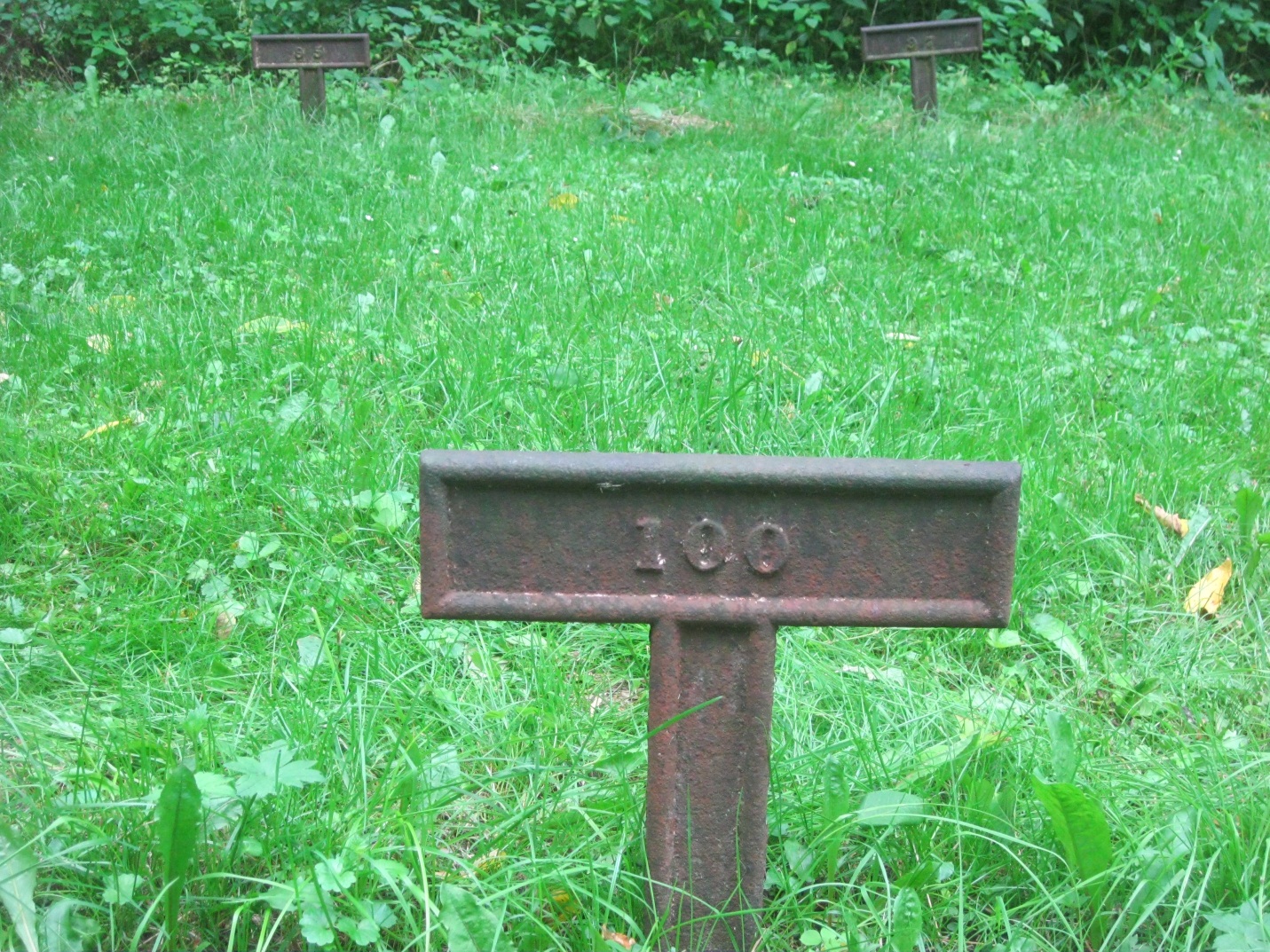
Cast Iron Monument #100 in the Wheater Road Cemetery in Gowanda

Cast Iron Monument #100 in the Wheater Road Cemetery in Gowanda

Seven years ago, People Inc. and the Museum of disABILITY History aligned with the statewide 1033 Group and the nationwide Operation Dignity movement to embark upon the restoration of some local institutional cemeteries.

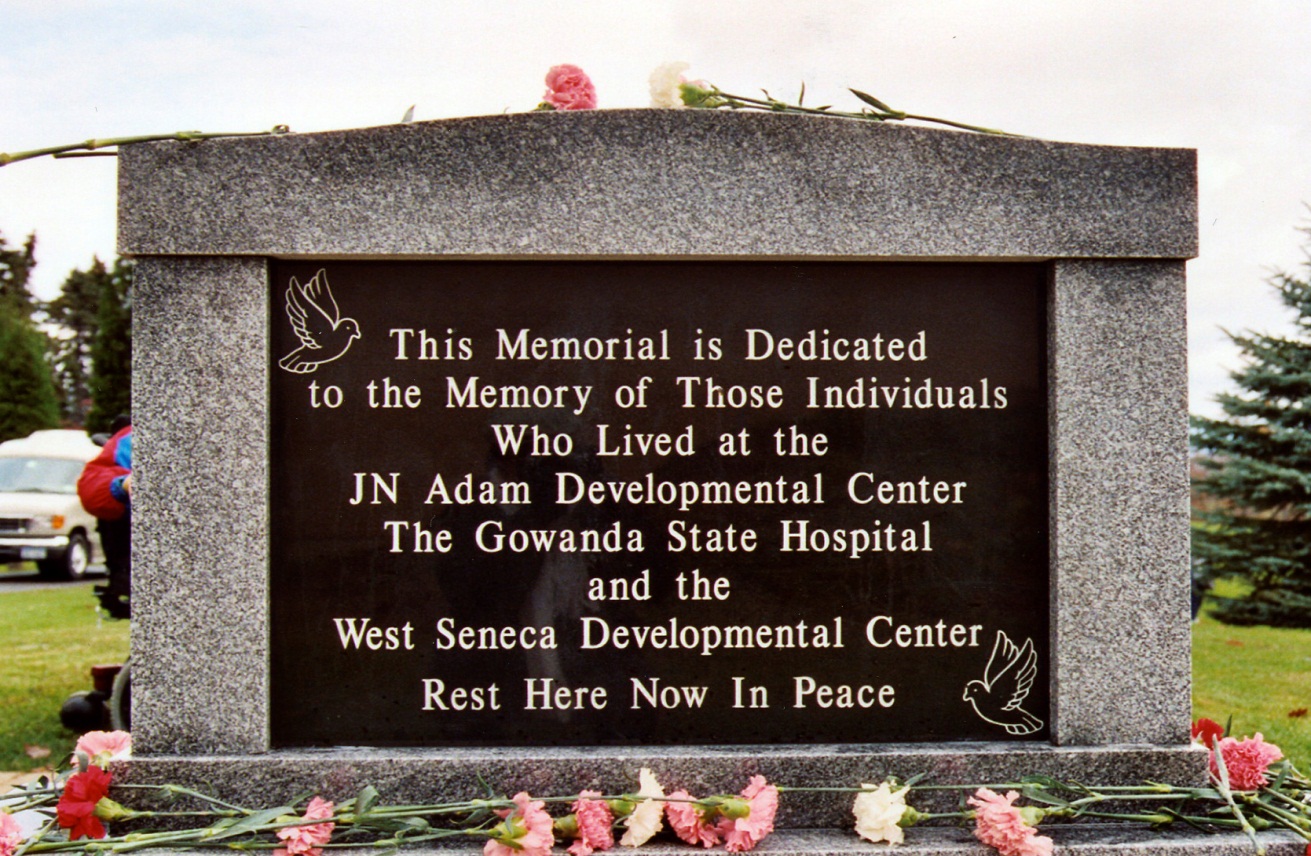
In 2006, a monument was placed in the Jolls Road Cemetery in Perrysburg. On a hillside in the cemetery, the graves of nearly four hundred residents of various state institutions were discovered. Some had small headstones but for many, there is no permanent marker. Self-Advocacy groups from Western New York planned the Ceremony of Remembrance during which the monument was unveiled.

Monument in the Jolls Road Cemetery in Perrysburg

Monument in the Jolls Road Cemetery in Perrysburg

In 2007, work began at the Gowanda Psychiatric Center Cemetery on Route 62 in Gowanda. More than five hundred grave markers were photographed and documented. They were dusted, edged, and cleaned. Community businesses provided support and officials of the Collins Correctional Facility assisted the project in numerous ways. Many markers had sunken under the ground including an entire Jewish section which contained more than thirty graves marked with the Star of David. Once all stones were accounted for and placed again on the surface, a Ceremony of Remembrance was held on a warm, breezy day. Former patients and employees of the facility joined Self-Advocacy groups, State officials, numerous People Inc. volunteers and the Superintendents of the Correctional Facility for a memorable event. The names of all those buried there were given to the Museum of disABILITY History.

Memorial Cemetery sign installed by People Inc. in 2007

Memorial Cemetery sign installed by People Inc. in 2007

In a grassy hollow along the banks of Clear Creek in Collins, volunteers spent the next three summers restoring the Wheater Road Cemetery. More than five hundred headstones were unearthed in an area which was about the size of a football field. Taking the utmost care not to damage the long buried markers, volunteers tapped the earth until they felt resistance, carefully dug around the stones and lifted them to the surface. They were washed with water and placed back on the surface. In addition, more than five hundred other grave markers were straightened and reinforced with shims or gravel. Hundreds of red tulips were planted throughout the cemetery and a heart shaped garden was constructed. A Remembrance Ceremony was held at this location as well, including a release of doves by Self-Advocates. Media attention led some families to contact the Museum of disABILITY History, which assisted them in finding the final resting places for their ancestors.

#502 in the Protestant section is unearthed in the Wheater Road Cemetery

#502 in the Protestant section is unearthed in the Wheater Road Cemetery

In 2012, the volunteers shifted focus to Niagara County and the site of the former Niagara County Almshouse. Virtually undisturbed for ninety-six years, this cemetery had just a few stones which appeared to be marking graves. Nature had literally taken over the site with thick overgrowth of grape vines, wild roses, Hawthorne trees, and poison ivy. Initially, it was very difficult to determine the boundaries of the cemetery. With community assistance and volunteer labor, the site gradually began to take shape. The volunteers cut back the vines, trimmed trees, weeded, and created a beautiful corner space in which a memorial bench was installed. In a beautiful ceremony, the names of many of those buried there were read, including the foundlings and those whose names were, “unknown.” After the ceremony, several family members inquired about their ancestors and have been provided information from the almshouse registers.

The Niagara County Almshouse Cemetery

The Niagara County Almshouse Cemetery

This summer, volunteers will assist with cleaning the marble headstones at Craig Colony Cemetery in SonyeaPeople Inc. and the Museum of disABILITY History will join with Self-Advocates from the Finger Lakes area, town historians, and, the employees of the Groveland Correctional Facility to complete yet another, fulfilling cemetery restoration.
New York State Hospitals and Custodial Institutions & Cemetery Projects.

Mental Illness & Ignorance

I am the first to admit that I didn’t have a clue about what mental illness really is, and I have never claimed to be an expert on this issue, because I am not. When I discovered that my great-grandmother was sent to Willard State Hospital at the end of her life, it made my stomach flip and I felt overwhelming sadness. I remember reading her obituary over and over again to see if I had read it correctly. I even asked myself, could there be another state hospital at Willard that wasn’t a mental institution? Did she really die there? Why was she sent there? What was her diagnoses? Before I lose your attention, let me explain who was sent to Willard so that you will no longer be uneducated, unaware, or uninformed. Anyone who was not considered “normal” was sent to Willard including the elderly with Dementia and Alzheimer’s Disease. Remember, there really were no nursing homes until the 1950s. Others were Hearing Impaired, had Developmental Disabilities, were Trauma Victims including Victims of Domestic Violence and Rape (back then they called it “Seducer’s Victim”), had PTSD (Soldier’s Heart & Shell Shock), Menopausal Women, Depression, Anxiety Disorders, Brain Injuries, Stroke Victims, Epilepsy, Neurological Disorders, Psychiatric Disorders, and some were locked up because of their sexual orientation, personal beliefs, and religious beliefs.

You have to ask yourself, why are we so ignorant on this issue? Why are we receiving the great majority of mental health information from television commercials put out by the pharmaceutical companies and Dr. Phil? God Bless Him! Why is the jail at Riker’s Island being used as the largest mental health facility in the country? This is how we used to treat the mentally ill 150 years ago. When we pay our taxes which is a huge burden on the people of New York State, we assume that the people appointed to these high paying positions are actually doing their jobs and taking care of the people they are supposed to be advocating for; those who need the most help. Obviously, this is not the case and this abuse of the public trust needs to end.

Are burial records available to the public? Yes, but you would have to sit in the town clerk’s office and pull out each record that applies to that county’s particular state hospital or custodial institution. If you post their names online, you run the risk of being charged $10,000 for each violation, or each person. It would be much easier to record this information from each institution’s burial ledgers. Is it ridiculous that the Office of Mental Health classified burial records from state facilities as medical records? Yes. Were they really protecting the identities of former patients? No. In every correspondence that I received, it was made crystal clear that this was done to protect the families because some may find it offensive. Not only has the OMH insulted families and descendants of these people who were buried in anonymous graves, they have contributed to the stigma. They need to step out of the way, focus on the living, and hand over the burial ledgers to cemetery groups and responsible volunteers who will get the job done at NO cost to the state. Our ancestors and our families have nothing to be ashamed of! That would be like being ashamed of heart disease or diabetes. Putting names on a memorial, headstone, or list, should not be offensive to anyone, unless, of course, you are ignorant.

“I Got A Name” by Jim Croce
Abused and Used – New York Times
CLICK HERE TO VIEW THE VIDEO They’re Buried Where? by Seth Voorhees

The list of these former New York State Hospitals includes but is not limited to: BinghamtonBuffaloCentral IslipDannemoraEdgewoodGowandaHudson RiverKings ParkLong IslandManhattanMatteawanMiddletownMohansicPilgrimRochesterSt. LawrenceSyracuseUtica, and Willard. The Feeble-Minded and Epileptic Custodial Institutions of New York includes but is not limited to: Craig Colony for EpilepticsLetchworth Village for Epileptics & Developmentally DisabledNewark State School for Developmentally Disabled WomenRome State School for Developmentally Disabled Adults & Children, and Syracuse State School for Developmentally Disabled Children. There may be more.

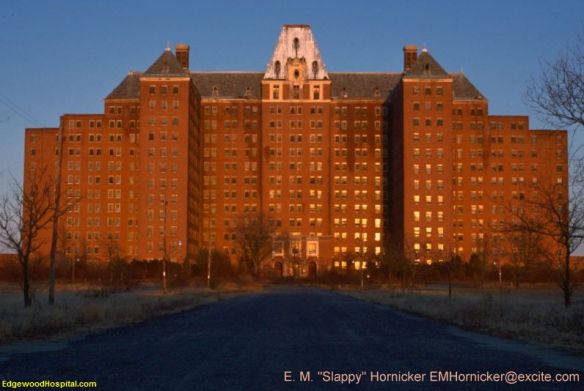
Edgewood State Hospital & Cemetery

Edgewood State Hospital (Deer Park, Long Island) & Cemetery

Edgewood State Hospital by E.M. Hornicker

Syracuse Psychiatric Hospital & Cemetery

“Having a separate psychiatric hospital in Syracuse was the idea of Herman G. Weiskotten, M.D., Dean of the Syracuse University College of Medicine. At his urging, in 1926 the New York State legislature authorized the creation of Syracuse Psychopathic Hospital on land donated by Syracuse University at the corner of Irving Avenue and Adams Street. The first patient was admitted in 1930; the first clinic was held in 1931. name changed to Syracuse Psychiatric Hospital.”

A Short History of Selected Hospitals in Syracuse

CLICK HERE TO VIEW THE VIDEO They’re Buried Where? by Seth Voorhees

THE BAD NEWS: Thousands Remain Nameless! 6.15.2015.

THE GOOD NEWS: One Man Is Remembered! 6.14.2015.

A Day at Willard Cemetery 5.18.2013

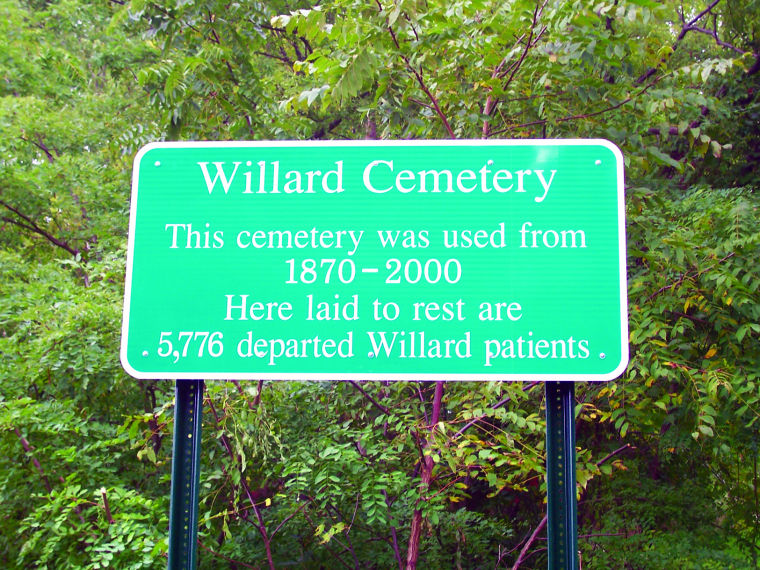
On Saturday, May 18, 2013, I visited the Willard Cemetery for a second time. This was the day of the annual Willard Tour that benefits a day care center on the old Willard property. Hundreds of people attended the tour and a good crowd gathered at the cemetery. Quite a bit has changed since my first visit on May 14, 2011, when the grass was up to my knees and no one was there but me, my husband, and two of our friends. It was a very sad place. The Willard Cemetery Memorial Project was formed by Colleen Kelly Spellecy in 2011. She has done a fabulous job organizing the group, having a sign installed at the entrance, raising awareness about the project, getting the cemetery lawn mowed, and collecting donations. I was happy to see so many concerned people at the cemetery.

Now there is hope, not only for the Willard Cemetery but for all state hospital and custodial institution cemeteries across the State of New York. A bill was introduced to the NYS Legislature in March 2012 and was re-introduced on January 18, 2013 as S2514-2013. If this bill becomes law, then the names of our forgotten ancestors will be released. They will finally be honored and remembered with dignity. This bill specifically addresses the “burial records” issue. Although HIPAA has stepped out of the way to allow individual states to release “medical records” 50 years after a patient has died, I am not sure if this issue was specifically addressed in this bill. Let’s take one step at a time and be grateful for what is in the works right now! Anyone who has ever dealt with the New York State Office of Mental Health in trying to obtain any type of information on an ancestor, whether it concerns asking where they are buried or obtaining a medical record, knows how arrogant and non-responsive they are unless you have a Ph.D. after your name. This needs to change.

Another fact that people don’t realize is that the great majority, if not all, of these historical cemeteries are “inactive” which means no one else will be buried there. I hope that ALL names are released including more recent burials. For example, when Willard closed in 1995, a gentleman was transferred to another facility. When he died in 2000, he asked to be buried in the Willard Cemetery because this was his home. Who will be here in 2050 to add this man’s name to a headstone or memorial? Who allowed these cemeteries to become forgotten?

Who was sent to Willard? Anyone who was not considered “normal” including the elderly with Dementia and Alzheimer’s Disease. Remember, there really were no nursing homes until the 1950s. Others were Hearing Impaired, had Developmental Disabilities, were Trauma Victims including Victims of Domestic Violence and Rape (back then they called it “Seducer’s Victim”), had PTSD (Soldier’s Heart & Shell Shock), Menopausal Women, Depression, Anxiety Disorders, Brain Injuries, Stroke Victims, Epilepsy, Neurological Disorders, Psychiatric Disorders, and some were locked up because of their sexual orientation, personal beliefs, and religious beliefs. These people, their families, and descendants, have nothing to be ashamed of. That would be like being ashamed of heart disease or diabetes. Putting names on a memorial, headstone, or list, should not be offensive to anyone.

Also attending the tour on this day was Seth Voorhees, Senior Reporter for the Time Warner Cable news channel YNN that serves Rochester and the Finger Lakes. Mr. Voorhees was genuinely interested in my mission to get this law passed in New York and offered me the opportunity of an interview. Although I am not a public speaker, I jumped at the chance to get the word out to a larger audience. I can’t thank him enough for all the time he spent putting this video report together. This piece aired on YNN, Saturday, May 25, 2013. I also need to thank Senator Joseph E. Robach for drafting and introducing the bill to the New York State Legislature. I hope this piece will raise awareness about the anonymous graves issue as this was never about patient confidentiality, it’s about respect.

CLICK HERE TO VIEW THE VIDEO They’re Buried Where? by Seth Voorhees.
Not Forgotten by Colleen Spellecy.

The list of these former New York State Hospitals includes but is not limited to: BinghamtonBuffaloCentral IslipDannemoraEdgewoodGowandaHudson RiverKings ParkLong IslandManhattanMatteawanMiddletownMohansicPilgrimRochesterSt. LawrenceSyracuseUtica, and Willard.

The Feeble-Minded and Epileptic Custodial Institutions of New York includes but is not limited to: Craig Colony for EpilepticsLetchworth Village for Epileptics & Developmentally DisabledNewark State School for Developmentally Disabled WomenRome State School for Developmentally Disabled Adults & Children, and Syracuse State School for Developmentally Disabled Children. There may be more.

Seth Voorhees & Lin Stuhler 5.18.2013

Seth Voorhees & Lin Stuhler 5.18.2013

Roger Luther from nysAsylum.com & Lin Stuhler 5.18.2013

Roger Luther from nysAsylum.com & Lin Stuhler 5.18.2013

Colleen Spellecy, Craig Williams, Lin Stuhler 5.18.2013

Colleen Spellecy, Craig Williams, Lin Stuhler 5.18.2013

Willard Cemetery Sign 5.18.2013

Willard Cemetery Sign 5.18.2013

Willard Cemetery Memorial Project 5.18.2013

Willard Cemetery Memorial Project 5.18.2013

Willard Cemetery 5.18.2013

Willard Cemetery 5.18.2013

Old Metal Marker 5.18.2013

Old Metal Marker 5.18.2013

Willard Cemetery 5.18.2013

Willard Cemetery 5.18.2013

This photo is of the Civil War Veterans Section of the cemetery. They were provided with clearly inscribed headstones from the government. Colleen discovered that a few of them were not “inmates” of Willard but were residents of the town. I wonder how many other United States Veterans who served their country with honor but ended up at Willard are buried here among the 5,776 in anonymous graves?

Matteawan State Hospital for Insane Criminals & Cemetery

Matteawan State Hospital for Insane Criminals – Men & Women.

1916 Matteawan State Hospital.
Beacon, Dutchess County, New York.
Matteawan State Hospital 7 Names – Find A Grave.

1. South Flank Pavilions-Matteawan

1. South Flank Pavilions-Matteawan

2. Administration Building-Matteawan

2. Administration Building-Matteawan

3. Entrance Hallway-Matteawan

3. Entrance Hallway-Matteawan

4. South Interior Court-Matteawan

4. South Interior Court-Matteawan

5. Matteawan

5. Matteawan

6. Public Kitchen-Matteawan

6. Public Kitchen-Matteawan

7. Laundry Building-Matteawan

7. Laundry Building-Matteawan

8. Boiler House and Dynamo Building-Matteawan

8. Boiler House and Dynamo Building-Matteawan

9. Front View-Matteawan

9. Front View-Matteawan

Twenty-Third Annual Report Of The Medical Superintendent Of The State Asylum For Insane Criminals, Matteawan, N.Y., For the Year Ending September 30, 1892.
[Post-Office, Fishkill-On-The-Hudson.]

OFFICERS OF THE ASYLUM 1892.
Manager:
Hon. AUSTIN LATHROP, Superintendent Of State Prisons.

Resident Officers:
H.E. ALLISON, M.D., Medical Superintendent. 

J. ELVIN COURTNEY, M.D., First Assistant Physician.
LUTHER C. JONES, M.D., Second Assistant Physician.
JAMES F. HOWELL, Steward.
R.B. LAMB, M.D., Resident Clinical Assistant.

REPORT.
Hon. Austin Lathrop, Superintendent of State Prisons:

Sir.— The following pages which, in accordance with the statute, I have the honor to submit, constitute the first annual report issued from this new institution, which was created by act of the Legislature for the relief of the overcrowded asylum at Auburn, and is the thirty-third of a series presented annually since the original establishment of the State Asylum for Insane Criminals.

This new hospital structure of modern architecture, commandingly situated and furnished with every convenience for the care of its inmates, was occupied during the latter part of April of the present year; the first patients having been received by transfer from Auburn on the twenty-fifth of that month. The entire population of the Auburn asylum, a total of 261 patients, were moved into their present quarters and the new asylum organized and put in operation within a period of five days. Fortunately the transfer was made safely, without the slightest accident or any attempt at escape. The buildings and grounds at Auburn, which were occupied for more than thirty years, are now entirely relinquished, and the oldest of asylums for insane criminals is domiciled in these new quarters as its permanent abode.

Owing to the increased accommodations afforded by the opening of these new buildings, we have been able to provide for those patients who had, up to this time, been retained in the various State hospitals awaiting transfer to our custody, and who had previously been refused admission to Auburn for the lack of room. Because of this large and rapid influx the total number of admissions has more than doubled that of any previous year. During the year the various courts of the State have also, to a larger extent than heretofore, committed patients to this asylum directly. The practice, however, still exists of sending patients charged with crime to the general hospitals of the insane, where their presence is objectionable, and whence they are transferred to us under the provisions of chapter 515, Laws of 1884; the superintendents of the various State hospitals applying under this law to justices of the Supreme Court for orders permitting such transfers. We hope, when the scope and character of this institution become more widely known, that commitments in the future will be made to us directly in all cases where the plea of insanity prevails as a defense for criminal acts. It is the purpose of this hospital to care for all insane persons competed or unconvicted, who are charged with crime, whether the disease of insanity is known to exist at the time of arraignment or trial, or subsequently develops while undergoing sentence.”

SOURCE: Documents of the Assembly of the State of New York, One Hundred and Sixteenth Session, 1893, Volume I, Nos. 1 to 6, Inclusive, Albany: James B. Lyon, State Printer, 1893. Pages 203-208.

CLICK HERE TO VIEW THE VIDEO They’re Buried Where? by Seth Voorhees

THE BAD NEWS: Thousands Remain Nameless! 6.15.2015.

THE GOOD NEWS: One Man Is Remembered! 6.14.2015.

Dannemora State Hospital / Prison & Cemetery

Dannemora State Hospital was a state hospital prison.

1916 Dannemora State Hospital.
Dannemora State Hospital Cemetery – Find A Grave.
Photos Of Dannemora – Zach Babbie.
The Village Of Dannemora.

Dannemora 1875 - Clinton Prison - Zach Babbie

Dannemora 1875 – Clinton Prison – Zach Babbie

 It appears that Dannemora State Hospital Cemetery (Clinton Prison) had inscribed headstones. The following link may be an incomplete list.
Dannemora State Hospital Cemetery – Find A Grave.

Clinton Prison 1892 - Zach Babbie

Clinton Prison 1892 – Zach Babbie

 CLICK HERE TO VIEW THE VIDEO They’re Buried Where? by Seth Voorhees

THE BAD NEWS: Thousands Remain Nameless! 6.15.2015.

THE GOOD NEWS: One Man Is Remembered! 6.14.2015.