1879 Dutchess County Alms-House – Poughkeepsie, NY

A DISGRACE TO DUTCHESS COUNTY. MISERABLE CONDITION OF THE ALMS-HOUSE-THE SUPERVISORS AND SUPERINTENDENT AT LOGGERHEADS.

POUGHKEEPSIE, N.Y., Dec. 14. – The Board of Supervisors visited the Dutchess County Alms-house on Friday, and found a good many things which common humanity and decency require should be at once remedied. every room and hall in the buildings was examined. A committee appointed by a previous Board of Supervisors spent $700 out of an appropriation of $1,000 in making certain improvements. but they only began a work which ought to be speedily finished. They put new floors in the hallways and 110 pairs of blinds on the windows. Friday’s inspection showed that the floors in every room are worn out, and have been for years. Strips of tin and zinc have been nailed over the cracks here and there to keep the cold out, and in some of the rooms and hallways portions of the walls have fallen. The window-panes are cracked and broken everywhere. The rooms are supplied with dilapidated wooden bedsteads of the commonest sort, which are so unclean that they are fit only to be thrown into a bonfire. Six of these beds are in one room. There are 25 new iron bedsteads stored in the building, with new mattresses, which have never been used. The kitchen is in the basement of the main building, and is so poorly ventilated that the odors from the cooking penetrate everywhere, and often make the atmosphere noisome. The garret of the main building is a miserable death-trap. Across the centre runs a partition, and 17 beds are under the low-peaked roof in the east end. A narrow, ill-contrived stairway furnishes the only exit from this man-hole. Let a fire once break out on the floors below, and the 25 or 30 paupers who usually huddle about the steam-pipes would stand very little chance of getting out alive. In the day-time this miserable room is lighted by one window in the east end. At night the light is furnished by a single candle fastened to the centre of an iron rod, which crosses the room over the heads of the occupants. The partition should be ripped out, three dormer windows should be built on each side, and substantial fire-escapes should be put up at the east and west ends. It is criminal recklessness to house the paupers in the garret as it is now.

Near the main building stands what is called the “insane building.” It needs a thorough overhauling. The “rooms” it contains are little better than wooden cells. Sliding doors separate these cells from a narrow corridor, and in each door is a small aperture through which food was formerly passed to the insane inmates. In some of these cells are two and three beds, and all the wood-work is impregnated with foul odors. New floors were put in the cells last season, but the whole affair needs to be rebuilt, and good rooms put where the cells now are. The chapel building is mainly occupied by the keeper and his family. It ought to be converted into a hospital and infirmary. The chapel could be left as it is, and at least 12 good rooms built for the use of the sick paupers. Another greatly needed improvement is a new boiler for the engine. The one now in use was put in 19 years ago, and it was only a second-hand boiler then. In its present condition it is liable to explode at any moment.

To this disgraceful condition of affairs is to be added the present commingling of the sexes. There is nothing to separate them in either the buildings or yards. They ought to be separated, and to do so need not be a difficult task. Proper fencing is all that is required in the yards. The keeper’s quarters should be removed from the chapel building to rooms in the centre of the main building. The male inmates could then be assigned to apartments in one end of the building, and the females placed in the other end. Proper partitions and doors could be easily built to divide the building in this way. The total expense in making all the necessary improvements is estimated at the very small sum of $1.500.

One thing that has helped to bring about the present disgusting state of affairs at the Alms-house is the lack of harmony between Superintendent Ladue and the Board of Supervisors. The committees of 1878 and of this year complain of the Superintendent for his refusal to carry out their suggestions, and say that had he done so many of the present evils would not exist. The committee of 1878 built an additional stairway at the west end of the building, but lath has been nailed across the exit and the stairway closed. The new iron bedsteads purchased this year have not been put in use by the Superintendent, nor have the new mattresses. Some of the latter still remain in the store where they were purchased. Other shortcomings of the same sort are charged against him by the Supervisors, and it is hoped that when the new Superintendent takes office he will make a beneficial change.

There are now 130 inmates in the Alms-house, but cold weather will probably increase the number to 150. At this time last year there were 180 inmates. Only one insane person is among the inmates, 10 incurable cases having been sent to the Willard Asylum during the past season.

SOURCE: The New York Times, Published: December 15, 1879, Copyright @ The New York Times.

UPDATE Craig Colony Cemetery

The volunteers of People Inc. and the Museum of disABILITY History will be cleaning up the Craig Colony for Epileptics Cemetery and the white marble engraved headstones this summer as part of the nationwide movement Operation Dignity to restore local institutional cemeteries. The fact that there are headstones and that they are engraved with the patients’ name is rare. The names of the 2,274 people buried in this cemetery can be found at Find A Grave. The following photographs were taken and sent to me by David Mack-Hardiman, Director of Training, People Inc. To volunteer, please contact David Mack-Hardiman at: dmack@people-inc.org.

We still need this bill to pass! Please call or write a letter to your state senator and tell them that you support this bill! S2514-2013 – NY Senate Open Legislation – Relates to patients interred at state mental health hospital cemeteries – New York State Senate.

Craig Colony 1 - 6.2013

Craig Colony 1 – 6.2013

Craig Colony 2 - 6.2013

Craig Colony 2 – 6.2013

Craig Colony 3 - 6.2013

Craig Colony 3 – 6.2013

Craig Colony 4 - 6.2013

Craig Colony 4 – 6.2013

Craig Colony 5 - 6.2013

Craig Colony 5 – 6.2013

Craig Colony 6 - 6.2013

Craig Colony 6 – 6.2013

Craig Colony 7 - 6.2013

Craig Colony 7 – 6.2013

Craig Colony 8 - 6.2013

Craig Colony 8 – 6.2013

Mental Illness & Ignorance

I am the first to admit that I didn’t have a clue about what mental illness really is, and I have never claimed to be an expert on this issue, because I am not. When I discovered that my great-grandmother was sent to Willard State Hospital at the end of her life, it made my stomach flip and I felt overwhelming sadness. I remember reading her obituary over and over again to see if I had read it correctly. I even asked myself, could there be another state hospital at Willard that wasn’t a mental institution? Did she really die there? Why was she sent there? What was her diagnoses? Before I lose your attention, let me explain who was sent to Willard so that you will no longer be uneducated, unaware, or uninformed. Anyone who was not considered “normal” was sent to Willard including the elderly with Dementia and Alzheimer’s Disease. Remember, there really were no nursing homes until the 1950s. Others were Hearing Impaired, had Developmental Disabilities, were Trauma Victims including Victims of Domestic Violence and Rape (back then they called it “Seducer’s Victim”), had PTSD (Soldier’s Heart & Shell Shock), Menopausal Women, Depression, Anxiety Disorders, Brain Injuries, Stroke Victims, Epilepsy, Neurological Disorders, Psychiatric Disorders, and some were locked up because of their sexual orientation, personal beliefs, and religious beliefs.

You have to ask yourself, why are we so ignorant on this issue? Why are we receiving the great majority of mental health information from television commercials put out by the pharmaceutical companies and Dr. Phil? God Bless Him! Why is the jail at Riker’s Island being used as the largest mental health facility in the country? This is how we used to treat the mentally ill 150 years ago. When we pay our taxes which is a huge burden on the people of New York State, we assume that the people appointed to these high paying positions are actually doing their jobs and taking care of the people they are supposed to be advocating for; those who need the most help. Obviously, this is not the case and this abuse of the public trust needs to end.

Are burial records available to the public? Yes, but you would have to sit in the town clerk’s office and pull out each record that applies to that county’s particular state hospital or custodial institution. If you post their names online, you run the risk of being charged $10,000 for each violation, or each person. It would be much easier to record this information from each institution’s burial ledgers. Is it ridiculous that the Office of Mental Health classified burial records from state facilities as medical records? Yes. Were they really protecting the identities of former patients? No. In every correspondence that I received, it was made crystal clear that this was done to protect the families because some may find it offensive. Not only has the OMH insulted families and descendants of these people who were buried in anonymous graves, they have contributed to the stigma. They need to step out of the way, focus on the living, and hand over the burial ledgers to cemetery groups and responsible volunteers who will get the job done at NO cost to the state. Our ancestors and our families have nothing to be ashamed of! That would be like being ashamed of heart disease or diabetes. Putting names on a memorial, headstone, or list, should not be offensive to anyone, unless, of course, you are ignorant.

“I Got A Name” by Jim Croce
Abused and Used – New York Times
CLICK HERE TO VIEW THE VIDEO They’re Buried Where? by Seth Voorhees

The list of these former New York State Hospitals includes but is not limited to: BinghamtonBuffaloCentral IslipDannemoraEdgewoodGowandaHudson RiverKings ParkLong IslandManhattanMatteawanMiddletownMohansicPilgrimRochesterSt. LawrenceSyracuseUtica, and Willard. The Feeble-Minded and Epileptic Custodial Institutions of New York includes but is not limited to: Craig Colony for EpilepticsLetchworth Village for Epileptics & Developmentally DisabledNewark State School for Developmentally Disabled WomenRome State School for Developmentally Disabled Adults & Children, and Syracuse State School for Developmentally Disabled Children. There may be more.

Edgewood State Hospital & Cemetery

Edgewood State Hospital (Deer Park, Long Island) & Cemetery

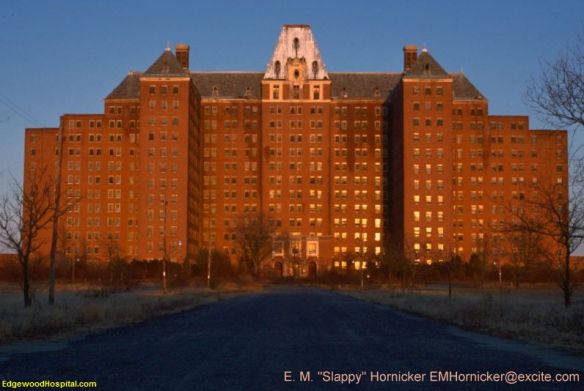
Edgewood State Hospital by E.M. Hornicker

Syracuse Psychiatric Hospital & Cemetery

“Having a separate psychiatric hospital in Syracuse was the idea of Herman G. Weiskotten, M.D., Dean of the Syracuse University College of Medicine. At his urging, in 1926 the New York State legislature authorized the creation of Syracuse Psychopathic Hospital on land donated by Syracuse University at the corner of Irving Avenue and Adams Street. The first patient was admitted in 1930; the first clinic was held in 1931. name changed to Syracuse Psychiatric Hospital.”

A Short History of Selected Hospitals in Syracuse

CLICK HERE TO VIEW THE VIDEO They’re Buried Where? by Seth Voorhees

THE BAD NEWS: Thousands Remain Nameless! 6.15.2015.

THE GOOD NEWS: One Man Is Remembered! 6.14.2015.

A Day at Willard Cemetery 5.18.2013

On Saturday, May 18, 2013, I visited the Willard Cemetery for a second time. This was the day of the annual Willard Tour that benefits a day care center on the old Willard property. Hundreds of people attended the tour and a good crowd gathered at the cemetery. Quite a bit has changed since my first visit on May 14, 2011, when the grass was up to my knees and no one was there but me, my husband, and two of our friends. It was a very sad place. The Willard Cemetery Memorial Project was formed by Colleen Kelly Spellecy in 2011. She has done a fabulous job organizing the group, having a sign installed at the entrance, raising awareness about the project, getting the cemetery lawn mowed, and collecting donations. I was happy to see so many concerned people at the cemetery.

Now there is hope, not only for the Willard Cemetery but for all state hospital and custodial institution cemeteries across the State of New York. A bill was introduced to the NYS Legislature in March 2012 and was re-introduced on January 18, 2013 as S2514-2013. If this bill becomes law, then the names of our forgotten ancestors will be released. They will finally be honored and remembered with dignity. This bill specifically addresses the “burial records” issue. Although HIPAA has stepped out of the way to allow individual states to release “medical records” 50 years after a patient has died, I am not sure if this issue was specifically addressed in this bill. Let’s take one step at a time and be grateful for what is in the works right now! Anyone who has ever dealt with the New York State Office of Mental Health in trying to obtain any type of information on an ancestor, whether it concerns asking where they are buried or obtaining a medical record, knows how arrogant and non-responsive they are unless you have a Ph.D. after your name. This needs to change.

Another fact that people don’t realize is that the great majority, if not all, of these historical cemeteries are “inactive” which means no one else will be buried there. I hope that ALL names are released including more recent burials. For example, when Willard closed in 1995, a gentleman was transferred to another facility. When he died in 2000, he asked to be buried in the Willard Cemetery because this was his home. Who will be here in 2050 to add this man’s name to a headstone or memorial? Who allowed these cemeteries to become forgotten?

Who was sent to Willard? Anyone who was not considered “normal” including the elderly with Dementia and Alzheimer’s Disease. Remember, there really were no nursing homes until the 1950s. Others were Hearing Impaired, had Developmental Disabilities, were Trauma Victims including Victims of Domestic Violence and Rape (back then they called it “Seducer’s Victim”), had PTSD (Soldier’s Heart & Shell Shock), Menopausal Women, Depression, Anxiety Disorders, Brain Injuries, Stroke Victims, Epilepsy, Neurological Disorders, Psychiatric Disorders, and some were locked up because of their sexual orientation, personal beliefs, and religious beliefs. These people, their families, and descendants, have nothing to be ashamed of. That would be like being ashamed of heart disease or diabetes. Putting names on a memorial, headstone, or list, should not be offensive to anyone.

Also attending the tour on this day was Seth Voorhees, Senior Reporter for the Time Warner Cable news channel YNN that serves Rochester and the Finger Lakes. Mr. Voorhees was genuinely interested in my mission to get this law passed in New York and offered me the opportunity of an interview. Although I am not a public speaker, I jumped at the chance to get the word out to a larger audience. I can’t thank him enough for all the time he spent putting this video report together. This piece aired on YNN, Saturday, May 25, 2013. I also need to thank Senator Joseph E. Robach for drafting and introducing the bill to the New York State Legislature. I hope this piece will raise awareness about the anonymous graves issue as this was never about patient confidentiality, it’s about respect.

CLICK HERE TO VIEW THE VIDEO They’re Buried Where? by Seth Voorhees.
Not Forgotten by Colleen Spellecy.

The list of these former New York State Hospitals includes but is not limited to: BinghamtonBuffaloCentral IslipDannemoraEdgewoodGowandaHudson RiverKings ParkLong IslandManhattanMatteawanMiddletownMohansicPilgrimRochesterSt. LawrenceSyracuseUtica, and Willard.

The Feeble-Minded and Epileptic Custodial Institutions of New York includes but is not limited to: Craig Colony for EpilepticsLetchworth Village for Epileptics & Developmentally DisabledNewark State School for Developmentally Disabled WomenRome State School for Developmentally Disabled Adults & Children, and Syracuse State School for Developmentally Disabled Children. There may be more.

Seth Voorhees & Lin Stuhler 5.18.2013

Seth Voorhees & Lin Stuhler 5.18.2013

Roger Luther from nysAsylum.com & Lin Stuhler 5.18.2013

Roger Luther from nysAsylum.com & Lin Stuhler 5.18.2013

Colleen Spellecy, Craig Williams, Lin Stuhler 5.18.2013
Colleen Spellecy, Craig Williams, Lin Stuhler 5.18.2013

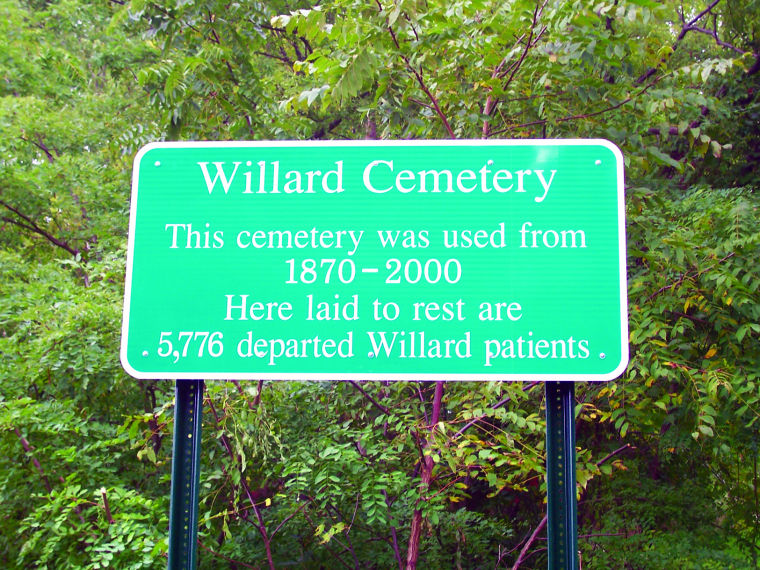
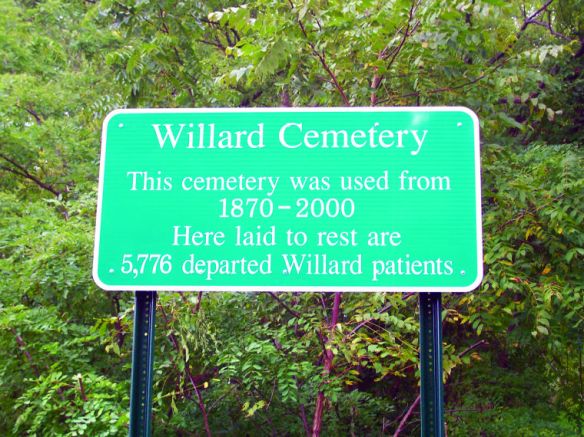
Willard Cemetery Sign 5.18.2013

Willard Cemetery Sign 5.18.2013

Willard Cemetery Memorial Project 5.18.2013
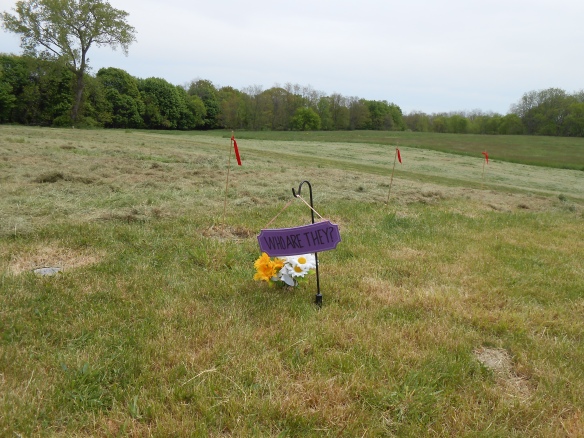
Willard Cemetery Memorial Project 5.18.2013

Willard Cemetery 5.18.2013

Willard Cemetery 5.18.2013

Old Metal Marker 5.18.2013
Old Metal Marker 5.18.2013

Willard Cemetery 5.18.2013

Willard Cemetery 5.18.2013

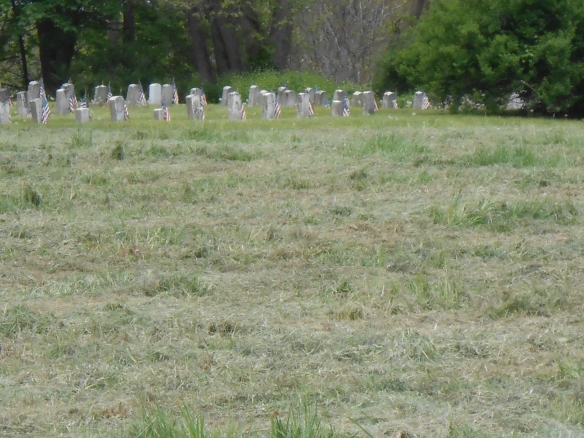
This photo is of the Civil War Veterans Section of the cemetery. They were provided with clearly inscribed headstones from the government. Colleen discovered that a few of them were not “inmates” of Willard but were residents of the town. I wonder how many other United States Veterans who served their country with honor but ended up at Willard are buried here among the 5,776 in anonymous graves?

Matteawan State Hospital for Insane Criminals & Cemetery

Matteawan State Hospital for Insane Criminals – Men & Women.

1916 Matteawan State Hospital.
Beacon, Dutchess County, New York.
Matteawan State Hospital 7 Names – Find A Grave.

1. South Flank Pavilions-Matteawan

1. South Flank Pavilions-Matteawan

2. Administration Building-Matteawan

2. Administration Building-Matteawan

3. Entrance Hallway-Matteawan

3. Entrance Hallway-Matteawan

4. South Interior Court-Matteawan

4. South Interior Court-Matteawan

5. Matteawan

5. Matteawan

6. Public Kitchen-Matteawan

6. Public Kitchen-Matteawan

7. Laundry Building-Matteawan

7. Laundry Building-Matteawan

8. Boiler House and Dynamo Building-Matteawan

8. Boiler House and Dynamo Building-Matteawan

9. Front View-Matteawan

9. Front View-Matteawan

Twenty-Third Annual Report Of The Medical Superintendent Of The State Asylum For Insane Criminals, Matteawan, N.Y., For the Year Ending September 30, 1892.
[Post-Office, Fishkill-On-The-Hudson.]

OFFICERS OF THE ASYLUM 1892.
Manager:
Hon. AUSTIN LATHROP, Superintendent Of State Prisons.

Resident Officers:
H.E. ALLISON, M.D., Medical Superintendent. 

J. ELVIN COURTNEY, M.D., First Assistant Physician.
LUTHER C. JONES, M.D., Second Assistant Physician.
JAMES F. HOWELL, Steward.
R.B. LAMB, M.D., Resident Clinical Assistant.

REPORT.
Hon. Austin Lathrop, Superintendent of State Prisons:

Sir.— The following pages which, in accordance with the statute, I have the honor to submit, constitute the first annual report issued from this new institution, which was created by act of the Legislature for the relief of the overcrowded asylum at Auburn, and is the thirty-third of a series presented annually since the original establishment of the State Asylum for Insane Criminals.

This new hospital structure of modern architecture, commandingly situated and furnished with every convenience for the care of its inmates, was occupied during the latter part of April of the present year; the first patients having been received by transfer from Auburn on the twenty-fifth of that month. The entire population of the Auburn asylum, a total of 261 patients, were moved into their present quarters and the new asylum organized and put in operation within a period of five days. Fortunately the transfer was made safely, without the slightest accident or any attempt at escape. The buildings and grounds at Auburn, which were occupied for more than thirty years, are now entirely relinquished, and the oldest of asylums for insane criminals is domiciled in these new quarters as its permanent abode.

Owing to the increased accommodations afforded by the opening of these new buildings, we have been able to provide for those patients who had, up to this time, been retained in the various State hospitals awaiting transfer to our custody, and who had previously been refused admission to Auburn for the lack of room. Because of this large and rapid influx the total number of admissions has more than doubled that of any previous year. During the year the various courts of the State have also, to a larger extent than heretofore, committed patients to this asylum directly. The practice, however, still exists of sending patients charged with crime to the general hospitals of the insane, where their presence is objectionable, and whence they are transferred to us under the provisions of chapter 515, Laws of 1884; the superintendents of the various State hospitals applying under this law to justices of the Supreme Court for orders permitting such transfers. We hope, when the scope and character of this institution become more widely known, that commitments in the future will be made to us directly in all cases where the plea of insanity prevails as a defense for criminal acts. It is the purpose of this hospital to care for all insane persons competed or unconvicted, who are charged with crime, whether the disease of insanity is known to exist at the time of arraignment or trial, or subsequently develops while undergoing sentence.”

SOURCE: Documents of the Assembly of the State of New York, One Hundred and Sixteenth Session, 1893, Volume I, Nos. 1 to 6, Inclusive, Albany: James B. Lyon, State Printer, 1893. Pages 203-208.

CLICK HERE TO VIEW THE VIDEO They’re Buried Where? by Seth Voorhees

THE BAD NEWS: Thousands Remain Nameless! 6.15.2015.

THE GOOD NEWS: One Man Is Remembered! 6.14.2015.

Dannemora State Hospital / Prison & Cemetery

Dannemora State Hospital was a state hospital prison.

1916 Dannemora State Hospital.
Dannemora State Hospital Cemetery – Find A Grave.
Photos Of Dannemora – Zach Babbie.
The Village Of Dannemora.

Dannemora 1875 - Clinton Prison - Zach Babbie

Dannemora 1875 – Clinton Prison – Zach Babbie

 It appears that Dannemora State Hospital Cemetery (Clinton Prison) had inscribed headstones. The following link may be an incomplete list.
Dannemora State Hospital Cemetery – Find A Grave.

Clinton Prison 1892 - Zach Babbie

Clinton Prison 1892 – Zach Babbie

 CLICK HERE TO VIEW THE VIDEO They’re Buried Where? by Seth Voorhees

THE BAD NEWS: Thousands Remain Nameless! 6.15.2015.

THE GOOD NEWS: One Man Is Remembered! 6.14.2015.

Syracuse State School & Cemetery

Syracuse State School – New York State Custodial Institution for Intellectually Disabled Children. The children who died at the Syracuse State School are buried at Oakwood Cemetery in Syracuse, New York.

1916 Syracuse State Custodial Institution For Feeble-Minded Children.

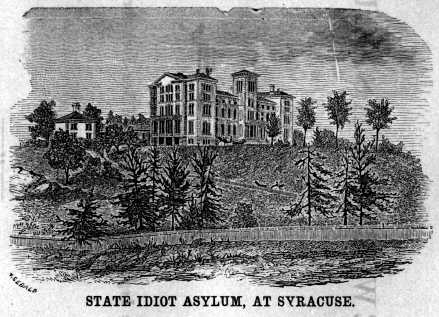
State Idiot Asylum at Syracuse 1858

State Idiot Asylum at Syracuse 1858

“AN ACT making an appropriation for the purchase of grounds for burial purposes for the use of the Syracuse State Institution for Feeble-Minded Children. Became a law February 11, 1896, with the approval of the Governor. Passed by a two-thirds vote. The People of the State of New York, represented in Senate and Assembly, do enact as follows: Section 1. The trustees of the Syracuse State Institution for Feeble-Minded Children are hereby authorized to purchase sufficient grounds, in Oakwood cemetery, at Syracuse, for the burial of four hundred and eight of such inmates of the institution as may die while residing therein; and the sum of nineteen hundred and fifty-eight dollars and forty cents, or so much thereof as may be necessary, is hereby appropriated out of any money in the treasury belonging to the general fund, not otherwise appropriated, payable to the order of the treasurer of the institution, for carrying out the purposes of his act; subject to the approval of the comptroller as to the value of the grounds, and of the attorney-general as to the form and terms of the conveyance thereof. § 2. This act shall take effect immediately.”
SOURCE: General Laws of the State of New York, Volume I, Chapter 16, Page 10, One Hundred Nineteenth Session, January 1, 1896 – April 30, 1896, Google Books

The New York State Asylum for Idiots was authorized by the New York State Legislature in 1851, acting upon a recommendation contained in the 1846 annual report of the New York State Asylum for Lunatics. Hervey B. Wilbur, M.D., was appointed the first superintendent and remained in that position until his death in 1883. First located on rented land in Albany, it admitted its first ‘pupils’ in 1851. The cornerstone was laid in 1854 for a new building in Syracuse, and the institution removed to Syracuse in 1855. After 1855 it was generally known as either the New York Asylum for Idiots or just the State Idiot Asylum, but in 1891 it was officially renamed the Syracuse State Institution for Feeble-Minded Children. In 19?? the name was changed to The Syracuse State Institution for Feeble-Minded Children, and later became just the Syracuse State School. Wilbur collaborated with Edward Seguin, M.D., the originator of the physiological method of training. Maria Montessori was also Seguin’s student and much of the ‘Montessori Method‘ is based on foundations laid by Wilbur and Seguin in Syracuse. In its 85th annual report (1935), the Syracuse State School rightly noted that it was ‘the pioneer institution in the United States for the care and training of mentally deficient children.’ Surgery was done in the old building, and at least one child was born there. The School also operated a farm and a number of satellite cottages. In the 1970s, the Syracuse State School building was torn down and replaced by a residential facility called the Syracuse Developmental Center. With the growing emphasis on community living rather than institutionalization for developmentally disabled persons, no new individuals were placed at SDC and there has been a gradual movement of residents into the community. In early 1998, there were about six persons left. SDC is to be closed, and it is not clear what will happen to the building.”
SOURCE: Upstate Medical University, Health Sciences Library, A Short History of Selected Hospitals in Syracuse

Syracuse State Institution for Feeble-Minded Children

Syracuse State Institution for Feeble-Minded Children

Photograph courtesy of The Museum of disABILITY History

“The first of these institutions, The New York State Asylum for Idiots, was established near Albany in 1851. The idea for such a school had originally been proposed in 1846 by senator Frederick F. Backus, a physician from Rochester. However, because many legislators reserved skepticism about the educability of ‘idiots’ and had concerns over the cost of such an experiment, the measure took five years to pass. These doubts proved to be unfounded, for the students achieved such favorable progress that the school’s Board of Trustees declared, in 1853, that the experiment had ‘entirely and fully succeeded.’ The legislature responded by funding the construction of a new building, which opened in 1855. This building, located in Syracuse, was the first in the United States designed specifically for children with developmental disabilities. Under the dedicated leadership of Dr. Hervey Backus Wilbur, superintendent for the initial thirty-two years of operation, this institution provided inspiration to many other states seeking to establish similar schools of their own.”
SOURCE: Museum Of disABILITY History, Early State Schools in New York by Thomas Stearns, Contributor.

Account of the ceremonies at the laying of the corner-stone of the New York Asylum for Idiots: at Syracuse, September 8, 1854.

Seventh Annual Report of the New-York Asylum for Idiots to the Legislature of the State of New York 1858.

CLICK HERE TO VIEW THE VIDEO They’re Buried Where? by Seth Voorhees

THE BAD NEWS: Thousands Remain Nameless! 6.15.2015.

THE GOOD NEWS: One Man Is Remembered! 6.14.2015.

Rome State School & Cemetery

New York State Custodial Institution at Rome for Intellectually Disabled Children and Adults.

1916 Rome State Custodial Institution For Feeble-Minded Children.
Rome Developmental Center Cemetery Names.
Rome State Custodial Asylum Map.

Rome State School

Rome State School

Photograph courtesy of The Museum of disABILITY History

“Although the initial purpose was essentially eugenic in nature, the scope of the institution expanded over the years. Educational training and independent living became central aspects, and several colony homes were established. The New York State Custodial Asylum for Un-Teachable Idiots was established in 1893 to address the growing public need for increased custodial provisions for ‘idiots’ deemed beyond the reach of education.  However, the staff soon realized that these individuals were capable of far more than the name of their institution implied. Led by Superintendent Charles Bernstein, the Board of Managers assumed a philosophy that focused on the recognition that people with disabilities “have a right to experiences and opportunities equivalent to those available to all other citizens.” Over fifty colony homes were established during Dr. Bernstein’s forty year superintendence, providing the people in attendance with many opportunities to live and work in the community.”

Rome Developmental Cemetery – This cemetery appears to be well maintained.
Annual Report of the Board of Managers of the Rome State …, Volumes 1-12.

CLICK HERE TO VIEW THE VIDEO They’re Buried Where? by Seth Voorhees

THE BAD NEWS: Thousands Remain Nameless! 6.15.2015.

THE GOOD NEWS: One Man Is Remembered! 6.14.2015.