1907 Eugenics

The mid-nineteenth century was the dawn of scientific thought and research concerning evolution and the human condition. Three men made an influential mark in history with their provocative theories which are still debated today. These men were: Charles Darwin, “natural selection;” Herbert Spencer, “survival of the fittest;” and Sir Francis Galton, “nature versus nurture.” Galton invented the term “eugenics.” Eugenics is the science of selective breeding in order to manipulate the gene pool and improve the human race. In other words, only certain members of society should be allowed to procreate. One of the goals of the Eugenics Movement was to rid the United States of the dregs of society: the defective, dependent, and delinquent classes by means of forced sterilization.

15 states enacted Eugenics legislation in America: Indiana, Washington, California, Connecticut, Nevada, Iowa, New Jersey, New York, North Dakota, Michigan, Kansas, Wisconsin, Nebraska, Oregon, and South Dakota. Eugenics began on March 9, 1907, with Indiana being the first state to enact a law, and ended on December 13, 1921, with Oregon proving the law unconstitutional. But that wasn’t the end. Wisconsin’s law was still active on January 1, 1922. From 1913 to January 1, 1921, the state of Wisconsin performed 76 forced sterilizations on inmates at the Home for Feeble-Minded at Chippewa Falls: 15 males (Vasectomy); and 61 females (Salpingectomy).

New York State passed a Eugenics Law on April 16, 1912, Chapter 445; Declared Unconstitutional by the Supreme Court of Albany County, March 5, 1918, and by Appellate Division July 1, 1918; and Repealed by the State Legislature, May 10, 1920. Forty-two operations were performed in the State of New York “while the statute was in force, but none of them was performed under this statute; all were performed by special arrangement with the patients and their families under the laws and customs governing ordinary surgical operations.” An agreement was made between the inmate who was targeted for sterilization and the inmate’s family, for permission to perform the needed operation that would make the life of their loved one more comfortable, leaving them to lead a productive, “normal” life. One vasectomy (1) was performed at the Auburn State Prison; twelve salpingectomies (2) at the Buffalo State Hospital; and twenty-four salpingectomies (2) and five ovariotomies (3) by the Gowanda State Hospital at Collins. Buffalo State Hospital opened in December 1880 and Gowanda State Homeopathic Hospital (Collins Farm) opened on August 9, 1898. Both were for the care of the mentally ill and were located in Erie County, New York.

These are the people mentioned in the book as being considered for sterilization and/or involved in litigation. According to my research, none of them were sterilized, with the possible exception of Peter Feilen.

Washington:
Peter Feilen, convicted rapist, inmate; ordered vasectomy, Washington State Penitentiary Walla Walla.

William Henry Harrison, inmate; ordered vasectomy, Washington State Penitentiary Walla Walla.

John Hill, inmate (stole hams for his family); ordered vasectomy, Yakima County, Washington.

Chris McCauley, alias Harry Taylor, inmate; ordered vasectomy, State Reformatory, Monroe, Washington. Formerly at Washington State Penitentiary Walla Walla.

New Jersey:
Alice Smith, epileptic: ordered salpingectomy; State Village for Epileptics at Skillman.

Iowa:
Rudolph Davis, twice convicted of felony; ordered vasectomy; Penitentiary at Fort Madison.

New York:
Frank Osborn, feeble-minded; ordered vasectomy; Rome State Custodial Asylum.

Nevada:
Pearley C. Mickle or Mickie, convict; ordered vasectomy, Elko County.

Michigan:
Nora Reynolds, inmate; ordered sterilization, Michigan Home and Training School at Lapeer.

Oregon:
Jacob Cline, convict; ordered sterilization, Oregon State Penitentiary.

ALL of this information was taken from the book Eugenical Sterilization in the Untied States by Harry Hamilton Laughlin.

Fountain Of The Ages by Charles Haag

Fountain Of The Ages by Charles Haag

Keep The Life Stream Pure

Introduction
Dr. Harry H. Laughlin
, Eugenics Associate of the Psychopathic Laboratory of the Municipal Court of Chicago, and Eugenics Director of Carnegie Institution of Washington, Cold Springs Harbor, N. Y., has rendered the nation a signal service in the preparation of this work, “Eugenical Sterilization in the United States.”

Since the rediscovery of Mendel’s Law of Heredity and the recent advances made by the biologists and psychopathologists in respect to the causes of mental and physical defects in the human race, with the consequent revelation of the great role played by heredity as a producing cause, the science of eugenics has become of vital importance.

“Eugenics,” says Professor Irving Fisher, “stands against the forces which work for racial deterioration, and for improvement and vigor, intelligence and moral fiber of the human race. It represents the highest form of patriotism and humanitarianism, while at the same time it offers immediate advantages to ourselves and to our children. By eugenic measures, for instance, our burden of taxes can be reduced by decreasing the number of degenerates, delinquents and defectives supported in public institutions; such measures will also increase safeguards against crimes committed against our persons or our property.”

America, in particular, needs to protect herself against indiscriminate immigration, criminal degenerates, and race suicide.

The success of democracy depends upon the quality of its individual elements. If in these elements the racial values are high, government will be equal to all the economic, educational, religious and scientific demands of the times. If, on the contrary, there is a constant and progressive racial degeneracy, it is only a question of time when popular self-government will be impossible, and will be succeeded by chaos, and finally a dictatorship.

Dr. Laughlin is well qualified for the work he has undertaken. For twelve years he has been in immediate charge of the Eugenics Record Office (founded in 1910 by Mrs. E. H. Harriman and since 1918 a part of the Carnegie Institution of Washington), located at Cold Spring Harbor, Long Island, New York. There he is engaged in organizing and conducting eugenical investigations. He is, also, Expert Eugenics Agent of the Committee on Immigration and Naturalization of the House of Representatives of Washington, D. C., and recently organized the exhibits of the Second International Congress of Eugenics in New York City.

As a product of scientific research the book will have permanent value. The importance and usefulness of the work is not to be gauged by the extent of its circulation. Enough copies will be published to reach the leaders of the medical, legal and clerical professions, the press and members of legislative bodies.

The Municipal Court of Chicago, which has for years made an intensive study of crime prevention, punishment and suppression, feels privileged to be able to make another notable contribution in this field.

The courts have special functions to perform in the suppression of crime. The first of these is to enforce the laws impartially and justly. Incidental to this duty much original information comes to the judges of our courts, and it has been the policy of the Municipal Court to make public such incidental information, as the relationship between degeneracy and crime and their relationship to heredity, through the reports of its Psychopathic Laboratory. In the performance of this duty the Municipal Court of Chicago has pointed out the need of the permanent segregation of incorrigible defectives, which serves three purposes: First, the protection of society from the individual offender; second, the protection of the individual from himself, and, third, the restriction of propagation of the defective type due to heredity. The alternative to segregation is to continue to do what we have been doing, that is, incarcerate the offender for a time, more or less brief, and then permit him freedom to repeat his offense, and to propagate his kind.

Segregation is necessary, even though sterilization were invoked. Sterilization protects future generations, while segregation safeguards the present as well. The segregation of incorrigible defectives on farm colonies as a measure of crime prevention is urgently needed in the State of Illinois. However, in a number of states, fifteen up to the present time, experiments have been made with sterilization. The two theories of segregation and sterilization are not antagonistic, but both may be invoked.

With the intention of covering every phase of crime prevention, the Municipal Court of Chicago publishes this work as an important contribution to that cause.

We desire to make acknowledgment to the sculptor, Charles Haag, for the use of his “Fountain of the Ages,” to illustrate the significance of heredity and the continuity of the blood stream. Harry Olson, Chief Justice.

Preface
This volume is intended primarily for practical use. It is designed to be of particular service to four classes of persons: First, to law-makers who have to decide upon matters of policy to be worked out in legislation regulating eugenical sterilization; second, to judges of the courts, upon whom, in most of the states having sterilization statutes, devolves the duty of deciding upon the constitutionality of new statutes, and of determining cacogenic individuals and of ordering their sexual sterilization; third, to administrative officers who represent the state in locating, and in eugenically analyzing persons alleged to be cacogenic, and who are responsible for carrying out the orders of the courts; and fourth, to individual citizens who, in the exercise of their civic rights and duties, desire to take the initiative in reporting for official determination and action, specific cases of obvious family degeneracy.

The work is designed also as an historical record of the several types of activities which characterized the early days of modern eugenical sterilization, and of the later working out, through legislation, litigation, experimental administration and scientific research, of a conservative state policy in reference to eugenical sterilization as an aid in protecting the country’s family stocks from deterioration.

The facts here reported have been secured, and the analyses and principles here given have been worked out during the past ten years. The present study was begun by the author in 1911, as secretary of a committee appointed by the Eugenics Section of the American Breeders’ Association “to Study and to Report on the Best Practical Means for Cutting Off the Defective Germ-Plasm in the American Population.” Of this committee, Mr. Bleecker Van Wagenen was chairman. He reported a summary of the first year’s work to the First International Congress of Eugenics in London in 1912. In February, 1914, under the authorship of the secretary, it issued bulletins 10-a and 10-b of the Eugenics Record Office, entitled respectively, “The Scope of the Committee’s Work,” and “The Legal, Legislative and Administrative Aspects of Sterilization.”

The statistics reported in this work are brought down to January 1, 1921, and the legal records to January 1, 1922. Great care has been taken to insure completeness and accuracy of record and fact throughout the study, and an attempt has been made to cover the whole field of policy, legality and practice.

Thanks are due for hearty co-operation in securing the facts needed for this work, to the superintendents of the custodial institutions in which eugenical sterilizing operations have been performed, to state officials who willingly supplied copies of official records, to judges of the courts of law before whom seven sterilization statutes have been tested, to the attorneys-at-law who have generously given legal advice and opinions, to many physicians who have been consulted in reference to the medical aspect of the problem, to the scientific field investigators of the Eugenics Record Office, to surgeons who have furnished case-records of persons sexually sterilized, and to authors and publishers of the several text-books on anatomy and surgery who have kindly permitted quotations in reference to the technique of given sterilizing operations.

Besides these many persons who have so generously aided the investigations, special obligations are due to Dr. Charles B. Davenport, Director of the Eugenics Record Office, for many constructive suggestions and for constant encouragement throughout the investigations, and to Hon. Harry Olson, Chief Justice of the Municipal Court of Chicago, for kindly writing the foreword, for rendering an opinion on the legal aspects of sterilization, which appears as Section 1 of Chapter IX, and for publishing the whole of these studies under the auspices of the Psychopathic Laboratory of his court.

Harry Hamilton Laughlin. Cold Spring Harbor, Long Island, N. Y., January 1, 1922.”

(SOURCE: Laughlin, Harry Hamilton, Eugenical Sterilization in the Untied States, Psychopathic Laboratory of the Municipal Court of Chicago, 1922, Pages v-viii).

Definitions:
1. Salpingectomy
– surgical excision of a fallopian tube.

2. Ovariotomies – surgical incision of an ovary. (Not sure if this procedure is the same as Oophorectomy – the surgical removal of an ovary, called also ovariectomy.)

3. Vasectomy – surgical division or resection of all or part of the vas deferens usually to induce sterility.
(SOURCE: Definitions by Dictionary and Thesaurus – Merriam-Webster Online: http://www.merriam-webster.com/).

4. Eugenics – is the applied science of the bio-social movement which advocates the use of practices aimed at improving the genetic composition of a population, usually a human population. It is a social philosophy which advocates for the improvement of human hereditary traits through the promotion of higher reproduction of more desired people and traits, and the reduction of reproduction of less desired people and traits.

5. Dysgenics (also known as Cacogenics) – is the study of factors producing the accumulation and perpetuation of defective or disadvantageous genes and traits in offspring of a particular population or species. Dysgenic mutations have been studied in animals such as the mouse and the fruit fly. The term dysgenics was first used as an antonym of eugenics – the social philosophy of improving human hereditary qualities by social programs and government intervention.
(SOURCE: Definitions by Wikipedia: http://en.wikipedia.org/wiki/Main_Page)

1912-1920 Eugenics in New York State.

1920 Margaret Sanger & Eugenics.

1922 Eugenics – New York State.

Percy Crosby, FDR & Skippy Peanut Butter

A friend told me a disturbing story about a man named Percy Crosby who was committed to Kings Park State Hospital in January, 1949. I had never heard of Mr. Crosby but his story was intriguing. If everything that I have been able to discover in just a matter of days turns out to be true, then a heinous crime was committed against Mr. Crosby. The story is quite complicated and involves a number of people and government agencies. This is what I found.

Abandoned America TM – Matthew Christopher’s Autopsy of the American Dream

Percy Crosby was born on December 8, 1891, in Brooklyn, New York. He was an accomplished author and artist who spent the last sixteen years of his life locked up in Kings Park State Hospital, and died there on his 73rd birthday on December 8, 1964. According to Joan Crosby Tibbetts, daughter of Percy Crosby: “During his career as a celebrity American artist and author, Percy Crosby crusaded against corruption and stood up to the likes of Al Capone and his henchmen when American citizens were too frightened to speak out. He used his Irish humor and gift of satire to lampoon politicians, President Roosevelt, the Ku Klux Klan, and fought for civil liberties, child labor laws, rights of veterans, and freedom of the press. Although he made a profound impression with millions of Americans, primarily through Skippy, the loveable and mischievous cartoon character who became a household word, Percy Crosby was unable to prevent retaliation by those who coveted control of Skippy for their commercial gain, and wanted him silenced. Percy Crosby was falsely imprisoned in a New York mental hospital (KING’S PARK), for the last 16 years of his life, following years of harassment by the IRS. He referred to this period of his life as a “political witch hunt.” During this time, Crosby’s famous Skippy trademark and its valuable goodwill was pirated by a bankrupt peanut butter company, which later merged with a Fortune 500 company, making a fortune in illicit sales under the Skippy brand name.” (1)

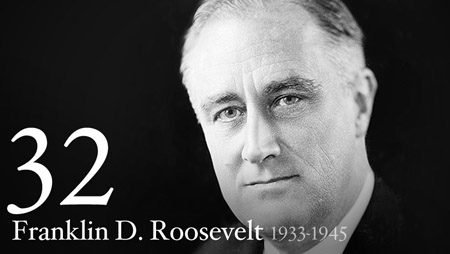
Franklin D. Roosevelt

Franklin D. Roosevelt

Franklin Delano Roosevelt, nicknamed FDR, was the 32nd President of the United States who served from March 4, 1933, to April 12, 1945. He was born on January 30, 1882 in Hyde Park, New York, and died on April 12, 1945, in Warm Springs, Georgia. FDR won the presidency in November of 1932. In 1936, he was re-elected for a second term; 1940 third term; 1944 fourth term. The Twenty-Second Amendment of the United States Constitution was passed by The Congress on March 21, 1947, and was ratified on February 27, 1951. It set a two term limit (4 years per term, 8 years total), for the office of President of the United States.

So, what does FDR have to do with Percy Crosby?

According to political commentator, David Martin, in his December 10, 2006, piece entitled, Roosevelt’s Revenge: “In 1937 Crosby drew a political cartoon, entitled “Paying the Price”, showing the slain figure of Justice lying on the ground with a giant boot on her chest, captioned “One Man Rule”. Crosby sent copies of the cartoon to the Supreme Court and all members of Congress, which depicted Roosevelt’s attempt to “pack the Supreme Court” after its unanimous decision against the NRA. Roosevelt was reputedly furious, and already sensitive to public outrage at his “court packing” plan. The IRS claimed Skippy, Inc. was incorporated by Percy Crosby to evade taxes and filed liens for $47,000, which was published nationally and reported during congressional hearings on tax evasion. Crosby fought back with prominent newspaper ads denying liability, and Lord, Day & Lord filed protest briefs, to no avail. He was forced to discontinue his publications under “The Freedom Press”, which he founded in 1932, and had to sell valuable real estate at distress prices to pay the IRS debt and penalty fines. In 1939 his wife filed for divorce and took custody of the four young Crosby children. The bitter divorce proceedings were publicized to portray the creator of Skippy as selfish and cruel. The children never saw their father again.” (2)

Most of us have heard the famous quote, “It is better to let 100 guilty men go free than to imprison one innocent man.” As we have seen over and over again, this adage only applies to criminal law cases but was never applied to those unfortunate people who were unjustly labeled as mentally ill and incarcerated in state mental hospitals. You decide.

SOURCES:
1. The Life And Times Of Percy Crosby

2. Roosevelt’s Revenge by David Martin 12.10.2006

ADDITIONAL RESOURCES:

Skippy.com

David Martin (DCDave)

The “SKIPPY” Mystery by Collin Nash

Internet Archive – Would Communism Work Out in America? by Percy Crosby

Abandoned America TM – Matthew Christopher’s Autopsy of the American Dream

Franklin Delano Roosevelt Presidential Library and Museum

Dictatorship: The Road Not Taken

Whitehouse.gov – Franklin D. Roosevelt

SKIPPY Peanut Butter at peanutbutter.com

Bloomberg Business Week

1858 Biographical Sketch of Amariah Brigham, M.D.

I always try to obtain obituaries from The New York Times but the newspaper wasn’t founded until 1851, two years after the death of Dr. Amariah Brigham, M.D., the first Medical Superintendent of the New York State Lunatic Asylum at Utica. This piece has been reprinted from Biographical Sketch of Amariah Brigham, M.D., published in 1858.  

AMARIAH BRIGHAM, M. D.
December 26, 1798 – September 8, 1849

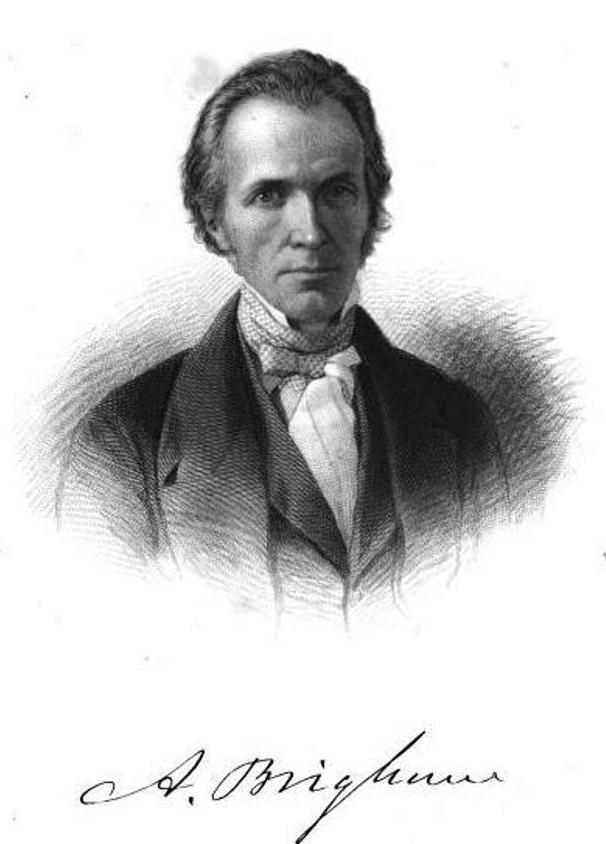
Dr. Amariah Brigham

Dr. Amariah Brigham

The following sketch was written by one of the managers of the Asylum – a distinguished physician – Dr. Charles B. Coventry:

Dr. Amariah Brigham was born in the town of New Marlborough, Berkshire county, Massachusetts, on the 26th day of December, 1798, where his father, John Brigham, was also born. His grandfather, Francis Brigham, one of the first settlers of the place, was from Marlborough, in Worcester county, a descendant of Thomas Brigham, who came over from England, and settled in Cambridge in 1640. In 1805, the father of Amariah moved to Chatham, Columbia county, New York, where he had purchased a farm, and died there in 1809. On the death of his father, the subject of this memoir, who was now eleven years of age, went to reside with an uncle, Dr. Origen Brigham, a highly respectable physician in Schoharie, New York. Here he hoped long to reside, and to follow the profession of his uncle, for which he had already imbibed a fondness. But it was so ordered in Providence, that in the course of a few years, this beloved relative was removed by death, and the nephew left with limited resources, to seek some new home and employment.

After remaining a short period with his mother in Chatham, having little taste for the farm, and an ardent desire for books and knowledge, he started off alone at the age of fourteen, for Albany, in pursuit of a livelihood. He soon found a place there, in a book and stationery establishment, where he resided in the family of the proprietor, and found himself happy. He had there abundant access to books, was in the neighborhood of the courts, the Legislature, and public men, and embraced with eagerness every possible means of acquiring knowledge. One who furnishes the material for this part of the memoir, well remembers the enthusiasm with which he would describe men and scenes of the capital, on his occasional visits to his mother at Chatham. Though but fifteen years of age, he could describe the person and qualities of almost every man of note who came to Albany, had his own opinion formed on nearly all matters of public interest, and could cite book and chapter for the ground of his opinion.

He often mentioned one little occurrence in connection with the late Daniel D. Tompkins, who was then Governor of the State. He was directed, soon after entering on his new employment, to carry some articles of stationery to the Chief Magistrate, who resided in a mansion with spacious grounds in front, near the Capitol. After delivering his parcel, and coming down one of the winding paths to the gate, he picked up a new silk handkerchief which had been accidentally dropped. Presuming it to belong to some of the Governor’s family, he went back and inquired for an owner. The Governor soon appeared in person, gave him many thanks for the return of the article, inquired of him his history, and then dismissed him with a cordial shake of the hand and a generous piece of money. That occurrence, which he often mentioned in later years, impressed deeply on his mind two things: the value of strict integrity in boys, and of kind attention towards them by men of prominence. He said he could not be bribed after that to do a dishonest act for all the wealth of the capital.

During a three year’s residence at Albany, while he had given perfect satisfaction to his employer, he had retained his desire for professional life, and had devoted all his leisure time to reading and inquiry relating to the same. His mother now moving back to his native place in Berkshire, Massachusetts, he soon got released from his engagements and resided with her, and entered on the study of medicine with Dr. Edmund C. Peet, a distinguished physician, brother of H. P. Peet, Esq., President of the New York Deaf and Dumb Asylum.

Here he resided and studied more than four years, subtracting one or two winter terms, when he taught school; and one spent in New York, attending lectures. His study too, was close and thorough, often amounting to twelve hours a day, besides miscellaneous reading.

While he had at this time, when his professional studies commenced, acquired an extensive acquaintance with books, had practiced much in composition, and wrote well, he had never in form studied English grammar. One who was the teacher of a select school in the place, informs us that he was waited on by the young medical student, with a proposition to be taught the grammar, and wished to have it all done in a single day. A day was given him, and a hard day’s work it was, for hundreds of questions had to be thoroughly answered, and different parts of the text-book explained. In the evening several young persons, who had spent months in the same study, undertook to examine the pupil of a day, and found, to their surprise, that he had not only reached their position in the study, but had gone beyond them, and could propose and solve difficulties in the language quite too hard for them. Within a few weeks he commenced the teaching of a school for the winter, in which he had a large class in grammar, and which was so taught, that at the closing examination, both teacher and pupils received high commendation.

In prosecuting his medical studies, he found that many things which he wanted were locked up in the French language. With the same resolution which had led him to master the English grammar, he procured dictionaries and other helps, and without any teacher mastered the French. Nearly one-third of his large library left, is in this tongue, and was read, in later years particularly, with as much facility as his own vernacular.

The year 1820, when his professional studies closed, he spent with Dr. Plumb, of Canaan, Connecticut, engaged, most of the time, in practice with him. In 1821, he commenced practice by himself in the town of Enfield, Massachusetts. Here he remained for two years, with fair prospects, but finding a more inviting field before him in Greenfield, the shiretownof Franklin county, he removed thither, and practiced for two years, when he went to Europe. After a year’s residence in France, Italy, England, and Scotland, he returned to Greenfield, but moved, in April, 1841, to Hartford, Connecticut. Here he had a large and successful practice, much of it in the line of surgery, until 1837, when he moved to New York, and lectured one winter in the Crosby Street Medical College. But his health here not being good, and not liking the confinement, to which he was so unused, he returned in October, 1838, to Hartford, a place which was always dear to him, and where he had hoped, even the last year, to spend the evening of his days. Dr. Brigham was married, January 23, 1833, to Susan C. Boot, daughter of Spencer Boot, Esq., of Greenfield, Massachusetts, by whom he had four children, of whom three, with their mother, survive to mourn his death.

In January, 1840, he was appointed in connection with Dr. Sumner, to take charge of the Retreat for the Insane, at Hartford, and in July, 1840, was appointed Superintendent of the same.

In the summer of 1842, Dr. Brigham was appointed Superintendent of the New York State Lunatic Asylum, at Utica. The institution was opened on the 16th of January, 1843. From this time, until the period of his death, he was unceasing in his devotion to the great cause of humanity in which he was engaged. It is well known that the building first erected, was intended as only a part of the entire establishment, and consequently, was not susceptible of such an arrangement, as was necessary for a proper classification. It was the ambition of Dr. Brigham that the State of New York should have a model institution, and this was impossible without further accommodations; and although his duties were thereby rendered more arduous and responsible, without any increase of remuneration, he was unceasing in his application to the managers and the Legislature, for additional buildings. In May, 1844, an additional appropriation of $60,000 was made by the Legislature, to enable the managers to erect two additional wings for patients, thus doubling the accommodations, and also the necessary room for bakery, wash-rooms, &c, in the rear of the buildings, and thus removing them from the basement of the main building. The new erections were completed in 1846, and were soon filled with patients. From that time until the present, the average number of patients has been from four hundred and fifty to five hundred. Dr. Brigham was not only desirous of establishing an institution which should be creditable to the State, but, in order that our citizens should avail themselves of its advantages, he labored to diffuse a more extended knowledge of the subject of insanity. This he did by popular lectures, and by embodying in his reports details of the causes, the early symptoms, and means of prevention, but particularly by the establishment of a quarterly journal, viz: “The Journal of Insanity,” which was devoted exclusively to this subject. In order to secure its more extensive circulation, it was placed at the low price of one dollar a year, in addition to many copies gratuitously distributed. To the readers of the Journal, nothing need be said of its merits. At the time it was commenced, it was the only Journal of the kind published, either in this or any other country, and elicited the highest encomiums from the medical and legal professions, both in Europe and America. Although Dr. Brigham was the responsible editor, it was the medium of communication for some of the ablest writers in our country. We have reason to know, that in addition to the gratuitous labor of editing and superintending its publication, it was long maintained at a heavy pecuniary sacrifice. In the Prospectus to the first number, the Doctor says:

“The object of this Journal is to popularize the study of insanity – to acquaint the general reader with the nature and varieties of this disease, methods of prevention and cure. We also hope to make it interesting to members of the medical and legal profession, and to all those engaged in the study of the phenomena of mind.

“Mental philosophy, or metaphysics, is but a portion of the physiology of the brain; and the small amount of good accomplished by psychological writers, may perhaps be attributed to the neglect of studying the mind, in connection with that material medium which influences, by its varying states of health and disease, all mental operations.

“We regard the human brain as the chef-d’oeuvre, or master-piece of creation. There is nothing that should be so carefully guarded through all the periods of life. Upon its proper development, exercise, and cultivation, depend the happiness and higher interests of man. Insanity is but a disease of this organ, and when so regarded, it will often be prevented, and generally cured by the early adoption of proper methods of treatment.”

In August, 1848, Dr. Brigham lost his only son, John Spencer Brigham, a promising and particularly attractive lad of the age of 12 years. In this son was treasured a father’s fondest hopes and proudest aspirations. He fell a victim to the dysentery which was prevailing in the Asylum, as also in the neighboring city of Utica and surrounding country, in a malignant form. A few weeks after he was called to follow to the grave his only remaining parent. These repeated afflictions, which were felt as parents who have lost the child of their affections alone can feel, evidently preyed upon a constitution naturally feeble, and seemed to prepare the way for his own premature removal. Though educated by a pious mother, and enjoying the advantages of an early religious education, he, like too many others, had been too much engrossed with the cares of this life to attend much to the future. This circumstance, with some severe strictures in his writings on the pernicious effects of revivals and protracted meetings on the health of young persons, very unjustly gave rise to a charge of skepticism and infidelity. If there was a fault, it was one into which a medical man, like Dr. B., possessed of a strong feeling of benevolence, would naturally run, viz: in his solicitude for the health and physical well-being, to forget that there were other and higher claims than those of this world. For the last four or five years more attention was paid to the subject of religion. The death of his son and mother made him feel more strongly the vanity and uncertainty of all earthly ties, and induced him to place his treasures in heaven. Dr. B. seemed to have a presentiment that his earthly pilgrimage was approaching its termination, and in his letter to his brother, the Rev. John C. Brigham, on the subject of the death of his son and mother, he spoke freely of his own death as not far distant; expressing, however, neither fear or regret. It was but too evident to the friends of Dr. B. that his afflictions, together with his arduous duties, were preying upon a constitution naturally feeble, and he was urged to relax his exertions, and if that could not be done to resign his situation; but he could not consent to leave his work unfinished, and only promised that when the institution was in a condition to dispense with his services, he would retire; but, alas! that period never arrived. In the month of August, the dysentery again made its appearance in the institution, but in a much milder form than in the preceding year. Dr. B. was seized with diarrhoea, which in many cases was the precursor of the more formidable affection. He, however, still persisted in discharging the duties of his office, and attending to his patients, until so far exhausted that it was impossible. The writer first saw him on the 27th of August; he had then been confined to his bed three days, and was suffering from the ordinary symptoms of dysentery; with fever, pain, and discharges of blood, but combined with extreme debility and prostration, so as to cause great apprehensions for the result. The severer symptoms yielded readily to the treatment, and his medical attendants flattered themselves with the hope that he might still be spared; but these hopes proved delusive: the disease, though not severe, had exhausted the little strength which he possessed, and there seemed no power of restoration. Every effort was made to sustain the system, (which was all that could be done,) but these efforts were all vain, and he expired without a struggle or a groan, on the morning of the 8th of September, 1849. The Doctor himself from the first said he should not recover, spoke calmly but freely about his death, gave directions about his affairs, and as to his burial, requesting to be laid beside his beloved son, and that the bodies of both should subsequently be removed to the new cemetery, where a spot has been selected for their interment.

Dr. Brigham was a philanthropist, a lover of his brother man, in the strictest sense of the term; he no doubt was ambitious of fame and distinction, but he was still more ambitious of being useful, and often expressed the idea, that he saw no object in living after a man had ceased to be useful. Fortunately for the community, the usefulness of which he was most ambitious will not perish with him. As the first Superintendent and organizer of the New York State Lunatic Asylum, he has erected a monument as durable as the blocks of stone of which it was built. His teachings too live in his writings. In additional to his annual reports, in which the whole subject of insanity is discussed, and the editorial articles in the “Journal of Insanity,” he has at different times published works of a more permanent character. In 1832, he published a small volume on the epidemic or Asiatic cholera; also a work on mental cultivation and excitement. In 1836, a volume on the influence of religion upon the health and physical welfare of mankind. In 1840, a volume on the brain, embracing its anatomy, physiology, and pathology. His last publication was an appropriate crowning of his labor of benevolence; it is a small duodecimo volume, entitled “The Asylum Souvenir,” and is dedicated to those who have been under the care of the author and compiler. It consists of a collection of aphorisms and maxims, to aid in the restoration and preservation of health, and we have no doubt it will be cherished with a double care, as it may now be considered the parting legacy of their friend and benefactor. The following extracts will exhibit the general tenor of the work:

 “THE ASYLUM SOUVENIR.

“To all those who are or have been in my charge as patients, this little book is affectionately dedicated by their friend, – Amariah Brigham.

 “ ‘Peace be around thee wherever thou rovest,
May life be for thee one summer’s day,
And all that thou wishest, and all that thou lovest,
Come smiling around thy sunny way.
If sorrow e’er this calm should break,
May even thy tears pass off so lightly,
Like spring showers, they’ll only make
The smiles that follow shine more brightly.’ ”

Were we asked what were the leading traits in the character of our departed friend, we should answer, that the first and strongest impulse was one of kindness and benevolence, but this was combined with a high sense of justice, and he would not indulge the former at the expense of the latter. In addition, he possessed a strong feeling of self-reliance, a quickness of perception which enabled him to seize readily the views of others, and use them for his own purpose; but above and before all, an iron will and determination, which brooked no opposition; consequently in whatever situation he was placed, he must be absolute, or he was unhappy. It is seldom we find this strong determination of purpose connected with a feeble constitution, but whenever it exists, the individual may be marked for a premature grave: the strongest constitution can scarcely long maintain itself under the thousand irritations and annoyances to which such a will is subject.

The following extracts from the reports of Dr. B. while Superintendent of the Asylum, at Utica, are a specimen of the tone of kindness which pervades all his writings:

“That education which consults the good of the whole man, that tends to develop and strengthen in just proportion the moral, intellectual, and physical powers, is conducive to health of body and mind. But in all countries the intellect or some of the intellectual faculties are cultivated to the neglect of the moral qualities, while in others the feelings, appetites, and propensities, are too greatly indulged and cultivated, to the neglect of just intellectual improvement. Hence arise unbalanced minds which are prone to become disordered. They feel too intensely, and are too ardently devoted to the accomplishment of certain purposes to bear disappointment without injury. They have not been taught self-denial, without which all education is defective.” – 3d Annual Report, pp. 54, 55.

“Allusion has been made to a predisposition to insanity being given by premature cultivation of the mental faculties. This appears to be a fruitful source of weak, ill-regulated, and, not unfrequently, disordered minds. The mental powers being unduly and irregularly tasked in early life, never after obtain their natural vigor and harmonious action. The dominion of reason should extend over all the feelings and impulses, the good as well as the bad, for insanity is perhaps most frequently produced by the excitement of some of the best impulses of our nature.” – 1st Report, pp. 34, 35.

Dr. Brigham, as we have said, was ambitious, but his was a noble ambition. He was ambitious of being useful to mankind, and of leaving a monument by which he should be remembered in after ages, and be ranked among the benefactors of our race; and most nobly has he succeeded. Few men were less covetous of personal popularity, or more regardless of the opinions of those about him, so long as he was sustained by the approbation of his own conscience. The following extract from Bryant, which he himself selected for “The Asylum Souvenir,” but a short time before his death, beautifully expresses the purpose of his life, and the manner of his death:

“So live, that when thy summons comes to join
The innumerable caravan, that moves
To that mysterious realm, where each shall take
His chamber in the silent halls of death,
Thou go not like the quarry-slave at night,
Scourged to his dungeon; but sustain’d and sooth’d
By an unfaltering trust, approach thy grave,
Like one who draws the drapery of his couch
About him, and lies down to pleasant dreams.” C. B. C.

SOURCE: Reprinted from Biographical Sketch of Amariah Brigham, M.D., Late Superintendent Of The New York State Lunatic Asylum, Utica, N.Y., W.O. McClure, 177 Genesee Street, Curtiss & White, Printers, 171 Genesee Street, 1858, Pages 110-117.

1873 Monroe County Poor House – Rochester, NY

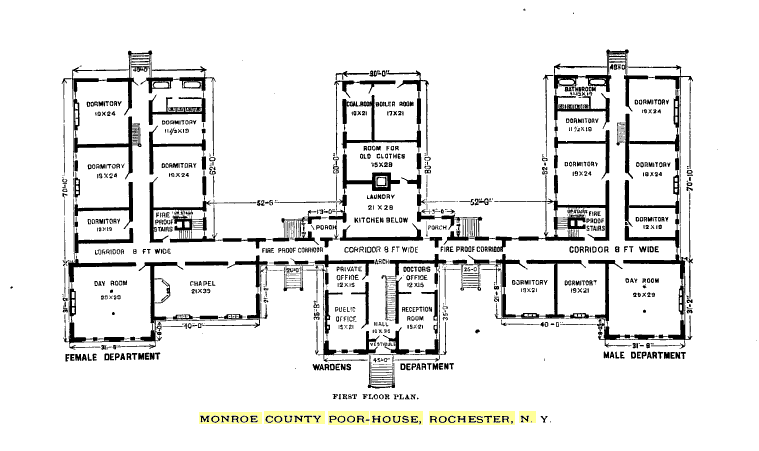
The Monroe County Poor-House – This institution, situated near the city of Rochester, was completed and occupied near the close of the past year. It consists of a centre building and two wings, each connected with the former by fire-proof corridors. The centre building is forty-five feet square, and is three stories besides the basement and a high attic. It is occupied by the warden and family, and also furnishes room for offices.

Monroe County Poor House 1873 (Rochester, New York)

Monroe County Poor House 1873 (Rochester, New York)

The wings each have a width of seventy-one feet in front, forty-nine feet in rear, and a depth of 102 feet. They are both three stories high, and nearly alike in their structure and arrangement. The left is occupied by males and the right by females. The third story of the whole front is used as a hospital. In the rear of the centre structure there is a building thirty feet wide and sixty feet long. The basement of this is used for general kitchen purposes, the first floor for laundry, etc., and the second for the hospital kitchen. The entire edifice has a front of 238 feet, and is 105 feet deep.

Monroe County Poor House Floor Plan

Monroe County Poor House Floor Plan

The basement is built of stone, and the stories above of brick, with partition walls of the same material. The roofs are of slate and the cornices of iron. The floors are of oak and maple, and the stairways of iron, and fire-proof. All the rooms are high and well ventilated. The edifice is plain, substantial and well built, and is appropriately arranged and furnished for its purposes. The entire cost of the building, including steam-heating, plumbing, etc., it is reported, was $71,000. It will accommodate and suitably classify five hundred inmates.”

SOURCE: Sixth Annual Report of The Board of State Commissioners of Public Charities of the State of New York To Which Is Appended The Report Of The Secretary Of The Board, Transmitted to the Legislature January 28, 1873, Albany: The Argus Company, Printers, 1873, Pages 84, 86, 87.

Monroe County Almshouse (Pages 12 – 22).

Monroe County Asylum 1888 – Inmate’s Names on pages 4 & 5.

1907 The Deportation of Insane Aliens

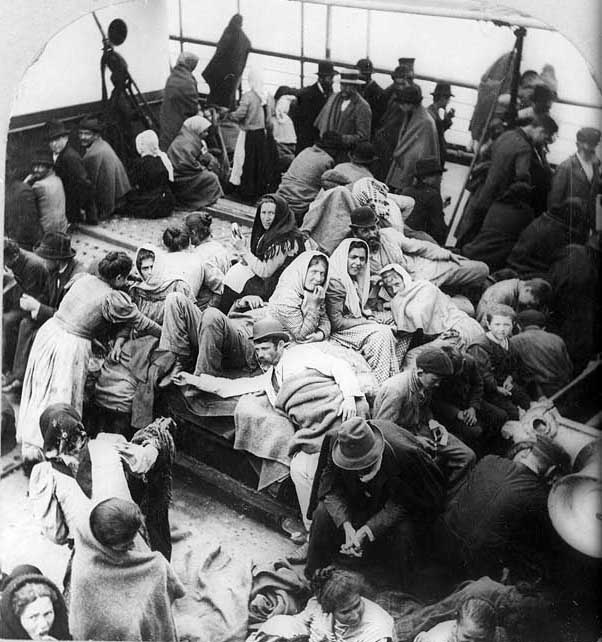
By 1880, New York State was overwhelmed with the immigrant pauper insane population which by its own laws, was required to care for them. The state legislature enacted new laws allowing for the deportation of this “dependant, defective and delinquent class” of immigrants in order to relieve the state of its financial burden. One of the problems that resulted from the actions of the state legislature was that the sick, blind, deaf and dumb, crippled, feeble-minded, and insane class of immigrants, were sent back to their original port of departure in Europe by themselves with little or no money, and many were sick and improperly clothed. No one bothered to make sure that these helpless people actually made it back to their homes, which in many cases was quite a distance from the port. Many of their relatives and friends never saw or heard from them again. Without the efforts of Miss Louisa Lee Schuyler and The State Charities Aid Association in 1904, this problem may never have been brought to light. On February 20, 1907, the problem was resolved with a new immigration law.

Immigrants Aboard Ship 1902

Immigrants Aboard Ship 1902

State Charities Aid Association of New York 1904
“The United States immigration regulations exclude from admission into the United States insane persons, persons who have been insane within five years previous to landing, and persons who have had two or more attacks of insanity at any time previously. Any alien of these classes who succeeds in entering the United States, or any person who becomes a public charge from causes existing prior to landing, may be deported at any time within two years after arrival, at the expense of the person bringing such alien into the United States. Under certain conditions, the secretary of the treasury is authorized to deport such aliens within three years of landing. Under the provisions of this law 147 insane persons were deported to foreign countries from the State of New York during the fiscal year 1903.

From different sources it came to the attention of the Association that insane aliens deported by the government did not always reach their homes so promptly as they should, and sometimes not at all.  In this connection the following quotation from the annual report of the superintendent of the Manhattan State Hospital, West, for the year just closed is significant:

‘While perhaps, it is a matter that does not officially concern the hospital, I desire to state, that I have received several communications from the relatives of patients deported, who claim, up to four or six weeks after such deportation, they have been unable to find that they have arrived at their homes, and could obtain no trace of them. Any conditions which do not afford protection to the insane alien until she reaches her home, are indeed unfortunate, and it appears to me, that some steps should be taken by the proper authorities, toward remedying these matters. The steamship companies do not appear to hold themselves responsible beyond the port where the patient was originally received aboard their steamship.’

The Association, therefore, has made some inquiry into the methods pursued in the deportation of insane aliens, and although it has been possible as yet to make only a cursory examination of a few cases, the conviction is inevitable that the methods of deportation are not such as to afford the patients proper care and protection in all cases, nor to do justice to their friends and relatives. Only five cases have been studied. A brief account of three of the five cases which are at all complete will give some idea of present methods.

1. ‘Case of M.S., a young woman, aged 29 years, a native of Finland, arrived in this country November 1, 1902. About a year and a half later she became insane and was committed to the Manhattan State Hospital, West, April 14, 1904, where she was visited the following week by her friends, the matron and missionary of the Immigrant Girl’s Home. Hearing that the girl was to be deported, these friends offered to arrange for her deportation, hoping to find some woman returning to Finland who would take charge of her. Ten days after this, before the girl’s friends had had time to move in the matter, they received a notice from the hospital that she was to be deported in three days. The names and addresses of the girl’s relatives in Europe were not in the possession of the hospital nor of the steamship company which was to take charge of her, and how she was expected to reach her home, the Association has been unable to discover. The friends of the girl, at the suggestion of the Association, procured these names and addresses, and gave them to the purser of the steamer on which she was to sail, and the Association took the precaution of sending the information to the home office of the steamship company in Glasgow, and of asking the officials there for some particulars regarding the method of transporting the patient from Glasgow to Finland. The following extract from the steamship company’s reply shows the methods employed:

‘Immediately on landing at the dock she was taken to a boarding house where she was properly taken charge of, being attended to by the women of that house. We are forwarding her to-night in charge of our shore interpreter to Hull, and he has instructions to see her safely on board the steamer for Helsingfors, which leaves Hull to-morrow. We have also addressed letters to the owners of the steamer, both in Hull and in Helsingfors, with a request to take some interest in the case, and to give the necessary instructions regarding treatment on board.’

A letter received by the girl’s friends in New York from the girl’s sister in Finland says that no communication was ever received by the friends in Finland from the steamship company, or from any one except the New York friends. The sister writes that she spent three days going from place to place trying to get information regarding the whereabouts of the patient, and finally located her in the Helsingfors hospital for the insane, where she had presumably been sent by the steamship company. This was in July, – two months after the girl sailed from America. The latest letter received from the patient’s sister came in October, and mentioned that she had been unable to find the trunk which was sent with the patient by the New York friends, and which contained all her possessions. The steamship company seems to have done nothing to see that the patient’s property followed her to the hospital.

The features of this case to which we would call attention are these: The failure of the hospital to cooperate with the friends of the patient in providing for her deportation, though no great haste was necessary, as the time in which she could be deported would not expire for six months; the failure of the authorities of this State to take any responsibility for the patient after she had been handed over to the steamship company, including a failure both on their part and on the part of the steamship company to notify the relatives in Europe, or even to ask her friends in this country to notify her relatives; the failure of the steamship company to make any effort to secure the names and addresses of the girl’s family or to make any use of them when furnished by others; the lack of proper care and protection shown in sending an insane person to a boarding house instead of to a hospital, and in forwarding her by night, in the company of a male attendant, on a long railroad journey. It would be interesting to know how this girl fared from the time she left Glasgow in May until her friends found her in July and how she would have fared if her friends in this country and this Association had not actively interested themselves in her case.

2. Case of M.R., an Austrian girl, aged 20 years. The following account of this case was given by the girl’s cousin: ‘When she became insane her brother, who lives in New York city, thought he would send her home, and told the Manhattan State Hospital authorities that he would try to arrange to do this, planning to send her with some acquaintance who was going over. The hospital, however, said that this could not be done; that she was to be returned by the government. The brother was not informed regarding the time of her return until May 3rd, when he received a letter saying that she was to be deported on May 4th. By the time he received the letter she was already on board, and it was impossible for him to go to the steamer that night. He went, however, the next morning about 8 o’clock, and had great difficulty in getting permission to see her. Finally he was allowed to see her for a few minutes. He found her dressed in a cotton wrapper, such as is worn at the State hospital, and provided with no other clothing. He would have brought her clothing if he had known that she needed it, but as nothing had been said by the State hospital it had not occurred to him to do this. He wished to give her money so that she could buy clothing when she got to Hamburg and spoke to the captain about the matter. The captain thought it useless for the girl to have money, but finally consented to take a few dollars for her use.’

The girl was taken to a hospital in Hamburg on landing there, and the parents of the patient were notified by the hospital of her arrival. In this case the significant feature seems to be again the failure of the authorities in this State to co-operate with the friends of the patient for her deportation.

3. Case of F.H. This patient is the son of one of the two sisters whose pathetic story appeared in the newspapers in November, 1904, at the time they committed suicide because of inability to support themselves. The following extract from the newspaper account of the case, though not altogether accurate, gives an idea of the story of the boy: ‘Everything went well with the sisters until a little more than a year ago. Then the boy was taken sick. His illness left him with a deranged brain. He was kept for a time in Bellevue Hospital and then was sent to Ward’s Island. The sisters visited him regularly once a week there. One week, about a year ago, they learned on their regular visit, that he had been sent back to Austria. This, friends of the sisters say, had been done without notification being sent to the mother. Her grief and her fear that some harm would come to him on the voyage were intense. She immediately raised all the money she could get, and, taking also the little which her sister had, she boarded a fast ocean liner for Hamburg. She landed there on the same day that her son landed, and, taking him under her charge, continued the journey to Vienna, where she had him put in an asylum. Then she hurried back to her sister in this country. The strain on the income of the two, however, was too great, and when they got out of work a few weeks ago they became despondent.’

It appears from the records of the Manhattan State Hospital, East, that the boy was admitted there September 25, 1902, and was visited by his mother Sunday, October 5. As he was an alien, having been but nine months in the United States, arrangements were made immediately for his deportation. On October 16, the hospital was informed that the boy would be deported on a vessel sailing October 18, and that he was to be placed on board the 17th. A letter dated October 17 was sent by the hospital to the boy’s mother informing her of his deportation.

Again we note the failure of the State authorities to make any effort to co-operate with the friends of the patient. In this case the hospital did not know of the plans of the Immigration Department for the deportation of the patient until the day before his deportation, and cannot be blamed for not writing earlier to his mother, but under such circumstances it would seem that the friends of the patient should be notified by telegram or special messenger, instead of by a letter, which could hardly be expected to reach its destination before the patient sailed.

To subject insane persons, many of them young and in an acute stage of the disease, to the vicissitudes of a long ocean voyage, with a further journey on the other side of the ocean, is certainly a sufficient risk under the best conditions, and every possible protection should be provided against physical or moral injury. The inhumanity of subjecting relatives of patients to unnecessary anxiety and alarm by leaving them in ignorance of what is happening to those they hold dear, should also be prevented by the establishment of some system which will provide for more personal attention to each case. At present insane aliens are dispatched with little more ceremony than if they were able-minded and able-bodied immigrants, capable of attending to their own interests.”

SOURCE: Reprinted from Twelfth Annual Report of the State Charities Aid Association to the State Commission In Lunacy, No. 89, November 1, 1904, New York City, Untied Charities Building, 105 East 22d Street, Pages 29-34.

To continue reading the rest of the article, click on the PDF file located on the “Interesting Articles & Documents” page.

1879 Moral & Physical Causes of Insanity

An interesting passage from the book, A Manual of Psychological Medicine, published in England in 1879 by John Charles Bucknill and Daniel Hack Tuke, lists the “Exciting or Determining Causes of Insanity” which are divided into Moral and Physical categories. This list provides the reasons, upon admission, why people were admitted to mental hospitals in England. The same basic list holds true for the United States.

Intemperance, in Drink”, caused roughly fifty per cent of admissions. Around 1840, Spiritualism was the newest fad that had swept across the U.S. and Western Europe, thus “Religious Excitement” is listed as a moral cause. In America, there were new religious movements such as the Millerites, Mormons and Shakers, just to name a few. “Self Abuse (Sexual)” is of course, masturbation, which we all know causes insanity, dementia and imbecility. I was always told that it also caused blindness. To the Victorian’s, masturbation was a crime that was absolutely despised.

“MORAL CAUSES:
Domestic Trouble (including loss of relatives and friends).
Adverse Circumstances (including business anxieties and pecuniary difficulties).
Mental Anxiety and “Worry” and Overwork.
Religious Excitement.
Love Affairs (including Seduction).
Fright and Nervous Shock.

PHYSICAL CAUSES:
Intemperance, in Drink.
Intemperance, Sexual.
Venereal Disease.
Self Abuse (Sexual).
Over-exertion.
Sunstroke.
Accident or Injury.
Pregnancy.
Parturition and the Puerperal State.
Lactation.
Uterine and Ovarian Disorders.
Puberty.
Change of Life.
Fevers.
Privation and Starvation.
Old Age.
Other Bodily Diseases or Disorders.
Previous Attacks.
Hereditary Influence ascertained.
Congenital Defect ascertained.
Other ascertained causes.”
(Bucknill & Tuke 3:92)

“To estimate with anything like accuracy the relation which Sexual Vice bears to Insanity, requires considerable discrimination. In Dr. Earle’s recent tables of the Northampton State Lunatic Hospital, it appears that out of the male admissions (572) 19 were attributed to masturbation. In those of the York Asylum prepared by Dr. Needham, out of 603 male admissions this cause is set down at 15. Reliable facts are of course most difficult to obtain, and such figures reveal little of the real truth – the extensive mental mischief done – of which there can be no doubt whatever.” (Bucknill & Tuke 3:98)

Religious Anxiety and Excitement. – In the analysis of our collected cases, we find it assigned in 3 per cent of the total admissions. Doubtless, in many instances it was in reality the initial symptom of the disorder. Still we cannot for a moment doubt that the form in which religion is but too frequently presented is a serious cause of Insanity. Dr. Earle gives 17 cases out of the total numbers already mentioned, as due to “religious excitement” and 6 to “Spiritualism;” Dr. Needham, 26 out of 1029 admissions, as due to the former.” (Bucknill & Tuke 3:99)

SOURCES:
Bucknill, John Charles & Tuke, Daniel Hack, A Manual of Psychological Medicine, (John Charles Bucknill, M.D, Lond., F.R.S., F.R.C.P. Formerly Lord Chancellor’s Visitor of Lunatics and by Daniel Hack Tuke, M.D., F.R.C.P. Joint Editor of “The Journal of Mental Science”; Formerly Lecturer on Psychological Medicine at The York School of Medicine and Visiting Physician to The York Retreat), Fourth Edition, London, J. & A. Churchill, New Burlington Street, 1879, Page 92, 98 & 99.

1872 Miss Louisa Lee Schuyler – The State Charities Aid Association

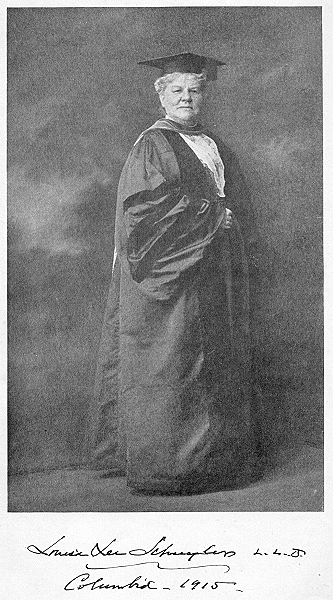
To say that Louisa Lee Schuyler was a humanitarian and a pioneer in social work would be an understatement. Miss Schuyler was the driving force in the movement to reform the poor house system in New York State. She was born into a life of wealth and privilege on October 26, 1837, the daughter of George Lee and Eliza (Hamilton) Schuyler; and great-granddaughter of General Phillip Schuyler and Alexander Hamilton. She founded The State Charities Aid Association on May 11, 1872, which was based in New York City and consisted of volunteer members; men and women, from all walks of life. Her involvement with the Sanitary Commission during the Civil War had taught her the great value and importance of organization. She had read the official reports about the deplorable conditions of the poor houses and alms houses in the state and knew that something had to be done about the inhumane treatment of the poor. She also knew that the “say-so” of one woman wouldn’t change anything; she needed a league of educated citizens united in a common goal.

Louisa Lee Schuyler

Louisa Lee Schuyler

(Photograph Source: http://educationtechnologyreview.com/folio/dodge/images05/index.html)

The association’s purpose was to raise the awareness of the general public to the abuses and sufferings of paupers in the poor house system; to visit every institution of charity supported by public funds in the state of New York; to report findings of mismanagement and corruption, and to make recommendations to the State Commissioners of Public Charities (later renamed The State Board of Charities). Miss Schuyler formed the association first; wrote the by-laws; encouraged her friends to join the association; visited the Westchester County Poor House and Bellevue Hospital with a few of her volunteers; and then, wrote a letter that included a complete report of the association’s findings of both institutions to the State Board of Commissioners. The association immediately received the approval of the State Commissioners and was given the right to visit and inspect the charitable public institutions under the powers and authority already held by the State Commissioners of Public Charities. There were three committees whose purpose it was to focus on the interests of the dependent classes. The categories were divided into: Children (all aspects of their welfare), Adult Able-Bodied Paupers (in poor houses and alms houses), and Hospitals (that included a sub-committee representing the Insane).

Led by Miss Schuyler, Chairman of the Committee on the Insane, the State Charities Aid Association pushed for and eventually forced the passage of The State Care Act, Chapter 126, Laws of 1890. Miss Schuyler started the first Training School for Nurses in connection with Bellevue Hospital in 1873, and was instrumental in After Care of the Insane which was implemented in 1906. In 1907, she was appointed as one of the original Trustees of the Russell Sage Foundation, and in 1908, she organized the first committee of physicians and laymen for the prevention of blindness. Honored by her forty years of charitable work, she was the first woman to receive an honorary degree of laws (LL.D.) from Columbia University in 1915. Miss Schuyler died at the age of eighty-eight on October 10, 1926, in Highland Falls, Westchester County, New York.

The following First Annual Report of the State Charities Aid Association was addressed to The Board of State Commissioners of Public Charities of the State of New York, on March 1, 1873.

 First Annual Report of the State Charities Aid Association

“The objects of our work are of a twofold nature. 1. To promote an active public interest in the New York State Institutions of Public Charities, with a view to the physical, mental and moral improvement of their pauper inmates. 2. To make the present pauper system more efficient, and to bring about such reforms in it as may be in accordance with the most enlightened views of Christianity, Science and Philanthropy.” (54)

“Again another question: Has not the time come for the officers in charge of our County Charities to be appointed and not elected? How can a man with no especial fitness for the position be expected, during his short term of office, to understand the best way of treating several hundred human beings suddenly placed under his care? He is at once obliged to grapple with this great question of pauperism, not as a theory, but practically – a subject to which, in its separate branches, philanthropists have given lives of study and of work. But he is called upon to deal, not merely with single branches, but with the whole question – with the best method of caring for pauper-children, how to keep them from following in the footsteps of their intemperate parents; with the most enlightened treatment of insanity; with the vexed questions of diet-lists for sick and well, of ventilation, and sanitary science, and hospital management; with occupation for the blind, and instruction for the idiot; with the labor question as affected by work-houses. How can one man, who has previously given no study to the subject, fit himself in one, two or three years to fill such a position? And then, when perhaps he may have gained some little knowledge of the subject, the next turn of the political wheel whirls him off and puts in another beginner as his successor. Can we not have carefully selected persons, thoroughly qualified, appointed to fill these positions for long terms of office? Are not the great improvements in our City Charities due to the adoption of this plan? The advanced methods of treatment used in our State Asylums are undoubtedly due to the fact that those in charge are pre-eminently fitted to hold the permanent positions they do. In a large city like ours, where the care of the poor is an enormous business in itself, taking the whole time of those having the supervision of it, good salaries should be paid, for the work is no light task; it demands and should have first-class ability. But in the country, where the supervision required is comparatively slight, taking perhaps a few hours a week, or two or three days a month, we are confident that benevolent and capable citizens can be found to fill these offices without pay, from motives of humanity alone. And even these should be held strictly accountable for the good management of their trust to a supervisory board like your own, as well as to their own county supervisors, for too many safeguards cannot be placed round those who have human beings in their keeping. The streets are out of order, and our carriages break down; the gas is poor, and our eyes pain us every evening; the sewerage is defective, and we tremble for the health of our children; criminals go unpunished, and our lives are in danger; taxes are exorbitant, and we feel it in our pockets; and when these abuses become so great as to be unbearable, we rise in our might, unite with other indignant citizens, drive out the thieves, and insist upon reform. But who knows what goes on in those far-away great buildings called hospitals and poorhouses? There is a class of persons who, if abused, cannot defend themselves – whose sufferings we do not see, whose cries we cannot hear, who have no influence or power to help them break their bonds. At least, let us see to it that those who have the lives of these unfortunate fellow-beings under their control shall be fitted for the position, and shall also be responsible to some authority above them. With this reform, and with the intelligent co-operation of our citizens as Visitors, we may feel that our duty toward these helpless people has been in some degree fulfilled.” (54)

 THE STATE CHARITIES AID ASSOCIATION OF THE
STATE OF NEW YORK
1872-1893

“Voluntary, Unofficial Supervision Of Public Charitable Institutions In Co-Operation With Official Boards, As Illustrated By The Work Of The State Charities Aid Association Of New York. By Miss Louisa Lee Schuyler, Member of the Association.

The following are named as direct results of the work of the State Charities Aid Association. And, in stating them, we wish it borne in mind that what has been accomplished is equally due to the co-operation of the local authorities. In addition to this, and where this has not been attainable, the co-operation of the State Board of Charities and the State Commission in Lunacy have been invaluable.  At times the association as been obliged to carry its reforms single-handed, but these instances are fortunately rare.

1. A higher standard of care has been introduced into every poor house and alms house in the state. – This means better nursing, special diet for the sick, improved hospital accommodation, separation of the sexes, suitable food, proper clothing, and many little comforts for the aged and infirm. It is impossible to enumerate the small and the great benefits conferred upon the inmates of these institutions through the presence of a few humane and intelligent visitors, commanding the confidence and respect of their own communities and sure of a powerful backing from headquarters.

2. Training-School for Nurses, 1873. – This school, attached to Bellevue Hospital, one of the largest pauper general hospitals of the city of New York, was established by our New York County Visiting Committee, who raised the necessary $20,000 with which to begin it, opened the training school on the first day of May, 1873, and to whom is due its efficient management and great success. At first governed by a special committee, the school increased so rapidly in importance that it was soon incorporated as a separate society, merely reporting annually to the parent association in recognition of its origin. The whole number of patients nursed by this school, from 1879 to 1893, is 50,059. Its graduates number 424; of these, 45 are now holding positions in hospitals, 19 as superintendents of training schools, 10 as matrons, and 16 as head nurses.

3. Hospital Book and Newspaper Society, 1874. – Boxes for the reception of fresh daily newspapers are placed, by this society, at the railway stations, the ferry slips, the exchanges, etc., in New York city, whence the papers are collected every day and taken to the hospitals, to be immediately distributed through the wards. In 1892 these daily papers numbered 158,417. Books and pamphlets are received at the office of the society, and are sent every week to hospitals, asylums, poor-houses, prisons, life saving stations, light houses, etc., often forming the nucleus of a small library. During the year 1892 the society distributed 7,716 books, 15,944 magazines, and 54,020 illustrated and weekly papers. The Hospital Book and Newspaper Society, at first a committee of the association, is now a branch with independent membership and treasury.

4. Farming Out the Poor Abolished, 1875. – In one of the counties of the State of New York there yet remained, when the visiting committee of that county was organized, a remnant of the barbarous system of farming out the care of the poor to the lowest bidder. The abuses connected with this practice can well be imagined. Through the exertions of our visiting committee, this system was speedily and completely abolished.

5. Temporary Homes for Children, 1877-85. – In 1875 the New York State Board of Charities secured the enactment of a law, known as ‘the Children’s Law,’ which made obligatory the removal of all children over two years of age from the poorhouses and almshouses of the state. In this great reform the board had the full sympathy of the members of the association throughout the state, who have also been active in promoting the enforcement of the law. To provide a suitable place (the poorhouse being very properly forbidden) where temporary lodging for children could be had, pending their removal to homes in families, the visiting committees of Ulster, Westchester and Queens counties established three Temporary Homes for Children, in 1877, 1880 and 1885.

6. Tramp Act, 1880. – In several counties it was found to be the direct pecuniary interest of the Overseers of the Poor to encourage vagrancy, as they received from the county treasury fifty cents per capita, often more, for each night’s lodging given a tramp. It required three years to obtain the necessary remedial legislation; but since the enactment of this deterrent measure, the State of New York has been less attractive to tramps. (Laws of New York, 1880, Chap. 176.)

7. First Aid to the Injured, 1882. – The serious condition in which accident cases were received at the hospitals in New York city, owing to ignorance of what should be done before a physician could be summoned, induced the organization, by the Hospital Committee of the association, of a Society for Instruction in First Aid to the Injured, modeled upon the English societies of like nature. This society, since its formation, (at first as a committee of the association,) has given 264 courses of lectures, of which 62 were to pay-classes and 202 to free classes, to the police, railroad employees, working girl’s clubs, and to members of the Young Men’s Christian Association and Young Men’s Institute, making a total of 6,595 persons thus instructed, of which number 3,545 received diplomas qualifying them to render first aid to the injured. During the eleven years of the existence of the society, it has received over one thousand testimonials from members of the police force and others, attesting the value of the instructions received.

8. Trained Nurses for the Insane, 1885. – Acting in co-operation with the Bellevue Training-School for Nurses and the City Commissioners of Charities of Kings County, the Association secured for six graduates of that school a special course of training at the Kings County Insane Asylum. Later, one of these nurses was the first principal of a training-school for nurses for the insane, established at the Hudson River State Hospital.

9. Municipal Lodging Houses, 1886. – The association obtained the passage of an act for the establishment, by the New York city authorities, of one or more municipal lodging houses, with the object of diminishing the number of tramps and vagrants at present sheltered without charge by the city in the police-station houses, and of providing decent lodging for respectable persons in temporary distress; labor to be exacted in return for shelter. The act, being permissive and not mandatory, has never been put in operation. An amendment will doubtless be applied for by the Committee on Adult Able-bodied Paupers, to remedy this defect.

10. State Care for the Insane Act of 1890.  State Care Appropriation Act of 1891. – For over fifty years it has been the policy of the State of New York to provide hospital treatment and care for its dependent insane. State asylums were first established for acute cases of insanity, to be succeeded later by state asylums for the reception of chronic cases from the poorhouses. Seven large state hospitals have thus been erected and equipped, for the purpose of giving the insane skilled medical treatment and suitable care. It was owing to an infringement, in recent years, of this humane policy, a backward step of the legislature, through which county after county was authorized to retain its milder cases of insanity, until one-third of all the counties of the state had been exempted from the general law, that brought about the necessity, in 1888, of applying for legislation which should restore to the state its old-time policy, and at one stroke completely abolish the poorhouse system of caring for the insane.” (55)

54. Reprinted from First Annual Report of The State Charities Aid Association To The State Commissioners Of Public Charities Of The State Of New York, March 1, 1873, New York: Cushing, Bardua & Co., Steam Book and Job Printers, Nos. 644 and 646 Broadway, Pages 6, 21-23.

55. Reprinted from The Organization of Charities, Being a Report of The Sixth Section Of The International Congress Of Charities, Corrections, And Philanthropy, Chicago, June 1893, Baltimore: The John Hopkins Press; London: The Scientific Press, 428 Strand W.C., 1894, Pages 62-65.

Louisa Lee Schuyler  

1906 After Care for the Insane

After Care for the Insane was another much needed service that was introduced, organized and came to fruition in 1906 by Miss Louisa Lee Schuyler. When inmates were discharged from the state hospitals, many had no where to go. They had no home, no job, no friends or relatives willing to help them and many had children that had been separated from them during their incarceration. Miss Schuyler and her league of volunteers of The State Charities Aid Association helped these people to re-enter society with a helping hand by working in co-operation with the superintendents of the state hospitals.

 FIRST ANNUAL REPORT OF THE SUB COMMITTEE ON THE AFTER CARE OF THE INSANE

“In our last year’s report we expressed the hope that during the coming year it might ‘be found possible to carry into practical operation some plan of assistance for those among the recovered insane (recently discharged from State Hospitals), who are in need of material relief or advice and counsel.’ This hope has been realized, and it is gratifying to be able to state that this Association, during the past year, has initiated and put into operation the first organized practical work in this country for After Care of the Insane. The first steps in this movement were taken on November 19, 1906, when at a conference of the State Commission in Lunacy with the Managers and Superintendents of State Hospitals, held in New York City, Miss Louisa Lee Schuyler, of our Committee on the Insane, upon invitation of the Chairman, Dr. Mabon, addressed the conference on the subject of ‘After Care of the Insane.’ Miss Schuyler gave a brief account of the work of the English After Care Association, based upon information obtained by her during the previous summer while in England, and closed with the following statement, outlining a plan for the organization of such work in the State of New York:

‘Conditions in England differ from those we have here, but the need of a helping hand to be extended to poor and friendless convalescents, and those discharged cured, upon leaving our State Hospitals, is just as much needed here as there, and this is what we ought to do. We need no new society because we have the machinery ready at hand; nor do we need to establish a new institution, or to own buildings, or incur large expense. All that we need is earnest interest in the subject, co-operation, organization, readiness to work.

I have thought that, with the concurrence of the medical superintendents, of two or three members of the re-established boards of managers of our State Hospitals, and of some of the local visitors of the State Charities Aid Association – those living in the respective State Hospital districts – that, with this combination, a working joint committee to provide After Care might be formed for each State Hospital. The experiment might be tried at first on a small scale, with one State Hospital, to see how it would work. I should like to see it tried, and will gladly help toward it in any way I can.’

The Chairman suggested that the subject be again presented in the form of a paper at a later conference. This suggestion was promptly adopted by the Chairman of the Committee on Topics and, at the next conference of the State Commission in Lunacy with the Managers and Superintendents of State Hospitals, held at the State Capitol at Albany, January 30, 1906, a paper upon After Care of the Insane, by Dr. Adolf Meyer, was read and discussed. The conference was largely attended, by representatives of the State Commission in Lunacy, by the medical superintendents and some of the managers of the State Hospitals, and by several officers and members of the State Charities Aid Association. It was presided over by Dr. William Mabon, President of the State Commission in Lunacy. The following resolutions were adopted by unanimous vote of the conference:

‘Resolved, That in the opinion of this Conference, it is desirable that there shall be established in this State, through private philanthropy, a system for providing temporary assistance and friendly aid and counsel for needy persons discharged, recovered, from State Hospitals for the Insane, otherwise known as ‘After Care for the Insane.’

Resolved, That the State Charities Aid Association be requested, by this Conference, to organize a system of After Care for the Insane in this State, and to put it into practical operation.

Resolved, That the representatives of the State Commission in Lunacy and the managers and superintendents of the State Hospitals for the Insane, here present, hereby pledge to the State Charities Aid Association their earnest and hearty co-operation in the establishment and maintenance of a system of After Care for the Insane in this State.”

“Immediately after this Conference the Committee on the Insane of the Association appointed a Sub-committee on the After Care of the Insane (Miss Schuyler, Chairman, Miss Mary Vida Clark, Secretary), to carry into effect the resolutions adopted by the Conference as quoted above.  At a meeting of the Board of Managers of the State Charities Aid Association, held February 9, 1906, the first report of the Sub-committee was presented and approved.  The report outlines the plan of organization as follows:

‘We propose that After Care Committees for each State Hospital shall be appointed by the Association, which shall work under the immediate control and direction of the ‘Sub-committee on After Care of the Insane’ of our Standing Committee on the Insane. These Hospital District Committees shall consist of the present visitors of the Association to the State Hospitals, or such of them as may be willing to serve, with others added as the need may arise, all residents of their respective Hospital Districts; and with them, as ex-officio members of the Committee, two or more Managers to be appointed by each Hospital Board, and the Superintendent of the Hospital. The chairmen and secretaries of the Committees are to be members of the Association. The Committees are to receive the names of their respective Hospitals, viz.: ‘Manhattan After Care Committee of the State Charities Aid Association,’ ‘Willard After Care Committee,’ etc.

In regard to expenses. Fortunately there is a humane provision on the statute books of our State, which makes it mandatory for Superintendents of Hospitals to supply to each patient leaving hospital, who may require it, clothing suitable to the season, and money, not to exceed $25, for traveling and other necessary expenses until he can reach his home or find employment. That section of the Insanity Law reads as follows:

Section 75. Clothing and money to be furnished discharged patients. No patient shall be discharged from a State Hospital without suitable clothing adapted to the season in which he is discharged; and, if it cannot be otherwise obtained, the steward shall, upon the order of the Superintendent, furnish the same, and money not exceeding twenty-five dollars, to defray his necessary expenses until he can reach his relatives or friends, or find employment to earn a subsistence.

It is expected that money advanced by the Committee for the temporary assistance of needy discharged patients, as defined and limited by the above section, will be repaid by the hospitals upon the presentation of proper vouchers.

For our part, we have offered to pay the entire administrative expenses; more especially for the employment of an agent whose duties, under our direction, will be to help local Committees requiring assistance in different parts of the State. This means a salary, traveling and other After Care expenses, which we estimate to amount to about $2,500 annually. For these purposes and for the assistance, if needed, of patients beyond the $25 allowed by the State, we shall have to ask for contributions from those who may wish to help.’

At the first meeting of the Sub-committee on the After Care of the Insane, held February 15, 1906, the first Hospital District Committee was appointed, that of the ‘Manhattan After Care Committee’ (Miss Florence M. Rhett, Chairman). Shortly afterwards an agent trained and experienced in work among the poor in their homes, Miss E.H. Horton, was engaged as After Care agent by the Sub-committee, and was immediately assigned to the duty of assisting the Manhattan After Care Committee.

After Care Committees were subsequently appointed as follows: For the Willard State Hospital, April 10, 1906; for the Hudson River State Hospital, May 22, 1906; for the Binghamton State Hospital, November 8, 1906.  These Committees have done very valuable work for the patients discharged, recovered, from their respective State Hospitals and have presented interesting reports to the Sub-committee. The work of the Committees outside of New York City has been done almost exclusively by the regular and ex-officio members, but the Agent of the Sub-committee has continued to assist the Manhattan After Care Committee in the great amount of work required in connection with the large numbers of patients discharged from the hospital on Ward’s Island to their homes in the City of New York, or frequently discharged to the Committee in the absence of a home or friends to whom they can go.

The plan of co-operation between the Hospital District After Care Committees and the State Hospitals has been outlined in detail and, to give a definite idea of the actual procedure which is followed, is here presented:

1. The Hospital is to notify the Committee of cases likely to be discharged, as soon as such discharge seems reasonably certain, preferably from a week to a month before the patient is likely to leave the Hospital. The Hospital is to furnish the Committee at that time with a summary of such facts in connection with the history of such patient recommended for supervision as will be of assistance to the Committee in the investigation of the case, including the name, age, nativity, creed, occupation, civil condition, date of commitment, previous commitments, form of insanity, character, habits and tendencies and previous history and circumstances of the patient, and the names and addresses of the patient’s relatives and friends, the character and condition of the home and the number in the family so far as known.

2. The Hospital is to notify the Committee of the final discharge, or discharge on parole, of every patient within 48 hours of such discharge, and to furnish at this time particulars regarding the case, if such particulars have not been previously furnished.

3. The Hospital is to notify the Committee if it learns of a likelihood on the part of any former patient to relapse, or of the desirability of assistance or advice in preventing a relapse on the part of former patients, whether such patients are on parole or have been finally discharged.

The Hospital After Care Committees undertake to visit through their members, or the agent of the Sub-committee, the homes and friends of patients about to be discharged, and to report immediately to the hospital such facts and recommendations as may seem likely to be helpful to the hospital in making a decision as to when and to whom patients should be discharged. The Committees also undertake to visit in their homes all patients discharged on parole, who in the opinion of the hospital may need supervision, and to report to the hospital before the expiration of the period of parole such facts as may be of service to the hospital. The Committees are ready, at the request of the hospital, to investigate the circumstances of any former patients who have been discharged, recovered, who may be considered by the hospital to be in danger of a relapse, and to require assistance or advice to maintain their physical or mental health.

In carrying out this plan of co-operation the hospital physicians have shown a generous appreciation of the value of the work done for their patients, and an earnest effort to fulfill the requirements made of them, by bringing to the attention of the Committees cases requiring assistance or supervision. By making suggestions from their extensive experience of such cases, as to the kind of assistance required, the hospital physicians can be, and have already proved themselves, invaluable allies of the Committees, co-operating with them for the permanent welfare of their patients. The practical operation of this plan may be better understood by a study of individual cases. We therefore select, from among those reported by the different After Care Committees a few individual cases assisted by these Committees, to illustrate the aims and methods and results of this work.

A.B. – A middle-aged woman, discharged from hospital May 14, 1906. She was too weak to work and the After Care agent arranged to send her to board in the country on a farm. While there she has gained steadily.  Upon her return a situation will be found for her.

C.D. – While in hospital for a number of months, her husband died, and her only child, a little girl of 12, had to be cared for by strangers. Mother worried about child, and doctor asked agent to see child and report. She found the child well and happy, and the man and wife with whom it was, much attached to the little girl. Agent secured a place with this family, at low wages, for the mother upon her discharge from the hospital. Has visited C.D. several times, and finds her much improved and very happily settled with her child.

E.F. – Discharged September 8, 1906. Agent visited her relatives several times, but found them not able to assist her in any way; also made various attempts to secure work for her. Finally found a place for her as ward helper in BellevueHospital, purchasing for her the necessary clothing. When calling to see her two weeks later, learned from the nurses that her work was satisfactory and that she was doing well.

G.H. – A married man, about 40 years old, who had broken down from over-work as bookkeeper in a large firm. After a few months at the hospital, he completely recovered, and a position was found for him in a bank, where he had formerly worked and where he was given employment of a less responsible and exacting nature, but at a very good salary.

J.K. – A young woman who had been a domestic. She was without friends to assist her and was provided for by the Committee with a temporary lodging place in the city, through the courtesy of the Children’s Aid Society Emergency Shelter, and later with a good situation, as a domestic, through the Charity Organization Society’s Agency for the Handicapped.

L.M. – A young girl of 17, whose mind became unbalanced largely because of poverty, sickness and unsanitary conditions at home. The Committee, with the co-operation of the Association for Improving the Condition of the Poor, the church and a settlement in the neighborhood, established the home-life on a somewhat better basis, provided better rooms and sent the girl and her little sister to the seashore and after their return, got the girl to join a social club at the Settlement where she will have pleasant associates and more opportunities for recreation.

N.O. – A preventive case, heard of through a State Hospital physician who served at a dispensary in the city, and there met a young girl who was so run down and nervous as to be threatened with a mental breakdown. She was sent to the country for several weeks and was completely restored to health.

P.R. – Young woman from the West who had no friends or relatives in the city; an excellent worker but, when recovered and able to leave the hospital, had no place to go to. She was discharged to the Agent who placed her with a lady, with whom she is happy, and who finds her a most satisfactory servant.

S.T. – Young woman, a Hungarian, entirely recovered, whose husband was anxious to take her home. Agent called to see her home, and found that the man was boarding in very crowded quarters and not working, although a plasterer who could earn good wages. Learned from neighbors and the woman’s family that he never had worked, that his wife had supported him. Her brother was willing to pay her passage home to Germany, where her father and mother have their own home, and she was glad to go. The husband was finally persuaded to consent, and the woman sailed for Germany within a week of her discharge from the hospital.

The Committee is glad to report that the expense of the work has not been so large as was expected at the outset. It has averaged about $100 a month. The comparatively small cost of the work is due to the fact that the Committee has been able to avail itself of the many existing charities in New York City which have shown a gratifying willingness to co-operate with our After Care Agency in furnishing temporary boarding places in the country or at the seashore, in providing material assistance in the home, in helping us to secure employment for our recovered patients, and in other ways.

The Committee has not been obliged, except in a very few instances, to call upon the State hospital funds for reimbursement for expenditures, provided for under section 75 of the Insanity Law, which authorizes the expenditure of $25 for the temporary assistance of a patient discharged from a State hospital. Whenever it has been found necessary to call upon a State hospital for such assistance the bills have been immediately approved and forwarded to the office of the State Commission in Lunacy where they have been honored. While the central office is responsible for the administrative expenses, including the salary and traveling expenses of the After Care Agent, and the hospital district After Care Committees are at liberty to call upon the Sub-committee to assist them, it is hoped that each Committee will endeavor to raise a small fund of its own over and above the amount received from the public funds, to meet the expense of assisting individual patients accepted for supervision by the Committee.

The Committee is gratified to note the many evidences of a widespread interest in After Care work. An account of the work of the Association for the After Care of the Insane was presented by Dr. Adolf Meyer, Director of the New York State Pathological Institute, at the annual meeting of the American Neurological Association, and by Dr. William Mabon, Superintendent and Medical Director of the Manhattan State Hospital, at a meeting of the American Medico-Psychological Association, both held in Boston in June, 1906.

The following resolution was unanimously adopted at the annual meeting of the American Medico-Psychological Association:

‘Whereas, The State Charities Aid Association of New York has recently established a Committee on the After Care of the Insane to work in co-operation with the State Hospitals for the Insane in that State, and to provide temporary assistance, employment and friendly aid and counsel for needy persons discharged from such hospitals as recovered, and Whereas, In the opinion of the American Medico-Psychological Association, it is very desirable that there should be carried on in connection with all hospitals for the insane such a system of After Care, therefore Resolved, That the American Medico-Psychological Association expresses its gratification at the inauguration of this movement in the State of New York, and its earnest hope that similar work may be undertaken for hospitals for the insane generally.’

Editorial articles on the subject appeared in the July, 1906, numbers of the ‘American Journal of Insanity’ and the ‘Albany Medical Annals.’ The Sunday editions of the New York Tribune and the New York Sun had, during the summer months, extensive articles on the work of the Association for the After Care of the Insane. A number of letters have been received from physicians and public officials in different parts of the country, referring to articles which had appeared in papers or medical journals and asking for printed reports and further information. Several of these correspondents have written with a view to the establishment of similar work in their localities. We greatly hope that work for the After Care of the Insane, now in practical operation in the State of New York, may soon be undertaken in other States of this country.”

SOURCE: Reprinted from Fourteenth Annual Report of the State Charities Aid Association to the State Commission in Lunacy, November 1, 1906, No.93, New York City, United CharitiesBuilding, 105 East 22d Street, Pages 20-28.  http://books.google.com/

1892 Hair of the Insane

A Dictionary of Psychological Medicine by Dr. Daniel Hack Tuke 1892

HAIR OF THE INSANE. – Dr. Bucknill has said that a lunatic is a lunatic to his finger ends; he might have added, writes Darwin, ‘and often to the extremity of each particular hair.’ Although this is true, the indications of insanity which the hair affords are not great importance. The prevailing colour of the hair of the insane, there are grounds for supposing, is different from that of sane people of the same class in the same district. Those possessing hair of a black, dark, or dark brown shade, have a greater tendency to become insane than those having hair of a fair or light brown hue, and those having brown hair, neither very light nor very dark, have the least tendency any…

It is commonly believed that people with certain colours of hair are more prone to certain forms of insanity than others. It has long been recognised that black hair very often accompanies a melancholic temperament, and there is an impression that black-haired people are more liable to melancholia than light-haired, and that the latter are more subject to attacks of mania. Though our statistics confirm this impression the difference is not of a very striking nature. Esquirol believed that some people with dark hair and eyes became violently maniacal, and we have found that the percentage of dark-haired among the acutely maniacal is above the average. He also believed that the illness in the dark-haired terminated more frequently in a marked crisis, and that the fair haired fell more readily into chronic disease.

Grey hair is less common among the chronically insane who have become insane when young, and among the demented, owing partly to the fact that the cares and worries of life fall on them less, and are less felt. If, however, a person above middle age be attacked by insanity, greyness of hair rather tends to develop, whether recovery takes place or not, and in this respect insanity does not differ from many other diseases. Grief and fear are well known to turn the hair grey, and it is found that melancholia has a greater tendency to produce greyness than mania. Dr. Hack Tuke reports a case of recurrent insanity in which the hair turned grey during each attack, and recovered its healthy brown colour when the patient was well. Grey hair in the insane is very frequently found patchy.”

Reprinted from Tuke, D. Hack, A Dictionary of Psychological Medicine Giving The Definition, Etymology, And Synonyms Of The Terms Used In Medical Psychology,  with the Symptoms, Treatment, And Pathology Of Insanity And The Law Of Lunacy In Great Britain And Ireland.  (Edited by D. Hack Tuke, M.D., LL.D., Examiner in Mental Physiology in the University of London; Lecturer on Psychological Medicine At The Charing Cross Hospital Medical School; Co-Editor Of The “Journal Of Mental Science”), Volume I, London, J. & A. Churchill, 11 New Burlington Street, 1892, Pages 562, 563.

1906-1907 Elopements, Suicides & Accidents at New York State Hospitals

“The Commission is pleased to report an unusually small number of untoward occurrences at the State hospitals during the year. At the Utica State Hospital a somewhat unusual case was that of a woman patient who, escaping from the institution, found means to reach Albany where she obtained employment as a clerk in a department store. Here her peculiarities were noticed after a few days and her services were discontinued. She also received notice from the mistress of the boarding-house in which she had found domicile that she must look for quarters elsewhere. The excitement which followed these events brought on an attack of considerable violence necessitating her commitment to a local institution for safe keeping. When she became quieter efforts were made to send her to the home of her husband but she declined to consider this, alleging that he was, in the first instance, responsible for her unjustifiable commitment to a hospital for the insane. Through the good offices of a local attorney she consented to return to the Utica State Hospital, upon condition that she would be granted a parole within a short time. As she was able to exhibit considerable self-control she was discharged upon the hospital books within a short time afterward and has not, up to the close of is report, required recommitment. A woman patient at this hospital was paroled by the authorities for the purpose of spending Thanksgiving with her husband at home. Although she had not at any time previously exhibited suicidal tendencies she seized the opportunity thus afforded her to swallow a powerful drug, and although prompt measures were applied she died in a short time.

At the Willard State Hospital a patient secreted binding twine about her clothing and seizing a favorable opportunity hanged herself from the door of a room. At the same institution a male patient died from asphyxiation due to the lodgment of meat in the larynx.

At the Hudson River State Hospital a male patient left the grounds without permission, and was afterward found dead on the railway tracks near the hospital pumping station, his skull having been fractured evidently by contact with the locomotive or cars.

At the Middletown State Hospital a male patient committed suicide by drowning. It appears that he carried a pail of water to his room and held his head far enough in the pail to become asphyxiated. At the same hospital a male patient left the institution without permission or notice and remained for some months about the neighboring counties enlivening the situation at different times by transmitting to the authorities of the institution souvenir postal cards. At the same institution a male patient committed suicide by wading out into a small ice pond in the rear of the institution and lying down in the shallow water until this reached over his head.

At the Rochester State Hospital a woman patient committed suicide by suspension, using a bed sheet, one end of which was attached to the window guard. At the same institution a male patient committed suicide by drowning subsequent to an unsuccessful effort to persuade his wife to remove him from the institution.

At the Kings Park State Hospital a male patient met his death under somewhat unusual circumstances, and the hospital authorities called upon the local coroner to make the usual investigation. The patient’s relatives, not being satisfied with his report, requested the Commissioners to make a special inquiry which was done. Physicians and attendants were placed under oath, and all testimony that could throw light upon the patient’s death was adduced, but nothing was found to contradict the findings of the coroner.

At the Long Island State Hospital a woman patient, while on parole and in the charge of her friends, was accidentally killed by a trolley car.

At the Manhattan State Hospital a woman patient after leaving a dining-room started straight for the river. A nurse went in immediate pursuit and a hospital watchman also tried to intercept the patient, but she outstripped her pursuers and plunged into the river. No trace of her body was afterward discovered. At this same institution a male patient becoming very noisy in a small dormitory to which he had been assigned was attacked by a fellow patient whose rest he had disturbed and struck on the head with a small serving table. The patient died in a few days as a result of the injury. At the same institution a woman patient secured a poisonous drug, died, and upon investigation by the coroner evidences of mercurial poisoning were found. At this institution a male patient was found hanging in the closet in which are usually stored the brooms, polishers, etc., of the ward. The patient had placed a broom handle across the top of two shelves, and with the girdle of his dressing gown about his neck had produced asphyxiation. At this institution a male patient succeeded in throwing himself into the river. His body was taken to the Fordham Hospital, and afterward identified by the institution clothing. Another male patient committed suicide in the same way. At the same institution a woman patient eluded observation while patients were preparing for bed. The premises of the institution were searched throughout the night and the following day, but no traces of her was found. It was supposed she was drowned while attempting to swim the river. A Russian patient, while walking about the exercising court with other patients, eluded observation and rushing to the point of the grounds opposite Hell Gate plunged into the river, and after swimming a few strokes was carried away by the strong tide and soon disappeared. A second patient who had observed the first one escape attempted to throw himself into the river at the same time, but was prevented by the nurse who had started out to overtake the Russian patient.

Owing to the situation of the Manhattan State Hospital on Ward’s Island, it is at all times necessary to detail several attendants to specially guard the river banks and an attendant is also detailed to patrol the river near the shore in a row boat. Almost daily attempts are made to break through this line, but the escapes are relatively few in number. Owing to the proximity of this hospital to the city of New York, and the fact that all occurrences of an unusual character in an institution for the insane are seized upon eagerly by metropolitan dailies, occurrences of this kind are frequently exaggerated as are also injuries received by patients though these may not be actually serious. Charges were made against the Manhattan State Hospital in connection with the somewhat sudden death of a patient named Rodesky. Allegations of cruelty and maltreatment were made by the relatives of this patient, and the managers and the coroner made an investigation of the circumstances attending his death. It appears that he was a bed-ridden paretic and a few days prior to his death, on the thirtieth of July, was found to be suffering from a fracture of the sternum and three fractured ribs. The coroner reported the cause of death as septic poisoning from several large abscesses owing to the patient’s general septic condition. The managers at the close of their special inquiry reported that the patient was not handled in any rough manner.

At the Central Islip State Hospital a male patient who had been given parole of the grounds and was in the habit of taking long walks about the premises was found hanging by the neck in the woods some three miles distant.

At the Gowanda State Hospital two women patients committed suicide by hanging.”

SOURCE: Reprinted from State Commission in Lunacy, Nineteenth Annual Report, October 1, 1906 – September 30, 1907, Albany: J.B. Lyon Company, State Printers, 1908, Pages 39-42.  http://books.google.com/