Johannes (Jan) Pootman (Putman, Potman, Poutman) landed on the shores of New Netherland in the year 1661. He is the progenitor of my Dutch “Putman” family. I don’t know if he was an orphan upon one of the many ships from Holland to New Netherland bringing poor children to be “bound out” as servants, but he was about the age of sixteen when he arrived as an indentured servant working as an apprentice in “Beverwyck.” He was born in Leiden, Holland, Netherlands in 1645. In 1661, at age 16, he was apprenticed to Phillip Brower of Albany, New York, for a three year period. On September 14, 1661, he signed his own name to these papers after arriving in America. It was common in those days to become an apprentice in exchange for passage to America. In 1662, he moved with Brower and was one of the early settlers in Schenectady, New York. Brower died in 1664 and Jan became a free man. Sometime in the early 1670s, Jan married Cornelia Bratt, a daughter of Arent Andres Bratt, the Vice Governor of Renselaerwyck. Jan was Deacon of the Dutch Church and was a Justice of the Peace under the Leyster Administration. Both were very important positions at the time. He remained in Schenectady all his life. He owned considerable lands in the area. Years later, one of his sons sold some of the land and Union College was founded on that property. On the night of February 8, 1690, the Indians made a surprise attack on the white settlers. Both Jan and his wife were murdered in the Schenectady Massacre. He was forty-five and Cornelia was thirty-five at the time of their deaths. In 1715, the following children of Jan and Cornelia are listed: Arent, Maritje, Victoor, David, Cornelis, and Catalyntje. (SOURCE: Bill Putman at www.billputman.com)
I was shocked and saddened to read the accounts of my seventh great-grandparent’s tragic deaths. This is where reliable, documentary proof is essential to back up the story of your ancestors. Whenever you find relevant information that you want to keep, make sure that you include your sources in your notes, otherwise, your discovery means nothing. Even if you aren’t up on the latest and ever changing source citations, at least copy and paste the internet address into your database as your source. If you can cross reference or find multiple sources, do it. It is also common courtesy to acknowledge the people who have taken the time to document your ancestors’ lives. Give credit where credit is due by listing the person or persons who have done the research. In the case of Johannes Pootman, I was lucky enough to stumble upon the work of Warren T. Putman who had recorded the genealogy of the Putman family with articulate notes and reliable sources. If not for his work and the help of Bill Putman, I never would have found my seventh great-grandfather, nor would I have found another branch of my family tree, the Mudge family. (Warren T. Putman’s work is located at www.billputman.com: “ANCESTORS AND DESCENDANTS OF JOHANNES PUTMAN OF HOLLAND”).
Pootman, Potman, and Poutman became Putman. For some unknown reason, in the early to mid 1800’s, my third great-grandfather, James Putman, decided to change the family name to Putnam, which is an English surname. Some descendants continued with the original spelling of Putman, others went with Putnam, and my grandfather, Jarvis Mudge Putnam / Putman, apparently used both which made the searching of my ancestors very confusing. My grandfather was named after his grandfather. The marriage certificate of my grandparents shows the surname as PUTMAN, while the headstone of Jarvis and Bessie (Griswold) Putnam reflects the surname as PUTNAM. As far as I know, all descendants of my grandparents were given the surname of PUTNAM. I have no idea as to why my grandfather did this. This explanation also shows why I have the spelling of Maggie’s last name as Putnam (Putman) in my book, The Inmates of Willard 1870 to 1900 A Genealogy Resource.
According to the “PennYan Democrat” newspaper dated August 17, 1928: “PUTNAM-At the State Hospital in Willard, Monday, August 13, 1928, Mrs. Margaret Putnam, aged 76 years. She is survived by one son, Jarvis Putnam, of PennYan. The funeral was held from the Thayer Funeral Home Wednesday afternoon, Rev. W.A. Hendricks officiating. Burial in LakeView cemetery.”
The headstone of my great-grandfather, Richard T. Putman, who was buried in the Pine Grove Cemetery, Tribes Hill, Montgomery County, New York, reflects the spelling of Putman; while my great-grandmother, Margaret A. Putnam (Putman), who is buried in an unmarked grave in the Lakeview Cemetery, Penn Yan, Yates County, New York, reflects the spelling of Putnam in the cemetery records. Although they are buried in different towns and in different cemeteries, I have no idea why the spellings of their names are different as they were married for forty-one years.
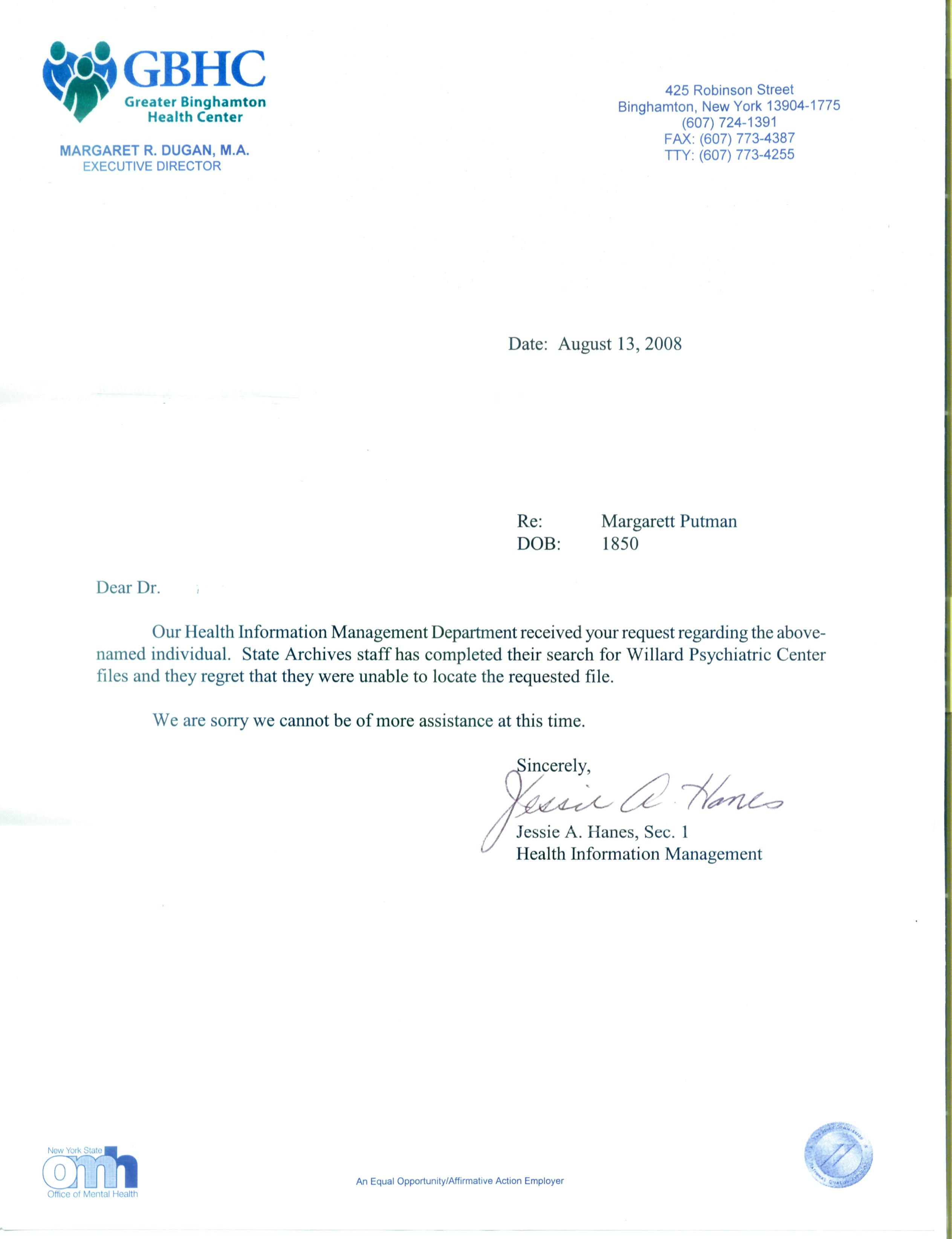
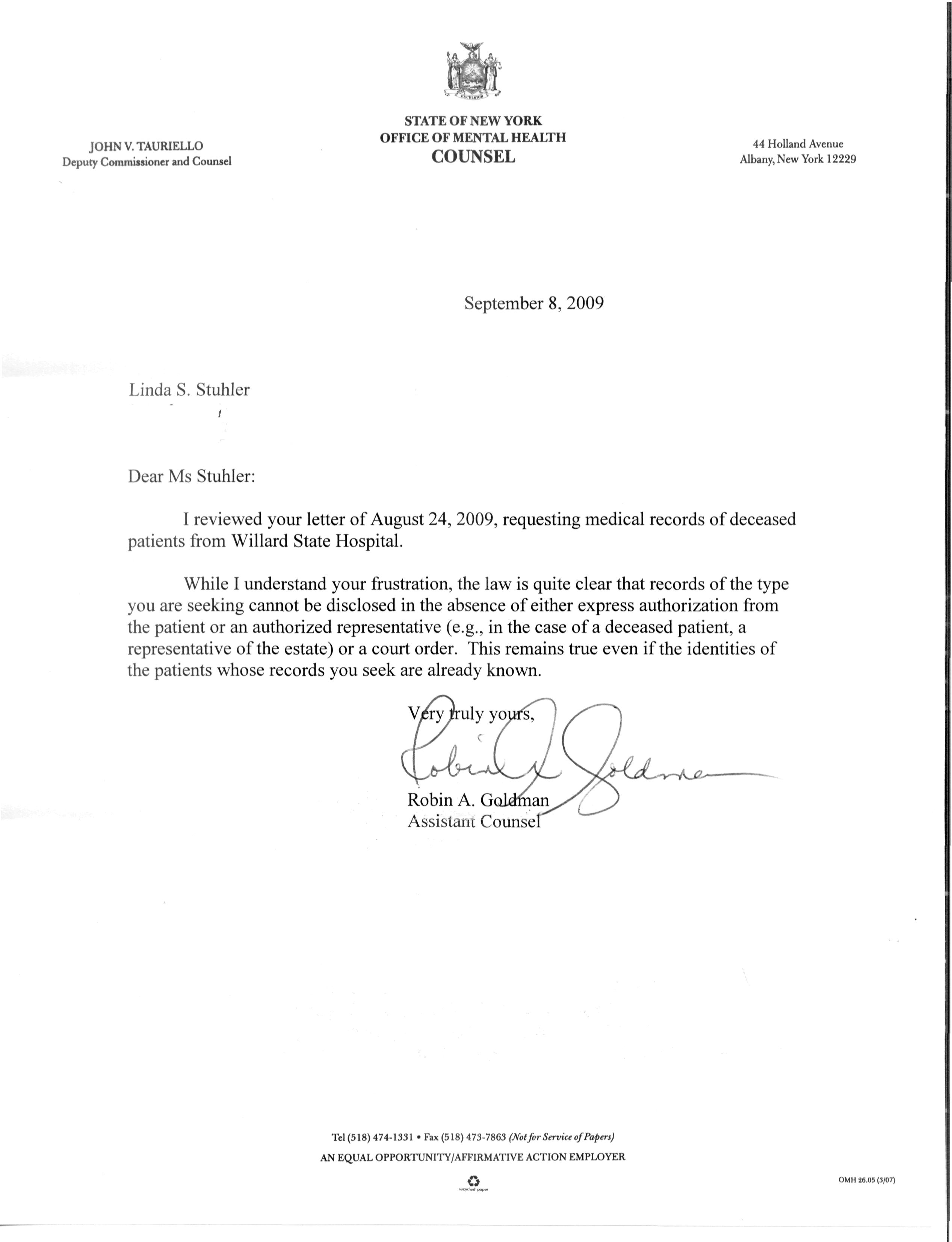
Richard and Maggie lived their entire married lives in Montgomery County, New York. Richard died and was buried there in 1924. Maggie moved in with my grandparents, who lived in Penn Yan, Yates County, New York, sometime after my great-grandfather’s death. About the year 1925, she was committed to Willard State Hospital and died there in 1928. When I sent Form OMH 11 to the Greater Binghamton Health Center requesting Maggie’s medical records from Willard, I wrote her name as “Margaret Orr-Putnam.” The letter that I received from them clearly stated “that they were unable to locate the requested file” of “Margarett Putman.” It is very clear to me that the New York State Office of Mental Health is no longer allowing the release of medical records of former “mental patients.” It would have been greatly appreciated if they would have told me the truth before I took the time and effort to have my physician fill out and mail in all the required paperwork.
I have shown below some of the sources that I used to document the life and death of Johannes Pootman. His property sat on the north corner of Union and Ferry streets which is now the site of Union College in Schenectady, New York.
“POOTMAN (PUTMAN) JOHANNES (Jan), sixteen years of age in 1661, was apprenticed by Jan Hendrickse Van Bael for three years to Philip Hendrickse Brouwer for his food and clothes. He married Cornelia, daughter of Arent Andriese Bratt and Catlyntje De Vos. His home lot, in the village, was on the north corner of Union and Ferry Streets, having 100 ft. frontage on the former street; later he purchased the 100 ft. lot next west, of Jan Roeloffse, son of the celebrated Anneke Janse. On the fatal night of the 8th of February 1690, both Pootman and his neighbor Roeloffse with their wives, were slain by the French and Indians. The following children were living in 1715, when they received their mother’s portion of her father’s estate (101 pounds, 13, 4): Arent; Maritie, married Stephen Bedeut; Victoor; David; Cornelis; Catalyntje, married Cornelis Post.”
SOURCE:http://www.schenectadyhistory.org/families/firstsettlers/oh_q.html
Genealogies of the First Settlers of Schenectady – Contributions to the Genealogies of the Descendants of the First Settlers of the Patent and City of Schenectady, from 1662 to 1800 by Jonathan Pearson (1873) is one of the standard works on early Schenectady genealogy, pages 142,143.
“List of ye people kild and destroyed by ye French of Canida and there Indians at Skinnechtady between Sat. and Sun. ye 9th of February, 1689/90. Joh. Pootman kild and his wife kild and her scalp taken off.”
SOURCE: Notes of Warren T. Putman at http://www.billputman.com. Callaghan, E.B.; Documentary History, State of New York; 1849, Vol 1; p. 305.
“They are both buried under a boulder in the ‘Old’ Cobblestone Church Yard, Rotterdam, Albany County, New York.”
SOURCE: Notes of Warren T. Putman at http://www.billputman.com. Putman, C.W.; Unpublished manuscript; 1914; p. 1; Schenectady Historical Society.
“ROELOFFSEN, JAN (De Goyer), son of the famous Anneke Janse, removed from Albany to Schenectady about 1670, in which year he accidentally killed Gerrit Verbeeck in the former place, for which he was pardoned by the Governor. His lot in Schenectady was on the north side of Union Street 100 Amsterdam ft. west of Ferry, the same lot now owned by Mr. Giles Y. Van der Bogart; this he sold to Jan Pootman, his neighbor on the east, reserving a life interest in the same for himself and wife. On the fatal night, Feb. 8, 1690, both were slain with their wives. Roeloffse left no children.”
SOURCE: http://www.schenectadyhistory.org/families/firstsettlers/r_sh.html
“In 1661 being then a resident of Beverwyck, he was apprenticed by Jan Hendrickse Van Bael for three years to Philip Hendrickse Brouwer. He was then sixteen years of age. (138-1) On Brouwer’s removal to Schenectady in 1662, Pootman became a resident here and shortly after married Cornelia, daughter of Arent Andriese Bratt. His house lot was on the north corner of Union and Ferry streets, having a front of 100 feet on the former street; later he purchased the 100 feet next west, of Jan Roeloffse, son of the well known Anneke Janse. (138-2) On the fatal night of Feb. 8, 1689/90, both Pootman and his neighbor Roeloffse with their wives were slain. Three of his sons, – Arent, Victoor and Cornelis arrived at maturity and had families. On the 6th April, 1709, Arent Pootman, the eldest son, conveyed to his brother Victoor, ‘a certain lot of ground being part of the lot now in my possession and occupation, bounded on the east and south by the common highway (Ferry and Union streets) and on the north and west by the other part of the lot of said Arent Pootman; in length on the east and west sides 217 feet and in breadth on the north and south 69 feet 4 in., wood measure.’ (138-3).
Notes: (138-1) 14 Sept., 1661, “Soo heeft Jan Hendr. Van Bael besteet ende Philip Hendr. Brouwer aen genomen Johannes Pootman, jong gesel out jegenwordich omtrent sestien jaeren, to serve said Brouwer, van drye achtereen volgende jaaren. Jan Pootman signed his name to the indentures in a clear and beautiful hand. Brouwer engaged to pay him 80 gl. a year in lieu of outfit, for his services.”
(138-2) Toll Papers; see also Roeloffse. (138-3) Old deed.”
SOURCE:http://www.schenectadyhistory.org/resources/patent/pootman.html. A History of the Schenectady Patent in the Dutch and English Times. 7: Adult Freeholders-Jan Pootman (Putman) Prof. Jonathan Pearson. [This information is from pp. 137-138 of “A History of the Schenectady Patent in the Dutch and English Times”; being contributions toward “A History of the Lower Mohawk Valley” by Jonathan Pearson, A. M. and others, edited by J. W. MacMurray, A. M., U. S. A. (Albany, NY: J. Munsell’s Sons, Printers, 1883).
The Dutch Reformed Church in America kept great records. There are a number of websites where volunteers have transcribed these church records dating back to the 1600’s in New Netherland. The Dutch used a system of naming their children called patronymics that used the father’s first name as the child’s middle name and in some cases, eventually, the father’s first name became the family surname. (Matronymics is the use of the mother’s or female ancestor’s name). The use of the beginning of surnames differs from country to country but the Dutch used patronymics in America and in the Netherlands into the 1700’s. Patronymics is a tool to convey one’s lineage. The father’s first name would be accompanied with different endings such as: zoon, sz, se, s and sen, which basically translates into “son of” or “daughter of” as you can see using Jan’s employer-master as an example: Philip Hendrickse Brouwer, means Philip son of Hendrick Brouwer. The problem with Johannes is that he had no patronymic middle name which is very rare considering the Dutch traditions. It is possible that his lineage wasn’t Dutch, maybe he was indeed an orphan and didn’t know his father, or perhaps, he didn’t like his father and wanted to distance himself from him. Attempts to find Jan’s father will be very difficult indeed.

Garret Putman General Store
New York State Office Of Parks, Recreation & Historic Preservation
“Putman General Store Located at Yankee Hill Lock Location: 553 Queen Anne Street, Amsterdam, NY 12010: Garret Putman opened this store in the early 1850’s. Putman’s Store began as a family run business. Garret and his son John were listed as grocers in the 1855 NYS census. By 1860 the Putman’s returned to farming while neighbors ran the canal store for them. In 1892 he was once again a storekeeper. By 1900 (or 1905 at the latest) it was no longer in operation. The store carried dry goods, fresh meat, poultry groceries, liquors and literature.”
Owners of the Putman General Store located on the Erie Canal were my third great-grandparents: GARRET VICTOR PUTMAN: Born September 19, 1793, North Mohawk, Montgomery County, New York. Died February 16, 1875, Yankee Hill, Montgomery County, New York. At the age of 81 years, 4 months, 28 days; and MARIA DOUWSE HANSEN: Born 1795, New York. Died December 5, 1866, Yankee Hill, Montgomery County, New York. At the age of 71 years.
Daughter of Garret and Maria Putman was: Deborah A. PUTMAN, born 1826 in Fonda, Montgomery County, New York; died 25 Apr 1898 in Tribes Hill, Montgomery County, New York. Age 72 years. Buried April 1898 in Tribes Hill, Montgomery County, New York, Pine Grove Cemetery. She married on 23 December 1847 in Montgomery County, New York, Jarvis Mudge PUTMAN, born 29 March 1827 in Tribes Hill, Montgomery County, New York; died 16 December 1883 in Amsterdam, Montgomery County, New York. Age 56y/8m/17d. Son of James PUTNAM (PUTMAN) and Catalina (VAN BUREN) PUTNAM.
My second great-grandparents, Jarvis Mudge Putman and Deborah Ann Putman were third cousins.
The line for Jarvis Mudge Putman is: Jarvis Mudge> James (Putnam)> John Arent> Arent Victor> Victoor Janse> Jan Putman (Pootman).
The line for Deborah Ann Putman is: Deborah A.> Garret Victor> Victor Jacob> Jacob Victor> Victoor Janse> Jan Putman (Pootman).
“Jarvis Mudge Putman is 34 NY, a shoemaker, living with his wife, Deborah Ann 34 NY, sons; Garrett 9, Richard 6, Charles E. 3, Marcus H. 1.” SOURCE: http://www.billputman.com: According to the New York State Census of 1860.
“Jarvis M. (Mudge) Putman: Amsterdam, Montgomery County, New York. He is a farmer, 44, NY, Debra (also a Putman) 44, NY, Garret H., 19, NY, Richard T., 16, NY, Charles E., 12, NY, Martha F. (Marcus), 11, NY, and Minnie, 7, NY.” SOURCE: http://www.billputman.com: According to the New York State Census of 1870.
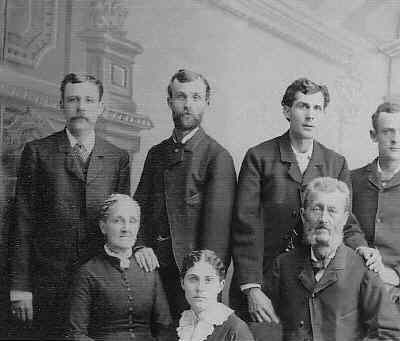
Jarvis Mudge Putman I & Family
Seated are Jarvis Mudge and Deborah Ann Putman. Standing are sons: Garret H.; Richard T. married Margaret A. Orr ; Charles E. married Lydia A. Barber and Elizabeth Mosher; and Marcus H. (I do not know who is who). Seated is daugher Minnie Estella who married Francis McCabe.
The only child born to Richard T. and Margaret A. (Orr) Putman was my grandfather, Jarvis Mudge Putman (Putnam). He was born on February 4, 1884 in Amsterdam, Montgomery County, New York and died on January 29, 1965 in Penn Yan, Yates County, New York, at the age of 80.

Jarvis Mudge Putman about 1894
Jarvis is standing on the bottom, far left corner of this photograph. He has a flower in his lapel. Montgomery County, New York about 1894.

Wedding Certificate of Jarvis & Bessie Putnam
As you can see on my grandparents wedding certificate, Jarvis’s surname is clearly spelled PUTMAN. My grandparents headstone clearly shows the surname PUTNAM. All of Jarvis and Bessie’s children used the surname PUTNAM. My grandparents have been gone a long time but I still miss them and cherish their memories.

Putnam Headstone

Jarvis & Bessie Putnam 4.10.1912

Jarvis & Bessie 1940s







 The Inmates of Willard 1870 to 1900 / A Genealogy Resource