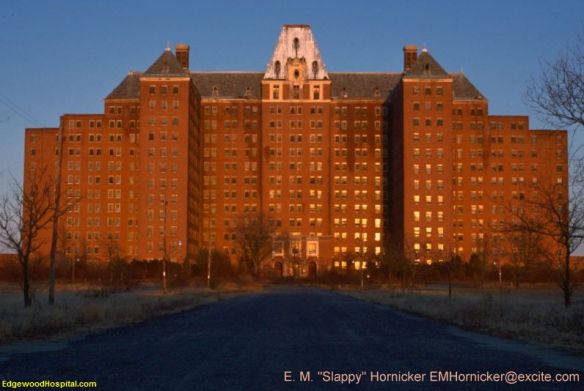
Edgewood State Hospital (Deer Park, Long Island) & Cemetery

Edgewood State Hospital (Deer Park, Long Island) & Cemetery

“Having a separate psychiatric hospital in Syracuse was the idea of Herman G. Weiskotten, M.D., Dean of the Syracuse University College of Medicine. At his urging, in 1926 the New York State legislature authorized the creation of Syracuse Psychopathic Hospital on land donated by Syracuse University at the corner of Irving Avenue and Adams Street. The first patient was admitted in 1930; the first clinic was held in 1931. name changed to Syracuse Psychiatric Hospital.”
A Short History of Selected Hospitals in Syracuse
CLICK HERE TO VIEW THE VIDEO They’re Buried Where? by Seth Voorhees
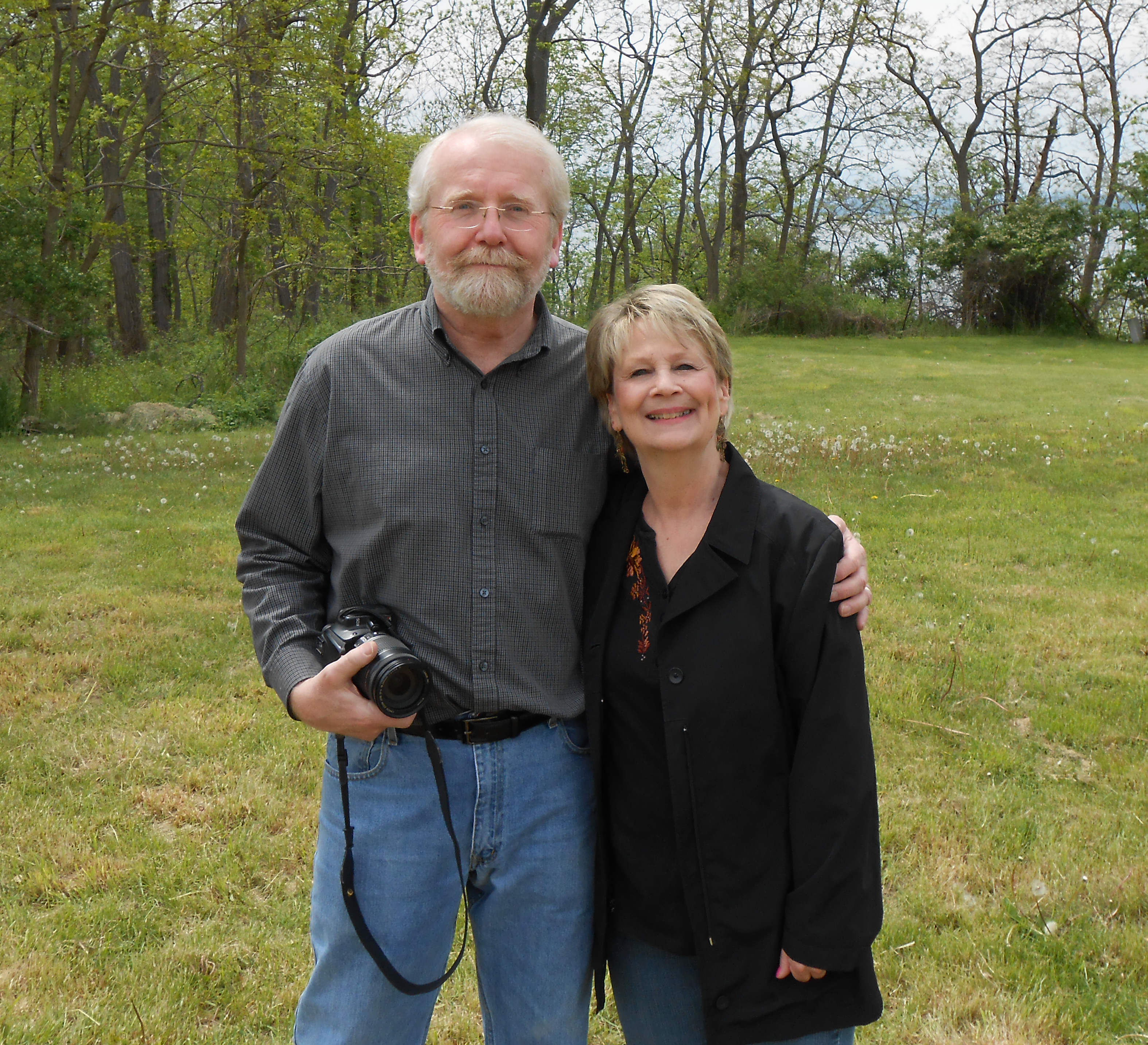
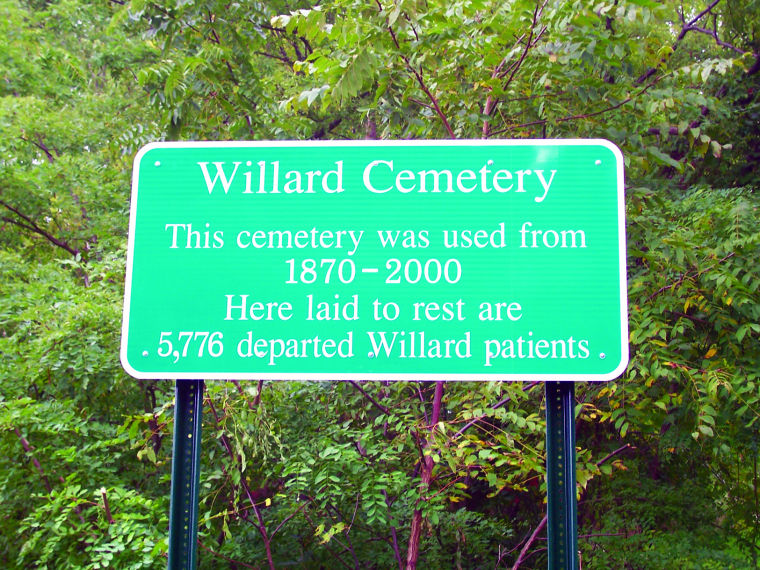
On Saturday, May 18, 2013, I visited the Willard Cemetery for a second time. This was the day of the annual Willard Tour that benefits a day care center on the old Willard property. Hundreds of people attended the tour and a good crowd gathered at the cemetery. Quite a bit has changed since my first visit on May 14, 2011, when the grass was up to my knees and no one was there but me, my husband, and two of our friends. It was a very sad place. The Willard Cemetery Memorial Project was formed by Colleen Kelly Spellecy in 2011. She has done a fabulous job organizing the group, having a sign installed at the entrance, raising awareness about the project, getting the cemetery lawn mowed, and collecting donations. I was happy to see so many concerned people at the cemetery.
Now there is hope, not only for the Willard Cemetery but for all state hospital and custodial institution cemeteries across the State of New York. A bill was introduced to the NYS Legislature in March 2012 and was re-introduced on January 18, 2013 as S2514-2013. If this bill becomes law, then the names of our forgotten ancestors will be released. They will finally be honored and remembered with dignity. This bill specifically addresses the “burial records” issue. Although HIPAA has stepped out of the way to allow individual states to release “medical records” 50 years after a patient has died, I am not sure if this issue was specifically addressed in this bill. Let’s take one step at a time and be grateful for what is in the works right now! Anyone who has ever dealt with the New York State Office of Mental Health in trying to obtain any type of information on an ancestor, whether it concerns asking where they are buried or obtaining a medical record, knows how arrogant and non-responsive they are unless you have a Ph.D. after your name. This needs to change.
Another fact that people don’t realize is that the great majority, if not all, of these historical cemeteries are “inactive” which means no one else will be buried there. I hope that ALL names are released including more recent burials. For example, when Willard closed in 1995, a gentleman was transferred to another facility. When he died in 2000, he asked to be buried in the Willard Cemetery because this was his home. Who will be here in 2050 to add this man’s name to a headstone or memorial? Who allowed these cemeteries to become forgotten?
Who was sent to Willard? Anyone who was not considered “normal” including the elderly with Dementia and Alzheimer’s Disease. Remember, there really were no nursing homes until the 1950s. Others were Hearing Impaired, had Developmental Disabilities, were Trauma Victims including Victims of Domestic Violence and Rape (back then they called it “Seducer’s Victim”), had PTSD (Soldier’s Heart & Shell Shock), Menopausal Women, Depression, Anxiety Disorders, Brain Injuries, Stroke Victims, Epilepsy, Neurological Disorders, Psychiatric Disorders, and some were locked up because of their sexual orientation, personal beliefs, and religious beliefs. These people, their families, and descendants, have nothing to be ashamed of. That would be like being ashamed of heart disease or diabetes. Putting names on a memorial, headstone, or list, should not be offensive to anyone.
Also attending the tour on this day was Seth Voorhees, Senior Reporter for the Time Warner Cable news channel YNN that serves Rochester and the Finger Lakes. Mr. Voorhees was genuinely interested in my mission to get this law passed in New York and offered me the opportunity of an interview. Although I am not a public speaker, I jumped at the chance to get the word out to a larger audience. I can’t thank him enough for all the time he spent putting this video report together. This piece aired on YNN, Saturday, May 25, 2013. I also need to thank Senator Joseph E. Robach for drafting and introducing the bill to the New York State Legislature. I hope this piece will raise awareness about the anonymous graves issue as this was never about patient confidentiality, it’s about respect.
CLICK HERE TO VIEW THE VIDEO They’re Buried Where? by Seth Voorhees.
Not Forgotten by Colleen Spellecy.
The list of these former New York State Hospitals includes but is not limited to: Binghamton, Buffalo, Central Islip, Dannemora, Edgewood, Gowanda, Hudson River, Kings Park, Long Island, Manhattan, Matteawan, Middletown, Mohansic, Pilgrim, Rochester, St. Lawrence, Syracuse, Utica, and Willard.
The Feeble-Minded and Epileptic Custodial Institutions of New York includes but is not limited to: Craig Colony for Epileptics, Letchworth Village for Epileptics & Developmentally Disabled, Newark State School for Developmentally Disabled Women, Rome State School for Developmentally Disabled Adults & Children, and Syracuse State School for Developmentally Disabled Children. There may be more.
This photo is of the Civil War Veterans Section of the cemetery. They were provided with clearly inscribed headstones from the government. Colleen discovered that a few of them were not “inmates” of Willard but were residents of the town. I wonder how many other United States Veterans who served their country with honor but ended up at Willard are buried here among the 5,776 in anonymous graves?
Matteawan State Hospital for Insane Criminals – Men & Women.
1916 Matteawan State Hospital.
Beacon, Dutchess County, New York.
Matteawan State Hospital 7 Names – Find A Grave.
Twenty-Third Annual Report Of The Medical Superintendent Of The State Asylum For Insane Criminals, Matteawan, N.Y., For the Year Ending September 30, 1892.
[Post-Office, Fishkill-On-The-Hudson.]
OFFICERS OF THE ASYLUM 1892.
Manager:
Hon. AUSTIN LATHROP, Superintendent Of State Prisons.
Resident Officers:
H.E. ALLISON, M.D., Medical Superintendent.
J. ELVIN COURTNEY, M.D., First Assistant Physician.
LUTHER C. JONES, M.D., Second Assistant Physician.
JAMES F. HOWELL, Steward.
R.B. LAMB, M.D., Resident Clinical Assistant.
REPORT.
Hon. Austin Lathrop, Superintendent of State Prisons:
Sir.— The following pages which, in accordance with the statute, I have the honor to submit, constitute the first annual report issued from this new institution, which was created by act of the Legislature for the relief of the overcrowded asylum at Auburn, and is the thirty-third of a series presented annually since the original establishment of the State Asylum for Insane Criminals.
This new hospital structure of modern architecture, commandingly situated and furnished with every convenience for the care of its inmates, was occupied during the latter part of April of the present year; the first patients having been received by transfer from Auburn on the twenty-fifth of that month. The entire population of the Auburn asylum, a total of 261 patients, were moved into their present quarters and the new asylum organized and put in operation within a period of five days. Fortunately the transfer was made safely, without the slightest accident or any attempt at escape. The buildings and grounds at Auburn, which were occupied for more than thirty years, are now entirely relinquished, and the oldest of asylums for insane criminals is domiciled in these new quarters as its permanent abode.
Owing to the increased accommodations afforded by the opening of these new buildings, we have been able to provide for those patients who had, up to this time, been retained in the various State hospitals awaiting transfer to our custody, and who had previously been refused admission to Auburn for the lack of room. Because of this large and rapid influx the total number of admissions has more than doubled that of any previous year. During the year the various courts of the State have also, to a larger extent than heretofore, committed patients to this asylum directly. The practice, however, still exists of sending patients charged with crime to the general hospitals of the insane, where their presence is objectionable, and whence they are transferred to us under the provisions of chapter 515, Laws of 1884; the superintendents of the various State hospitals applying under this law to justices of the Supreme Court for orders permitting such transfers. We hope, when the scope and character of this institution become more widely known, that commitments in the future will be made to us directly in all cases where the plea of insanity prevails as a defense for criminal acts. It is the purpose of this hospital to care for all insane persons competed or unconvicted, who are charged with crime, whether the disease of insanity is known to exist at the time of arraignment or trial, or subsequently develops while undergoing sentence.”
SOURCE: Documents of the Assembly of the State of New York, One Hundred and Sixteenth Session, 1893, Volume I, Nos. 1 to 6, Inclusive, Albany: James B. Lyon, State Printer, 1893. Pages 203-208.
CLICK HERE TO VIEW THE VIDEO They’re Buried Where? by Seth Voorhees
Dannemora State Hospital was a state hospital prison.
1916 Dannemora State Hospital.
Dannemora State Hospital Cemetery – Find A Grave.
Photos Of Dannemora – Zach Babbie.
The Village Of Dannemora.
It appears that Dannemora State Hospital Cemetery (Clinton Prison) had inscribed headstones. The following link may be an incomplete list.
Dannemora State Hospital Cemetery – Find A Grave.
CLICK HERE TO VIEW THE VIDEO They’re Buried Where? by Seth Voorhees
THE BAD NEWS: Thousands Remain Nameless! 6.15.2015.
THE GOOD NEWS: One Man Is Remembered! 6.14.2015.
St. Lawrence State Hospital served the counties of Clinton, Essex, Franklin, Jefferson, Lewis, Onondaga, Oswego, and St. Lawrence.
1916 St. Lawrence State Hospital.
2014 St. Lawrence State Hospital Preservation Society.
There appears to be a group already in place that takes care of the St. Lawrence State Hospital Cemetery. They have placed a beautiful memorial in the cemetery and it appears that they will, in fact, let you know if an ancestor is buried there if you write them a letter. In the meantime, please visit St. Lawrence State Hospital Preservation Society.
CLICK HERE TO VIEW THE VIDEO They’re Buried Where? by Seth Voorhees
Pilgrim State Hospital served the counties of Brentwood, Suffolk, and New York. Pilgrim was the largest state hospital in New York State. At its peak in 1954 it held 13,875 patients.
2012 Pilgrim State Hospital History
Pilgrim State Hospital – OPACITY
Pilgrim State Hospital – Emptiness – OPACITY.
A word about TOM KIRSCH, the man who created OPACITY. His work is superb! You could spend a few hours just looking at his photographs!
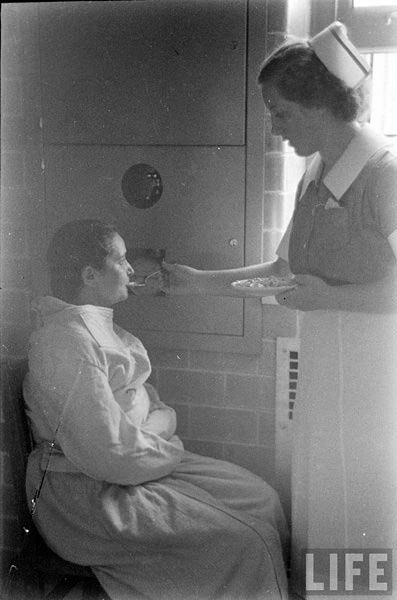
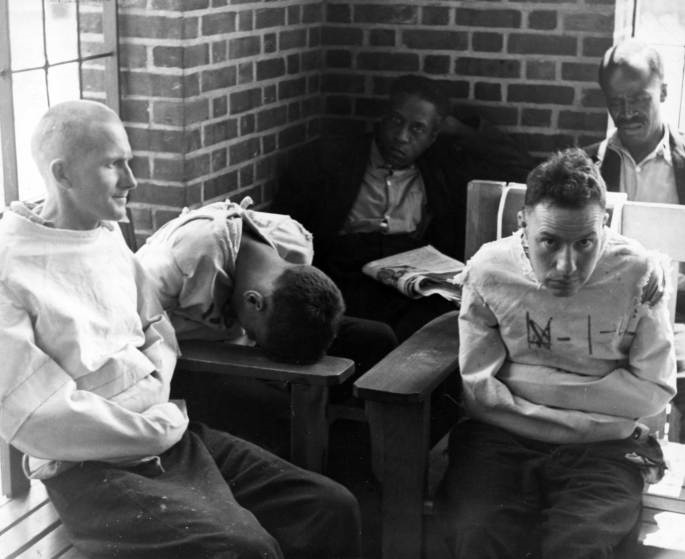
Life.Time.Com – Strangers To Reason: Life Inside A Psychiatric Hospital, Pilgrim State Hospital 1938.
(LIFE Magazine Article: The Shadow Of Insanity 1938.)
LIFE Magazine Article: The Shadow Of Insanity 1938.
CLICK HERE TO VIEW THE VIDEO They’re Buried Where? by Seth Voorhees
Mohansic State Hospital served the counties of Yorktown and Westchester.
CLICK HERE TO VIEW THE VIDEO They’re Buried Where? by Seth Voorhees
Middletown State Homeopathic Hospital served the counties of Orange, Rockland, Sullivan, and Ulster.
1916 Middletown State Homeopathic Hospital.
One of my blog followers has shared some great news about Middletown State Hospital. The Rockland Psychiatric Center has all the records for Middletown and will give the date of admission, date of death, and the marker number of your ancestor / loved one. The cemetery is located on Dorothy Dix Road, Middletown, NY. Call 845-359-1000 for more information.
Rockland Psychiatric Center
140 Old Orangeburg Road
Orangeburg, NY 10962
CLICK HERE TO VIEW THE VIDEO They’re Buried Where? by Seth Voorhees
At various times, New York City’s Insane Asylums included the asylums on Blackwell’s, Hart, Randall’s, and Ward’s Islands; and Central Islip. The Asylum for the Insane on Ward’s Island with branches on Ward’s and Randall’s Islands, were for Men. The Lunatic Asylum of Blackwell’s Island with branches on Blackwell’s and Hart Islands were for Women. On February 28, 1896, the New York City Asylum became Manhattan State Hospital. After 1896, it served the counties of New York and Richmond.
1916 Manhattan State Hospital.
1839 New York City Lunatic Asylum.
1887 Ten Days In A Madhouse by Nellie Bly.
1887 State of New York, State Board of Charities, In the Matter of the Investigation of the New York City Asylum for the Insane, Report, August 12, 1887.
Ward’s Island, now Wards Island.
Blackwell’s Island, Welfare Island, now Roosevelt Island.
Hart Island.
Randall’s Island.
Central Islip, New York.
New York City Map.
VARIOUS ARTICLES ABOUT MANHATTAN STATE HOSPITAL:
“Kings county and New York county provide for their insane under special statutes. The former county provides for 800 or 1000 insane and the latter for over 1,700. On Ward’s island is situated the State Emigrant Insane Asylum which provides for the insane emigrants for the term of five years from the time of their landing in this country. This asylum furnishes accommodations for about 200 patients. The annual expense per patient in this institution is $150. The per capita cost of building $1,138 and the total annual cost, $22,500. There are upward of 500 patients in private asylums so that the insane population of New York state is probably not far from 7,000 or 8,000 at the present time. . .The annual expense per patient in the two New York county institutions is in the New York City Asylum for the insane $92.89, and for the New York Lunatic Asylum on Blackwell’s island $73.84. The annual expense per patient in the Kings County Lunatic Asylum, situated at Flatbush, L. I., is $120. The total annual cost for these three county institutions for the insane is as follows: New York City Asylum for the insane, Ward’s island, $53,504 ; New York Lunatic Asylum, Blackwell’s island, $89,420 ; Kings County Lunatic Asylum, Flatbush, $92,400. . .”
SOURCE: Proceedings of the Conference Of Charities, Held In Connection With The General Meeting of the American Social Science Association, Detroit, May 1875, Tolman & White Printers, Boston, Mass., October 1875, Page 56.
“MEDICAL OFFICERS:
Hart’s Island – Superintendents. (First opened for 50 patients, January 23, 1877.) Dr. Armand Duploo 1877-1878; Dr. Andrew Egan 1883-1891; Dr. T. M. Franklin 1878-1879; Dr. George A. Smith 1892-1893; Dr. James R. Healy 1880-1882.
Ward’s Island – Department For Men. W. A Macy, M. D 1886-1897; Geo. F. M. Bond, M. D., acting med. supt 1890; Percy Bryant, M. D. 1897-1900.
Dr. Alexander Trautman, superintendent of the State Emigrant Hospital 1880-1881. Richard M. Lush, warden-in-charge 1872-1873. Dr. Alexander E. MacDonald 1874-1894 (Became general superintendent in 1894, so continuing until the departments for men and women were separated in 1900, when he became superintendent of the men’s division, so continuing until his resignation in 1903.) Dr. E. C. Dent 1904-1906; Dr. Wm. Mabon, supt. and med. director 1906.
Blackwell’s Island – Department For Women. Moses H. Ranney, M. D. 1857-1864; Ralph L. Parsons, M. D. 1865-1876; W. W. Strew, M. D 1876-1879; T. M. Franklin, M. D. 1880-1886; E. C. Dent, M. D. 1887-1895. (Institution abandoned in 1895.)
Ward’s Island—Women’s Department. Dr. E. C. Dent 1896-1906. (In 1906 the departments for men and women were consolidated and Dr. William Mabon became superintendent and medical director.)
Central Islip. Dr. H. C. Evarts, physician-in-charge 1889-1895; Dr. George A. Smith, superintendent 1895.
NEW YORK CITY ASYLUM FOR THE INSANE Medical Officers. Dr. J. N. DeHart 1875; Dr. Wickes Washburn 1875; Dr. W. V. Day 1875; Dr. John A. Arnold 1876; Dr. J. S. Christison 1876 …. ”
SOURCE: 1916 Manhattan State Hospital.
“The most serious fire in the history of the State hospital system occurred at the Manhattan State Hospital on Sunday morning, February 18, 1923. The fire, which started in an attic above ward 43 on the third floor of the right wing of the main building of the men’s division of the hospital, was discovered by an attendant at 5.15 A. M. An alarm was immediately sounded and a stream of water from the standpipe in the ward was quickly applied to the flames. In spite of the most strenuous efforts of the attendants and the fire department of the hospital assisted by the New York City firemen, the fire spread rapidly and destroyed the entire roof and third story of the right wing of the building before it could be checked. Heroic efforts to save all patients in the burning section of the building were made, but owing to the dense volume of smoke and the falling of a water tank, the work of rescue was rendered extremely difficult. Twenty-two patients and three attendants lost their lives in the flames. Two patients later died from exposure. As we go to press the cause of the fire is being investigated.”
SOURCE: The State Hospital Quarterly, Volume VIII, November 1922, No. 1, New York State Hospital Commission, Albany, New York, Publication Office, Utica State Hospital, Utica, N.Y., State Hospital Press, Page 318.
“On February 28, 1896, by act of the Legislature, the New York City asylums for the insane were transferred to state care, under the name of the Manhattan State Hospitals, with three divisions, namely: Manhattan State Hospital East (male department), Manhattan State Hospital West (female department), on Ward’s Island; and Manhattan State Hospital at Central Islip for both sexes. At that date there were 30 buildings at Central Islip. In 1912, not including a group of four in process of construction, there are 118.”
CLICK HERE TO VIEW THE VIDEO They’re Buried Where? by Seth Voorhees