Linda Stuhler is a Genealogy Geek from Rochester, New York, who loves to find out the facts. She has been researching her family tree for over twenty years and has accumulated an abundance of information on various subjects that she enjoys sharing on her blog at: https://inmatesofwillard.com/. She was responsible for the creation of the New York State Senate Bill S840, initiated in August 2011, which allows for the release of the names, dates of birth and death, of former patients who were buried in anonymous graves in New York State Custodial Institutions. The bill was changed from the original draft to S840A and does not work the way it was intended. It became a law on August 18, 2016, but it did not include provisions for a searchable database available to the public as New York State attorneys and the Office of Mental Health believed that if they did so, they would be sued. She is the author of "THE INMATES OF WILLARD 1870 TO 1900, A GENEALOGY RESOURCE."
“The Willard Cemetery Memorial Project chair Colleen Spellecy of Waterloo said the ceremonies will begin at 11 a.m., Saturday, May 16, 2015, at the cemetery, located near the east shore of Seneca Lake. It is being billed as a memorial celebration for all those interred at the cemetery in unmarked graves, with a special remembrance of Lawrence Mocha.” Two 3 hour tours of Willard will begin at 9:00am and 1:00pm with the Memorial Celebration at 11:00am.
Lawrence Mocha
Mocha was born June 23, 1878 in Austria. He emigrated to the United States in 1907, settling in New York City. He experienced some mental issues that ended up with him being sent to Willard in 1918. He stayed there until dying Oct. 26, 1968, at the age of 90.
Memorial Plaque
During his 50 years at Willard, he dug more than 1,500 graves for his fellow patients. The cemetery operated from 1870 to 2000, and those who died at the psychiatric center, both with and without family, were buried in graves marked only by a number.” SOURCE:Finger Lakes Times – March 22, 2015.
UPDATE 12.21.2014, From DARBY PENNEY: “A shout-out to the power of the press to shame government into doing the right thing, and the power of dogged activists to make change! Breaking news: Lawrence Mocha will be honored by name in the Willard Cemetery. Thanks to Dan Barry’s powerful 11/28/14 article in the NY Times, and years of hard work by Colleen Spellecy and the Willard Cemetery Memorial Committee, the New York State Office of Mental Health has changed their mind and will allow the plaque to be placed with his name and full information about him. They located a relative of Mr. Mocha who gave permission. In addition, according to Colleen Spellecy, “They also want to work with us on a general memorial honoring all of the individuals buried within Willard cemetery. After these memorials are installed they want to support a multi-denominational community service to re-consecrate the cemetery lands and dedicate the memorials. They will then invite the Mocha family to participate in this event and OMH will work with them to provide necessary travel arrangements.”
“OVID, N.Y. — For a half-century, a slight and precise man with an Old World mustache resided as a patient at the Willard State Psychiatric Hospital, here beside spectacular Seneca Lake. You are not supposed to know his name, but it was Lawrence Mocha. He was the gravedigger.
Using a pick, a shovel, and a rectangular wooden template, he carved from the upstate loam at least 1,500 graves, 60 to a row and six feet deep. At times he even lived in the cemetery, in a small shack with a stove, beside a towering poplar.
The meticulous Mr. Mocha dug until the very end, which came at the age of 90, in 1968. Then he, too, was buried among other patients in the serene field he had so carefully tended.
But you will not find the grave of Mr. Mocha, whose name you should not know, because he was buried under a numbered marker — as were nearly 5,800 other Willard patients — and the passing years have only secured his anonymity. The hospital closed, the cemetery became an afterthought, and those markers either disappeared or were swallowed into the earth.
Photo
A few original cast iron grave markers. Nearly 5,800 patients were buried under numbered markers to shield their names.Credit Ángel Franco/The New York Times
Now, though, this obscure gravedigger has come to represent the 55,000 other people buried on the grounds of old psychiatric hospitals across New York State — many of them identified, if that is the word for it, by numbers corresponding with names recorded in old books. This numerical system, used by other states as well, was apparently meant to spare the living and the dead from the shame of one’s surname etched in stone in a psychiatric hospital cemetery.
A retired schoolteacher, Colleen Spellecy, is seeking to end the anonymity, which she says only reinforces the prejudices surrounding mental illness. One way to do this, she says, is to place a plaque bearing Mr. Mocha’s name on the spot where his shack once stood.
“He’s a symbol for what we want to do with all the rest,” Ms. Spellecy said. “It’s almost like if we could just do something for one, we could do it for all.”
But the State Office of Mental Health, which oversees some two dozen hospital cemeteries tucked in upstate corners and along busy Long Island highways, has consistently denied her request. Its officials say that a generations-old state law protects the privacy of people who died in these institutions.
“Stigma and discrimination is alive and well, though I wish it were not,” said John Allen, special assistant to the commissioner of mental health. “Outing every family, whether they want to be outed or not, does not conform with the reality.”
But advocates say that other states have long since figured out how to return names to those buried under numbers — a process that the advocacy organization Mental Health America says would help to end prejudice and discrimination. In an email, its spokeswoman, Erin Wallace, wrote: “These people had names, and should never have been buried with us forgetting them.”
Larry Fricks, the chairman of the National Memorial of Recovered Dignity project, an effort to create a Washington tribute to all mental patients buried without names, agreed. He suggested that the cost of memorializing so many people could be a factor in a state’s reluctance — and some of those books with recorded names have been damaged and even lost over the many years. The issue is not trivial, Mr. Fricks said. “There is something embedded deep in our belief system that when people die, you show respect.”
In addition to his name and burial site, here is what else you are not supposed to know about Lawrence Mocha: Born poor in Austro-Hungarian Galicia in 1878. Hit in the head with a rock as a young man. Drank heavily, was briefly institutionalized, and served in the Army. Emigrated, and found work at Bellevue Hospital in New York City. Caused a ruckus one day and was sent to the psychiatric unit, where he talked of guilt and depression, of hearing God and seeing angels. Sent to Willard in 1918, never to leave. Kept to himself for years, but eventually took an interest in tending to the graveyard. Requested freedom in 1945, but was ignored. Made an extra dollar here and there by preparing bodies for burial. Stopped having episodes, if that was what they were. Dug, and dug, and dug.
Gunter Minges, 73, the last grounds superintendent at Willard, sat on his pickup’s tailgate at the cemetery’s edge and recalled Mr. Mocha in his last decade. A reclusive man, he said. Had special kitchen privileges. Smoked a pipe. Wore hip waders, because groundwater would fill his neat rectangular holes. “He dug until he died,” Mr. Minges said, and was rechristened with a number. Then, with a Catholic priest at graveside, the grounds crew used ropes to lowered Mr. Mocha’s coffin into a hole dug by someone else. “But where it is,” Mr. Minges said, “I don’t know.”
Many of the numbered metal markers, forged by hospital patients and spiked into the ground, vanished over the years, sold for scrap or tossed into a nearby gully as impediments to mowing. In the early 1990s, groundskeepers began affixing numbered plaques flat onto the ground, but the job was left incomplete when the hospital shut down in 1995. In a last-minute search of Willard’s buildings for items worthy of posterity, state workers opened an attic door to find 427 musty suitcases. Among them: a brown leather case containing two shaving mugs, two shaving brushes, suspenders, and a pair of black dress shoes that a slight and precise immigrant hadn’t worn since World War I.
The discovery of the suitcases led to an exhibit at the New York State Museum in Albany, a traveling display, and a well-received book about forgotten patients called “The Lives They Left Behind: Suitcases From a State Hospital Attic.” Confidentiality laws forced its authors, Darby Penney and Peter Stastny, to reluctantly use pseudonyms; Lawrence Mocha, then, became Lawrence Marek.
Ms. Penney said that for the last several decades of his life, Mr. Mocha exhibited no signs of mental illness and was not on any medication. Her guess: “There were certain people who were kept there because they were decent workers.”
Photo
Lawrence MochaCredit New York State Archives and New York State Museum
And Mr. Mocha was the meticulous gravedigger.
Ms. Spellecy read the book. She is a wife, a mother, and a retiree who lives in Waterloo, about a half-hour’s drive from Willard. Visiting the cemetery for the first time, she “sensed the injustice immediately,” she said, and quickly set about to forming the Willard Cemetery Memorial Project. Its mission: “To give these people a name and a remembrance.”
Ms. Spellecy and other volunteers got on their knees to begin unearthing the numbered plaques. They searched the surrounding woods to salvage discarded metal markers. With the help of another former groundskeeper, Mike Huff, they erected signs to identify sections divided by religion — Protestant, Catholic, Jewish — and planted a small boulder where Mr. Mocha’s shack stood.
They have also engaged in a contentious back and forth with the Office of Mental Health over its refusal to grant names to the dead — beginning with a plaque on that boulder to honor Mr. Mocha, and then, perhaps, a central memorial that would feature the names of all those buried anonymously or beneath numbers.
“It’s as if they are saying that they own the cemetery and therefore they own the names,” Ms. Spellecy said. “In so owning the names, they are owning the person — as if these people continue to be wards of the state.”
State officials say that they are bound by state law to protect patient confidentiality, even after death, unless granted permission by a patient’s descendants to make the name public. They also say that attempts to change the law have failed, and that, even now, some descendants express concern about prejudice.
Mr. Allen said that the state had worked with communities throughout New York to restore these cemeteries as places of reverence and contemplation, and had assisted families in locating graves. In fact, he said, “We have helped a number of families place a marker at a number.”
But without some descendant’s consent, Willard’s dead will remain memorialized by a number, if at all.
State officials also say that at the request of the Willard Cemetery Memorial Project, they are searching for any relatives of a certain individual — they would not say “Lawrence Mocha” — who might grant permission for the public release of that individual’s name. This is highly unlikely, advocates say, given that this individual never married and left Europe a century ago.
But Ms. Spellecy will not give up. She and other volunteers are developing a list of the dead through census rolls and other records, and hope to secure permission from descendants to have those names made public, perhaps even in granite. When asked why she has committed herself to this uphill task, Ms. Spellecy paused to compose herself. With her eyes wet from tears, she said: “Every stage of life is very sacred. Life deserves to be remembered, and revered, and memorialized.”
A few weeks ago, Ms. Spellecy and some others bundled up and went out again to the 29 acres of stillness that is the Willard cemetery. They removed a little brush and cleaned a little dirt from a few of the numbers in the ground. The autumn winds carved whitecaps from the steel-gray lake below, while fallen leaves skittered across a field of anonymous graves, many of them dug by a man buried here too, whose name, Lawrence Mocha, you are not supposed to know.”
The following excerpt from NEW YORK The Empire State is a wonderful outline for those who want to understand why County Poor Houses were created in the State of New York. Here are a few additional resources:
“Public Welfare – Though privation and hardship were fairly general throughout the Dutch Colonial period, the number of actual dependents was small, and relief, when needed, was administered by the officers of the Dutch Reformed Church. Churches of other denominations were expected to care for their own poor, an in localities lacking a religious organization relief was a function of the civil authorities. Funds for the poor were raised through church collections, individual donations, and court fines for misdemeanors and violations of the excise laws.
Soon after the organization of the Colonial Government, several sieck-entroosters, minor ecclesiastical functionaries, were sent to the Colony charged with the duty of visiting sick persons in their homes. These were the first social workers in what is now the Empire State.
For the dependent aged, almshouses were established by Dutch Reformed congregations at New Amsterdam, Rensselaerswyck, and other settlements, and a company hospital was erected in New Amsterdam in 1657 to care for sick soldiers and Negroes. Orphanmasters were appointed at New Amsterdam, Beverwyck (Albany), and Wildwyck (Kingston) to protect the interests of propertied widows and orphans, but when the latter became desititute they were turned over to the care of the deacons.
After the Colony came under English rule, poor relief in the southern counties was regulated by the Duke’s Laws (1665), which made each parish responsible for its own poor and for raising funds by taxation. The few general poor laws enacted were directed against vagabonds, beggars, and others moving from their places of legal settlement. Until formally accepted as an inhabitant of a town, a newcomer might at any time be “warned’ to depart by the authorities. An undesirable was ‘passed on’ from constable to constable until her reached his place of legal settlement or the border of a neighboring colony.
The prevailing attitude toward dependency was stern, cold, and strait-laced; in many places the pauper was made to wear a brightly colored badge on his sleeve inscribed with a large letter ‘P.’ No attempt was made to segregate the types of dependents; the insane and the physically handicapped, the aged and the young, the inebriates and the sober were housed together. The first public institution for ‘the employing of Poor and Indigent People’ was established in New York City in 1734 and opened two years later under the name ‘House of Correction, Workhouse and Poor House.’ The only method of caring for destitute children was through apprenticeship and indenture, by which children were bound out singly or in groups with the specification that their masters have them taught to read, write, and cipher.
During the Revolutionary War the local poor relief system broke down in many communities. Refugees from areas controlled by the British or ravaged by raids, not being chargeable to either county or town units, became the first ‘State poor,’ cared for by State commissioners. In the wake of the Revolution a great wave of humanitarian reform surged over the new Nation. Private philanthropic organizations were set up, the most important being the Society for the Prevention of Pauperism established in New York City. A sweeping revision of the penal code in 1796 reduced the number of crimes punishable by death from thirteen to two and established the first State prison. Corporal punishment, such as confinement in the stocks, whipping, and branding, was gradually abolished. Reforms were made in the laws against debtors. Public poor relief was completely secularized; the office of overseer of the poor was made elective instead of appointive; and towns too small to maintain individual almshouses were permitted to join others in town unions for the purpose of providing institutional care. Poor funds continued to be raised by local taxation supplemented by income from fines.
Several severe yellow fever epidemics at the turn of the century resulted in such public health measures as systematized quarantine, general sanitation, isolation of patients, and appointment of public health officers. The Ladies’ Society for the Relief of Poor Widows with Small Children was established in New York City in 1797 to help surviving dependents of fever victims. An offshoot of this Society founded the first orphan asylum in 1806. But child aid grew slowly, and for many years dependent children were herded indiscriminately with all other classes of dependents.
In the same period the insane were recognized as a separate social problem. In September 1792 the first mental patient was admitted into the newly opened New York Hospital, but treatment remained custodial rather than curative. The Bloomingdale Asylum, opened in 1821 as a separate unit of the New York Hospital, was the first institution for the insane in the State operated primarily on therapeutic principles. It received annual State grants for many years. The New York Institution for the Instruction of the Deaf and Dumb-second of its kind in the Untied States-was incorporated in 1817 and later received State grants.
In 1824 the secretary of state, J.V.N. Yates, published under legislative authority the first State-wide poor law survey, which revealed that besides almshouse and home relief, the indigent were being cared for under the ‘contract system,’ whereby the dependent poor were let out to householders at a fixed rate, and under the ‘auction system,’ whereby the poor were bid off to persons offering to maintain them for the lowest cost. After summing up the chaos, cruelty, and waste arising from prevailing poor law practices, Yates recommended a State-wide system of county poorhouses, where all paupers were to be maintained at county expense, the able-bodied to be set to suitable work and the children to be given adequate education.
As a result of the Yates report the legislature in 1824 passed ‘An act to provide for the establishment of county almshouses’; but so many exceptions were allowed that, although poorhouses were established in all but four counties during the ensuing decade, the attempt to put the county system into effect eventually collapsed and relief was returned to local responsibility. However, the indiscriminate herding of dependents resulted in abuses so shocking as to lead to constant pressure for proper classification and segregation of different groups. The earliest effective changes took place in the field of child welfare. In 1824 the House of Refuge for Juvenile Delinquents, the first juvenile reformatory in the country, was established in New York City by the Society for the Reformation of Juvenile Delinquents. It was supported mainly by State funds. In 1849 the Western House of Refuge (now the State Agricultural and Industrial School at Industry) was opened in Rochester as the first American juvenile reformatory under complete State financial and administrative control. The Asylum for Idiots (now the Syracuse State School) was established in 1851, the first of its kind to be opened under State ownership and control.
Several other important child welfare organizations were founded in the middle years of the nineteenth century, including the New York Juvenile Asylum (now the Children’s Village at Dobbs Ferry) and the Children’s Aid Society, which inaugurated the placing-out movement. The Thomas Asylum for Orphan and Destitute Indian Children was organized in 1855 under private auspices and taken over by the State in 1875. By 1866 the total number of privately managed orphanages exceeded 60.
A distinctive feature of this period was the development of State institutional facilities for the mentally and physically handicapped. The State Lunatic Asylum at Utica was established in 1836 and opened in 1843. The New York City Lunatic Asylum (now Manhattan State Hospital), founded in 1834, was the first municipal mental hospital in this country. The blind had received separate care as early as 1831, with the founding of the New York Institution for the Blind. In 1865 the State Institution for the Blind (now the New York State School for the Blind) was established at Batavia to serve the western counties.
Mass immigration in the nineteenth century brought in its wake grave problems of public health and poor relief. Large numbers of immigrants needed medical care upon landing; many were poverty-stricken; others were mulcted of their meager savings by thieves and swindlers. Without friends of funds, they soon found themselves drawn into the slums or the poorhouse, or were obliged to engage in the meanest forms of work for low wages and under conditions that exposed them to vice, disease, and death. Alarmed by the growing hordes of indigent aliens, poor-law officials demanded State and Federal legislation to protect local communities. In 1847 a State board was created to help and advise newcomers and to reimburse local communities for immigrant relief. Funds for this purpose came out of head taxes and indemnity bonds imposed on immigrants. The agitation against ‘alien pauperism’ culminated in 1882 in an act of Congress regulating immigration and containing a provision intended to exclude persons likely to become public charges.”
This is a very simple request. Please click the link below and sign this petition that will allow the Willard Cemetery Memorial Project to honor and remember with dignity former patient and resident grave digger, Lawrence Mocha, with a plaque at the Willard State Hospital Cemetery. Thank You!
Support New York State Senate Bill S2514 that will allow the release of the names, dates of birth and death, and location of graves of former patients buried in anonymous, unmarked graves in long-closed NYS Hospital and Custodial Institution Cemeteries! There are THOUSANDS of forgotten souls who deserve to be remembered with DIGNITY! This bill introduced by Senator Joe Robach has been before the NYS Legislature for over three years. It is time for this bill to become law! http://www.youtube.com/watch?v=gtaQX8uQdmY
When I first started this blog, I did it in order to help other people find their forgotten ancestors. I persuaded my State Senator, Joe Robach, to draft legislation in 2011 that would allow for the release of patient names, dates of death, and location of graves to the public, which he introduced to the New York State Legislature. It first appeared on March 23, 2012 as S6805-2011. On January 8, 2014, it was reintroduced as S2514-2013.
There are at least 17 former New York State Hospitals / Insane Asylums that have been renamed, closed, demolished, or turned into New York State Prisons. The cemeteries located on former NYS Hospitals are filled with anonymous, unmarked graves. Willard alone has close to 6,000. Some of these former State Hospitals, such as Buffalo and Rochester, used city or county cemeteries and they are filled with the nameless as well. How many? I do not know. How long will it take to give these people the dignity in death that they deserve? When will they be allowed to rest in peace? When will they be remembered as fellow human beings who were on the same earthly path as everyone else before their lives and their freedom were taken from them? What else do I have to do to get the attention of the Governor and Assembly members to release the names of former patients who lived and died in these warehouses? The Department of Health and Human Services declared last March that patient medical records may be released to the public after 50 years of a patient’s death. Now we have to ask for another bill to be drafted and introduced to the Senate again in order to allow New York State to release medical records. After seven years on this journey, I am tired and just don’t have the desire to fight anymore.
Before I began my research on Willard and the other New York State Hospitals and Custodial Institutions, I considered myself to be normal, whatever that means. All kinds of interesting things happened to me and I wondered, why? I lost my job, went through menopause, osteoarthritis, and a neurological problem that I have always had, had become progressively worse. Depression is one of those “Mental Illnesses” that I never thought of as a “Mental Illness.” I thought that depression was a normal human emotion that one experiences when subjected to trauma or pain in any of its various forms. I would not have believed that I was “Mentally Ill,” until my neurologist, who I no longer go to, informed me that I have delusional thinking and I’m paranoid because I believe that I can no longer protect myself if I needed too like being able to run from a dangerous situation. This came from a 30 something year old man in perfect health who stands over 6 feet tall. I’m 57 years old, stand 5 feet 2 inches tall, and have Familial or Essential Tremors in my head and my right hand. My thinking is based on facts, not delusions. I thought that doctors were above this archaic type of thinking but I was wrong. Many men, even doctors, still don’t get it.
The reason why I am relating my story is that I am sure that had I lived one hundred years ago with these same progressive diseases, I would have been locked up! I would not have believed that a doctor would ever say such things to me and I can only imagine what must have happened to my great-grandmother, Maggie, who died at Willard State Hospital 86 years ago. If you wonder why people do not seek help, my little story is why they don’t. Am I labeled? I don’t know. It is frightening when you realize that you’re not feeling like your normal self, and seek help, and this is what a doctor says to you. Maybe we all need to be a little more aware of who is crazy and who is normal and realize that the people buried in those anonymous, unmarked graves were human beings like me, and you, just trying to make their way in life. Please write or call your New York State Senator so that this bill will become a law. Thank you!
Here is another wonderful genealogy resource for those who are looking for loved ones who lived and died at St. Lawrence State Hospital in Ogdensburg, New York. Please take a moment to visit their website.
“The historical structures of the St. Lawrence State Hospital are worth being memorialized, not dismantled, though their destruction is most likely inevitable. They stand now with windows broken, paint peeling, and frames crumbling. The St. Lawrence State Hospital Preservation Society’s mission is to collect, preserve, interpret, store, and disseminate anything historically related or relevant to the hospital, whether it be New York State Assembly documents, plans and drawings, reports, or personal accounts. Countless hours already have been spent gathering much of this information, which is, in turn, available to you here, on the Society’s official website. And countless more hours are still to be spent before this work is complete. It has been a long and often difficult process, and it has only just begun. We’re hoping that as more people become interested in this research and take up the challenge to help preserve it, information that we might never have expected will come to light, furthering this cause.”
St. Lawrence State Hospital-Grave Markers & Casket
TREASURES OF THE TIER by Roger Luther is a column about Historic Locations in New York’s Southern Tier. Roger has also created nysAsylum a website that has countless photographs and historical information on Binghamton, Buffalo, Utica, and Willard State Hospitals.
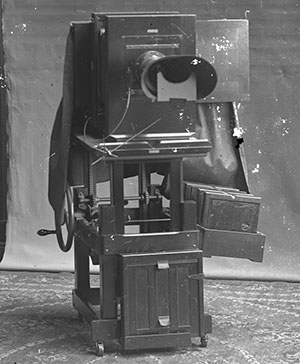
Camera-Roger Luther
The discovery of these rare, historical photographic dry plates tells us a few things. One, photographs do indeed exist of patients who lived and died at Binghamton State Hospital over one hundred years ago. It also tells us that the New York State Office of Mental Health never took the time to save and preserve these important artifacts and didn’t give a hoot about them until the finding was brought to their attention. As usual, now they are very concerned. I believe the burial ledger was also found among the piles of dirt, dust, and pigeon poop. It will be interesting to see if the OMH will let these photographs be released and viewed by the public, or if they will come up with some lame excuse as to why we are not allowed to view them. Thank You, Roger Luther and the volunteers of the Broome County Historical Society and the Greater Binghamton Health Center, for meticulously scanning, restoring, and preserving these historical artifacts!
Materials-Roger Luther
The following article “Windows Into The Past-Thousands of Glass Photo Negatives Discovered in Binghamton’s Historic Asylum” by Roger Luther is reprinted with permission. Please click on the RED link below to view more photographs. Sorry friends, there are no photographs of patients.
Photographic Dry Plates-Roger Luther
“Sarah was led from her ward to a nearby building. Entering a small room she sat motionless in a chair facing a large strange-looking wooden contraption. In a flash, her photograph was taken. The man behind the camera told her to turn her head to the right and then… another flash. While Sarah was led away, the photographer removed a large wooden frame from the camera and inserted another for his next subject.
Later in his darkroom, a 5×7-inch glass plate was carefully removed from its wooden frame and washed in chemical baths revealing two black & white negative images of Sarah’s face and profile. The photographer then scribed Sarah’s name and a number on the back of the glass plate and placed it in a box with several others.
That was one hundred years ago, and according to the U.S. Census of 1900, at that time Sarah was listed along with 1,388 others as a patient at Binghamton State Hospital.
A century after her photograph was taken, preparations were being made to rehabilitate the long-vacant Main Building, known as the Castle, on the campus of the former Binghamton State Hospital. A small team of volunteers representing the Broome County Historical Society and the Greater Binghamton Health Center, took on the task of removing items of historical significance from the building, then relocating them to a controlled environment and cataloguing each of the artifacts. Early in the process an amazing discovery was made. A door at the back of the old asylum chapel opened into a small room piled high with various items and debris. Photographs, books, documents, and a variety of other items were mixed with pieces of fallen ceiling plaster, decomposed pigeon parts, and a thick mixture of dirt and dust.
Like excavating an archeological site, layer by layer the material was carefully removed. At one point a small stack of dusty glass plates was uncovered, each measuring 5×7 inches. Holding one of the plates up to a window, a negative image on the glass could be seen. These glass plates were in fact hundred-year-old photographic negatives. Soon, more plates were uncovered in a broken cardboard box, and the dig continued. At the bottom of the pile several more boxes were found. Ultimately, hundreds of glass plates were discovered scattered throughout the room, some broken, some cracked, and most covered with a layer of dirt and plaster dust. Finally a path was cleared to the back of the room where a tall wooden cabinet stood. The cabinet door was pried open and there it was… the mother lode. Over the next several days over 5,000 glass dry-plate photo negatives were removed from the room.
After relocating the glass plates to a controlled environment, a plan was established to carefully clean the plates and then package them in protective acid-free archival material. The next step would be to digitally scan and catalogue each image – an ongoing effort that continues to this day.
Taken over an approximate 25-year period during the early 1900’s, the photos show life at the StateHospital as it was in the earliest years. Subject matter includes hospital staff, buildings, farms, medical charts, and events – but by far, most of the photos are of patients.
As stated in the 1892 Annual Report of the Trustees of Binghamton State Hospital, “it is very desirable to preserve with the records of cases treated in the hospital, photographs of the individual patients.” The report goes on to say that “the modern dry-plate methods of photography are so simple that they are easily managed… the sum we should require to purchase the apparatus necessary would be $300.” Soon after that a camera was procured, and in 1894 one of the nurses at the hospital, Fred W. Ernie, took on the task as photographer along with his other responsibilities.
The trustees could not have known how significant their decision would prove to be. Thanks to their foresight, images were recorded representing thousands of lives-once-lived. Images, that according to Mark Stephany, Director of the Greater Binghamton Health Center, “restore a level of dignity to people long forgotten.”
Today, the images would be invaluable as a resource for historians and those researching family history, however, issues regarding possible public access cannot be addressed until the restoration and scanning effort has been completed. As stated by Darby Penney, co-author of The Lives They Left Behind: Suitcases from a State Hospital Attic, “the discovery, rescue and conservation of this collection of 5,000 images from Binghamton State Hospital is an incredible feat of preservation and an invaluable contribution to the historical record.”
What happened to Sarah? Nearly 30 years after her listing on the 1900 census, while still a patient at the StateHospital she died and was buried in the hospital cemetery, her grave marked only by a number. But her story does not end there. Construction of an interstate highway in 1961 cut directly through the cemetery forcing the relocation of 1,504 of its nearly 4,000 graves to a nearby field. According to records released by the Department of Transportation at the time, Sarah’s grave was among those moved. Today the relocated cemetery appears as a large empty field, its numbered stone grave markers having long ago settled below ground.
Sarah’s existence, like many of the others on that census list, was one of obscurity. But unknowingly, she and the other patients left their mark for posterity. Like a century-old Facebook, the discovery of this 100-year old time capsule has brought their images to light – and as these faces from the past are being restored and preserved, so to is the dignity of people long forgotten.”






 The Inmates of Willard 1870 to 1900 / A Genealogy Resource