Creedmoor State Hospital & Cemetery

Creedmoor State Hospital, Long Island, New York

The Lost World Of Creedmoor Hospital – New York Times.
Fear And Brutality In A Creedmoor Ward – New York Times.
Inside Creedmoor State Hospital’s Building 25 – AbandonedNYC.
Creedmoor Psychiatric Center – Wikipedia.

“REPORT OF THE BOARD OF MANAGERS, October 30, 1912.
To the State Hospital Commission, Albany, N. Y.:

Gentlemen. – We respectfully present the annual report of the Board of Managers of the Long Island State Hospital for the year ending September 30, 1912. The operations of the hospital during the year have been described in sufficient detail in the report of the Superintendent, which we adopt and present as part of our own…..The beginnings of the development of the Creedmoor property have been made with some success and a promise of much larger achievement. The report of the Superintendent gives details. Plans for an institution with a capacity of over 2,000 have been presented to the Board by the State Architect, discussed at length and finally adopted. It is earnestly hoped that definite action to carry them out may be made possible by legislative appropriation. The necessity for such provision is apparent to all who have given even slight study to the problem of the metropolitan insane. We are gratified that the need of thorough rehabilitation of the present hospital has been recognized by the Commission to the extent that the report of the Superintendent shows; and that in addition, appropriations are being considered for further alterations in the buildings and the erection of several new ones.

Respectfully submitted, A. E. ORR, President, Board of Managers of the Long Island State Hospital.

CREEDMOOR – The land and premises situated at Creedmoor in the town of Queens, thirteen miles distant from the main hospital, acquired by legislative act of 1908, have continued subject to the control of the Commission and the board of managers of the Long Island State Hospital. This property originally comprised 192 (200) acres, but at a time when it was decided to sell this land and acquire a new site, nearly seven acres for roadway purposes were sold to the Long Island Motor Parkway, Incorporated, for $18,942. This money was reappropriated by the Legislature for the alteration of the existing buildings and for new construction generally. The roadway passes through the grounds diagonally in a northeasterly direction, and for the most part through the wooded, upland portion of the premises. It is below grade and properly protected by a fence and an overhead crossing. The parkway would not seriously interfere with the erection of new buildings for hospital purposes in the level area southeast therefrom, and some preliminary steps have been taken and are still under way to plan for such buildings, since the difficulty of acquiring a new site on Long Island is fully recognized by the Commission and the Managers. In April, 1912, the Governor signed, among other items in the Omnibus Bill, an appropriation of $50,000 for the commencement of the erection of buildings, including a railroad switch, power house and farm cottages.

As soon as a suitable block plan for a hospital is approved, the expenditure of moneys already appropriated will be made, since it is necessary to first decide upon a general hospital scheme before the installation of a railway, system of sewage disposal and other initial steps can be properly gotten under way. In the meantime, however, the property has been put to use to the extent of colonizing it with thirty-two patients. This was done early in the summer. The patients have been located in one of the twelve regimental buildings, and the necessary money to put this building in order was taken from the special legislative appropriation as a result of the sale of the strip of land. Patients have been employed daily at farm work, and the area of farm land under cultivation has been somewhat over forty acres. Care has been observed in the selection of the patients who have resided at Creedmoor, and no complaint has resulted from their presence in the neighborhood. There is no reason why the colony system cannot be enlarged. There are sufficient buildings to accommodate two hundred or more patients conveniently. On the following page is shown a view of the building at Creedmoor which is occupied by patients.”

Long Island State Hospital - Creedmoor

Long Island State Hospital – Creedmoor

SOURCE: Annual Report of the Long Island State Hospital to the State Hospital Commission For the Year Ending September 30, 1912, Albany, J.B. Lyon Company, Printers, 1913, Pages 6, 16, 17.

Creedmoor. A tract of land in east central Queens, one mile (1.6 kilometers) north of Queens Village and centered on Braddock Avenue and old Rocky Hill Road (now Braddock Avenue), named for the family that farmed there. The name is used only locally and does not refer to any village or settlement, past or present. Conrad Poppenhusen of College Point ran a railroad through the area parallel to Braddock Avenue in 1871 and donated some of the surplus land to the National Rifle Association for use by the National Guard, which opened firing ranges in 1873. The growth of Queens Village from the 1890s and the hazards connected with the firing ranges led to the eviction of the National Guard in 1908. In 1910 the tract became the site of a large state mental hospital.”

Creedmoor Psychiatric Center. State mental hospital on Winchester Boulevard near Queens Village, built on land originally owned by the Creed family. It opened in 1912 as a “farm colony” for the Brooklyn Psychiatric Center in facilities formerly used as barracks for the National Guard. With the construction of new buildings in 1926, 1929, and 1933 Creedmoor became a separate state hospital. Although its nominal capacity was 3,300 patients, there were 6,000 patients by the 1940s, and overcrowding was exacerbated by staff shortages and limited funds. During these years various new treatments for mental illness were introduced at Creedmoor, including hydrotherapy, insulin therapy, electroshock therapy, and in a few cases lobotomy. A more important innovation was the introduction of antidepressant and tranquilizing drugs, which became widely used in the state mental health system in 1955. At Creedmoor the new drugs meant quieter wards, fewer injuries to staff members and patients, and a dramatic increase in the number of patients who could manage daily life in the community. As a result the number of inpatients at the hospital declined to 1,100 by 1991, while outpatient services and residential placements were expanded in keeping with the new policy of deinstitutionalization. When it became clear during the late 1980s that many of the homeless in New York City had urgent psychiatric needs, Creedmoor established a special impatient program of psychiatric rehabilitation intended specifically for the homeless. The Living Museum, presenting art by patients, was founded by Bolek Greczynski in 1984 in the hospital. In 2001 the city sold part of the mental hospital to residential developers and used another portion to develop three schools and athletic fields.”
SOURCE: The Encyclopedia of New York City: Second Edition, Kenneth T. Jackson, Lisa Keller, Nancy Flood, Yale University Press, 2010.

Brooklyn State Hospital, Brooklyn.
The institution is very greatly overcrowded, but it is hoped to obtain relief at an early date. There is under construction, and to be soon completed, a reception hospital and a building for the care of the chronic type of patients. The reception hospital will accommodate about 150 patients, while the building for the chronic type will accommodate 450.

Foundations for a new store house and cold storage building have been laid. A large number of repairs have been accomplished during the last year. The domes of the main building have been renewed and painted. A large quantity of flooring has been laid and a number of the wards have been repainted.

A number of cottages at Creedmoor are being remodelled and made ready for occupancy, and it is expected shortly to house at least 150 patients at this branch.

This hospital has been visited during the year by the State Finance Committee, the State Hospital Development Commission and the State Hospital Commission, and it is the concensus of opinion that the present old building should be razed and new ones built. There is planned a new and modern psychopathic hospital that will accommodate the needs of this portion of Greater New York.

When plans have been consummated, this site will accommodate about 2,100 patients, while at Creedmoor plans are in contemplation for about 2,500 patients.

The medical service is very active at this institution. At least 51 per cent of the cases admitted are of the feeble and exhausted type, or of the very acute maniacal type, and are brought in on stretchers. Those who are physically able are sent to Kings Park. The admissions here during the year were 626. Beginning July 1st, we organized a school for male patients and a male instructor was appointed. It is hoped to obtain very beneficial results from the re-education of certain cases.

In August, 1916, a social worker was appointed who has been of great benefit to the institution and to the paroled patients. She visits all patients who are paroled, attends the clinics, inspects environmental conditions, obtains positions for recovered patients, and assists in obtaining proper histories for the physicians. Three outdoor clinics are held weekly, one at the Brooklyn State Hospital, one at the Williamsburg Hospital on Saturdays; and one at the Long Island College Hospital on Fridays. These clinics are of great value, as it is through them that information is spread that is of great use to the general public. The present census is 925; the certified capacity is 637, and 70 patients are on parole.

At the east of the institution there is an old potters’ field which has been used for years for the burial of the poor of Kings County. This land was turned over to the state two years ago, and it is now proposed to construct buildings on this area. Therefore the Charities Department of the City of New York was requested to remove the bodies buried there by that department during the last two years, and several hundred bodies were taken away during the summer.
SOURCE: The American Journal of Insanity, Volume 74, 1917, Pages 353-354.

BROOKLYN (Brooklyn State Hospital)
An investigation of the sanitary conditions of the Brooklyn State Hospital at Brooklyn was made by Mr. C. A. Howland, assistant engineer in this Department on August 15, 1919. Previous examinations of the sanitary condition of this institution were made by this Department in 1915, (see page 906 of the 36th Annual Eeport) and in 1917 (see page 642 of the 38th Annual Report).

Location: The main institution is situated in the borough of Brooklyn, New York City, while Creedmoor Farm is located north of the village of Creedmoor close to the eastern boundary of Queens borough.

Site of institution: The hospital is situated in Brooklyn on Clarkson avenue just east of the Kings County Hospital. Although the grounds of the institution in Brooklyn are somewhat flat they are apparently well drained. At Creedmoor the farm land, much of which is under cultivation, is also flat but appears to be well drained.

Area of grounds: 25 acres in Brooklyn; 195 acres at Creedmoor; total, 220 acres.

Number of occupied buildings: 14 (2 practically complete but not occupied, one in course of construction).

Capacity: 343 men, 457 women, 305 employees; total, 1,105.

Present population: 441 men, 603 women, 206 employees; total, 1,252.

Class of inmates: All classes of insane except the criminal insane.

Water supply: The water supply for the main institution in Brooklyn is obtained from the Flatbush Water Company while the water supply for the Creedmoor farm is obtained from the Jamaica Water Supply Company.

Milk supply: The milk for the main institution in Brooklyn, which amounts to about 400 quarts of fluid milk, grade B, pasteurized, and 40 quarts condensed milk, are purchased per day from the Delancy Milk and Cream Company of Brooklyn. At Creedmoor farm the milk supply is obtained from a herd of five cows. The cow barn in which the milking is done is an old wooden structure which was not in a satisfactory sanitary condition at the time of the inspection.

Sewerage and sewage disposal: The sewage and storm water of the institution in Brooklyn is discharged through combined tile and brick sewers ranging in size from 6 to 18 inches into the sewerage system of the city of Brooklyn. At Creedmoor the sewage is at present discharged into two large cesspools located about 300 feet northwest of the building. A sewage disposal plant which will treat the sewage from the hospital to be ultimately constructed at Creedmoor is in the course of construction. This disposal plant will consist of Imhoff tanks, siphon chamber and sand filters, of which the inlet chamber, Imhoff tank and siphon chamber have been completed.

Refuse disposal: The garbage of the institution is fed to pigs at the Creedmoor farm. The garbage not suitable for feeding is disposed of in the institution incinerator. At the time of the inspection it was found that the piggery was not in a satisfactory condition and the engineer was informed that a new piggery is to be constructed. It was found that the barrels in which the garbage is stored at the institution were in some cases without covers. Rubbish, such as broken crockery, etc., is removed by the city street cleaning department. Waste paper is baled and sold and similar disposal is made of the rags. Combustible refuse is collected twice daily and burned in an incinerator of the Morse-Boulger Destructor type.

As a result of this examination the following recommendations were made in regard to the improvement of certain insanitary conditions found at the institution.

Recommendations:
1. That the garbage receptacles be kept covered at all times.
2. That a modern piggery of proper design and construction be built as soon as possible.
3. That every precaution be taken in the handling of the milk at the Creedmoor farm in order to prevent the communication of disease by this means and that a plant for the pasteurization of the milk be installed as soon as practicable.
4. That the sewage disposal plant for Creedmoor be completed according to the plans approved by this Department and be put in operation as soon as possible.
SOURCE: State of New York, Fortieth Annual Report of the State Department of Health for the Year Ending December 31, 1919, Volume II, Report of Division of Sanitary Engineering, Albany: J.B.Lyon Company, Printers, 1920, Pages 421-422.

I’m not sure if Creedmoor State Hospital had a cemetery, they may have used a public cemetery.

CLICK HERE TO VIEW THE VIDEO They’re Buried Where? by Seth Voorhees

THE BAD NEWS: Thousands Remain Nameless! 6.15.2015.

THE GOOD NEWS: One Man Is Remembered! 6.14.2015.

Lin Stuhler’s Willard Cemetery Project

Thanks, Jon!

joncrispin's avatarJon Crispin's Notebook

Central stairway, Chapin House, Willard Asylum

There are a lot of great and interesting people working on New York State asylum issues.  I have been following Lin Stuhler’s work on the Willard cemetery for a while, but only had the chance to meet her a few months ago.  We keep in touch, and she just emailed me with a link to her recent blog post about the recent open house, and the bill she has been pushing in the state legislature to name the people buried at the graveyard.  There is also a link to a really great video that was made by her local cable company.  It is an interesting post and there is some nice video footage of some of the buildings and the cemetery.  She has a real passion for this issue and should be commended for all the hard work she has done in the name…

View original post 3 more words

Cemetery Restoration – People Inc. & The Museum of disABILITY History

In Remembrance by David Mack-Hardiman, Director of Training, People Inc.

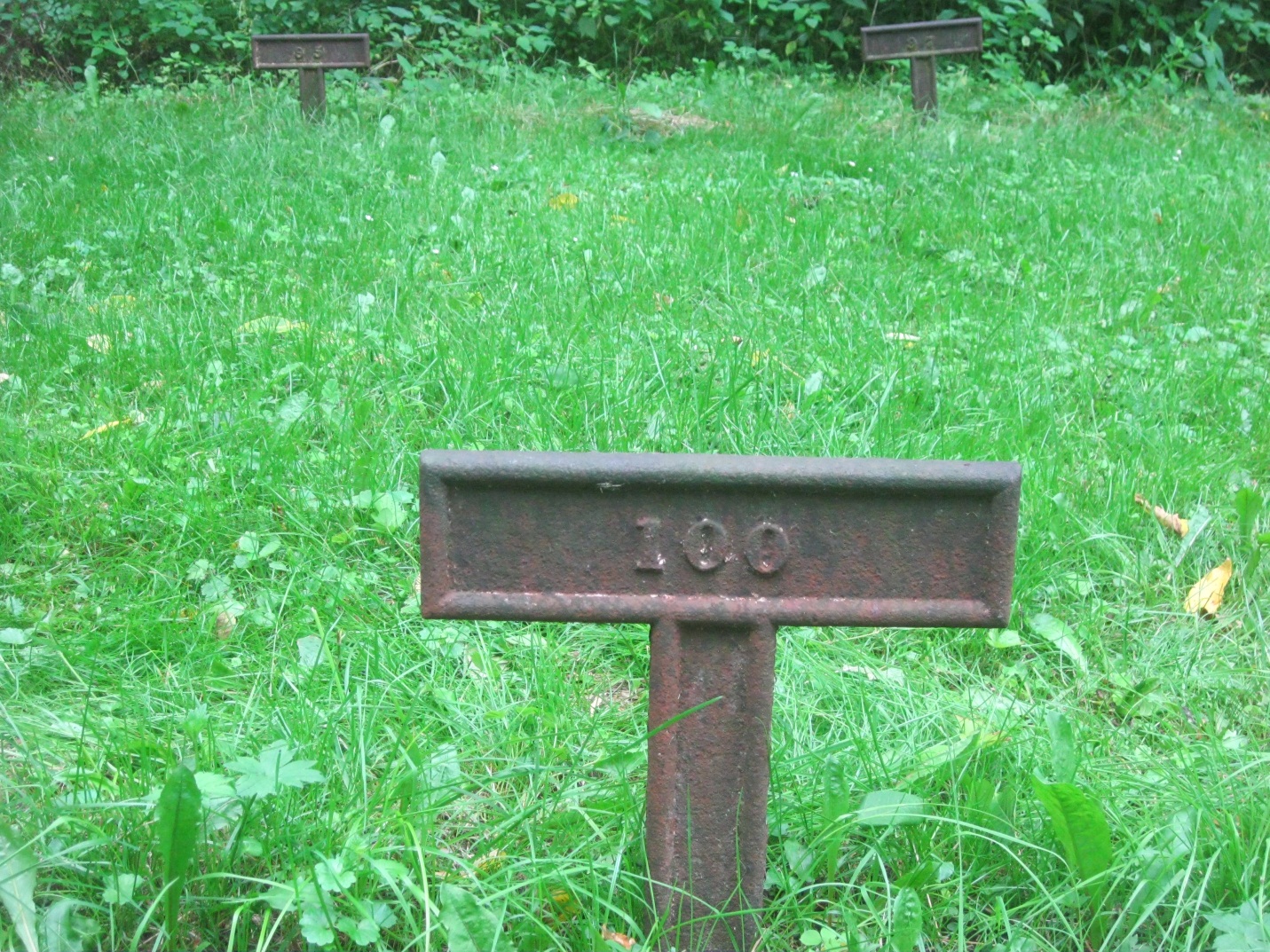
More than one million Americans are buried in institutional cemeteries. Many institutions which served people who had mental illness or developmental disabilities are now closed. Upon their closure, the cemeteries have been abandoned or passed on to the current owner of the property. Because the monuments were made more cheaply than traditional gravestones, time and neglect have taken their toll. Some grave markers are broken, leaning, tipped over, sunken under the ground, or tossed off into the weeds. Many of them are just numbers with no further clue as to the identity of the person. (TO VOLUNTEER, PLEASE CONTACT DAVID MACK-HARDIMAN at dmack@people-inc.org.)

Cast Iron Monument #100 in the Wheater Road Cemetery in Gowanda

Cast Iron Monument #100 in the Wheater Road Cemetery in Gowanda

Seven years ago, People Inc. and the Museum of disABILITY History aligned with the statewide 1033 Group and the nationwide Operation Dignity movement to embark upon the restoration of some local institutional cemeteries.

In 2006, a monument was placed in the Jolls Road Cemetery in Perrysburg. On a hillside in the cemetery, the graves of nearly four hundred residents of various state institutions were discovered. Some had small headstones but for many, there is no permanent marker. Self-Advocacy groups from Western New York planned the Ceremony of Remembrance during which the monument was unveiled.

Monument in the Jolls Road Cemetery in Perrysburg

Monument in the Jolls Road Cemetery in Perrysburg

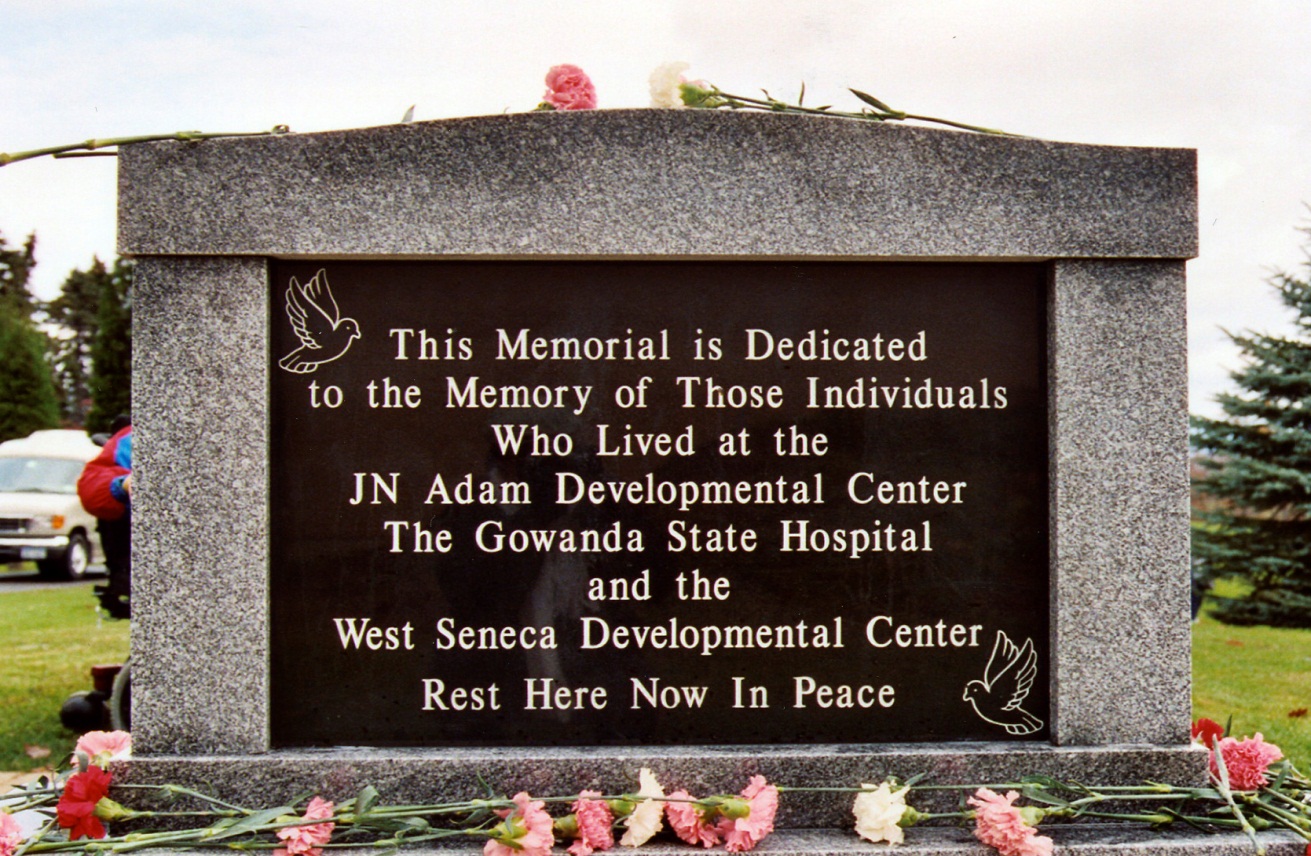
In 2007, work began at the Gowanda Psychiatric Center Cemetery on Route 62 in Gowanda. More than five hundred grave markers were photographed and documented. They were dusted, edged, and cleaned. Community businesses provided support and officials of the Collins Correctional Facility assisted the project in numerous ways. Many markers had sunken under the ground including an entire Jewish section which contained more than thirty graves marked with the Star of David. Once all stones were accounted for and placed again on the surface, a Ceremony of Remembrance was held on a warm, breezy day. Former patients and employees of the facility joined Self-Advocacy groups, State officials, numerous People Inc. volunteers and the Superintendents of the Correctional Facility for a memorable event. The names of all those buried there were given to the Museum of disABILITY History.

Memorial Cemetery sign installed by People Inc. in 2007

Memorial Cemetery sign installed by People Inc. in 2007

In a grassy hollow along the banks of Clear Creek in Collins, volunteers spent the next three summers restoring the Wheater Road Cemetery. More than five hundred headstones were unearthed in an area which was about the size of a football field. Taking the utmost care not to damage the long buried markers, volunteers tapped the earth until they felt resistance, carefully dug around the stones and lifted them to the surface. They were washed with water and placed back on the surface. In addition, more than five hundred other grave markers were straightened and reinforced with shims or gravel. Hundreds of red tulips were planted throughout the cemetery and a heart shaped garden was constructed. A Remembrance Ceremony was held at this location as well, including a release of doves by Self-Advocates. Media attention led some families to contact the Museum of disABILITY History, which assisted them in finding the final resting places for their ancestors.

#502 in the Protestant section is unearthed in the Wheater Road Cemetery

#502 in the Protestant section is unearthed in the Wheater Road Cemetery

In 2012, the volunteers shifted focus to Niagara County and the site of the former Niagara County Almshouse. Virtually undisturbed for ninety-six years, this cemetery had just a few stones which appeared to be marking graves. Nature had literally taken over the site with thick overgrowth of grape vines, wild roses, Hawthorne trees, and poison ivy. Initially, it was very difficult to determine the boundaries of the cemetery. With community assistance and volunteer labor, the site gradually began to take shape. The volunteers cut back the vines, trimmed trees, weeded, and created a beautiful corner space in which a memorial bench was installed. In a beautiful ceremony, the names of many of those buried there were read, including the foundlings and those whose names were, “unknown.” After the ceremony, several family members inquired about their ancestors and have been provided information from the almshouse registers.

The Niagara County Almshouse Cemetery

The Niagara County Almshouse Cemetery

This summer, volunteers will assist with cleaning the marble headstones at Craig Colony Cemetery in SonyeaPeople Inc. and the Museum of disABILITY History will join with Self-Advocates from the Finger Lakes area, town historians, and, the employees of the Groveland Correctional Facility to complete yet another, fulfilling cemetery restoration.
New York State Hospitals and Custodial Institutions & Cemetery Projects.

Edgewood State Hospital & Cemetery

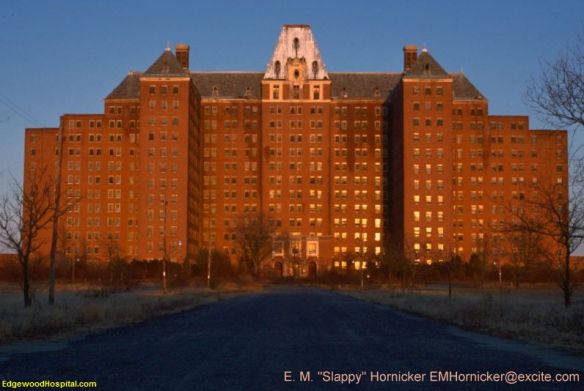
Edgewood State Hospital (Deer Park, Long Island) & Cemetery

Edgewood State Hospital by E.M. Hornicker

Syracuse Psychiatric Hospital & Cemetery

“Having a separate psychiatric hospital in Syracuse was the idea of Herman G. Weiskotten, M.D., Dean of the Syracuse University College of Medicine. At his urging, in 1926 the New York State legislature authorized the creation of Syracuse Psychopathic Hospital on land donated by Syracuse University at the corner of Irving Avenue and Adams Street. The first patient was admitted in 1930; the first clinic was held in 1931. name changed to Syracuse Psychiatric Hospital.”

A Short History of Selected Hospitals in Syracuse

CLICK HERE TO VIEW THE VIDEO They’re Buried Where? by Seth Voorhees

THE BAD NEWS: Thousands Remain Nameless! 6.15.2015.

THE GOOD NEWS: One Man Is Remembered! 6.14.2015.

A Day at Willard Cemetery 5.18.2013

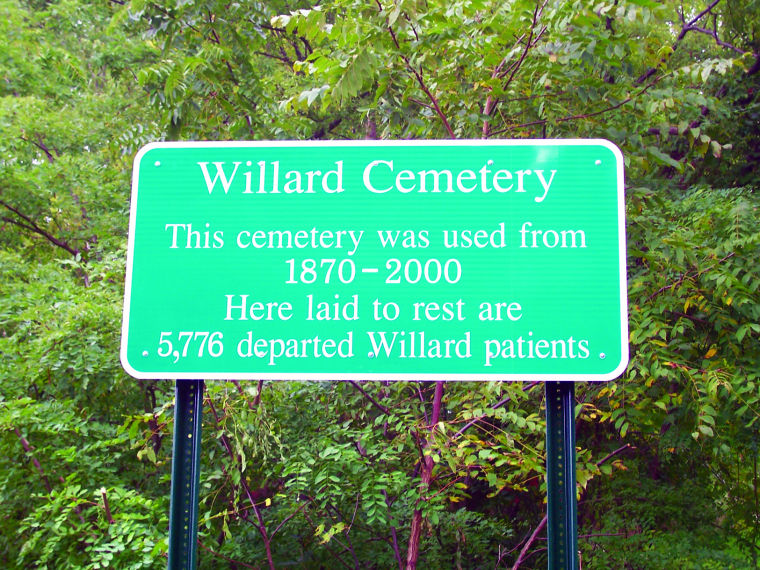
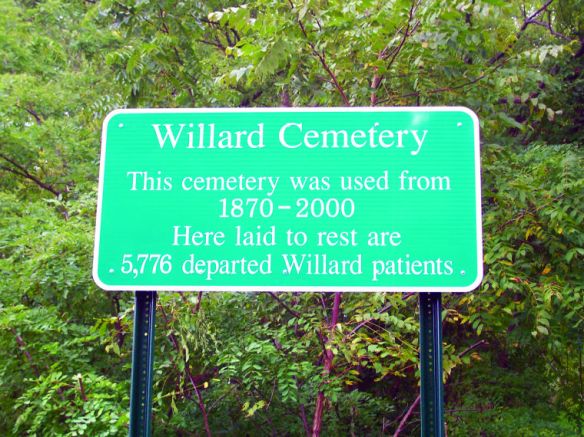
On Saturday, May 18, 2013, I visited the Willard Cemetery for a second time. This was the day of the annual Willard Tour that benefits a day care center on the old Willard property. Hundreds of people attended the tour and a good crowd gathered at the cemetery. Quite a bit has changed since my first visit on May 14, 2011, when the grass was up to my knees and no one was there but me, my husband, and two of our friends. It was a very sad place. The Willard Cemetery Memorial Project was formed by Colleen Kelly Spellecy in 2011. She has done a fabulous job organizing the group, having a sign installed at the entrance, raising awareness about the project, getting the cemetery lawn mowed, and collecting donations. I was happy to see so many concerned people at the cemetery.

Now there is hope, not only for the Willard Cemetery but for all state hospital and custodial institution cemeteries across the State of New York. A bill was introduced to the NYS Legislature in March 2012 and was re-introduced on January 18, 2013 as S2514-2013. If this bill becomes law, then the names of our forgotten ancestors will be released. They will finally be honored and remembered with dignity. This bill specifically addresses the “burial records” issue. Although HIPAA has stepped out of the way to allow individual states to release “medical records” 50 years after a patient has died, I am not sure if this issue was specifically addressed in this bill. Let’s take one step at a time and be grateful for what is in the works right now! Anyone who has ever dealt with the New York State Office of Mental Health in trying to obtain any type of information on an ancestor, whether it concerns asking where they are buried or obtaining a medical record, knows how arrogant and non-responsive they are unless you have a Ph.D. after your name. This needs to change.

Another fact that people don’t realize is that the great majority, if not all, of these historical cemeteries are “inactive” which means no one else will be buried there. I hope that ALL names are released including more recent burials. For example, when Willard closed in 1995, a gentleman was transferred to another facility. When he died in 2000, he asked to be buried in the Willard Cemetery because this was his home. Who will be here in 2050 to add this man’s name to a headstone or memorial? Who allowed these cemeteries to become forgotten?

Who was sent to Willard? Anyone who was not considered “normal” including the elderly with Dementia and Alzheimer’s Disease. Remember, there really were no nursing homes until the 1950s. Others were Hearing Impaired, had Developmental Disabilities, were Trauma Victims including Victims of Domestic Violence and Rape (back then they called it “Seducer’s Victim”), had PTSD (Soldier’s Heart & Shell Shock), Menopausal Women, Depression, Anxiety Disorders, Brain Injuries, Stroke Victims, Epilepsy, Neurological Disorders, Psychiatric Disorders, and some were locked up because of their sexual orientation, personal beliefs, and religious beliefs. These people, their families, and descendants, have nothing to be ashamed of. That would be like being ashamed of heart disease or diabetes. Putting names on a memorial, headstone, or list, should not be offensive to anyone.

Also attending the tour on this day was Seth Voorhees, Senior Reporter for the Time Warner Cable news channel YNN that serves Rochester and the Finger Lakes. Mr. Voorhees was genuinely interested in my mission to get this law passed in New York and offered me the opportunity of an interview. Although I am not a public speaker, I jumped at the chance to get the word out to a larger audience. I can’t thank him enough for all the time he spent putting this video report together. This piece aired on YNN, Saturday, May 25, 2013. I also need to thank Senator Joseph E. Robach for drafting and introducing the bill to the New York State Legislature. I hope this piece will raise awareness about the anonymous graves issue as this was never about patient confidentiality, it’s about respect.

CLICK HERE TO VIEW THE VIDEO They’re Buried Where? by Seth Voorhees.
Not Forgotten by Colleen Spellecy.

The list of these former New York State Hospitals includes but is not limited to: BinghamtonBuffaloCentral IslipDannemoraEdgewoodGowandaHudson RiverKings ParkLong IslandManhattanMatteawanMiddletownMohansicPilgrimRochesterSt. LawrenceSyracuseUtica, and Willard.

The Feeble-Minded and Epileptic Custodial Institutions of New York includes but is not limited to: Craig Colony for EpilepticsLetchworth Village for Epileptics & Developmentally DisabledNewark State School for Developmentally Disabled WomenRome State School for Developmentally Disabled Adults & Children, and Syracuse State School for Developmentally Disabled Children. There may be more.

Seth Voorhees & Lin Stuhler 5.18.2013

Seth Voorhees & Lin Stuhler 5.18.2013

Roger Luther from nysAsylum.com & Lin Stuhler 5.18.2013

Roger Luther from nysAsylum.com & Lin Stuhler 5.18.2013

Colleen Spellecy, Craig Williams, Lin Stuhler 5.18.2013
Colleen Spellecy, Craig Williams, Lin Stuhler 5.18.2013

Willard Cemetery Sign 5.18.2013

Willard Cemetery Sign 5.18.2013

Willard Cemetery Memorial Project 5.18.2013
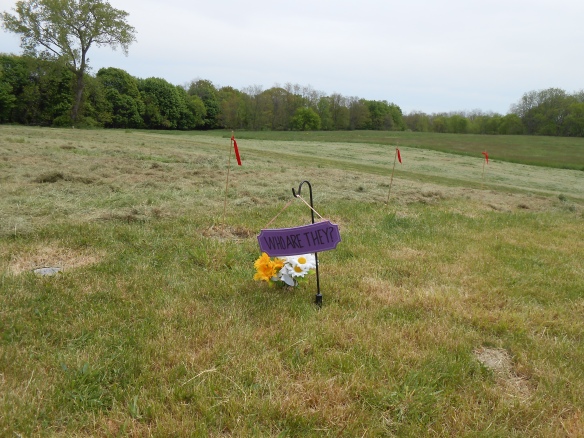
Willard Cemetery Memorial Project 5.18.2013

Willard Cemetery 5.18.2013

Willard Cemetery 5.18.2013

Old Metal Marker 5.18.2013
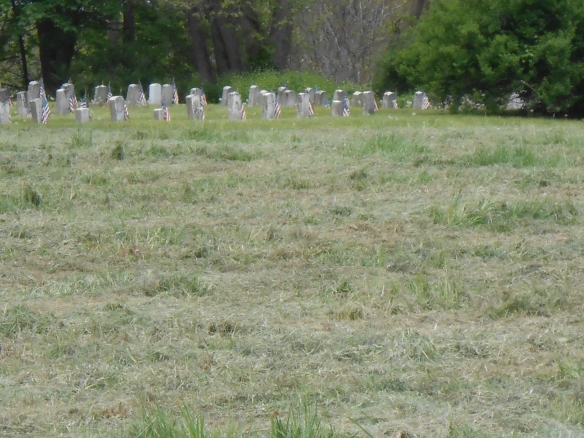
Old Metal Marker 5.18.2013

Willard Cemetery 5.18.2013

Willard Cemetery 5.18.2013

This photo is of the Civil War Veterans Section of the cemetery. They were provided with clearly inscribed headstones from the government. Colleen discovered that a few of them were not “inmates” of Willard but were residents of the town. I wonder how many other United States Veterans who served their country with honor but ended up at Willard are buried here among the 5,776 in anonymous graves?

Matteawan State Hospital for Insane Criminals & Cemetery

Matteawan State Hospital for Insane Criminals – Men & Women.

1916 Matteawan State Hospital.
Beacon, Dutchess County, New York.
Matteawan State Hospital 7 Names – Find A Grave.

1. South Flank Pavilions-Matteawan

1. South Flank Pavilions-Matteawan

2. Administration Building-Matteawan

2. Administration Building-Matteawan

3. Entrance Hallway-Matteawan

3. Entrance Hallway-Matteawan

4. South Interior Court-Matteawan

4. South Interior Court-Matteawan

5. Matteawan

5. Matteawan

6. Public Kitchen-Matteawan

6. Public Kitchen-Matteawan

7. Laundry Building-Matteawan

7. Laundry Building-Matteawan

8. Boiler House and Dynamo Building-Matteawan

8. Boiler House and Dynamo Building-Matteawan

9. Front View-Matteawan

9. Front View-Matteawan

Twenty-Third Annual Report Of The Medical Superintendent Of The State Asylum For Insane Criminals, Matteawan, N.Y., For the Year Ending September 30, 1892.
[Post-Office, Fishkill-On-The-Hudson.]

OFFICERS OF THE ASYLUM 1892.
Manager:
Hon. AUSTIN LATHROP, Superintendent Of State Prisons.

Resident Officers:
H.E. ALLISON, M.D., Medical Superintendent. 

J. ELVIN COURTNEY, M.D., First Assistant Physician.
LUTHER C. JONES, M.D., Second Assistant Physician.
JAMES F. HOWELL, Steward.
R.B. LAMB, M.D., Resident Clinical Assistant.

REPORT.
Hon. Austin Lathrop, Superintendent of State Prisons:

Sir.— The following pages which, in accordance with the statute, I have the honor to submit, constitute the first annual report issued from this new institution, which was created by act of the Legislature for the relief of the overcrowded asylum at Auburn, and is the thirty-third of a series presented annually since the original establishment of the State Asylum for Insane Criminals.

This new hospital structure of modern architecture, commandingly situated and furnished with every convenience for the care of its inmates, was occupied during the latter part of April of the present year; the first patients having been received by transfer from Auburn on the twenty-fifth of that month. The entire population of the Auburn asylum, a total of 261 patients, were moved into their present quarters and the new asylum organized and put in operation within a period of five days. Fortunately the transfer was made safely, without the slightest accident or any attempt at escape. The buildings and grounds at Auburn, which were occupied for more than thirty years, are now entirely relinquished, and the oldest of asylums for insane criminals is domiciled in these new quarters as its permanent abode.

Owing to the increased accommodations afforded by the opening of these new buildings, we have been able to provide for those patients who had, up to this time, been retained in the various State hospitals awaiting transfer to our custody, and who had previously been refused admission to Auburn for the lack of room. Because of this large and rapid influx the total number of admissions has more than doubled that of any previous year. During the year the various courts of the State have also, to a larger extent than heretofore, committed patients to this asylum directly. The practice, however, still exists of sending patients charged with crime to the general hospitals of the insane, where their presence is objectionable, and whence they are transferred to us under the provisions of chapter 515, Laws of 1884; the superintendents of the various State hospitals applying under this law to justices of the Supreme Court for orders permitting such transfers. We hope, when the scope and character of this institution become more widely known, that commitments in the future will be made to us directly in all cases where the plea of insanity prevails as a defense for criminal acts. It is the purpose of this hospital to care for all insane persons competed or unconvicted, who are charged with crime, whether the disease of insanity is known to exist at the time of arraignment or trial, or subsequently develops while undergoing sentence.”

SOURCE: Documents of the Assembly of the State of New York, One Hundred and Sixteenth Session, 1893, Volume I, Nos. 1 to 6, Inclusive, Albany: James B. Lyon, State Printer, 1893. Pages 203-208.

CLICK HERE TO VIEW THE VIDEO They’re Buried Where? by Seth Voorhees

THE BAD NEWS: Thousands Remain Nameless! 6.15.2015.

THE GOOD NEWS: One Man Is Remembered! 6.14.2015.

Dannemora State Hospital / Prison & Cemetery

Dannemora State Hospital was a state hospital prison.

1916 Dannemora State Hospital.
Dannemora State Hospital Cemetery – Find A Grave.
Photos Of Dannemora – Zach Babbie.
The Village Of Dannemora.

Dannemora 1875 - Clinton Prison - Zach Babbie

Dannemora 1875 – Clinton Prison – Zach Babbie

 It appears that Dannemora State Hospital Cemetery (Clinton Prison) had inscribed headstones. The following link may be an incomplete list.
Dannemora State Hospital Cemetery – Find A Grave.

Clinton Prison 1892 - Zach Babbie

Clinton Prison 1892 – Zach Babbie

 CLICK HERE TO VIEW THE VIDEO They’re Buried Where? by Seth Voorhees

THE BAD NEWS: Thousands Remain Nameless! 6.15.2015.

THE GOOD NEWS: One Man Is Remembered! 6.14.2015.

Syracuse State School & Cemetery

Syracuse State School – New York State Custodial Institution for Intellectually Disabled Children. The children who died at the Syracuse State School are buried at Oakwood Cemetery in Syracuse, New York.

1916 Syracuse State Custodial Institution For Feeble-Minded Children.

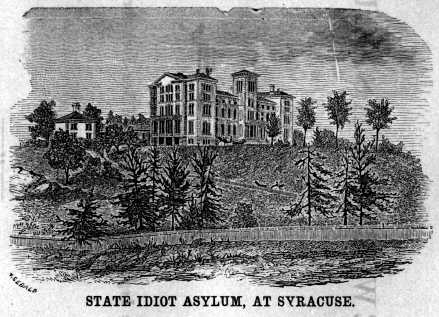
State Idiot Asylum at Syracuse 1858

State Idiot Asylum at Syracuse 1858

“AN ACT making an appropriation for the purchase of grounds for burial purposes for the use of the Syracuse State Institution for Feeble-Minded Children. Became a law February 11, 1896, with the approval of the Governor. Passed by a two-thirds vote. The People of the State of New York, represented in Senate and Assembly, do enact as follows: Section 1. The trustees of the Syracuse State Institution for Feeble-Minded Children are hereby authorized to purchase sufficient grounds, in Oakwood cemetery, at Syracuse, for the burial of four hundred and eight of such inmates of the institution as may die while residing therein; and the sum of nineteen hundred and fifty-eight dollars and forty cents, or so much thereof as may be necessary, is hereby appropriated out of any money in the treasury belonging to the general fund, not otherwise appropriated, payable to the order of the treasurer of the institution, for carrying out the purposes of his act; subject to the approval of the comptroller as to the value of the grounds, and of the attorney-general as to the form and terms of the conveyance thereof. § 2. This act shall take effect immediately.”
SOURCE: General Laws of the State of New York, Volume I, Chapter 16, Page 10, One Hundred Nineteenth Session, January 1, 1896 – April 30, 1896, Google Books

The New York State Asylum for Idiots was authorized by the New York State Legislature in 1851, acting upon a recommendation contained in the 1846 annual report of the New York State Asylum for Lunatics. Hervey B. Wilbur, M.D., was appointed the first superintendent and remained in that position until his death in 1883. First located on rented land in Albany, it admitted its first ‘pupils’ in 1851. The cornerstone was laid in 1854 for a new building in Syracuse, and the institution removed to Syracuse in 1855. After 1855 it was generally known as either the New York Asylum for Idiots or just the State Idiot Asylum, but in 1891 it was officially renamed the Syracuse State Institution for Feeble-Minded Children. In 19?? the name was changed to The Syracuse State Institution for Feeble-Minded Children, and later became just the Syracuse State School. Wilbur collaborated with Edward Seguin, M.D., the originator of the physiological method of training. Maria Montessori was also Seguin’s student and much of the ‘Montessori Method‘ is based on foundations laid by Wilbur and Seguin in Syracuse. In its 85th annual report (1935), the Syracuse State School rightly noted that it was ‘the pioneer institution in the United States for the care and training of mentally deficient children.’ Surgery was done in the old building, and at least one child was born there. The School also operated a farm and a number of satellite cottages. In the 1970s, the Syracuse State School building was torn down and replaced by a residential facility called the Syracuse Developmental Center. With the growing emphasis on community living rather than institutionalization for developmentally disabled persons, no new individuals were placed at SDC and there has been a gradual movement of residents into the community. In early 1998, there were about six persons left. SDC is to be closed, and it is not clear what will happen to the building.”
SOURCE: Upstate Medical University, Health Sciences Library, A Short History of Selected Hospitals in Syracuse

Syracuse State Institution for Feeble-Minded Children

Syracuse State Institution for Feeble-Minded Children

Photograph courtesy of The Museum of disABILITY History

“The first of these institutions, The New York State Asylum for Idiots, was established near Albany in 1851. The idea for such a school had originally been proposed in 1846 by senator Frederick F. Backus, a physician from Rochester. However, because many legislators reserved skepticism about the educability of ‘idiots’ and had concerns over the cost of such an experiment, the measure took five years to pass. These doubts proved to be unfounded, for the students achieved such favorable progress that the school’s Board of Trustees declared, in 1853, that the experiment had ‘entirely and fully succeeded.’ The legislature responded by funding the construction of a new building, which opened in 1855. This building, located in Syracuse, was the first in the United States designed specifically for children with developmental disabilities. Under the dedicated leadership of Dr. Hervey Backus Wilbur, superintendent for the initial thirty-two years of operation, this institution provided inspiration to many other states seeking to establish similar schools of their own.”
SOURCE: Museum Of disABILITY History, Early State Schools in New York by Thomas Stearns, Contributor.

Account of the ceremonies at the laying of the corner-stone of the New York Asylum for Idiots: at Syracuse, September 8, 1854.

Seventh Annual Report of the New-York Asylum for Idiots to the Legislature of the State of New York 1858.

CLICK HERE TO VIEW THE VIDEO They’re Buried Where? by Seth Voorhees

THE BAD NEWS: Thousands Remain Nameless! 6.15.2015.

THE GOOD NEWS: One Man Is Remembered! 6.14.2015.

Rome State School & Cemetery

New York State Custodial Institution at Rome for Intellectually Disabled Children and Adults.

1916 Rome State Custodial Institution For Feeble-Minded Children.
Rome Developmental Center Cemetery Names.
Rome State Custodial Asylum Map.

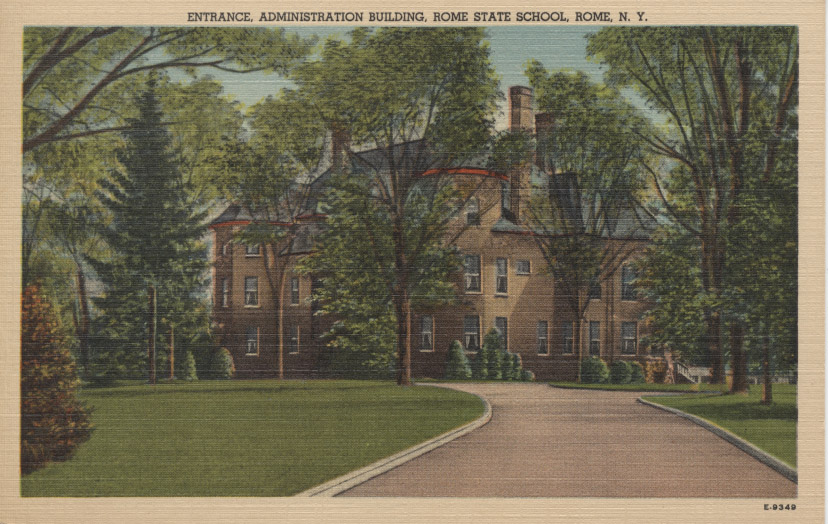
Rome State School

Rome State School

Photograph courtesy of The Museum of disABILITY History

“Although the initial purpose was essentially eugenic in nature, the scope of the institution expanded over the years. Educational training and independent living became central aspects, and several colony homes were established. The New York State Custodial Asylum for Un-Teachable Idiots was established in 1893 to address the growing public need for increased custodial provisions for ‘idiots’ deemed beyond the reach of education.  However, the staff soon realized that these individuals were capable of far more than the name of their institution implied. Led by Superintendent Charles Bernstein, the Board of Managers assumed a philosophy that focused on the recognition that people with disabilities “have a right to experiences and opportunities equivalent to those available to all other citizens.” Over fifty colony homes were established during Dr. Bernstein’s forty year superintendence, providing the people in attendance with many opportunities to live and work in the community.”

Rome Developmental Cemetery – This cemetery appears to be well maintained.
Annual Report of the Board of Managers of the Rome State …, Volumes 1-12.

CLICK HERE TO VIEW THE VIDEO They’re Buried Where? by Seth Voorhees

THE BAD NEWS: Thousands Remain Nameless! 6.15.2015.

THE GOOD NEWS: One Man Is Remembered! 6.14.2015.