1872 Scientific Charity Movement & Charity Organization Societies

On the surface, many of the key people who were involved in the Scientific Charity Movement during the late nineteenth century appear to be caring individuals who wanted nothing more than to lift the poor out of poverty with education and employment so that they could support themselves without government assistance. These charities did not receive state aid but depended on donations mainly from wealthy Americans. There is no doubt that these societies helped the plight of poor children, many of whom were under the age of 10 and working under terrible conditions in order to help out their families. But when it came to the defective, dependent, and delinquent classes, which was the label used to describe the insane, feeble-minded, blind, crippled, maimed, deaf and dumb, epileptic, criminal types, prostitutes, drug addicts, and alcoholics, the sincerity of their intentions to purely provide care to these individuals was overshadowed by the underlying goal of Eugenics.

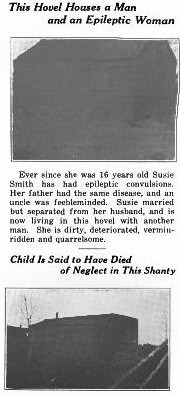
@Columbia University 1

@Columbia University 1

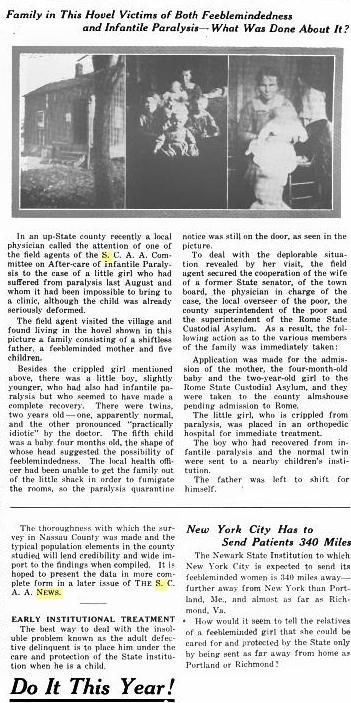
Photo: Columbia University – Social Forces Visualized: Photography and Scientific Charity, 1900-1920.

They didn’t want to see these poor, unfortunate souls suffering in squalor on the streets and in the poor houses but their ultimate objective of eradicating poverty and the financial drain that it caused on society resulted in the building of more asylums for the sole purpose of removing the defective classes from society so that they could not procreate. The Charity Organization Societies wanted to isolate the defective class in asylums in order to stop them from “breeding,” Alienists wanted to study and experiment on them, Medical Students wanted their dead bodies, Pathologists wanted their brains, Anthropologists wanted their bones, and the general public was just happy that someone was taking care of the problem. With the passage of the Social Security Act of 1935, the Poor Houses were abolished. Insane Asylums thrived and many remained in operation for over one hundred years. For more information, click on the RED links below.

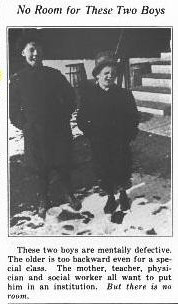
@Columbia University 2

@Columbia University 2

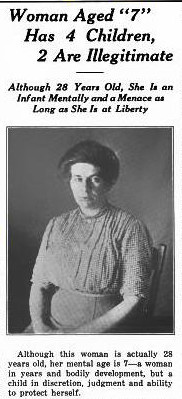
Photo: Columbia University – Social Forces Visualized: Photography and Scientific Charity, 1900-1920.

Scientific charity built on Americans’ notion of self-reliance, limited government, and economic freedom. Proponents of scientific charity shared the poorhouse advocates’ goals of cutting relief expenses and reducing the number of able-bodied who were receiving assistance, as well as the moral reformers’ goal of uplifting people from poverty through discipline and religious education via private charity. In this model, individuals responded to charity and the government stayed out of the economic sphere. Individuals were seen as rational actors who freely made decisions based on their own self-interest and who were responsible for how they fared economically. Scientific charity fit well with the post–Civil War concept of social Darwinism, which held that humans were in competition and the strong survived and thrived while the weak did not. Not surprisingly, Charity Organization Societies were generally opposed to unions.

Two of the leading advocates for Charity Organization Societies were Josephine Lowell and S. Humphrey Gurteen. Lowell, who was from a radical abolitionist family, believed that idleness was a major cause of poverty, and she advocated giving those who requested relief a labor test (such as breaking stones or chopping wood) before they received private charity. During her life, she developed several principles to guide her social reform work. One of her key principles was that “charity must tend to develop the moral nature of those it helps.” Lowell opposed both local government relief and almsgiving (individual giving directly to the poor) since she felt this practice did not morally uplift the people and created dependency. She felt that charity agents and visitors could provide a personal relationship conducive to helping needy individuals instead of treating them as “cases.”  Lowell thought “that each case must be dealt with radically and a permanent means of helping it to be found, and that the best way to help people is to help them to help themselves.”

Gurteen provided many practical ideas to implement organized Charity Organization Societies. Gurteen’s plan was to have various groups already providing services to the poor coordinate their efforts. There would be a central office that served as a charity clearinghouse where “friendly visitors” (COS agents) involved in investigating the poor would meet to compare notes to determine who was worthy of relief and who was an imposter. This collaboration would result in a complete registry of every person in the city who was receiving public or private assistance. The goal of this organized approach was to stop providing relief to the undeserving poor but continue to provide the deserving poor with the assistance to solve their own problems. Gurteen believed that COS would end outdoor relief, stop pauperism, and reduce poverty to its lowest possible level.”  SOURCE: Excerpted from “Social Solutions to Poverty” Scott Myers-Lipton, Pages 68-69 © Paradigm Publishers 2006.

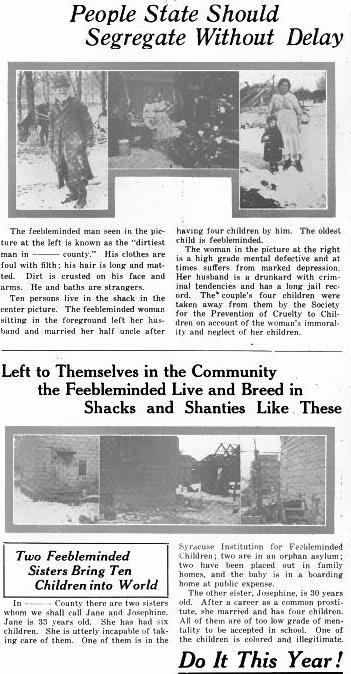
@Columbia University 3

@Columbia University 3

Photo: Columbia University – Social Forces Visualized: Photography and Scientific Charity, 1900-1920.

Social Darwinism: “Theory that persons, groups, and “races” are subject to the same laws of natural selection as Charles Darwin had proposed for plants and animals in nature. Social Darwinists, such as Herbert Spencer and Walter Bagehot in England and William Graham Sumner in the U.S., held that the life of humans in society was a struggle for existence ruled by “survival of the fittest,” in Spencer‘s words. Wealth was said to be a sign of natural superiority, its absence a sign of unfitness. The theory was used from the late 19th century to support laissez-faire capitalism and political conservatism. Social Darwinism declined as scientific knowledge expanded.”

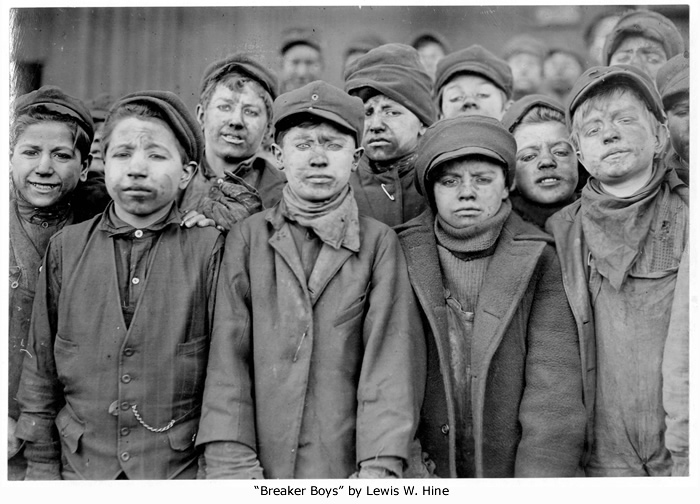
Breaker Boys by Lewis W. Hine

Breaker Boys by Lewis W. Hine

“An illustration of these times and the rise of a professional beggar class was described in 1880 by Reverend Oscar C. McCulloch, Pastor of Plymouth Church, Indianapolis at the seventh annual meeting of the National Conference of Charities and Corrections. His presentation entitled “Associated Charities” detailed the need to organize charities:

“…Every worker among the poor in our cities finds himself saying, “Who is sufficient for these things?” Let him conscientiously attempt to dispense charity wisely in any one instance, and he is made sensible of the organization of pauperism, and of the complex problem of poverty; of suffering beyond his reach, and of setting tides of evil beyond his control. My own introduction to this work was in this wise: In a small room I found an old blind woman, her son, his wife and two children, his sister with one child. There was no chair, table or stool, a little ” monkey stove,” but no fire; no plates, or kettles, or knife, fork or spoon. Such utter poverty horrified me. I soon had coal, provisions and clothing there. Chance led me into the office of our township trustee, where the historical records of all applicants for public aid are registered. Here I found that I had touched one knot of a large family known as “American Gypsies.” Three generations have been, and are, receiving public aid, numbering 125 persons; 65 per cent. were illegitimate; 57 per cent of the children died before the age of five. Distinctions of relationship were ignored. In the case above cited, the child of the sister was by her own brother. Since then I have found that family underrunning our society like devil-grass. In the diagram which I hold before you, the extent of it is traced to over 400 individuals. They are found on the street begging, at the houses soliciting cold victuals. Their names appear on the criminal records of the city court, the county jail, the house of refuge, the reformatory, the State prison and the county poor asylum. I give this as an illustration of the organization of pauperism, which takes it beyond the control of the individual and of the single society, making necessary an organization of charitable forces if the evil is ever to be controlled….”

COS leaders wanted to reform charity by including a paid agent’s investigation of the case’s “worthiness” before distributing aid. They believed that unregulated and unsupervised relief caused rather than cured poverty. The paid agent, usually a male, made an investigation and carried out the decisions of the volunteer committee concerning each applicant, including maintaining records. A volunteer or “friendly visitor” was recruited to offer advice and supervise the family’s progress. COS visitors sought to uplift the family and taught the values of hard work and thrift to individuals and families. The COS set up centralized records and administrative services and emphasized objective investigations and professional training. There was a strong scientific emphasis as the COS visitors organized their activities and learned principles of practice and techniques of intervention from one another. COS views dominated private charity philosophy until the 1930s and influenced the face of social welfare as it evolved during the Progressive Era.
SOURCE: The Social Welfare History Project – Charity Organization Societies: 1877-1893 by John E. Hansan, Ph.D.

The Social Welfare History Project – Progressive Era by John E. Hansan, Ph.D.

The Social Welfare History Project – Theodore Roosevelt.

The Social Welfare History Project – Josephine Shaw Lowell.

Unsentimental Reformer: The Life Of Josephine Shaw Lowell by Joan Waugh, 1997.

In Memoriam: Josephine Shaw Lowell, The Charity Organization Society Of The City Of New York, 1906.

Almost Worthy: The Poor, Paupers, and the Science of Charity in America, 1877-1917 by Brent Ruswick, 2012. (Info on Reverend Oscar C. McCulloch).

Reverend Stephen Humphreys Gurteen – The Charities Review, Volume 8, March-February 1898-99, Page 364.

Eugenics, Past and Future by Russ Douthat, June 9, 2012, New York Times.

Columbia University – Social Forces Visualized: Photography and Scientific Charity, 1900-1920.

1915 State Charities Aid Association News

The State Charities Aid Association, S.C.A.A., was founded in 1872. The S.C.A.A. inspected all charitable institutions that included all New York State Hospitals, Custodial Institutions for the Feeble-Minded, Prisons, Tuberculosis Hospitals, County Poor Houses, Polio Clinics, Houses of Refuge, and Orphanages. Charity Organization Societies (COS), were part of the “scientific charity movement” that began in the late nineteenth century. S.C.A.A. News, Volumes 3-11, 1915 through 1923 is a TREASURE TROVE of information and photographs!

SCAA 01

SCAA 01

SCAA 02

SCAA 02

SCAA 03

SCAA 03

SCAA 04

SCAA 04

SCAA 05

SCAA 05

“Brief Facts About State Charities Aid Association:

The object of the State Charities Aid Association, which is a voluntary body of citizens of New York State, is to improve conditions in public institutions and to promote public health and child care.

It is an incorporated body, State-wide, but without State aid.

Its budget is about $329,000 a year, and is met by voluntary contributions.

It has 12,000 members; it has local committees in every county. Its volunteer visitors visit and inspect all public institutions. The Association employs abut 95 persons in its Central Office, and about 20 in the field. It devotes itself to the following objects:

Finding homes for destitute or orphaned children.

Assisting mothers with babies.

Preventing mental disorders and securing better care for the mentally sick and defective.

Visiting public institutions in order to improve conditions, to promote with welfare and comfort of patients and inmates.

Helping to provide suitable occupations for sick persons in hospitals and institutions.

Assisting in securing wise laws about public health, care of the sick, institutions, and the expenditure of public funds for these purposes.”
SOURCE: S.C.A.A. News, Published Monthly by The State Charities Aid Association, 105 East 22nd Street, New York, N.Y., Volume X, No. 9, June, 1922, Page 13.

1872 Miss Louisa Lee Schuyler – The State Charities Aid Association.

SCAA 06

SCAA 06

SCAA 07

SCAA 07

SCAA 08

SCAA 08

SCAA 09

SCAA 09

SCAA 10

SCAA 10

SCAA 11

SCAA 11

SCAA 12

SCAA 12

SCAA 13

SCAA 13

SCAA 14

SCAA 14

1850 In The Spirit of Halloween

I’m not a fan of Halloween but I know many of you are. While researching old documents, I often come across gruesome articles from old medical journals. This is one such article concerning a Frenchman, Sergeant Francois Bertrand, who suffered from Necrophilia, also called Thanatophilia, Necrolagnia, and Paraphilia.

Le Sergent Bertrand

Le Sergent Bertrand

Photo “Le Sergent Bertrand”

1850 Extraordinary Madness

“Physiological pathologists have of late been as much on the alert, in France, concerning the case of a sergeant of the line, as they have been, in this country, concerning Miss Nottidge. The two cases bear, however, no analogy to each other. Religious monomania is not rare; but the derangement of mind, leading to the frightful and disgusting acts of Sergeant Bertrand, is, as far as we can remember, perfectly unique in the annals of mental alienation. His mania consisted in exhuming the dead, and taking pleasure in mutilating the corpses; but, shocking to relate, there was an erotic tendency mixed up with these horrible deeds, and he took especial delight in raising the corpses of females, and satisfying his unnatural appetites upon their putrefying remains.

From the trial which lately took place in Paris, before a court martial, and from the confession written by himself, we learn that this unfortunate individual is twenty-five years of age. He first studied for the church, but suddenly enlisted, and, by his good conduct, obtained the rank of sergeant. When young, he was rather of a sullen and melancholy disposition, but nothing positively pointing to derangement was then observed. His hideous propensities appears only in February, 1847, when they were excited by the sight of a grave left unfilled after interment, the diggers having been compelled to desist by a heavy shower of rain. He then struck the corpse, which he had exhumed with the tools left by the grave, with the utmost fury; and being interrupted, fled to a neighboring wood, where, according to him, he remained for three hours in a state of perfect insensibility, after having been most violently excited.

From this time to the 15th of March, 1849, this wretched man desecrated burying-places eight or ten times, both by day and night, regardless of the severity of the weather, the dangers he was encountering on the part of the keepers, and the difficulties he had to surmount. By the aid of his small sword he used to raise eight or ten corpses in a single night; and he adds that he opened many graves, and refilled them again, with no assistance but his hands. He had not the courage of telling the whole truth in his written declaration; but he confessed to his medical attendant, M. Marchal, (de Calvi), the most repulsive part of this awful tale—viz., his preference for the remains of females, and his hideous propensity of satisfying sexual desires upon them. He was wounded when getting over the wall of the cemetery of Mont Parnasse, in Paris, brought to the hospital, and thus was unveiled this unheard-of train of disgusting acts.

The court-martial have not taken that view of the case which at first sight would have looked the most rational; and waiving altogether the possibility of monomania having impelled the man to these hideous deeds they looked upon the offence as a misdemeanor, and condemned him to one year’s imprisonment.

Different opinions have been given in the medical journals as to which of the two kinds of mania exhibited was the first in existence—viz., the destructive, or the erotic. M. Marchal, the sergeant’s medical attendant thinks the destructive prevailed: but M. Michea, a well-known mental pathologist, maintains that the second was, on the contrary, the strongest and only mania. The various circumstances mentioned by each of these gentlemen, to strengthen their respective positions, merely rest on the prisoner’s own declaration; so that it would appear that no very strong case can be made on either side. Indeed, the whole series of these shocking occurrences might well be called in question, as it seems that no direct and conclusive evidence has been brought forward besides the man’s own account. But assuming the latter as true, the existence of monomania can hardly be doubted, when we consider that a natural instinct was entirely set aside, that there was not the slightest prospect of gain, that the wish of visiting churchyards returned almost periodically, that the dangers incurred were entirely disregarded, that none of the vices which generally accompany depravity were present &c. There was, besides, a melancholy disposition, a total insensibility to the agency of physical agents, (such as cold, rain, &c.,) during the paroxysm, and the extraordinary amount of muscular and nervous energy in the accomplishment of the acts, &c. All these considerations would tend to prove that this man was irresistibly impelled to such unheard of abominations.

This disgusting case recalls at once that form of mental aberration which reigned so extensively, about a century and a half ago, in the north of Europe, and known under the name of vampirism. It will be recollected that vampires were suffering under a sort of nocturnal delirium, which was often extended to the waking hours, during which they believed that certain dead persons were rising from their graves to come and draw their blood; hence arose a desire for revenge, and burial-places were disgracefully desecrated. Bertrand’s case seems the very reverse of this; for we here see, not the dead rising to torment the living, but a man disturbing the peace of cemetries in the most horrible manner imaginable.—London Lancet.”

Buffalo Medical Journal and Monthly Review of Medical and Surgical Science, Edited by Austin Flint, M.D., Volume Fifth, Buffalo: Published by Jewett, Thomas & Co, 1850, Page 341-342.

1824 New York State Poor House Law

1824 – An Act To Provide For The Establishment Of County Poorhouses.   Chapter 331, Laws of 1824, Passed 27th November 1824.   

“I. Be it enacted by the People of the State of New York, represented in Senate and Assembly, That it shall be the duty of the board of supervisors of each county in this State (the counties of Genesee, Yates, Greene, Washington, Rensselaer, Queens, Essex, New York, Montgomery, Suffolk, Schoharie, Chautauqua, Cortland, Dutchess, Orange, Allegany, Richmond, Monroe, Sullivan, Cattaraugus, Kings, Putnam, Delaware, Franklin, Oswego, Otsego, Columbia, St. Lawrence, Rockland, Albany, Tompkins, Tioga, Schenectady, Seneca, Madison, Onondaga, Oneida and Ulster, excepted), at their next meeting after the passing of this act, to direct the purchase of one or more tracts of land, not exceeding the quantity of two hundred acres, and thereon build and erect for the accommodation, employment and use of the said county, one or more suitable buildings, to be denominated the poorhouse of the county of _____ and to defray the expense of such purchase and building, raise by tax on estates real and personal, of the freeholders and inhabitants of the same county, a sum not exceeding the sum of seven thousand dollars, by such installments and at such times as may be ordered by the board of supervisors, to be assessed and collected in the same manner as the other county charges are assessed and collected, which money, when collected, shall be paid over by the treasurer of said county to said supervisors, or such persons as they shall for that purpose designate, to be applied to defraying the expenses aforesaid. II. And be it further enacted, That it shall be the duty of the supervisors of said county, at their meeting on the first Tuesday of October, annually, to choose and appoint, by plurality of votes, not less than five persons, who shall be denominated superintendents of the poorhouse of the county of who shall, until the first Tuesday of October next thereafter, take upon themselves, and have the exclusive charge, management, direction and superintendence of said poorhouse, and of everything relating to the same: and shall and may, from time to time, with the approbation and consent of a majority of the judges of the county courts of such county, make, ordain and establish such prudential rules, regulations and by-laws, for the well ordering of the same, and the employment, relief, management and government of the persons therein placed, and the officers and servants therein employed, and the correction of the refractory, disobedient and disorderly, by solitary confinement therein, and feeding them on bread and water only, as they shall deem expedient for the good government of the same; and shall and may, from time to time, appoint and employ a suitable person to be keeper of the same house, and necessary servants under him, and the same keeper and servants remove at pleasure, or otherwise, if they shall deem it more advisable; and it shall be lawful for the said superintendents to contract with some suitable person for the support of those persons who are placed in said poor house, who shall give a bond to said superintendents, with sufficient sureties, for the faithful performance of his contract, and who shall and may be authorized to employ the persons so committed to his charge, in like manner as if he was appointed keeper of said poorhouse. III. And be it further enacted, That whenever, after the said poorhouse shall be completed, any poor person in any city or town of the same county shall apply for relief, the said overseer of the poor of such city or town shall make application to a justice of the peace of said county, which said justice and overseer shall enquire into the state and circumstances of the person so applying for relief as aforesaid; and if it shall appear to the said justice and overseer of the poor, that such person is in such indigent circumstances as to require relief, it shall be their duty (unless the sickness of the pauper prevent) instead of ordering relief in the manner directed in and by the twenty-fifth section of the act entitled “An act for the relief and settlement of the poor,” to issue his warrant under his hand, directed to any constable of such city or town, whose duty it shall be to execute the same, thereby requiring said constable forthwith to take such poor person so applying for relief, and remove him or her to said poorhouse, and there deliver him or her to the care of the keeper of the same house, to be relieved and provided for as his or her necessities shall require; and he or she shall be discharged therefrom by order of the superintendents of the same house, or some one of them. And further, That in case the said superintendent, by a resolution to be passed by a majority of the board, shall give permission, and so long and no longer, as such permission shall be continued, it shall and may be lawful for any justice of the peace of said county, whenever a disorderly person, under or within the meaning of the act entitled “An act for apprehending and punishing disorderly persons,” instead of the punishment directed by the same act, by warrant under his hand and seal, to commit such disorderly person or persons to said poorhouse, into the custody of the keeper thereof, there to be kept at hard labor for any time not exceeding six months, unless sooner discharged therefrom by order of such superintendents or a majority of them; in which warrant it shall be sufficient to state and set forth generally, that such person has been duly convicted of being a disorderly person, without more particular specification of the offence. IV. And be it further enacted, That it shall and may be lawful for the overseers of the poor of any town or city in said county, to take up any child under the age of fifteen years, who shall be permitted to beg or solicit charity from door to door, or in any street or highway of such city or town, and carry or send him or her to said poorhouse, there to be kept and employed, and instructed in such useful labor as he or she shall be able to perform, and supported until discharged therefrom by order of said superintendents, whose duty it shall be to discharge such child as soon as he or she shall be able to provide for himself or herself. V. And be it further enacted, That it shall be lawful for the keeper of said poorhouse, to require and compel all persons committed to his care or custody in the same by virtue of this act, to perform such work, labor and service, towards defraying the expense of their maintenance and support, as they shall severally be able to perform, or said superintendent shall from time to time direct; and in case any such person shall neglect or refuse to perform the work, labor and service required of him or her, or shall at any time refuse or neglect any rule, regulation or by-law which, shall as aforesaid be made and established by said superintendents, for the well ordering and government of the persons committed or placed in said poorhouse, or shall at any time depart therefrom, until he or she shall be regularly and duly dismissed and discharged therefrom; in each and every such case, it shall and may be lawful for the keeper of the same house, to place and keep each and every such person in solitary confinement in some part of the same house, and feed him, her or them, with bread and water only, until he or she shall submit to perform the same labor, work and service, and obey, conform and observe the rules, regulations and by-laws aforesaid; or for such time as said keeper shall judge proportioned to his or her respective offence or offences: Provided however, That every such person who shall think himself or herself aggrieved by the conduct of such keeper towards them, may and shall be permitted to make his or her complaint to said superintendents, or any one of them, who shall immediately examine into the grounds of such complaint, and make such order and direction in the case as to him or them shall appear fit and proper; which order shall be final and conclusive in the case. VI. And be it further enacted, That the expense of supporting and maintaining such persons as shall or may be sent to or placed in said poorhouse pursuant to the provisions of this act, and all expenses incident to keeping, maintaining and governing said poorhouse, shall be a charge upon said county; and it shall and may be lawful for the supervisors of said county, to cause such sum as shall remain unpaid at the end of each year, and may be necessary to defray the same expenses, to be annually assessed and collected by a tax on the estates, real and personal, of the freeholders and inhabitants of the same county, in the proportion to the number and expenses of paupers the several towns respectively shall have in the said poorhouse; which monies, when collected, shall be paid by the collectors of the several cities and towns in the said county, into the hands of the treasurer of such county, subject to the orders of said superintendents, to be by them applied to the paying and defraying of the same expenses. VII. And be it further enacted, That the said superintendent may, at the expense of said county, from time to time, purchase and procure such raw materials to be wrought and manufactured by the persons in said poorhouse; and shall and may at all times sell and dispose of the produce of the labor of the same persons, in such manner as they shall judge conducive to the interests of said county; and it shall be the duty of the said superintendents annually, at the meeting of the supervisors of said county, on the first Tuesday of October in each year, to account with the board of supervisors of the said county, for all monies by them received and expended as such superintendents, and pay over any such monies remaining in their hands, as such superintendents, unexpended, to the superintendents who shall then be chosen and appointed in their stead. VIII. And be it further enacted, That no person shall be removed as a pauper, out of any city or town, to any other city, town or county, by any order of removal and settlement; but the county where such person shall become sick, infirm and poor, shall support him; and if he be in sufficient health to gain a livelihood, and still become a beggar or vagrant, then he shall be treated as a disorderly person: Provided, That nothing herein contained shall prevent the removal of any pauper from one city or town to any other city or town in the same county. IX. And be it further enacted, That if any person or persons shall hereafter send, carry or transport, or cause to be sent, carried or transported, any pauper or paupers, or other poor and indigent person or persons, from and out of any town in any county of this State, into any town in any other county, with intent to charge such other town or county with the maintenance and support of such pauper or paupers, poor and indigent persons, such offense shall be deemed and adjudged a misdemeanor; and such person or persons so offending, on conviction thereof before any court of competent jurisdiction, be punished, by fine in a sum not exceeding one hundred dollars, or imprisonment for a term not exceeding six months, or both, in the discretion of said court. X. And be it further enacted, That if any board of supervisors, or a majority of them, in any of those counties heretofore excepted, shall, at any of their annual meetings hereafter, determine that it will be beneficial to their county to erect a county poorhouse, that by filing such determination with the clerk of said county, they shall be at liberty to avail themselves of the provisions of this act.”

SOURCE: An Act To Provide For The Establishment Of County Poorhouses. Documents of The Senate of the State of New York, One Hundred and Twenty Seventh Session, 1904, Vol. XIV. No. 22, Part 4, Annual Report of the State Board of Charities for the Year 1903, In Three Volumes with Statistical Appendix to Volume One bound separately. Volume Three Charity Legislation in New York 1609 to 1900. Transmitted to the Legislature February 1, 1904, Pages 241-245. 

1892 The Infliction Of The Death Penalty By Means Of Electricity

THE INFLICTION OF THE DEATH PENALTY BY MEANS OF ELECTRICITY
by Carlos F. MacDonald, M.D.,
President of the New York State Commission in Lunacy.

Electric Chair-Auburn State Prison

Electric Chair-Auburn State Prison

“The widespread interest manifested by the general public in the new method of inflicting the death penalty by means of electricity, and the interest which medical science would naturally be expected to feel in the humane and scientific aspects of the subject, especially with reference to the absence of conscious suffering, and the changes, if any, in the tissues and organs of the human body resulting from the passage through it of electrical currents of lethal energy, together with the fact that this method of executing criminals may now be said to have practically passed beyond the experimental stage, would seem to justify, if not indeed to demand, the presentation of an authentic summary of the practical results thus far obtained by some one whose data and conclusions would be derived from actual observation and experience in the application of the statute. The fact that the writer happens to be the only physician who has participated in all of the official preliminary experimental tests of apparatus, and witnessed all of the executions thus far had under the new law-not, however, from any zealous interest in the subject, nor even inclination to be present, but in obedience to the expressed desire of the chief executive of the State and other official superiors-furnishes the only excuse he would offer for undertaking what otherwise might well be regarded as an undesirable task.

In view of the wide publication of distorted and sensational accounts of the Kemmler execution, and the amount of adverse criticism and even condemnation based thereon of those who were called to act in an advisory capacity in the administration of the law, the writer, at the request of the Governor, prepared an official report of that event, some portions of which are necessarily here reproduced.

The execution of William Kemmler, alias John Hart, at Auburn prison, on August 6, 1890, pursuant to the statute in such case made and provided, marked the first case in the world’s history of the infliction of the death penalty by electricity. Since then six other condemned murderers have been legally killed by this method at Sing Sing prison-namely James J. Slocum, Harris A. Smiler, Joseph Wood and Schichiok Jugigo, on July 7, 1891; Martin D. Loppy, on December 7, 1891, and Charles McElvaine, on February 8, 1892, making in all seven cases of successful infliction of the death penalty by electricity in the State of New York.”

“In all the cases except Kemmler’s and McElwaine’s contact was broken for the purpose of wetting the electrodes. From the foregoing it appears that the time consumed in the preliminary preparations — strapping, adjusting electrodes, etc.— varied from four minutes in the first to less than a minute and a half in the last instance; that the number of contacts varied from two to four, and that the aggregate length of the contacts in each case varied from forty-five to eighty-seven seconds, at the end of which, if not before, in most instances, both conscious and organic life were absolutely extinct.

In other words, the length of time which elapsed from the moment the prisoner entered the execution-room until he was absolutely dead was, in Kemmler’s case, eight minutes; in Slocum’s, six minutes; in Smiler’s, four minutes; in Wood’s, four minutes and ten seconds; in Jugigo’s, three minutes and thirty seconds; -in Loppy’s, three minutes fifty-three seconds and a half; and in McElvaine’s, three minutes and fifty-eight seconds.”

SOURCE: Documents of the Assembly of the State of New York, One Hundred and Sixteenth Session, 1893, Volume I, Nos. 1 to 6, Inclusive, Albany: James B. Lyon, State Printer, 1893. Pages 279-280.

1864 Yates County Poor House

This county poor house report really hits home knowing that my great-great-grandmother, Charity, lived in this place of squalor, with three of her children after her husband and eldest son, my great-great-grandfather and great-grandfather respectively, enlisted in the Union Army on January 18, 1862, at PennYan – Company B, 3rd Regiment, NY, Artillery. It has been a humbling experience uncovering the layers of the untold stories of my ancestors.  

Yates county poor-house has eighty-seven paupers, fifty-four males and thirty-three females. Six are insane, one male and five females; four of the females work a little, or, if unable to work, they amuse themselves in the care of pauper children. The male patient requires occasional restraint, but only confinement in a cell is resorted to to enforce restraint. The house has one bathing room, and is supplied with water, except in dry times in the summer. The insane are required to bathe every one or two weeks, and to wash hands and face daily. The more rational, room and sleep with the paupers, and eat at a common table with them. One male and one female are each confined in a separate cell. The county receives recent cases for treatment, and they are visited by a physician about once a week. They are usually healthy, and have the appearance of being comfortably and carefully taken care of.”

SOURCE: Documents of the Assembly Of The State Of New York, Eighty-Eighth Session, 1865, Volume 6, Nos. 199 to 112 Inclusive, Albany: C. Wendell, Legislative Printer, 1865, Page 223.

RESOURCES:
New York State County Poor Houses.
Yates County Cemetery Project – Part VII: Cemeteries in the town of Jerusalem.
YATES COUNTY, NY: GenWeb Page.

1864 Wyoming County Poor House

“No report.”

SOURCE: Documents of the Assembly Of The State Of New York, Eighty-Eighth Session, 1865, Volume 6, Nos. 199 to 112 Inclusive, Albany: C. Wendell, Legislative Printer, 1865, Page 223.

New York State County Poor Houses.

1864 Westchester County Poor House

“To a population of two hundred and twenty-five in the poor-house of Westchester county, twenty-two are lunatics. Seven are males, and fifteen are females. Three-quarters are of foreign birth. Seventeen of these cases are of mild form of insanity. One was admitted in 1829. It is not known that any of the whole number have been ever treated in an asylum. Several have been admitted to the poorhouse for the second or third time. Four males and eight females are capable of labor. Those who do not labor have no amusement or employment. The manner of restraint and coercion is by straight jacket, handcuffs and confinement. The house has a full supply of water and two bathing tubs, in which, however, the insane are washed and bathed at no particular times. The building is of stone, two and a half stories high, with eight feet ceilings, and rooms 8 x 5 feet. The cells are in the centre of the building, with corridors, after the style of a prison and penitentiary, and receive their light only through the doors. They are, of course, dark and ill ventilated, and there is a total and studied absence of all that contributes to cheerfulness or mental elasticity. The building is heated by furnaces, and a comfortable temperature is maintained in winter, but there is no provision for the various grades of the insane. The sexes are separated, the males in one ward and the females in another, with pauper attendants, and one male assistant in the care of the female insane. The general appearance of the rooms is clean and tidy. Provision is made to confine twenty-five insane, but thirty-nine have at times been forced into the space designed for twenty-five. All have shoes, and their under garments are changed weekly. Whenever they are sick, the physician of the alms-house visits them, but they never receive treatment with reference to their convalescence, yet the county does not, in view of such a startling fact, hesitate to receive recent cases for confinement, not for cure.”

SOURCE: Documents of the Assembly Of The State Of New York, Eighty-Eighth Session, 1865, Volume 6, Nos. 199 to 112 Inclusive, Albany: C. Wendell, Legislative Printer, 1865, Pages 222-223.

New York State County Poor Houses.

1864 Wayne County Poor House

“Of eighty inmates in the poor-house of Wayne county, twenty are lunatics, or one in every four. They have been severally admitted since 1850; thirteen are males and seven are females, Fifteen are of native birth. Fourteen of the cases are mild; two have been discharged during the year, and two have been sent to Utica for treatment. Previous to September, four cases were admitted in 1864; nine cases were admitted in 1863. Five males are capable of doing some labor; the only amusement for the others is going in the yard when the weather will admit of it. One is constantly restrained by handcuffs. The house has no bath tub, and the insane are not required to bathe more than their hands and face daily. One is confined in a basement cell without the privilege of coming daily to the open air. All the inmates have beds or bedsteads, none sleep without them; the straw in the beds is changed every two months. Their food is served on tin plates in their rooms. The rooms are heated by stoves in the hall, but no attention is paid to uniformity of heat in the winter. The rooms are neat and clean; in most of them the air is good. It is intended to separate the insane from the sane paupers. The accommodations are designed for ten lunatics, though twenty are now in confinement, crowded into the meagre room designed for ten. Three escaped during the year who are not returned, and two were removed by their friends. There is no provision for their management or treatment with reference to recovery. The county receives, as will be seen, recent cases. A new building designed to be used exclusively for the insane is in process of erection.”

SOURCE: Documents of the Assembly Of The State Of New York, Eighty-Eighth Session, 1865, Volume 6, Nos. 199 to 112 Inclusive, Albany: C. Wendell, Legislative Printer, 1865, Page 222.

New York State County Poor Houses.

1864 Washington County Poor House

“The Washington county poor house is a three story brick building, with nine feet ceilings, the rooms being seven by eight and eight by ten, lighted by windows two feet square. The whole number of inmates is (120) one hundred and twenty, of which thirty-six are insane. Several were admitted previous to 1840. Three are past seventy years of age. Thirteen are males, twenty-three are females; twenty-five are of native birth; ten have been treated in an asylum: twelve are capable of doing some labor. Those who do not labor have no light occupation or amusement, except going into the yard when circumstances admit of it. One is constantly restrained by hand-cuffs. The building is supplied with water, and has one bath tub; the insane are required to bathe occasionally.

The bedsteads are of wood; the bedding, straw and feathers. Two sleep on straw without bedstead or bedding. Those who are able eat at a common table, others have their food distributed to them. No attention is paid to the uniformity of heat in the winter, though it is designed to keep the rooms comfortable. Two are often confined in a single cell. The attendants employed to care for the insane are paupers. The county receives recent cases. The building is designed to accommodate fifty. They receive no medical treatment with reference to an ultimate cure. Cleanliness, comfortable clothing and sufficient food, are the three virtues of the institution. It aims at nothing more.”

SOURCE: Documents of the Assembly Of The State Of New York, Eighty-Eighth Session, 1865, Volume 6, Nos. 199 to 112 Inclusive, Albany: C. Wendell, Legislative Printer, 1865, Page 221.

New York State County Poor Houses.