“Lost Luggage, Recovered Lives” by Peter Stastny, MD, and Darby Penney, MLS

The Lives They Left Behind Suitcases From A State Hospital Attic offered a ray of hope for people like me, who had discovered that an ancestor was a former patient who died at Willard State Hospital. I read the book in a day, not being able to put it down. I wanted to know more. I wondered what kind of treatment was given to my great-grandmother, and I wonder to this day. The significance of this book is that no others before Darby Penney and Peter Stastny had ever gone through the patient medical records and personal belongings in order to tell the patient’s side of the story. To learn more, please feel free to download, read, and share “Lost Luggage, Recovered Lives” by Peter Stastny, MD, and Darby Penney, MLS.  

Darby Penney is a leader in the human rights movement for people with psychiatric disabilities. Peter Stastny is a psychiatrist and documentary filmmaker. You may contact Ms. Penney to inquire about your ancestor’s suitcase at: community@capital.net. For more information visit The Lives They Left Behind Suitcases From A State Hospital Attic Website. 

The Lives They Left Behind by Darby Penney & Peter Stastny

The Lives They Left Behind by Darby Penney & Peter Stastny

Within the pages of this book is where I first learned about the anonymous graves at Willard State Hospital Cemetery. Further research led me to the discovery that burying former patients of New York State Hospitals and Custodial Institutions, in numbered, anonymous graves, was not the exception but the rule. As I have stated before, I am a Genealogy Geek who was inspired by Ms. Penney and her book, to get a law passed that will require the NYS Office of Mental Health to release the names; dates of birth and death; and the location of these historic graves, to the public so that these people may be honored and remembered with dignity. Even with the new HIPAA ruling that allows the release of medical records after 50 years from the time of the patient’s death, it appears that the OMH will not comply with the new ruling unless forced to do so. One wonders how and where they got the authority to classify the burial ledgers (cemetery records) in the same category as medical records? Why are the deaths of thousands of people being kept a secret?

Hopefully, the NYSOMH will release historic patient burial information and when they do, it will be a wonderful opportunity to educate the public about what mental illness is; to reassure people that they should not be ashamed; that help is available; and that no one needs to struggle alone. But as of today, they are sticking with “the very fact of one’s mental illness, and receiving professional help for such illness, can, if generally revealed, cause a person to be subjected to prejudice and stigma in one’s personal and professional life.” Does this statement really encourage people to seek help?

“The only exception would be if you believe a patient was buried in one of our cemeteries. If so, then with appropriate family linkage documentation, including birth and death certificates, we could provide you with information on the individual’s burial site.”

One of the first lessons that you learn when researching your family history is that people have common names. In other words, you are not the only person in the world who has your name. Lesson two is, anyone can claim to be anyone’s descendant in order to get a historic copy of a birth, marriage, or death certificate. The state does not know your genealogy, nor do they care because they’re making money on the deal. Note that after spending the money on this documentation, writing a letter, mailing it in, and waiting months for a response from the OMH, they state we could, instead of, we will, provide you with the information.

The following “Frequently Asked Questions” page is posted at NYS Office of Mental Health Last Modified: 11/15/2012.

“Q. Can I get a copy of a birth or death certificate for a family member that was a resident of one of the Office of Mental Health’s facilities?

A. Birth records, death records, and marriage records are considered Vital Records in New York State and generally can be accessed by the public. If you are interested in exploring this option, you can obtain more information on how to obtain these records on the New York State Department of Health’s vital Records website at www.nyhealth.gov

Q. I have been doing genealogy research and have discovered that one of my relatives was a resident at one of the Office of Mental Health facilities. I would like to find out any personal or medical information about them. Can I obtain a copy of these records?

A. The Office of Mental Health is dedicated to the maintenance of privacy and confidentiality of patient information. We feel this is especially true with regard to mental health treatment records. It has long been recognized that the very fact of one’s mental illness, and receiving professional help for such illness, can, if generally revealed, cause a person to be subjected to prejudice and stigma in one’s personal and professional life. We also recognize that effective and lasting psychiatric therapy can take place only in an environment of privacy and trust in which the patient knows that his/her statements will be held in confidence.

New federal regulations that govern the privacy of individually identifying health information, have underscored this requirement. While it has always been our position that a person’s right to confidentiality of clinical information does not change upon his or her death, federal regulations have given us some additional specific guidance on access to records of deceased patients. Therefore, we have recently modified our policy and procedures and require the following before we can provide any information from a deceased patient’s clinical record:

A. Birth records, death records, and marriage records are considered Vital Records in New York State and generally can be accessed by the public. If you are interested in exploring this option, you can obtain more information on how to obtain these records on the New York State Department of Health’s vital Records website at www.nyhealth.gov

B. If you are a family member of the deceased patient and the patient allowed our facility to share information with you while he or she was living, and it is reasonable to assume that the patient did not intend to revoke his or her permission to continue to communicate with you prior to his or her death, we may provide you with basic information about the patient’s condition and circumstances of his or her death, if appropriate.

C. If you are a family member of the deceased patient and the information from the patient’s record is relevant to your own health care, we can release the information to your physician, provided the physician submits a written request to us on your behalf.

D. If you are the executor of the deceased patient’s estate, or if you otherwise have legal authority to act on behalf of the patient or his/her estate, (e.g. you have letters testamentary issued by a court), we can release information to you upon your written request which documents and attests to your legal authority to act on behalf of the deceased patient. We can also release information to you if you obtain and provide us with the written consent from the executor or legal representative of the deceased patient.

E. In all of these cases, we are required to review the record prior to its release to ensure it does not infringe upon the privacy rights of any other individual who may be named in the record.

The only exception would be if you believe a patient was buried in one of our cemeteries. If so, then with appropriate family linkage documentation, including birth and death certificates, we could provide you with information on the individual’s burial site. Requests should be sent to John Allen, Consumer Affairs, NYS Office of Mental Health, 44 Holland Avenue, Albany, NY 12229.”

Oregon State Hospital – Cremains

Honoring the Past – List of Unclaimed Cremains

Mental Health – Portland, Oregon

Maisel Library Of Dust

Maisel Library Of Dust

Oregon State Hospital-New York Times

Oregon State Hospital-New York Times

Once a ‘Cuckoo’s Nest,’ Now a Museum – Oregon State Hospital features a museum that pays tribute to the movie “One Flew Over the Cuckoo’s Nest” and explores mental health treatments of the past.

The Changing Face of What is Normal – Jon Crispin – Exploratorium

Congratulations, Jon Crispin! This wonderful exhibit of Jon’s photography of former patient suitcases found in the attic of Willard State Hospital will be displayed at the Exploratorium in San Francisco beginning April 17, 2013.
(Please click on the RED links).

Book Photo 5.20.2013 by Jon Crispin

Book Photo 5.20.2013 by Jon Crispin

I am very proud that The Exploratorium is selling my book! Thank you!

The Changing Face Of What Is Normal, The Exploratorium.

The Changing Face of What is Normal.

Slate.com-Jon Crispin-Suitcases From The Willard Asylum.

NPR Interview with Jon Crispin.

COLLECTORS WEEKLY -Abandoned Suitcases Reveal Private Lives Of Insane Asylum Patients.

1860 Susan B. Anthony

As I am always searching for historical articles concerning anything having to do with the nineteenth century perspective on mental illness, insane asylums, the patients, and any one who may have been involved, I was very pleased to find this particular passage from Eighty Years And More: Reminiscences 1815-1897 by Elizabeth Cady Stanton (1815-1902), involving Susan Brownell Anthony. After reading it, I wanted to know the specifics of the story, and I had to find out who the characters were. Being a life-long resident of Rochester, New York, I am proud to say that Miss Anthony was also a resident of this fine city from 1866 to 1906. She is one of America’s most famous, beloved, and inspirational women because of her strength, dedication, and undying tenacity for the cause of women’s rights. Miss Anthony was born on February 15, 1820 in Adams, Massachusetts, and died on March 13, 1906 in Rochester, New York. Her most famous quote is, “Failure is Impossible.”

Susan B. Anthony

Susan B. Anthony

Elizabeth Cady Stanton

Elizabeth Cady Stanton

“While all this was going on publicly, an equally trying experience was progressing, day by day, behind the scenes. Miss Anthony had been instrumental in helping a much abused mother, with her child, to escape from a husband who had immured her in an insane asylum. The wife belonged to one of the first families of New York, her brother being a United States senator, and the husband, also, a man of position; a large circle of friends and acquaintances was interested in the result. Though she was incarcerated in an insane asylum for eighteen months, yet members of her own family again and again testified that she was not insane. Miss Anthony, knowing that she was not, and believing fully that the unhappy mother was the victim of a conspiracy, would not reveal her hiding place.

Knowing the confidence Miss Anthony felt in the wisdom of Mr. Garrison and Mr. Phillips, they were implored to use their influence with her to give up the fugitives. Letters and telegrams, persuasions, arguments, and warnings from Mr. Garrison, Mr. Phillips, and the Senator on the one side, and from Lydia Mott, Mrs. Elizabeth F. Ellet, and Abby Hopper Gibbons, on the other, poured in upon her, day after day; but Miss Anthony remained immovable, although she knew that she was defying and violating the law and might be arrested any moment on the platform. We had known so many aggravated cases of this kind that, in daily counsel, we resolved that this woman should not be recaptured if it were possible to prevent it.

To us it looked as imperative a duty to shield a sane mother, who had been torn from a family of little children and doomed to the companionship of lunatics, and to aid her in fleeing to a place of safety, as to help a fugitive from slavery to Canada. In both cases an unjust law was violated; in both cases the supposed owners of the victims were defied; hence, in point of law and morals, the act was the same in both cases. The result proved the wisdom of Miss Anthony’s decision, as all with whom Mrs. P. came in contact for years afterward, expressed the opinion that she was, and always had been, perfectly sane. Could the dark secrets of insane asylums be brought to light we should be shocked to know the great number of rebellious wives, sisters, and daughters who are thus sacrificed to false customs and barbarous laws made by men for women.” (1)

The following article is reprinted from The Model Editions Partnership Historical Editions in the Digital Age, The Papers of Elizabeth Cady Stanton and Susan B. Anthony, Copyright 1997. Rutgers University Press. All rights reserved.

Phoebe Harris Phelps, wife of Charles Abner Phelps of Boston and the sister of prominent New York lawyers and politicians, approached SBA in Albany in December 1860 for help in her flight from her husband. On Christmas day SBA accompanied Phoebe Phelps and one daughter to New York City, where Abby Hopper Gibbons and the writer Elizabeth Ellet concealed the fugitives until they moved on to Philadelphia. Charles Phelps (1820-1902), who graduated from Union College in 1841 and Harvard Medical School in 1844, practiced medicine with his father. A successful political career began with election to the Massachusetts legislature in 1855. Meanwhile, his wife, who worked at the Albany Female Academy before her marriage, raised their three children and published several children’s books on religious themes. By her account, Charles Phelps became abusive and unfaithful before 1858, and when she confronted him, he committed her to the McLean Lunatic Asylum. After seventeen months of confinement, she got away to Albany. In one version she escaped; in another she was released to her brother’s home, and the flight to New York occurred after several months of disputes over visits with the children. In Philadelphia Phoebe Phelps supported herself by writing and sewing until, after ten months of safety, agents of her husband seized their daughter and returned her to Boston. Phoebe Phelps followed and with help from friends found a safe place from which to file for divorce. She published one more religious book in 1865. When Charles Phelps died in 1902, his obituary named his wife but said nothing more about her. Their daughters, both single, lived in Boston. SBA kept clippings about the case in her scrapbooks and identified the principals.” (2)

The following article is reprinted from Mothers on Trial: The Battle for Children and Custody by Phyllis Chesler.

“In 1860, the year Elizabeth Packard was psychiatrically imprisoned, Susan B. Anthony was visiting her friend Lydia Mott in Albany, New York. A disheveled and sobbing woman was admitted to the parlor. She was Mrs. Phelps, the wife of a Massachusetts state senator and a sister of a U.S. Senator. ‘Please won’t you help me? No one else will. I am a wife and mother. When I finally confronted my husband with proof of his adulteries, he beat me and had me put away in an Insane Asylum. My brother had me freed, but could not obtain permission for me to see my children. Yesterday, after a year, I was allowed to visit one child. I fled the state with her immediately. And now I am a fugitive.’

Anthony agreed to help Mrs. Phelps. She escorted her to New York City and obtained refuge for her there. State Senator Phelps threatened to have Anthony arrested during one of her public lectures. He also enlisted Anthony’s two most cherished abolitionist comrades, Garrison and Phillips, in his campaign against her.

Anthony’s comrades strongly believed that her action endangered the ‘women’s right’s movement and the anti-slavery cause.’ Anthony disagreed with them. She said, ‘Don’t you break the law every time you help a slave to Canada? Well the law which gives the father sole ownership of the children is just as wicked and I’ll break it just as quickly. You would die before you would deliver a slave to his master and I will die before I will give up the child to its father.’

Phelps hounded Anthony for more than a year. She remained firm. Finally, he hired detectives to locate his missing child. One Sunday morning, on her way to church, the young Miss Phelps was kidnapped on the street and ‘legally’ returned to her father.” (3)

Chapter XIII – Reforms and Mobs (Includes the origin of the word “bloomer”): Elizabeth Cady Stanton – Susan Brownell Anthony

Susan B. Anthony Grave, Mt. Hope Cemetery, taken by L.S. Stuhler 7.8.2001

Susan B. Anthony Grave, Mt. Hope Cemetery, taken by L.S. Stuhler 7.8.2001

SOURCES:
(1) Eighty Years And More: Reminiscences 1815-1897 by Elizabeth Cady Stanton (1815-1902) New York: T. Fisher Unwin, 1898, Chapter XIII. Reforms and Mobs.)

(2) The Papers of Elizabeth Cady Stanton and Susan B. Anthony, ed. Ann D. Gordon, et al. (Columbia, S.C.: Model Editions Partnership, 1999). Electronic version based on The Papers of Elizabeth Cady Stanton and Susan B. Anthony (New Brunswick, N.J.: Rutgers University Press, 1997) Vol. 1, pp. 196-461. On the Web at http://mep.blackmesatech.com/mep/ [Accessed 21 July 2012] Copyright 1997. Rutgers University Press. All rights reserved.

(3) Chesler, Phyllis, Mothers on Trial: The Battle for Children and Custody, Second Edition, Chicago Review Press, 2011, pages 7-8.

Susan Brownell Anthony Obituary – New York Times

National Susan B. Anthony Museum & House, 17 Madison Street, Rochester, NY 14608

Possible Grave of Phoebe Harris Phelps – Find A Grave

Ira Harris – Find A Grave
Ira Harris may be the brother of Phoebe Harris Phelps. Mr. Harris served as the Senator from New York from March 4, 1861 to March 4, 1867.

Corinthian Hall, Rochester, New York

Other articles concerning Dr. and Mrs. Phelps state that when Mrs. Phelps confronted Dr. Phelps about his adultery, he threw her down the stairs and beat her. When she threatened to tell authorities, he locked her up in an insane asylum and would not allow her to see her children. She remained in the asylum for eighteen months. Mrs. Phelps brother, the Senator from New York, freed her but could not get permission for her to see or have custody of her children. She was finally allowed to see one child, a daughter. Dr. Phelps was a member of the Massachusetts House of Representatives in 1856, and served as a State Senator in 1858. -L.S.Stuhler

1855 Samuel Joseph May

I need to explain who Samuel J. May was because he was mentioned in a previous post about Miss Phebe B. Davis who wrote the pamphlet, Two Years and Three Months in the New York State Lunatic Asylum at Utica: Together with the Outlines of Twenty Years’ Peregrinations in Syracuse. Miss Davis believed that “Priest May” had a hand in having her committed to the State Lunatic Asylum at Utica sometime between 1848 and 1853. Davis stated, “I have given simply the outlines of what took me to the Lunatic asylum. S. J. May, the great woman’s rights man of Syracuse, pretended that he thought it would be a great benefit to my health; yet he knew all the time that I could take care of myself, if I had any thing to do it with, – and that is more than his women-folks can do, though they are rational, I suppose – for they will not cook their own food after it is given them, while I was obliged to work for what little I did have and then do my own cooking besides. But however, as I could not make a comfortable living by sewing, I thought it best to go, and the more readily, as I had heard so much said in commendation of the institution and of the kind treatment the patients received there. Still, notwithstanding all these good hear-says, as soon as I thought of going there, a feeling of suspicion crept into my mind, which I could not eradicate and did not, that all was not right in that Asylum, and this impression proved to be too true – it was not imaginary, but real.”

Samuel May will also be mentioned in my next post in which Susan B. Anthony helps a mother, with her child, escape from an abusive husband who had her committed to an insane asylum for eighteen months. This story is taken from the book Eighty Years And More: Reminiscences 1815-1897, Chapter XIII, Reforms and Mobs, by Elizabeth Cady Stanton.

Samuel J. May

Samuel J. May

Samuel Joseph May was born in the Boston area of Massachusetts on September 12, 1797, to Colonel Joseph and Dorothy (née Sewell) May. In 1825, he married Lucretia Flagge Coffin and had five children. He was a minister and an influential reformer during the nineteenth century who advocated for women’s rights, better education for children, and the abolition of slavery. He died July 1, 1871, in Syracuse, New York. Abigail “Abba” Alcott (née May) was the sister of Samuel May. Abigail and Amos Bronson Alcott were the parents of Louisa May Alcott who was an American novelist best known as the author of the novel Little Women which was based on her childhood and home life.

According to the Dictionary of Unitarian & Universalist Biography website: “Samuel Joseph May (September 12, 1797 – July 1, 1871), a Unitarian minister, was one of the greatest social and educational reformers of the nineteenth century. He advocated and organized on behalf of freedom and civil rights for blacks, emancipation and voting rights for women, and just rights for workers. Because he was many decades ahead of mainstream acceptance of the policies he fought for, he was often at odds with his ministerial colleagues, church members, and the public at large.”

“In 1845 May began his longest ministry, at the Church of the Messiah in Syracuse, New York. There, he came to understand the plight of women as similar to that of blacks. In his seminal address, the Rights and Condition of Women, 1846, he asked why ‘half of the people have a right to govern the whole.’ He became a familiar figure in the women’s rights movement, speaking at conventions and accepting committee roles, working closely with Elizabeth Cady Stanton and Susan B. Anthony. ‘Humanity is dual, and yet when perfected it is one,’ said May at the 1850 Woman’s Rights Convention in Worcester, Massachusetts. ‘A perfect character in either man or woman is a compound of the virtues of each.’”

“On the eve of the Civil War the atmosphere in Syracuse became ever more incendiary. In January 1861, when a major antislavery rally was to be held, May and Susan B. Anthony were threatened with violence by an angry crowd that stormed the building. The rally was cancelled, and the mob paraded through the streets of Syracuse with effigies of May and Anthony, finally burning them in the center of town.”

“As war approached, May reluctantly recognized that human rights could no longer be pursued without violent means. He ended by supporting the war, urging the government to prosecute it quickly, and pressing Lincoln to free the slaves. During the war, May did charitable work on behalf of soldiers and prisoners. After the war he campaigned for the rights of workers and championed welfare for the poor, rights for women, and the redistribution of wealth through a graduated income tax. Into his last years he maintained his support of black and female suffrage.”
SOURCE: All material copyright Unitarian Universalist History and Heritage Society (UUHHS) 1999-2013 From the biography of  Samuel Joseph May, written by Dennis Landis, in the Dictionary of Unitarian and Universalist Biography, an on-line resource of the Unitarian Universalist History & Heritage Society. Dictionary of Unitarian & Universalist Biography, All material copyright Unitarian Universalist Historical Society (UUHS) 1999-2012.

Port City Paranormal – The Ghosts Of Willard Asylum

To quote their website: Port City Paranormal is a team of investigators that, “is dedicated to finding answers to the age old mystery of what lies beyond the grave. We investigate and research unexplained phenomena that includes, but is not confined to; experiences of hauntings, EVP, apparitions, ghost sightings, and a broad range of altered realities.”

Port City Paranormal Logo

Port City Paranormal Logo

Port City Paranormal of Wilmington, North Carolina, was founded by Doug and Jane Anderson. In September 2008, and with the permission of the N.Y.S.D.O.C., they began investigating The Maples which was the first and oldest “cottage style” building that was constructed on the property in 1872. The team returned to Willard in March 2009, and began investigating The Branch, later renamed The Grandview, in 1904. According to the plaque that was placed on the building in 1960 by The New York State Agricultural Society and The Willard State Hospital, “This is the original building of The First State Agricultural College in the United States. Chartered April 15, 1853, Constructed 1859, In Operation 1860 – 61. Undone by war, it was transformed into Willard State Hospital in 1865, and reconstructed and reduced in size in 1886. Here, Ezra Cornell, a trustee, received the inspiration which became Cornell University.” Port City Paranormal also investigated Elliott Hall that was built in 1937.

Port City Paranormal  - Willard Patients

Port City Paranormal – Willard Patients

According to the Port City Paranormal Team, “SWAT trainees bunking in Grandview and Elliott Hall, frequently report ghostly encounters and many refuse to stay in the buildings over night. Cell phones ring, keys repeatedly knocked to the floor, whispering, door knobs turning, screaming, and black shadows have been reported with every new class session.”

To read more about PCP’s extensive investigation of Willard State Hospital, please visit their website & blog!

Port City Paranormal

Port City Paranormal Blog

To learn more about The Willard Asylum for the Insane, buy my book:

The Inmates of Willard 1870 to 1900, A Genealogy Resource

1855 Miss Phebe B. Davis

Names of patients who were incarcerated at state insane asylums 72 years ago or more can be difficult to find; not because they aren’t there but because they are buried in old documents, records, and books. It is rare that one finds a first hand account of the experiences of a person who had lived to tell the story of being locked up at the state lunatic asylum. Miss Phebe B. Davis, wrote and published a pamphlet entitled TWO YEARS AND THREE MONTHS IN THE NEW-YORK STATE LUNATIC ASYLUM, AT UTICA: TOGETHER WITH THE OUTLINES OF TWENTY YEARS’ PEREGRINATIONS IN SYRACUSE, in 1855, with her own money. Her goal was to inform the public about the terrible abuses that were endured by the patients while in “the house.” I read her story with one hand over my mouth for many different reasons, and at times, I could be heard to say, “Oh, Jesus!” and “Oh my God!”

Davis Pamphlet 1855

Davis Pamphlet 1855

I have transcribed her pamphlet word for word and bolded the names of all the people she mentioned. This is what I meant in my book when I said: “To believe that all our ancestors were good, kind, law abiding citizens who were literate, owned their own homes, and held steady employment is unrealistic.” Some of our ancestors were down right mean!

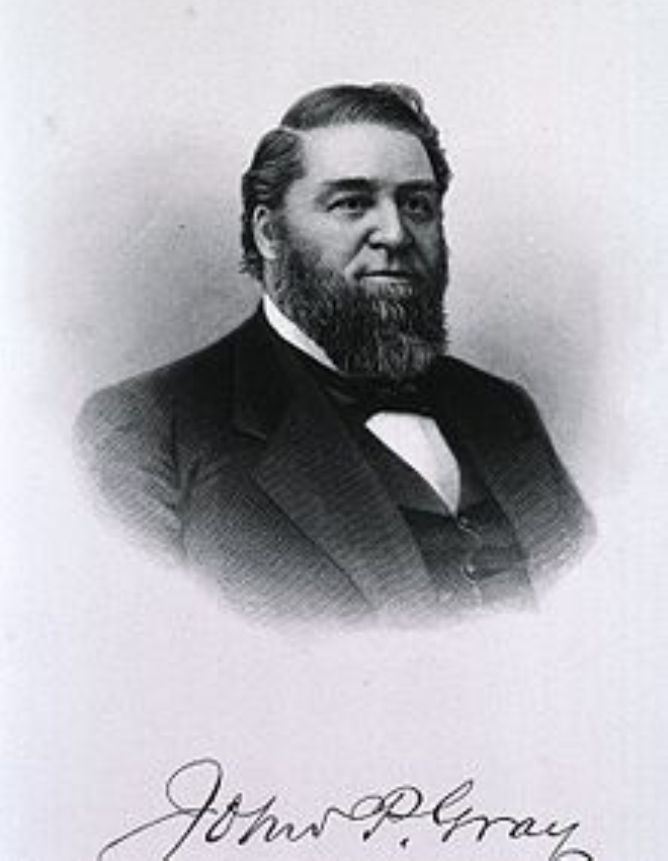
The pamphlet is not an easy read since it was written 157 years ago, but all 64 pages are worth the effort. I knew that some words were printing errors but everything else I kept as originally written. If you have read my blog, you will already know Dr. Amariah Brigham and Dr. John P. Gray. In the coming days, I will do more research on Miss Davis, Dr. Benedict, Dr. Nichols, and Dr. CookBub.”

1882 The Shooting of Dr. John P. Gray

1882 The Shooting Of Dr. Gray.
The Force Of A Presentiment – The Assailant Held For Trial.

“WASHINGTON, March 17. – Dr. John P. Gray, who was shot at Utica on Thursday night, has made many warm friends and acquaintances here during the last five months. He was the chief medical expert on the Government side in the Guiteau trial, and his advice was relied upon almost implicitly by Col. Corkhill, the Government’s attorney. Coming here early in the present week, he was occupied until Thursday going over the bid of exceptions filed by Mr. Scoville, examining it particularly with reference to the medical parts. On Wednesday night, with Col. Corkhill, he went to the theatre, and walked from Ford’s Opera-house along Pennsylvania-avenue to Willard’s Hotel after the performance. On the way Dr. Gray remarked to Col. Corkhill that it was, perhaps, a very imprudent thing for them to be strolling about in the city so late at night, as they were exposing themselves to the attack of any “crank” who might entertain a judge against them for the part they had taken in the conviction of Guiteau. Col. Corkhill says he paid little attention to the remark at the moment, but last night, when he received a dispatch from Utica informing him that Dr. Gray had been shot, it recurred to him with something of the force of a presentiment.

Dr. John Perdue Gray

Dr. John Perdue Gray

UTICA, N.Y. – March 17. – Remshaw, who shot Dr. Gray, Superintendent of the State Lunatic Asylum, was brought before Recorder Bulger this morning, and committed to await the action of the Grand Jury, which meets on Monday. Remshaw is judged insane by those who conversed with him last night and this morning. Dr. Gray is in bed but comfortable. A slight rise in temperature is reported. It is not thought that the pistol wound will much disfigure his face. There will be a small scar under the left eye where the ball entered, but the place whence it issued will be hidden by the Doctor’s beard.”
SOURCE: Reprinted from The New York Times. Published March 18, 1882, Copyright @ The New York Times.

Dr. Gray’s Would-Be Murderer.

“UTICA, May 8. – Dr. McDonald, of Auburn; Dr. Flandrau, of Rome, and William H. Bright, of Utica, the commission appointed by the court in the matter of Henry Remshaw, who shot Superintendent John P. Gray, of the State Lunatic Asylum, reported that Remshaw is insane, and recommend that he be committed to some asylum. They sharply criticise the Directors and others who heard Remshaw make threats against Dr. Gray weeks before the shooting occurred and did not report the fact to the proper authorities. Dr. Gray is again able to be out.”
SOURCE: Reprinted from The New York Times. Published May 9, 1882, Copyright @ The New York Times.

To learn more about Dr. Gray, click on the “Interesting Articles & Documents” page to read his obituary.

1880 The Treatment Of The Insane by William A. Hammond

“In all ages of the world, the most monstrous abuses have found their defenders among good and noble-minded people; and this is especially true of those acts which a subsequent period regards as outrages against the individual, but which at the time were defended by many on the ground of expediency, the advantage of the country, the glory of God, the progress of humanity, or the ultimate good of the person injured. Thus, the gladiatorial exhibitions of ancient Rome were looked upon as politic amusements, which tended to excite harmless emotions to the exclusion of more dangerous sentiments. The Duke of Alva, and others of his type, professed to be actuated by a laudable desire to put down rebellion; and it is entirely within the range of possibility that they were kind and loving fathers and friends. Witches and heretics were burned at the stake or drowned in the flood at the instigation of tender-hearted women, and by judges of gentle bearing, who honestly thought they were serving God and society; and the insane were loaded with chains, beaten and subjected to many other corporeal sufferings by the orders of learned and humane men, who sincerely believed that they were acting in accordance with the most benevolent instincts, – as in fact they probably were. But as time passes on the acts of those who have preceded us are seen in their true light, and judged by a higher standard. The human nature of to-day is more advanced than the human nature of yesterday, and what were deemed to be great truths then are seen to be vile errors now. It denounces the dungeon, the lash, and the fetters for lunatics, but it clings tenaciously to the strap, the camisole, and the Utica crib. It looks back with horror to the time when the insane were flogged as a therapeutical measure “to beat the devil out of them,” but regards with complacency and even favor the forcible feeding of the poor creatures by ignorant and brutal attendants, and the consequent life-long injury or death of the victims. That those who come after us will regard our conduct in these matters very much as we do that of the mad-house keepers of less than a century ago is not a matter for doubt. Already the revolution has begun.

Holding Chair

Holding Chair – Illustration by Etienne Equirol’s Des maladies mentales considérées sous les rapports médicale hygiénique et medico-legal (Paris 1838), at: Diseases Of The Mind: Highlights of American Psychiatry through 1900. http://www.nlm.nih.gov/hmd/diseases/debates.html.

Few, even among those who have given some attention to the subject, know the depth of wretchedness to which within a comparatively short period the lunatic was consigned, and which, even at the present day, is in some places scarcely lessened. Dr. Conolly, (1) whose advanced ideas of science and humanity led to the uniform adoption in England of the “non-restraint” system of treatment, speaking only thirty years ago on this subject, says: “Very few physicians of education were to be found, until a recent period, devoting themselves to mental disorders. Those occupied in asylums were chiefly distinguished by an eccentricity and a roughness which, unfitting them for other professional vocations, made them willing to undertake to treat mad people. By such persons, ill-educated, prejudiced, and without any resources but methods of violence, and who had never studied the forms and treatment of mental disorders, all attempts to ameliorate the condition of the insane were bitterly and unscrupulously opposed with every effort and every contrivance of vulgar minds. Meantime, the outside walls of an asylum were regarded with awe; the shrieks issuing from it made night hideous; the frantic creatures enclosed in their dens furnished appalling subjects for the artist or the novelist; squalor and dirt, and famine and ferocity were everywhere to be met with.” And now in the latter half of the nineteenth century we find that the methods which Conolly so vigorously denounced, and to the abolition of which he gave his life, are in full use in almost every asylum in the United States; that the attempts to improve the condition of the insane are opposed, as in his day, by those who have the charge of them; that dens are still in existence, chains still employed, blows still inflicted, systematic flogging still practised, the strait-jacket still used as a means of restraint; and that these agencies of subjection are supplemented by The Utica Crib. , – an apparatus not only inhuman, but one which no person possessing a competent knowledge of the physiology of the brain and the pathology of insanity would venture to introduce into the wards of a lunatic asylum.

Dress Camisole - Esquirol Bench

Dress Camisole-Esquirol Bench – Illustration by Etienne Equirol’s Des maladies mentales considérées sous les rapports médicale hygiénique et medico-legal (Paris 1838), at: Diseases Of The Mind: Highlights of American Psychiatry through 1900. http://www.nlm.nih.gov/hmd/diseases/debates.html.

I do not mean to be understood as saying that all these various measures for punishing and subduing a maniac are sanctioned by those in authority. No superintendent, so far as I know, approves of his patients being knocked down, beaten, or put in irons; but, nevertheless, these things and even worse are perpetrated in American institutions for the insane, either through the ignorance, the negligence, or the indifference of their superintendents; and others equally bad are done with their full knowledge and approval. Doubtless many of the outrages against humanity which are committed in our asylums are the direct result of the system by which their officers are appointed. But this only makes the matter worse. If it were individuals only with which those who have undertaken the task of ameliorating the condition of the insane had to contend, the contest would be neither long nor doubtful; but there are trustees and commissioners, and legislatures and political parties to meet, who have an interest – one which appeals with great force to the average American mind: the love of patronage – in keeping things as they are.

Now let us see what kind of atrocities are permitted by the system which prevails throughout this country. In this survey, it will not be necessary to go back farther than two or three years, or to refer to more than a few examples of the number which have been unearthed by legislative committees, casual visitors, and newspaper reporters, or which have been revealed by mere accident.

Within about a year four homicides occurred in the New York City lunatic asylum on Ward’s Island. In one of these a patient was beaten to death by an attendant; in another, an attendant was killed by a patient; in the third, a patient was thrown off the wharf and drowned by another patient; and in the fourth, one lunatic was ordered to give a hot bath to another, not only insane, but paralyzed. After getting him into the bath-tub he turned on the hot water and walked away leaving the poor wretch actually to be boiled to death. In the asylum at St. Peter, Minnesota, a patient who refused to eat had his mouth filled with food by a nurse, and the mess pushed down into his stomach with the handle of a knife, while another nurse held him down. On one occasion he ran away, yelling that they wanted to kill him. He was caught and laid on a bench; one attendant held his hands, and sat across his body; another attendant and a patient helped to hold him; his mouth was plugged to prevent his closing it. The food (soup) was poured in from a pitcher; his breath was heard to “gurgle” as the soup went into his windpipe, and in five minutes he was dead.

Force Feeding

Force Feeding

Owing to an erroneous idea that the food is poisoned, to some other delusion, or to a determined intention to commit suicide, it frequently happens that lunatics refuse to eat. The operation of forcible feeding is a delicate one, requiring anatomical skill; and yet it is one which in American asylums is often left to be performed by ignorant and brutal attendants, a physician not even being present. Thus, at the Bloomingdale Asylum in New York, a lady while being fed by a nurse had the soft parts of the roof of her mouth torn away by the spoon being rammed violently down her throat. From the testimony taken in this case, preliminary to a suit for damages, and which has not yet been published, I make the following citations:

Mrs. Cochran says she saw both Jane Eaton and Jane Gordon, nurses in Bloomingdale, forcibly feeding a patient. They had a wooden wedge which they put into her mouth, and then they fed her with a spoon (folio 93). Dr. Choate says it is done by attendants in asylums (folio 119). Jane Eaton, a nurse, puts on the camisole without instructions from the physician (folio 125). Was told to use force in feeding (folio 127). Used a spoon or a wedge to force open the mouth. “The most difficult person I ever had to feed” (folio 132), – and yet the duty was left to a nurse; the doctor was never present when she was fed (folio 133). The nurse does not always report to the physician when she uses the camisole. Has seen blood come from Mrs. N’s mouth when she was feeding her (folio 138). Was taken naked from her room to the bath-room (folio 146). The doctor says forcible feeding is delegated to an attendant (folio 150).

Last winter, rumors in regard to the bad management of the Longview Asylum, in Ohio, became so prevalent that the legislature appointed a committee to investigate them. From the report made on the subject I make the following extracts: –

According to the testimony of several eye-witnesses, a punishment frequently and sometimes gleefully resorted to by attendants in this asylum is one known as “taking down.” “Taking down,” in the words of the testimony, consists in tripping or throwing the patient to the floor, holding her down (for “taking down” is a female punishment; the men being usually knocked down) with the knee on the chest, while another employé gags the patient, and still another holds the patient’s hands. The patient is held down till she is quite weak and exhausted, becomes purple in the face, and the breath is almost gone.

Another punishment is to make a “spread eagle” of a patient. This consists in stripping a patient to nakedness, and making attendants whip him with wet towels. This is a punishment inflicted for a refusal to work. It is described as very painful, and is practised because it leaves no marks.

There is testimony as to ducking, kicking, beating, black eyes, and other marks of cruelty. It is in evidence that weak patients are overworked, and all inmates have not been properly fed and cared for. Hard work has been needlessly compelled in a room in which the mercury stood at one hundred and twenty degrees. The use of “cribs” and the “strong room” is shown. Loathsome vermin in loathsome numbers have been allowed to accumulate upon the bedding, the apparel, and the person of patients. All of these things and others told with a painful plainness is the testimony that is made part of this report.

The report then goes on to speak of the profanity of the attendants; that “the superintendent has been guilty of inattention to his duties and gross neglect;” and that the evidence “seems to the committee to destroy entirely the suggestion that the various hideous things were done without his knowledge and consent.” The Ohio legislative committee appears to have performed its work thoroughly; and it is the more to be commended for this, inasmuch as the superintendent was appointed on political grounds, and the majority of the committee was of the same political faith as this official.”

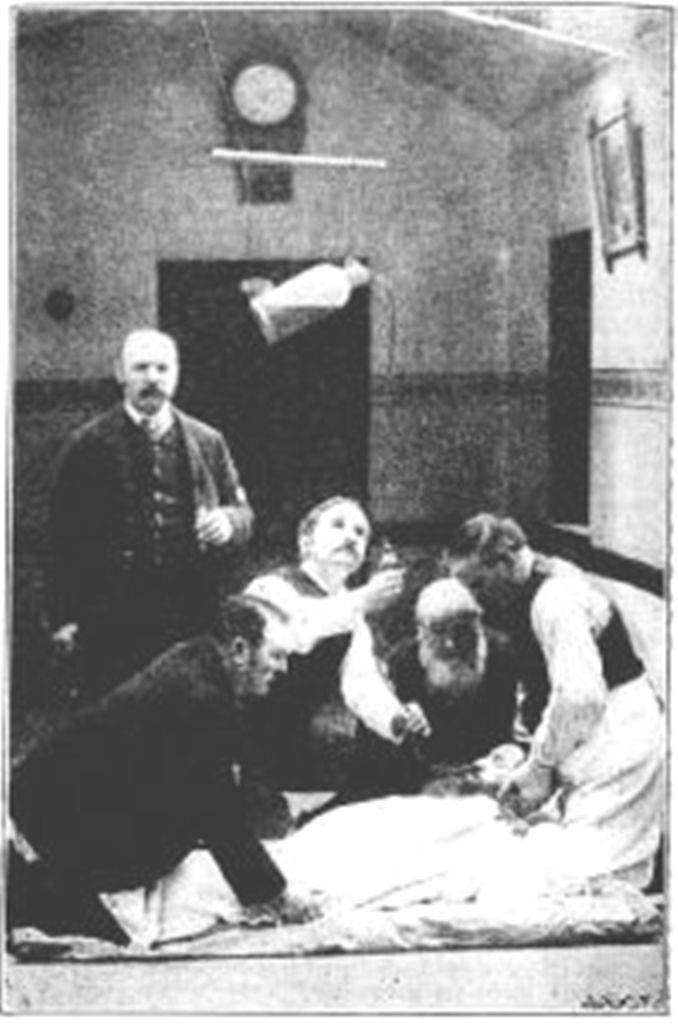
1880 The Utica Crib

It is so interesting to read original documents from the nineteenth century. It gives us a great insight into how people viewed the “insane.” The following articles feature Dr. William A. Hammond, who fought to remove all mechanical restraints, including the infamous “Utica Crib,” from New York State Insane Asylums. The first article was written by Dr. Hammond in March of 1880 and was published in The International Review. The second article from the Utica Morning Herald and Daily Gazette published on November 25, 1879, argues that Dr. Hammond was making “reckless and wholesale charges,” it also refers to the inmates as “unfortunate creatures” as if they were not human beings. What I discovered was that the Utica Crib was invented by Dr. M.H. Aubanel, of the Marseilles Lunatic Asylum in 1845, and was introduced at the New York State Lunatic Asylum at Utica in 1846 by Dr. Amariah Brigham, the first Medical Superintendent.

On November 29, 1886, Dr. John P. Gray, died. He had held the position as Medical Superintendent at Utica for several years. On December 14, 1886, Dr. George Alder Blumer was appointed as the new Medical Superintendent. On September 30, 1887, Dr. Blumer proudly reported: “Mention should be made in this connection of the so-called ‘Utica Crib,’ generally known in this hospital under the less suggestive euphemism of ‘covered bed.’ I am happy to report that we have been able to dispense with these restraint-beds, and that on January 18, 1887, all that remained of them were removed from the wards.”

Utica Crib 1

Utica Crib 1

 THE TREATMENT OF THE INSANE

“Now let us take a brief review of the treatment of lunatics as regards mechanical restraint in this country. While it is certainly true that there are lunatic asylums, the superintendents of which are actuated by a desire to keep the number of restraint cases at a minimum, there is not one in which mechanical restraint in some form or other is not employed, and in some the proportion equals that at Hanwell before Dr. Conolly instituted his reform measures. In the New York City lunatic asylum on Ward’s Island, for instance, there is a daily average of over twenty patients kept in mechanical restraint, and twenty-five in seclusion. The means employed are strait-jackets or camisoles, muffs for the hands, some kind of contrivance to restrain the motion of the legs, chairs in which refractory lunatics may be confined, and last, but by no means least, the “Utica crib.” The object in view in using most of these contrivances is readily apparent from their designations; but the crib probably requires a brief description. It is constructed somewhat after the manner of a child’s crib, having like it barred sides and ends; but in addition it is furnished with a lid also of bars or slats on hinges, and fastening with a spring or lock. It is so arranged that the inmate is unable to open it when it has been closed upon him. The space between the body of the lunatic imprisoned in this cage and the lid does not exceed twelve inches, and is probably less. The consequence is that he must lie at full length, and this sometimes for many hours at a time. For those maniacs whose cerebral bloodvessels are full to repletion, the enforced position of recumbency is in the highest degree prejudicial; for those whose brains are anaemic it is not required, as they will lie quiet enough without being thus imprisoned. It is a matter of experience that patients who were previously maniacal while in the crib, dashing themselves with violence against the bars like a wild lion in its cage when first confined, have become entirely quiet and composed when taken from the cage and allowed to sit or stand; and yet its use is held to tenaciously by many superintendents, and long papers are written in its defence. It is true that it is not found in some institutions. There has never been one at Willard, none at Flatbush; and since the agitation for lunatic-asylum reform, it has been discontinued at Bloomingdale, Poughkeepsie, and perhaps other asylums; and even at Ward’s Island the lids have been taken off.”
(SOURCE: The International Review, The Treatment Of The Insane by William A. Hammond, Volume VIII, March 1880, New York: Barnes & Company, Page 236).

Utica Crib 2

Utica Crib 2

 DR. HAMMOND’S ATTACK ON THE ASYLUMS.

“Some notion of the utter wantonness of DR. WILLIAM A. HAMMOND’S statements regarding the lunatic asylums of this state may be obtained from the report of the senate committee, elsewhere published this morning, and the letter of SENATOR GOODWIN, the chairman of that committee, addressed to the editor of this journal. In respect to HAMMOND’S assertion that the investigation SENATOR GOODWIN conducted was one-sided and unfair, it appears from this document – in which all the evidence taken is published in full – that DR. HAMMOND and all the physicians who signed his petition were invited to appear before this committee, and furnish all the evidence in their possession regarding their alleged abuses in the conduct of the state asylums. It is their own fault – the fault more especially of DR. HAMMOND – if they did not make a case; and their failure to do so was admitted by themselves in the testimony here published. The evidence of DR HAMMOND, who makes these reckless and wholesale charges in the New York Herald, is especially noteworthy, as showing his total ignorance of the management of our insane asylums. He was asked if he had ever visited any of the insane asylums; yes, he had visited the Utica asylum twelve and eight years ago – on which latter occasion he merely entered the office; the Po’keepsie asylum four years ago – which was before it was fairly in operation; the Blackwell’s Island asylum – but not during the day of the present superintendent there; and the Bloomingdale asylum, but not since DR. NICHOLS has been in charge there. This was the basis of his personal knowledge of the asylums – and it of course appeared in the investigation, that he knew nothing at all. DR. HAMMOND was not able to make a single allegation, either upon personal knowledge or hearsay, which indicated any basis for the investigation he then demanded. His nearest approach was his denunciation of what he called the “Utica crib” – a contrivance or the confinement of violent lunatics which was invented by AUBANEL, the superintendent of the Marseilles insane asylum in France, and introduced into the Utica asylum, among others, in 1846, by DR. BRIGHAM, and which has been fully described by DR. GRAY in his annual reports to the legislature – notably in the eighteenth report. Even in respect to this crib, so-called, DR. HAMMOND was compelled to admit that the question whether this method of restraint was more objectionable than others was “a matter of opinion.”

The answers of DR. HAMMOND to two questions put to him in this inquiry will be interesting to our readers in Utica. To the question – “How long were you at the Utica asylum?” he answered, “I don’t think I should be warranted in making any observations upon that institution.” – and again, “Utica is the asylum I know least about.” To the question that he knew that the two asylums of which he made the loudest complaint were under the control of the board of charities of New York city, DR. HAMMOND answered: “I believe they are; my personal views do not concern any of the state asylums; I only believe in a general way that this matter ought to be investigated.”

Utica Crib 3

Utica Crib 3

 THE UTICA CRIB. The Covered Bed at the State Asylum for Restless Patients – A Herald Reporter Comfortable within what Dr. Hammond declares a “Barbarous Device.”

The unfortunate creatures who become insane suffer but little or nothing within the walls of humane state institutions when compared with the great anxiety and pain of loving parents and friends over their afflictions. Justice to the friends of the insane in the New York state asylum located in this city demands that nothing be added to their trouble by permitting unfounded reports regarding the care of the insane to go uncontradicted. Such sensations are cruel and unjust, whether they are prompted by malice or ignorance of facts. DR. WILLIAM A. HAMMOND, of New York, in an interview with a reporter of the Sunday Herald, of that city, took occasion to refer to what he is pleased to call “the Utica Crib,” the covered bed in use in the state asylum for the insane in this city, and in what are known as model asylums of America and Europe. When asked to describe the “Utica crib,” DR. HAMMOND said:

“It is a bed like a child’s crib, with slatted sides, eighteen inches deep, six feet long and three feet wide. It has a slatted lid which shuts with a spring lock. A lunatic put in it can barely turn over. There is not as much space between the patient’s head and the lid as if he were in a coffin. He is kept in the crib at the will of an attendant, the key being in the possession of the latter and not of a physician. Patients have sometimes died in these cribs. DR. MYCERT, who is an authority, says the crib is a most barbarous and unscientific instrument because there is already a tendency to a determination of blood to the brain in excited forms of insanity which is increased by the horizontal position in the crib and the struggles of the patient. The crib was introduced by the superintendent of the Utica asylum. The padded room could always be substituted for the crib.”

Following this is what purports to be a cut of the Utica crib. Any one of the thousands who visit the state asylum every year and are shown the covered bed in use at that institution will bear us out in saying that the picture looks as much like the bed as a peach crate does like a cradle. The cut looks like a chicken-hatching machine, and is simply a burlesque upon the truth, for which there is no possible excuse.

 A REPORTER IN A CRIB.

A reporter of the Herald visited the asylum, yesterday, and requested permission to examine one of the cribs which he had frequently seen in visits to the asylum. DR. GRAY cheerfully gave the permission, and the reporter had an opportunity of selecting one of five or six of the covered beds or “barbarous devices,” for actual experiment. Simply removing his outer coat he got into the crib, which was in condition for use, and the lid was closed down upon him. As the reporter is nearly six feet in height, and weighs two hundred and seventy six pounds, and larger in every respect than any patient in the asylum, it will be admitted that this test was a fair one. When the lid was closed the occupant laid with perfect comfort upon either side and upon his back. When lying upon his left side the position was sufficiently easy to permit him to write his description of the covered bed if he had chosen to do so. The hands and arms could be put between the smooth wooden rounds which formed the slatted top, and there was a perfect circulation at the sides and top. The bed was easy and comfortable and there was an abundance of room for lifting the head from the plump pillow so that the lower end of the bed could be seen with ease. In short the reporter found that he could roll and toss about at will as easily as he could in his own bed at home, but he could not get out of it – and this is the humane plan of the device which is styled “barbarous” – as will be seen hereafter.

 THE COVERED BED AND ITS USES.

The covered bed or “Utica crib” is simply an ordinary hospital bed to all intents and purposes. It is made of smoothly finished and varnished wood with a woven wire bottom and slatted sides, like a child’s cradle. The one tested contained a mattress thicker than the ordinary ones, a plump soft pillow, clean and comfortable sheets, blankets and counterpanes. In the sides there are twenty wooden rollers, in the ends eight and in the cover seven rollers of smooth hard wood. The cover is attached to hinges which permit its entire removal at any time. The beds are frequently used without the cover by patients and attendants. A few months ago a venerable Utica patient got into one of these covered beds and permitted a reporter of the Herald to close it tightly to note its workings. The patient moved about easily in it and conversed cheerfully. When asked how he liked to sleep in this bed he replied: “Oh, I like it very much. I am often disturbed in my sleep. When I occupy this bed I rest easily, for I know where to find myself in the morning. Without such restraint, I might do myself some harm during the night.”

The patient, tho’ insane at intervals, really had more sense than those who denounce what they appear to know little about. Covered beds, patterned after those in use at the state asylum, are used in St. Elizabeth’s and other hospitals of Utica and thro’out the state, and they are daily seen and examined by visitors. So simple and harmless is the contrivance that parents, after seeing them, inquire, “Why would not this be a good plan to prevent our babies from falling out of their cradles?” It certainly would.

 THE USES OF COVERED BEDS.

The covered beds are used to secure the excited and restless patients, the requisite quiet and sleep in a horizontal position, that are absolutely necessary for their recovery. Insane people are sick people. When a sane person is sick his physician directs that he shall lie in bed, and a sensible invalid always obeys the orders of his physician. When an insane person requires rest he may be ever so much disposed to obey the doctor and lie in bed, but his mind is disordered and his will is gone so that he can not control his own actions. The result is he is liable to exhaust himself by getting in and out of bed at frequent periods, risking chances of falls and exposure to cold. Epileptics and paralytics are apt to fall out of open beds and receive severe injuries.

If such beds are not used, other more objectionable systems would have to be put into practice, such as the “bed strap,” for holding excited patients in the ordinary beds, or the forcible holding of the patient by attendants. This latter method better deserves the title of barbarous than does the covered bed system. No one or two attendants can hold an excited patient in a bed without using a force that must be more or less cruel and the marks of their grasp will not fail to be undeniably imprinted upon the delicate arms, body or limbs of the invalid. Insane people are endowed at times with extraordinary strength and the utmost exertions of strong men are required to quiet them. The use of the strap is harsh and at times injurious.

 THE ORIGIN OF COVERED BEDS.

The crib, or covered bed for restless patients, is not a new device and was not introduced by the superintendent of the state asylum at Utica as DR. HAMMOND alleges. It was devised in France by DR. AUBANEL of the Marseilles lunatic asylum, in 1845, and described in the Annales Psychologniques of the year. DR. BRIGHAM, in 1846, introduced the crib bedstead into the Utica asylum, and was described in the American Journal of Insanity in that year. In 1852, DR. WILLIAM WOOD, medical official of Bethlem hospital, England, improved upon the crib bed, and gave a description of the same in Winslow’s Journal of Psychological Medicine. This bed was like a child’s crib but the covering was of webbing. In 1854 the AUBANEL bed was abandoned in the Utica asylum and the present one was put into use, resembling DR. WOOD’S, with this exception – the sides were made with rounds like an ordinary child’s crib instead of with boards like the English bed, and a round slatted corner in place of webbing, which powerful patients could easily displace.

 DISTINGUISHED APPROVAL.

The covered bed is spoken of as the “box bed” or “locked bed,” by DR. LINDSAY, in an article on dipsomania, in the Edinburgh Medical Journal, of October, 1808, in which he says: “Its use renders him quiescent for the time, while it maintains warmth and does not prevent free ventilation. I have repeatedly tried it in various forms, and have no doubt as to its having prolonged several lives and prevented many accidents that would have been sacrificed or that would have occurred under the customary arrangements of many or most other asylums. Such is my opinion of its usefulness, that I think it should find place not only in every lunatic asylum, but in every general hospital, for I remember the difficulties that used to occur in the fever and delirium tremens wards of the Royal Infirmary of Edinburgh, and the impossibility of dealing with occasional patients other than by mechanical restraints of the nature of strait-waistcoats and strapping to bed.”

In the Edinburgh Medical Journal of February, 1878, DR. LINDSAY, M.D.,R.S.E., and physician to the Murray royal institution at Perth, published another article commending the covered beds in the highest terms as invaluable for preventing injuries – adding, however, “a lid in the case of patients who would scramble out of bed with sides merely. The kind of bed that I have found most useful is the following, and I venture to recommend some such bed to the attention of the medical profession generally because I am satisfied it is very much wanted in all departments of medical, surgical and obstetric practice.”

Then follows the description of forms of beds all alike, or closely resembling what is called by DR. HAMMOND “Utica crib,” but which is styled by DR. LINDSAY “the protection bed,” a term he says “happily applied to it many years ago by DR. BROWNE of Dumfries, when he was one of her majesty’s commissioners in lunacy for Scotland, and who had occasion to see such beds in use here during his official inspections. Moreover, he had himself, when at the head of Dumfries asylum used beds of a somewhat similar kind. And in America such beds are, and have long been in common use in its hospitals for the insane.”

Finally he adds: “The general result of the use of the protection bed in some of its forms, as compared with the orthodox modes of dealing with the classes of patients already described, is this – in my opinion – that it is directly and decidedly conservative of life and health, and preventive of injury and disease.”

The above is high authority in approval of the covered bed from professional and practical men who have daily opportunities of testing its merits. Laymen or friends of those who are confined in asylums can examine these beds in the Utica asylum and judge for themselves whether they are “barbarous” or “cruel devices” as has been alleged.

 REMARKABLE.

DR. HAMMOND, in his interview with the New York Herald reporter, makes the important announcement that sometimes patients die in covered beds or “Utica cribs.” Can not DR. HAMMOND, without particular effort, recall many instances where sane and insane patients have died in ordinary beds which have no sides or covers?”
(SOURCE: Reprinted from Utica Morning Herald and Daily Gazette. Wednesday, November 25, 1879).

1880 The Treatment Of The Insane by W.A. Hammond