2010 DSM-IV & HIPAA

1880 Forms of Insanity

In 1880, there were six general categories of insanity: Mania, Melancholia, Paresis (General Paralysis), Dementia, Epilepsy, and Dipsomania. Puerperal Mania was not included with these six but is listed for one woman in the 1880 Defective, Dependent & Delinquent U.S. Federal Census of The Willard Asylum for the Insane under the heading “Form of Disease.”

 DSM-IV

In the year 2010, The Diagnostic and Statistical Manual of Mental Disorders, Fourth Edition (DSM-IV), lists seventeen Criteria for Mental Disorders as opposed to the six general forms of diseases that were presented in 1880. DSM-IV Complete Criteria for Mental Disorders are: Adjustment, Anxiety, Child, Cognitive, Dissociative, Eating, Factitious, Impulse, Mental GMC (Disorder due to Medical Condition), Mood, Other, Personality, Psychotic, Sexual, Sleep, Somatoform and Substance.
(SOURCE: from the website of Dr. James Morrison at http://www.neurosurvival.ca/ClinicalAssistant/scales/dsm_IV/dsm_index.html)

 The HIPAA Law

Health Information Privacy
The Office for Civil Rights enforces the HIPAA Privacy Rule, which protects the privacy of individually identifiable health information; the HIPAA Security Rule, which sets national standards for the security of electronic protected health information; and the confidentiality provisions of the Patient Safety Rule, which protect identifiable information being used to analyze patient safety events and improve patient safety.

Understanding Health Information Privacy
The HIPAA Privacy Rule provides federal protections for personal health information held by covered entities and gives patients an array of rights with respect to that information. At the same time, the Privacy Rule is balanced so that it permits the disclosure of personal health information needed for patient care and other important purposes. The Security Rule specifies a series of administrative, physical, and technical safeguards for covered entities to use to assure the confidentiality, integrity, and availability of electronic protected health information.

For Covered Entities
The Privacy and Security Rules apply only to covered entities. Individuals, organizations, and agencies that meet the definition of a covered entity under HIPAA must comply with the Rules’ requirements to protect the privacy and security of health information and must provide individuals with certain rights with respect to their health information. If an entity is not a covered entity, it does not have to comply with the Privacy Rule or the Security Rule.

A Covered Entity is one of the following:
A Health Care Provider
This includes providers such as: Doctors, Clinics, Psychologists, Dentists, Chiropractors, Nursing Homes, Pharmacies…but only if they transmit any information in an electronic form in connection with a transaction for which HHS has adopted a standard.

A Health Plan
This includes: Health insurance companies, HMOs, Company health plans, Government programs that pay for health care, such as Medicare, Medicaid, and the military and veterans health care programs.

A Health Care Clearinghouse
This includes entities that process nonstandard health information they receive from another entity into a standard (i.e., standard electronic format or data content), or vice versa.”

 HEALTH INSURANCE PORTABILITY AND ACCOUNTABILITY ACT OF 1996
Public Law 104-191, 104th Congress

An Act
“To amend the Internal Revenue Code of 1986 to improve portability and continuity of health insurance coverage in the group and individual markets, to combat waste, fraud, and abuse in health insurance and health care delivery, to promote the use of medical savings accounts, to improve access to long-term care services and coverage, to simplify the administration of health insurance, and for other purposes.

(4) HEALTH INFORMATION

(B) Relates to the past, present or future physical or mental health or condition of an individual, the provision of health care to an individual, or the past, present, or future payment for the provision of health care to an individual.

(6) INDIVIDUALLY IDENTIFIABLE HEALTH INFORMATION

(B) Relates to the past, present or future physical or mental health or condition of an individual, the provision of health care to an individual, or the past, present, or future payment for the provision of health care to an individual, and —

(i) identifies the individual; or

(ii) with respect to which there is a reasonable basis to believe that the information can be used to identify the individual.

 WRONGFUL DISCLOSURE OF INDIVIDUALLY IDENTIFIABLE HEALTH INFORMATION

SEC. 1177.

(a) OFFENSE. – A person who knowingly and in violation of this part –

(1) uses or causes to be used a unique health identifier;

(2) obtains individually identifiable health information relating to an individual; or

(3) discloses individually identifiable health information to another person, shall be punished as provided in subsection (b).

(b) PENALTIES. – A person described in subsection (a) shall –

(1) be fined not more than $50,000, imprisoned not more than one year, or both;

(2) if the offense is committed under false pretenses, be fined not more than $100,000, imprisoned not more than 5 years, or both; and

(3) if the offense is committed with intent to sell, transfer, or use individually health identifiable information for commercial advantage, personal gain, or malicious harm, be fined not more than $250,000, imprisoned not more than 10 years, or both.”

(SOURCE: http://www.hhs.gov/ocr/privacy/)

1892 Hair of the Insane

A Dictionary of Psychological Medicine by Dr. Daniel Hack Tuke 1892

HAIR OF THE INSANE. – Dr. Bucknill has said that a lunatic is a lunatic to his finger ends; he might have added, writes Darwin, ‘and often to the extremity of each particular hair.’ Although this is true, the indications of insanity which the hair affords are not great importance. The prevailing colour of the hair of the insane, there are grounds for supposing, is different from that of sane people of the same class in the same district. Those possessing hair of a black, dark, or dark brown shade, have a greater tendency to become insane than those having hair of a fair or light brown hue, and those having brown hair, neither very light nor very dark, have the least tendency any…

It is commonly believed that people with certain colours of hair are more prone to certain forms of insanity than others. It has long been recognised that black hair very often accompanies a melancholic temperament, and there is an impression that black-haired people are more liable to melancholia than light-haired, and that the latter are more subject to attacks of mania. Though our statistics confirm this impression the difference is not of a very striking nature. Esquirol believed that some people with dark hair and eyes became violently maniacal, and we have found that the percentage of dark-haired among the acutely maniacal is above the average. He also believed that the illness in the dark-haired terminated more frequently in a marked crisis, and that the fair haired fell more readily into chronic disease.

Grey hair is less common among the chronically insane who have become insane when young, and among the demented, owing partly to the fact that the cares and worries of life fall on them less, and are less felt. If, however, a person above middle age be attacked by insanity, greyness of hair rather tends to develop, whether recovery takes place or not, and in this respect insanity does not differ from many other diseases. Grief and fear are well known to turn the hair grey, and it is found that melancholia has a greater tendency to produce greyness than mania. Dr. Hack Tuke reports a case of recurrent insanity in which the hair turned grey during each attack, and recovered its healthy brown colour when the patient was well. Grey hair in the insane is very frequently found patchy.”

Reprinted from Tuke, D. Hack, A Dictionary of Psychological Medicine Giving The Definition, Etymology, And Synonyms Of The Terms Used In Medical Psychology,  with the Symptoms, Treatment, And Pathology Of Insanity And The Law Of Lunacy In Great Britain And Ireland.  (Edited by D. Hack Tuke, M.D., LL.D., Examiner in Mental Physiology in the University of London; Lecturer on Psychological Medicine At The Charing Cross Hospital Medical School; Co-Editor Of The “Journal Of Mental Science”), Volume I, London, J. & A. Churchill, 11 New Burlington Street, 1892, Pages 562, 563.

1906-1907 Elopements, Suicides & Accidents at New York State Hospitals

“The Commission is pleased to report an unusually small number of untoward occurrences at the State hospitals during the year. At the Utica State Hospital a somewhat unusual case was that of a woman patient who, escaping from the institution, found means to reach Albany where she obtained employment as a clerk in a department store. Here her peculiarities were noticed after a few days and her services were discontinued. She also received notice from the mistress of the boarding-house in which she had found domicile that she must look for quarters elsewhere. The excitement which followed these events brought on an attack of considerable violence necessitating her commitment to a local institution for safe keeping. When she became quieter efforts were made to send her to the home of her husband but she declined to consider this, alleging that he was, in the first instance, responsible for her unjustifiable commitment to a hospital for the insane. Through the good offices of a local attorney she consented to return to the Utica State Hospital, upon condition that she would be granted a parole within a short time. As she was able to exhibit considerable self-control she was discharged upon the hospital books within a short time afterward and has not, up to the close of is report, required recommitment. A woman patient at this hospital was paroled by the authorities for the purpose of spending Thanksgiving with her husband at home. Although she had not at any time previously exhibited suicidal tendencies she seized the opportunity thus afforded her to swallow a powerful drug, and although prompt measures were applied she died in a short time.

At the Willard State Hospital a patient secreted binding twine about her clothing and seizing a favorable opportunity hanged herself from the door of a room. At the same institution a male patient died from asphyxiation due to the lodgment of meat in the larynx.

At the Hudson River State Hospital a male patient left the grounds without permission, and was afterward found dead on the railway tracks near the hospital pumping station, his skull having been fractured evidently by contact with the locomotive or cars.

At the Middletown State Hospital a male patient committed suicide by drowning. It appears that he carried a pail of water to his room and held his head far enough in the pail to become asphyxiated. At the same hospital a male patient left the institution without permission or notice and remained for some months about the neighboring counties enlivening the situation at different times by transmitting to the authorities of the institution souvenir postal cards. At the same institution a male patient committed suicide by wading out into a small ice pond in the rear of the institution and lying down in the shallow water until this reached over his head.

At the Rochester State Hospital a woman patient committed suicide by suspension, using a bed sheet, one end of which was attached to the window guard. At the same institution a male patient committed suicide by drowning subsequent to an unsuccessful effort to persuade his wife to remove him from the institution.

At the Kings Park State Hospital a male patient met his death under somewhat unusual circumstances, and the hospital authorities called upon the local coroner to make the usual investigation. The patient’s relatives, not being satisfied with his report, requested the Commissioners to make a special inquiry which was done. Physicians and attendants were placed under oath, and all testimony that could throw light upon the patient’s death was adduced, but nothing was found to contradict the findings of the coroner.

At the Long Island State Hospital a woman patient, while on parole and in the charge of her friends, was accidentally killed by a trolley car.

At the Manhattan State Hospital a woman patient after leaving a dining-room started straight for the river. A nurse went in immediate pursuit and a hospital watchman also tried to intercept the patient, but she outstripped her pursuers and plunged into the river. No trace of her body was afterward discovered. At this same institution a male patient becoming very noisy in a small dormitory to which he had been assigned was attacked by a fellow patient whose rest he had disturbed and struck on the head with a small serving table. The patient died in a few days as a result of the injury. At the same institution a woman patient secured a poisonous drug, died, and upon investigation by the coroner evidences of mercurial poisoning were found. At this institution a male patient was found hanging in the closet in which are usually stored the brooms, polishers, etc., of the ward. The patient had placed a broom handle across the top of two shelves, and with the girdle of his dressing gown about his neck had produced asphyxiation. At this institution a male patient succeeded in throwing himself into the river. His body was taken to the Fordham Hospital, and afterward identified by the institution clothing. Another male patient committed suicide in the same way. At the same institution a woman patient eluded observation while patients were preparing for bed. The premises of the institution were searched throughout the night and the following day, but no traces of her was found. It was supposed she was drowned while attempting to swim the river. A Russian patient, while walking about the exercising court with other patients, eluded observation and rushing to the point of the grounds opposite Hell Gate plunged into the river, and after swimming a few strokes was carried away by the strong tide and soon disappeared. A second patient who had observed the first one escape attempted to throw himself into the river at the same time, but was prevented by the nurse who had started out to overtake the Russian patient.

Owing to the situation of the Manhattan State Hospital on Ward’s Island, it is at all times necessary to detail several attendants to specially guard the river banks and an attendant is also detailed to patrol the river near the shore in a row boat. Almost daily attempts are made to break through this line, but the escapes are relatively few in number. Owing to the proximity of this hospital to the city of New York, and the fact that all occurrences of an unusual character in an institution for the insane are seized upon eagerly by metropolitan dailies, occurrences of this kind are frequently exaggerated as are also injuries received by patients though these may not be actually serious. Charges were made against the Manhattan State Hospital in connection with the somewhat sudden death of a patient named Rodesky. Allegations of cruelty and maltreatment were made by the relatives of this patient, and the managers and the coroner made an investigation of the circumstances attending his death. It appears that he was a bed-ridden paretic and a few days prior to his death, on the thirtieth of July, was found to be suffering from a fracture of the sternum and three fractured ribs. The coroner reported the cause of death as septic poisoning from several large abscesses owing to the patient’s general septic condition. The managers at the close of their special inquiry reported that the patient was not handled in any rough manner.

At the Central Islip State Hospital a male patient who had been given parole of the grounds and was in the habit of taking long walks about the premises was found hanging by the neck in the woods some three miles distant.

At the Gowanda State Hospital two women patients committed suicide by hanging.”

SOURCE: Reprinted from State Commission in Lunacy, Nineteenth Annual Report, October 1, 1906 – September 30, 1907, Albany: J.B. Lyon Company, State Printers, 1908, Pages 39-42.  http://books.google.com/

1883 New York State County Poor House Report

The following document is a yearly report to the Legislature of the State of New York, from the Secretary of the State Board of Charities, Dr. Charles S. Hoyt, dated January 10, 1884, for the year 1883. Dr. Hoyt was the physician in charge of visiting and inspecting all the county poor houses and asylums in the state which included examining the health, treatment, and living conditions of the “insane” population. This was an unbelievably enormous job for one man. Not only does Dr. Hoyt mention the names of the patients recommended for transfer from the county poor houses to the two State Asylums for the Chronic Insane: Willard (Ovid, Seneca County); and Binghamton (Binghamton, Broome County), but he gives a detailed account of his findings for each county poor house in the state. Willard Asylum for the Insane was the first and only “pauper chronic insane” institution in the State of New York from 1869 to 1881. Binghamton State Asylum opened in 1881 and was the second asylum in the state to care for the chronic insane only. It was originally named The New York State Inebriate Asylum, built in 1858, for the treatment of alcoholism. (I have divided Dr. Hoyt’s report into ten PDF files to make it easier for you to read. These reports contain the NAMES of several inmates. Click on the RED Links below to view the county reports.)

Considering the modes of travel in 1883 which did not include automobiles, and the harsh winters that New York State endures, Dr. Hoyt must have spent much of his time traveling on horseback and catching a train at the nearest station. He was dedicated to his work and spent most of his life trying to improve the lives of the poor, the pauper insane, and feeble-minded and destitute children, according to the social norms of his era. His obituary is located at the bottom of the “Interesting Articles & Documents” page.

There were many abuses to this “defective class” of Americans, especially for feeble-minded and mentally ill women, who literally had no rights during this time period. All women were vulnerable to rape and molestation in the county poor houses, and more than a few turned up pregnant (enceinte). When Dr. Hoyt came upon a young woman who was pregnant or nursing her baby in the county poor house, for her protection, he would remove her to a safer place, the Newark Custodial Asylum. Once the young woman had her baby and the nursing was sufficiently completed, usually between the ages of three to six months, the infant was removed from the mother and placed in an orphanage.

As you read Dr. Hoyt’s report, keep in mind that the New York State Asylums for the Acute Insane in 1883 were: State Lunatic Asylum at Utica (Utica, Oneida County), Hudson River State Hospital (Poughkeepsie, Dutchess County), State Homeopathic Asylum (Middletown, Orange County) and Buffalo State Asylum (Buffalo, Erie County). The Newark Custodial Asylum, located in Newark, Wayne County, New York, was an institution for feeble-minded, childbearing age women that opened in 1878. There were other state institutions that incarcerated sane, so-called sexually promiscuous, childbearing age women that could hold them in these institutions for up to five years in order to teach them how to become proper ladies, teach them some type of valuable employment skills, and prevent them from becoming pregnant again.

I have divided Dr. Hoyt’s report into ten PDF files to make it easier for you to read. Click on the RED Links below to view the county reports.

1883 Yearly Report Of The Secretary Of The State Board Of Charities

Report. – To the State Board of Charities:  Agreeably to the resolution of the Board of January 10, 1883, on motion of Commissioner Miller, directing me to visit the asylums of the counties exempted by the Board from the Willard Asylum Act, and the poor-houses of such other counties of the State, containing any considerable number of insane, as practicable, and to examine and inquire into their condition, with the view of securing the removal of the more disturbed and violent cases to the Willard and Binghamton State Asylums, and to communicate the result of such visits and examinations to the Board, I beg respectfully to report:The demands upon my time in other directions were such, that I was unable to enter upon this work until January 18, 1883.  It has frequently been interrupted by other duties, and the inclement weather, and at times almost impassable condition of the roads, in the winter months, also greatly embarrassed the work.  During the year, I have visited the asylums of the exempted counties, and the poor-houses of all the other counties of the State, one or more times, and have examined the insane in them as follows:

The exempted asylums of Broome, Chenango, Cortland, Erie, Oneida, Onondaga, Orange, Oswego, Queens, Suffolk and Wayne counties, each four times; and the exempted asylums of Cattaraugus, Chautauqua, Jefferson, and Wyoming counties, each three times; the poor-house of Genesee county, three times; the poor-houses of Lewis, Livingston, Madison, Montgomery, St. Lawrence, Tioga and Warren counties, each twice; and the poor-houses of the following counties, each once, viz.: Albany, Allegany, Cayuga, Chemung, Clinton, Columbia, Delaware, Dutchess, Essex, Franklin, Fulton, Greene, Herkimer, Monroe, Niagara, Ontario, Orleans, Otsego, Putnam, Queens, Rensselaer, Richmond, Rockland, Saratoga, Schenectady, Schoharie, Seneca, Steuben, Sullivan, Tompkins, Ulster, Washington, Westchester and Yates.

The number of insane in the counties thus visited, October 1, 1883, according to the reports of the proper officers, was as follows: In the asylums of the exempted counties, males, 569; females, 747; total, 1,316.  In the poor-houses and asylum departments of the other counties, males 228; females 325; total 553.  This gives an aggregate of 1,869 in these institutions, October 1, 1883, of whom 797 were males, and 1,072 females.

My visits to these institutions in every instance except one, when it was desirable to meet the superintendents of Genesee county, have been made without previous notice.  The examination in each county was extended to all the insane in its care, and in the case of disturbed and violent patients, careful notes were made of their condition, and as to the means employed for their custody and care.  In many of the exempted asylums, the examinations were made unattended by the superintendents or keepers, at the request of these officers.  A number of the visits were made in the evening, and opportunity was thus given carefully to observe and study the night service in these institutions.  In making these visits, I have frequently been accompanied by the Commissioner of the district, and in numerous instances by the State Commissioner in Lunacy, who often united with me in recommending removals, and in other matters respecting the treatment and care of the insane; and whenever practicable, the attendance of the visiting physicians has also been secured.  It may be well to add, that all recommendations for removals have been made in writing, and that every such positive recommendation, except in the case of Warren county, has been cheerfully and promptly carried out by the superintendents, unless subsequently modified or changed, upon consultation with those officers, or with the physician in charge.

As the buildings in use for the insane in the counties exempted from the Willard Asylum Act have so recently been described in the report of the committee of the Board upon the subject, it is deemed unnecessary for me to refer to them at length in this report.  I shall, therefore, only notice the improvements in them that have since been effected, the condition of the insane at the times of my visits, and the recommendations as to removals, etc., that have been made.  In some of the counties not exempt from the Willard Asylum Act, separate buildings have been provided for a limited number of chronic insane, while in others they are domiciled in the poor-houses, in common with the paupers, or in rooms set apart for the purpose.  In a few of them, attendants are employed to care for the insane, but they are generally overlooked by paupers, under the direction of the keeper, and the medical supervision is usually the same as that extended to other poor-house inmates.

Before entering upon this work I learned from the late Dr. Wilbur, superintendent of the State Idiot Asylum, that the Custodial Branch Asylum at Newark had accommodations for about twenty-five additional inmates.  I, therefore, examined such feeble-minded girls and young women as were found in the various poor-houses visited and recommended their removal to that institution.  A considerable number of this class has been thus removed during the year, but there are still large numbers in the poor-houses whose removal cannot be effected, owing to the lack of adequate State accommodations for their care.  The condition of the insane in each of the counties of the State at the times of my visits, and the recommendations in regard to removals, etc., will now be noticed:

(NAMES INCLUDED)

Albany, Allegany, Broome & Cattaraugus Counties 1883.
Cayuga, Chautauqua, Chemung, Chenango & Clinton Counties 1883.
Columbia, Cortland, Delaware, Dutchess & Erie Counties 1883.
Essex, Franklin, Fulton, Genesee, Greene, Hamilton & Herkimer Counties 1883.
Jefferson, Lewis, Livingston, Madison, Monroe & Montgomery Counties 1883.
Niagara, Oneida, Onondaga, Ontario & Orange Counties 1883.
Orleans, Oswego, Otsego, Putnam & Queens Counties 1883.
Rensselaer, Richmond, Rockland, St. Lawrence, Saratoga, Schenectady, Schoharie, Schuyler, Seneca, Steuben & Suffolk Counties 1883.
Sullivan, Tioga, Tompkins, Ulster & Warren Counties 1883.
Washington, Wayne, Westchester, Wyoming & Yates Counties 1883.

Results of the Visitations During the Year. – It may be well, before closing this report, briefly to sum up the results of these visitations during the year:

1. The number of insane removed to the Willard and Binghamton State Asylums during the year, as recommended, has been as follows: From the asylums of the exempted counties, 46; from the asylums and poor-houses of the other counties, 51; total, 97.  In addition to these, considerable numbers have also, voluntarily, been thus removed by the superintendents.  These have all been extremely disturbed and violent insane, and several of them suicidal and homicidal cases.  A much greater number of removals would have been recommended, if the State provision had been adequate to them.

2. These removals have greatly improved the condition of the asylums of the exempted counties, by relieving them of their most troublesome insane, and enabled a much better and more economic care of those remaining in them.  The amount of restraint has been largely reduced, and it may be kept thus, by continuing these removals, as disturbed and violent cases, from time to time arise.  In three of these counties, the high board fences, inclosing the asylum grounds, have been removed, and a much greater freedom of the insane, than heretofore, exists in these asylums.  The results in these counties have proved so largely beneficial and salutary, that their example in this respect is likely soon to be followed by other counties.

3. These removals of the insane from the poor-houses and asylum departments of the other counties have improved the condition of those institutions also, and rendered their management more easy and economic.  In two of these counties, viz.: Genesee and Tioga, all of their insane, requiring special oversight, have been removed to the care of the State, and the buildings heretofore occupied by them have been devoted to poor-house purposes.  It is believed that this course would soon be pursued by several other counties, were the accommodations of the State adequate for all of their insane.

4. These visitations and examinations during the year have clearly demonstrated that it is unwise and impolitic to retain violent and excited insane in the county institutions.  In the best regulated of the exempted county asylums they are the source of continued annoyance, and greatly disturb the more quiet and harmless patients; while in the poor-houses, and asylum buildings or wards of the other counties, they require persistent watchfulness and care, and are the cause of constant fear and distress to the other inmates.  The experienced officers of these institutions generally admit these facts, but owing to local influences, and the frequent changes of administration, these classes of insane are liable, from time to time, to accumulate.  In no way, it is believed, can the county asylums and poor-houses be kept clear of violent and disturbed insane, except by frequent visitations of these institutions, and recommendations for their removal.

5. The removals of feeble-minded girls and young women from the poor-houses, to the Custodial Branch Asylum at Newark during the year, have filled all the spare room of that institution, and no further action in this direction is practicable, until the State shall extend its accommodations for this class.

Respectfully submitted, Charles S. Hoyt, Secretary, Dated Albany, N.Y., January 10, 1884.”

SOURCE: Reprinted from State of New York, Seventeenth Annual Report of the State Board of Charities, Transmitted to the Legislature January 24, 1884, Albany: Weed, Parson & Company, Printers, Pages 187-246.   <http://books.google.com/&gt;

My Story by L.S. Stuhler – July 23, 2012

Featured

I include here my story about trying to obtain my great-grandmother’s medical records and photographs from the Willard State Hospital, along with asking for the release to the public of former patient names; dates of birth and death; and location of graves, in order that these forgotten people, of which there are thousands, may be honored and remembered with dignity. It all began on February 24, 2001, when I found my great-grandmother’s obituary: According to the “PennYan Democrat” newspaper dated August 17, 1928: “PUTNAM, At the State Hospital in Willard, Monday, August 13, 1928, Mrs. Margaret Putnam, aged 76 years. She is survived by one son, Jarvis Putnam, of PennYan. The funeral was held from the Thayer Funeral Home Wednesday afternoon, Rev. W.A. Hendricks officiating. Burial in Lake View cemetery.” 

It took a long time for me to figure out where I should be looking in order to obtain information about my great-grandmother. In 2001, I was unable to find anything on the internet pertaining to this issue which is the main reason I created this blog (July 10, 2011) and wrote the book The Inmates of Willard 1870 to 1900, A Genealogy Resource (December 17, 2011). In 2007, I came across an article about a new book written by Darby Penney, MLS, and Peter Stastney, M.D., entitled The Lives They Left Behind Suitcases From A State Hospital Attic. Wondering if my great-grandmother’s suitcase was among the 400 discovered in an attic of the Willard State Hospital, I contacted Ms. Penney. Unfortunately, it was not among the surviving suitcases. Ms. Penney’s book revealed the practice of burying “mental patients” in anonymous graves. I must admit that I had never heard of this practice before and thought it was extremely cruel. What amazed me most was that no one (that I knew of) had ever tried to rectify this sad, dehumanizing situation. What needs to be acknowledged is none of these well documented facts about the thousands of people buried in anonymous graves at Willard, and all former NYS Hospitals and Custodial Institutions, would ever have come to light without the tireless efforts of Ms. Penney, Dr. Stastney, and Mr. Craig Williams, Curator of History at the New York State Museum at Albany. I also need to thank Laurel Lemke, from the Grave Concerns Association, for sending me the law that she helped to pass in the State of Washington in 2004. Without her help in emailing me the bill, I never would have gotten the attention of Kate Munzinger, Senator Joseph Robach’s Chief of Staff. I met with Ms. Munzinger on August 22, 2011. Senator Robach introduced the bill to the New York State Senate in March 2012.

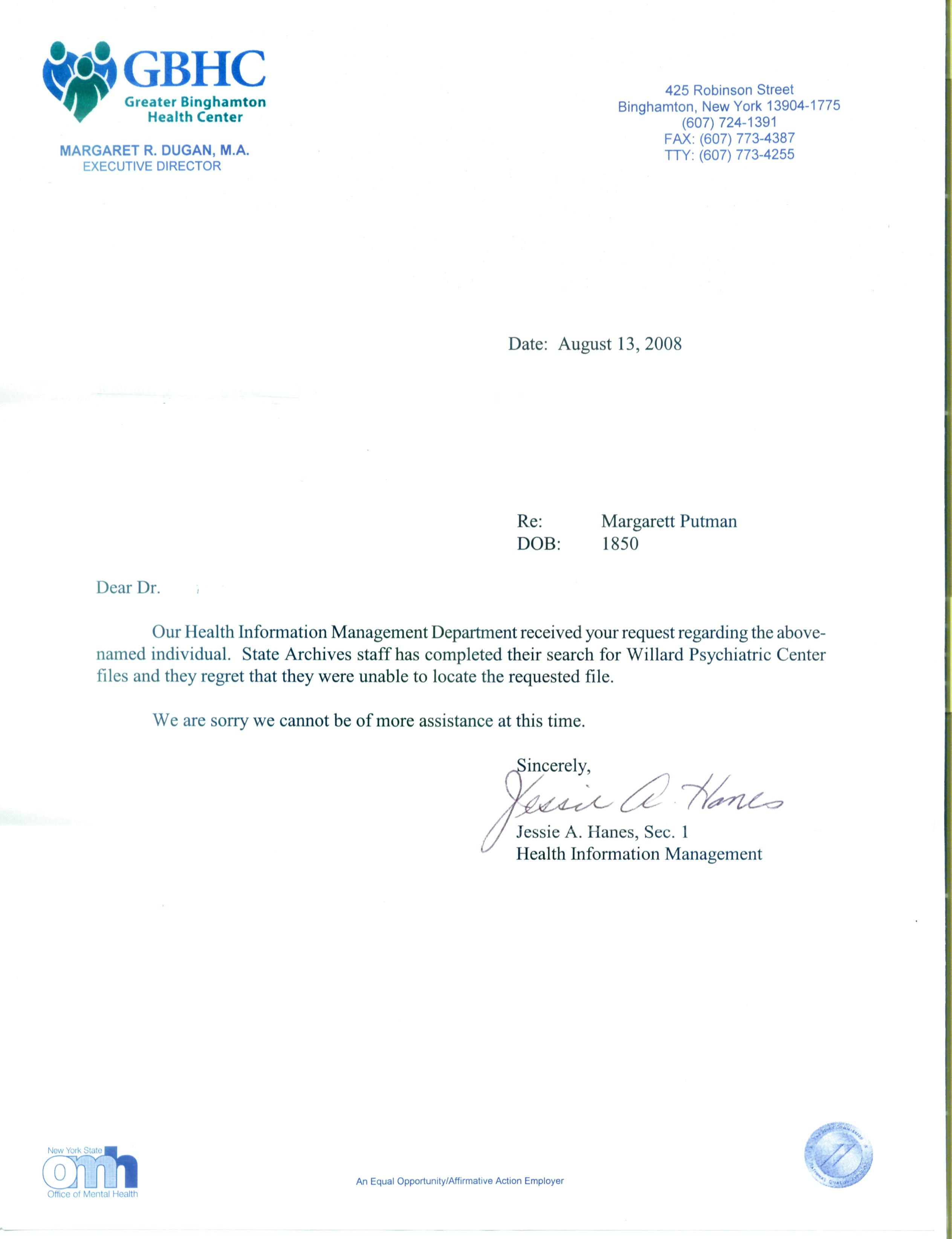
The following response letters, beginning in early 2008, are from everyone that I have contacted over the years. I have not included emails. Unless a modification is made to the present HIPAA Law and New York State Mental Hygiene Laws (See New HIPAA Update and S2514-2013), I and so many others like me, who want to know why our ancestor was committed to a state hospital, will never know the answer. My first response letter is dated April 16, 2008, in response to the original paperwork that my physician and I had sent in early September of 2007 (seven month wait). On August 13, 2008, I was denied a copy of my great-grandmother’s medical records and photographs from the Greater Binghamton Health Center. This three sentence response letter is the explanation given to me after waiting four months, taking the time and effort to speak with them on the phone, obtaining and filling out their required paper work with the help of my physician, and sending in the forms.

1- GBHC 04.16.2008

1- GBHC 04.16.2008

2 - GBHC 08.13.2008

2 – GBHC 08.13.2008

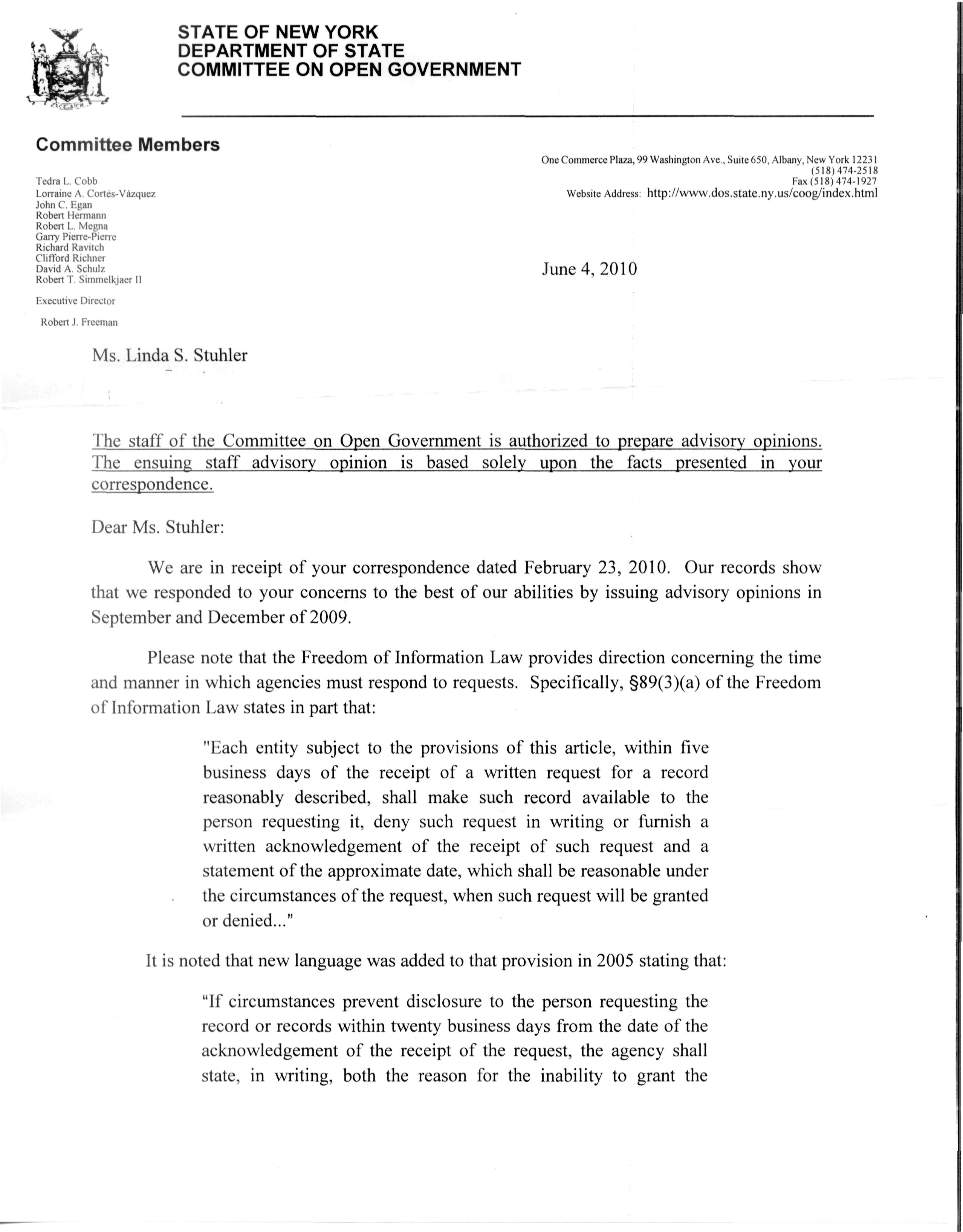
Besides writing a letter to former New York State Governor Patterson and present Governor Cuomo, both U.S. Senators from New York: Schumer and Gillibrand, State Senators, Congressmen, The Department of Correctional Services, The Commission on Quality of Care and Advocacy for Persons with Disabilities, The Office of Mental Health Counsel, and the State of New York Department of State Committee on Open Government (FOIL), I also wrote a letter to the doctor in charge of the Office of Mental Health Institutional Review Board asking permission to view, record, and publish the burial ledgers – names; dates of birth and death; and location of graves) located and stored at the NYS Archives. After waiting seven months for a response, I was told in an official letter, that my proposed study was not approved due to concerns about violating patient confidentiality. I was also told that I could take the New York State Office of Mental Health to court in order to get the names of former patients and the medical records of my great-grandmother, but seriously, who has the time and the money to go through all of that? Privacy ends at death but apparently patient confidentiality lasts forever.

I went through proper channels to obtain Maggie’s medical records and photographs. I filled out the paperwork, had my doctor and a witness sign the paperwork, and my doctor sent it in. I waited four months for a response and finally my doctor received a letter. I asked for the medical records and any photographs of my great-grandmother. When I received the response from the Greater Binghamton Health Center in August 2008, it stated the staff was unable to locate the requested file. Had I received my great-grandmother’s medical records, I would have been satisfied. Besides being genuinely interested in learning more about Willard, I created this blog for family genealogists like me, frustrated trying to find out if and when their ancestor was a Willard inmate, receiving the runaround obtaining their ancestor’s medical records and photos, and determining whether their ancestor is buried in the Willard Cemetery. The final answer came from the Commissioner of the NYS Office of Mental Health in responding to my inquiry by e-mail on October 25, 2010, which basically stated that publicly identifying former patients may be offensive to some families because of the stigma and repercussions that may follow, for example, in some small towns. I must say that I took offense to his statement because I live in a small town. What exactly was he trying to imply? It appears that we have not moved any further in our tolerance or understanding of people with problems and of people who live in small towns. I must say that my favorite letter is from the Commissioner, dated June 3, 2011, in which he reminds me “that the penalties for violations are very stiff – civil penalties under federal law can carry up to $10,000 per violation.”

Willard’s inmates who in life were incarcerated, forgotten, warehoused, and controlled by the state are once again controlled and intentionally forgotten in death by New York State, the New York State Office of Mental Health, or both. Perhaps they are interpreting the scope of the HIPAA Law incorrectly. The only logical assumption is the protection provided by these laws is not for long dead souls since U.S. Federal Censuses already reveal many of their names; it is for the protection of the descendants.

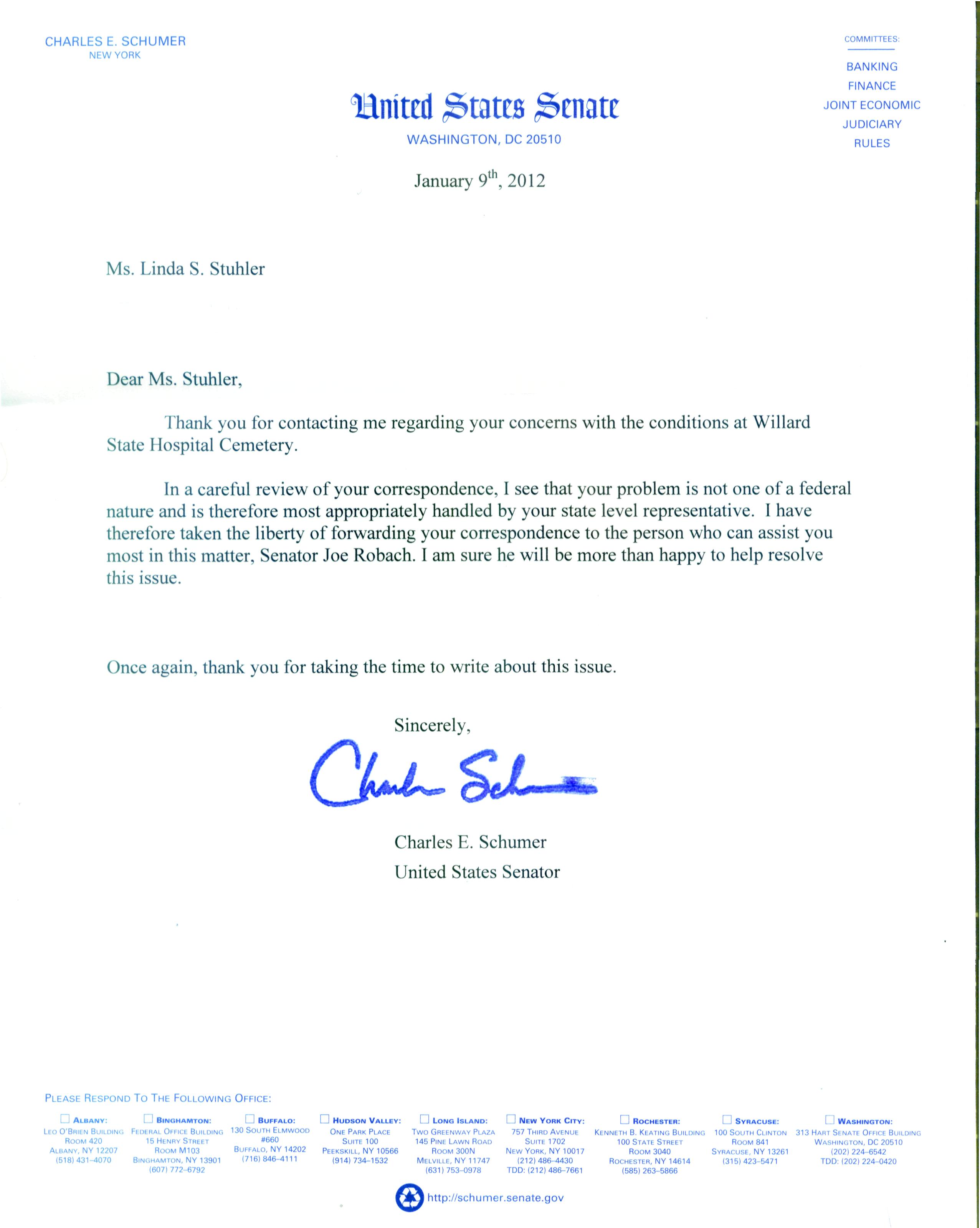
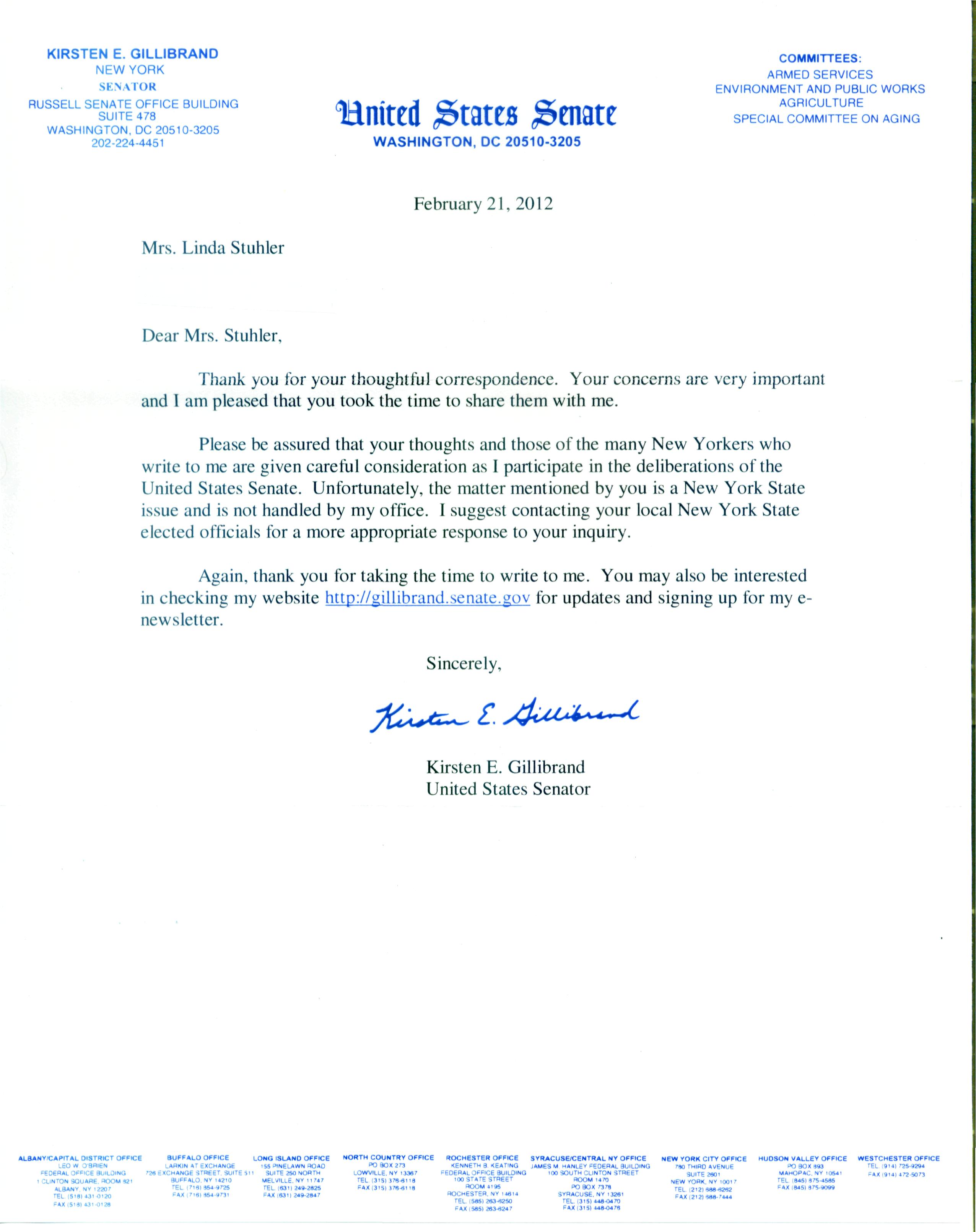
The responses from the Senators are interesting because they state that there is nothing they can do about the situation at Willard. They mention nothing about modifying the HIPAA Law which was one of the questions that I asked them to respond to. My understanding is that they are the only ones who can change or modify this federal law in order that descendants or anyone for that matter, would be allowed to have a copy of these historical medical records. When you’re dead, you’re dead. Who cares if someone looks at 80 year old medical records? The following letters were received by me from Senator Charles E. Schumer, dated January 9, 2012; and from Senator Kirsten E. Gillibrand, dated February 21, 2012. Perhaps this whole ridiculous situation of trying to uncover the identities and opening medical records of people who have been dead for one hundred years lies with the unique interpretation of the federal HIPAA Law by each individual state office of mental health.

Response Letter Senator Schumer 1.9.2012

Response Letter Senator Schumer 1.9.2012

Response Letter Senator Gillibrand 2.21.2012

Response Letter Senator Gillibrand 2.21.2012

14 - OMH 06.03.2011

14 – OMH 06.03.2011

13 - GBHC 09.07.2010

13 – GBHC 09.07.2010

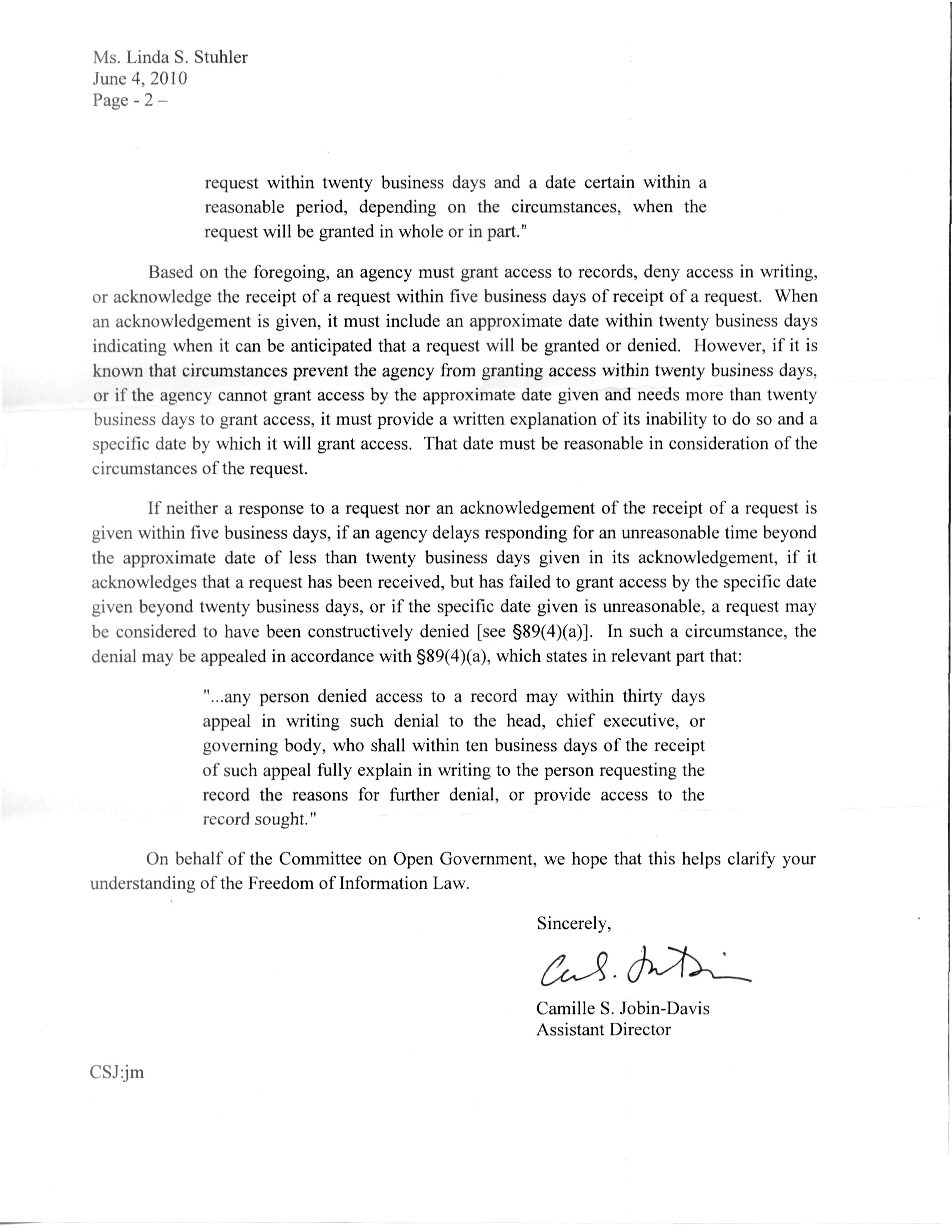
11 - FOIL 06.04.2010-1

11 – FOIL 06.04.2010-1

12 - FOIL 06.04.2010-2

12 – FOIL 06.04.2010-2

10 - Correctional Services 01.15.2010

10 – Correctional Services 01.15.2010

7 - FOIL 12.10.2009-1

7 – FOIL 12.10.2009-1

8 - FOIL 12.10.2009-2

8 – FOIL 12.10.2009-2

9 - FOIL 12.10.2009-3

9 – FOIL 12.10.2009-3

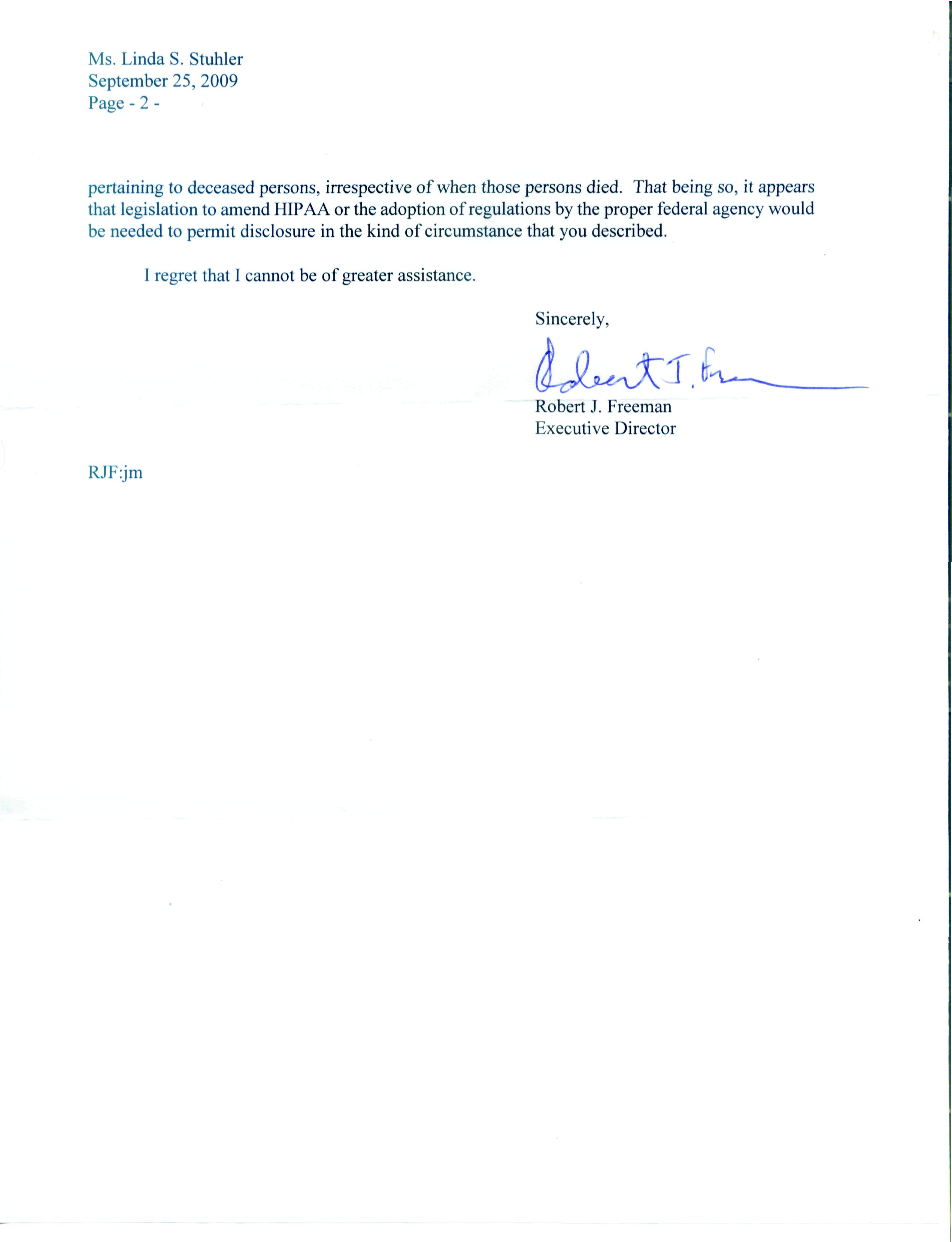
5 - FOIL 09.25.2009-1

5 – FOIL 09.25.2009-1

6 - FOIL 09.25.2009-2

6 – FOIL 09.25.2009-2

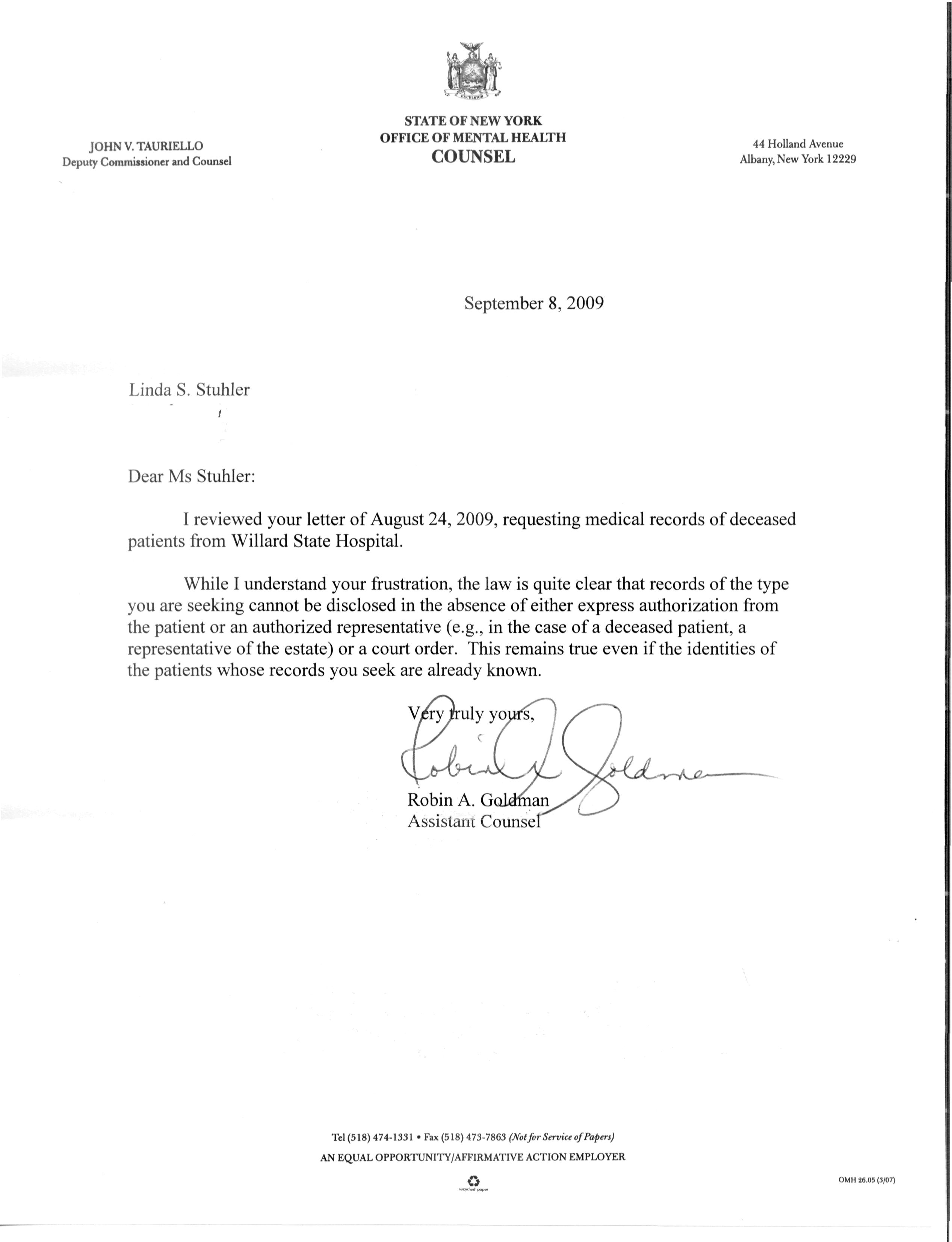
4 - OMH Counsel 09.08.2009

4 – OMH Counsel 09.08.2009

3 - Quality Care Advocacy 09.01.2009

3 – Quality Care Advocacy 09.01.2009

KINGS PARK-STORIES FROM AN AMERICAN MENTAL INSTITUTION – A Groundbreaking New Documentary – Lucy Winer

Kings Park Movie

Kings Park Movie

On June 21, 1967, at the age of 17, Lucy Winer was committed to the female violent ward of Kings Park State Hospital following a series of failed suicide attempts. Over 30 years later, now a veteran documentary filmmaker, Lucy returns to Kings Park for the first time since her discharge. Her journey back sparks a decade-long effort to face her past and learn the story of the now abandoned institution that once held her captive. Her meetings with other former patients, their families, and the hospital staff reveal the painful legacy of our state hospital system and the crisis left by its demise.

For More Information Click On The Links:

Kings Park Movie

Kings Park Movie on Facebook

Kings Park Movie Trailer

Life In A Mental Hospital by Lucy Winer

Demolition of Kings Park – CBS News

Kings Park: Stories from an American Mental Institution – A Review

1892 The Curious Case of Henry B. LaRue

The following three articles tell the fascinating story of how a wealthy businessman, Mr. Henry B. LaRue, was declared insane, made a pauper charge of Steuben County, and was locked up at Willard State Hospital in 1891 for fifty-two days. His tale is so unbelievable that it would make a great Hollywood movie! It might also explain why The Insanity Law of 1896 (New York State) was created. Although I was able to find the obituary for Miss Jennie O’Neil Potter, I was unable to find out more information about Mr. LaRue and the outcome of the trial. These articles give a wonderful insight as to how easy it was to have someone committed to an insane asylum during the nineteenth century.

1892. Miss Potter A Defendant,
Sued For Damages By An Eccentric Hornellsville Citizen.

Miss Jennie O’Neil Potter, the reader, is a defendant in a suit for damages brought by Henry B. LaRue of Hornellsville. She has not yet been served with a summons, and the exact nature of the suit or the amount of damages claimed cannot be learned. A year ago Henry B. LaRue was a prosperous railroad contractor and inventor, and enjoyed an income of about $6,000. He was often in New-York in the interest of his railroad inventions. Last Spring he attended an elocutionary entertainment given by Miss Potter. He was very much pleased with the entertainment, and became acquainted with the young reader. He invited Miss Potter to visit his wife in Hornellsville, and made arrangements to have her give an entertainment in the Hornellsville Opera House. The invitation was accepted, and Miss Potter went to the LaRue home.

LaRue proposed to become the reader’s manager, and arranged a date for her appearance in the Elmira Opera House. He made the date and commenced advertising Miss Potter without her knowledge or consent. He bought $500 worth of bouquets and hired four lackeys in livery to travel about the city and distribute the bouquets and advertisements of the entertainment. These extravagant preparations and other unusual actions attracted the attention of the authorities and newspapers, and a stop was put to further preparations. Mr. LaRue was induced to return to his home.

Mr. LaRue’s actions in Hornellsville were very eccentric, and he made the arrangements for Miss Potter’s appearance there in such a magnificent manner that every one thought he must be crazy. The night before the Hornellsville entertainment Mr. LaRue went to Elmira and demanded the keys of the Opera House at 3 o’clock in the morning. When they were refused he created a disturbance and was arrested. A few days afterward he was examined by three physicians and declared insane, and was taken to an asylum. Miss Potter gave the Hornellsville entertainment and then returned to New-York. In a few months LaRue was liberated from the asylum and returned home. He has now commenced suit for damages against the editors of several Elmira papers, many Elmira and Hornellsville citizens, the Superintendent of the asylum, and Miss Potter. Miss Potter is quietly evading a summons, and as the summons has not been served she is unwilling to say anything about the suit.” 
SOURCE: Reprinted from The New York Times. Published March 7, 1892. Copyright @ The New York Times.

Thursday, March 10, 1892. Mr. LaRue Wants Justice. He Also Wants Damages Claimed To Be $375,000 For False Imprisonment And Libelous Articles Published.

Mr. Henry B. LaRue of Hornellsville who, about a year ago was arrested at Elmira and locked up as a lunatic, and then committed to the State asylum at Willard, where he remained for fifty-two days before he was released began suits for damages against his abductors for $250,000, and against the Elmira Sunday “Telegram” and Elmira “Gazette” for commenting upon the facts for $125,000.

The Rochester “Democrat and Chronicle” says that: Since his release from the asylum Mr. LaRue has been carefully investigating the motives which led to his arrest. He charges that an attempt was made at Hornellsville to procure a decision that he was insane for the purpose of getting the option for the stock of the Morden Troy and Crossing Company out of his hands, and breaking up the deal at that time. He claims that three reputable physicians called upon him and refused to certify to his insanity alleging he was sane. The arrest at Elmira he ascribes to jealously on the part of one of the defendants at the success he was likely to achieve in the managing the entertainments of Miss Potter and that the arrest was timed so as to break up the two readings arranged for that city, and was instigated by telegrams from Hornellsville, that one of the defendants might himself manage the elocutionist. One of the grounds upon which the two Elmira physicians who saw him a few minutes at the jail at a late hour after his arrest, declared him insane, was that he had adopted a peculiar method of advertising the entertainments to be given by the elocutionist. One of these was the sending of cards of invitation to the best families of Elmira accompanied by a small bouquet. Mr. LaRue explains this by saying that the bouquets were small affairs costing only 5 cents each. Mr. LaRue has retained the services of J. and Q. VanVorhis of this city in all the cases and ex-congressman VanVorhis today stated to a Democrat and Chronicle reporter the facts fully sustained Mr. LaRue’s contention as to his entire sanity. It is nowhere stated that his relations with Miss Potter were otherwise than of a purely business character. While at Hornellsville the elocutionist was a guest at Mrs. LaRue’s. LaRue is a man of strikingly handsome presence and his friends scout the idea of his personal oddities which are said to be no more marked than those of any other business man, being construed into insanity. The summonses in the suits were severed some days ago, but this is the first time the contents of the complaints have been made public.” 
SOURCE: http://www.rootsweb.ancestry.com/~nysteube/this_that/pg2.html, [Rochester Democrat and Chronicle] copied by the Allegany Co. Reporter, Steuben County items mentioned in the Allegany County Reporter, Wellsville, Allegany County, NY, Abstracted by Judy Allen Cwiklinski – Steuben County, NY GenWeb coordinator.

1893. LaRue Wants Satisfaction. 
He Was Arrested As Insane And Made A Pauper Charge.

Rochester, N.Y., April 19, 1893. – At the special term of the Supreme Court to be held at Bath, Steuben County, N.Y., on Monday, April 24, will be called the first of a number of suits brought by Henry B. LaRue against certain newspapers and individuals for libel, abduction, and false imprisonment. The prominence of all the parties concerned, the highly-sensational character of the allegations in the plaintiff’s complaint, and the large damages which he claims, aggregating nearly $500,000, bid fair to make these cases celebrated.

The preliminaries of what is likely to prove a long and expensive litigation have all been arranged, and from the documents in the cases the following allegations are taken: Henry B. LaRue is a resident of Hornellsville, N.Y., and is a wealthy and highly-respected citizen, and as a railway contractor has been identified with many large enterprises. He is a heavy operator in railway switches and frogs, and his business takes him to all parts of the country. Mr. LaRue has a pleasant home and a charming family of three, a wife and two sons.

Among the temporary residents of Hornellsville in the Spring of 1891 was Mrs. Jennie O’Neil Potter, a popular and successful elocutionist. She was, in fact, a guest of Mrs. LaRue, and, having some leisure time on his hands, Mr. LaRue undertook to get up a series of readings for the lady, to be given in the Elmira Opera House on the evenings of April 29 and 30, 1891. He went to Elmira and engaged the Opera House and expended a considerable sum in advertising and other expenses. On this enterprise Mr. LaRue calculated there would be a net profit of $3,200, although he had been quite lavish in his expenditures, and had adopted some unique methods of advertising, which, however effective they might have been, were made one of the grounds upon which he was declared insane by two physicians who saw him in the Elmira Jail after his arrest.

On the day upon which the first reading was to be given, April 29, Mr. LaRue was arrested in Elmira charged with being a lunatic, and on the following day was committed to the State Asylum for Pauper Insane at Willard as a pauper lunatic and his expense charged to the County of Steuben. Here he remained for fifty-two days, until released by the operation of a writ of habeas corpus issued by the Judge of Seneca County, it being shown on this proceeding to the satisfaction of the court that Mr. LaRue was sane at the time of his arrest, and that he was confined without due process of law.

The arrest was commented on by the Elmira Gazette and by the Elmira Sunday Telegram, and subsequently Mr. LaRue brought suits against these newspapers for aggregate damages of $125,000. He also brought a suit for $250,000 damages for kidnapping and false imprisonment, naming as defendants John O. Adsit, Charles G. Hutchinson, William Richtmyer, O.M. Warner, Charles O. Green, William H. Murray, E.B. Yeomans, Roswell R. Morse, Chief of Police Levi Little, Dr. Henry Flood, Dr. I.A. Adams, Mrs. Jennie O’Neil Potter, and Charles W. Pilgrim, the Superintendent of the Willard Asylum.

In his complaint Mr. LaRue alleges that he was arrested without a warrant having been issued; that he was not permitted to have counsel or to communicate with his wife; that he was not arraigned before any Judge, Police Justice, or other judicial officer, and that he was not insane, but was in sound mental and physical health, and had been guilty of no offense whatever. Mr. LaRue also alleges that, although he had abundant means of support, and for many years had had a large income, the defendants falsely charged him with being a pauper and dependent on the County of Steuben for support, and caused him to be confined in an insane asylum for paupers at the expense of Steuben County, all of which he says was done ‘maliciously and for the purpose of humiliation the plaintiff.’

The plaintiff also alleges that at the time of his arrest he was negotiating for the purchase of the stock of the Morden Frog and Crossing Works of Chicago, and was organizing a New Jersey Company to take over the business; that his arrest and incarceration caused him to lose the benefit of this transaction and to lose $100,000 in that one item of business. Mr. LaRue says further that an attempt was made at Hornellsville to secure a decision that he was insane, for the purpose of getting out of his hands the option he held on the Morden Company. At this time, he says, three reputable physicians refused to certify that he was insane. The arrest at Elmira, he alleges, was instigated by jealousy on the part of one of the defendants because of his success in managing the two readings arranged for that city and was caused by a telegram from Hornellsville, so that one of the defendants might himself manage the entertainment. The defendants set up in their answer to the complaint, first the usual general denial of the facts alleged, and as a second defense they allege justification, inasmuch, as they claim that Mr. LaRue was actually insane at the time of his arrest. These cases are to be fought out on their merits. Among the defendants are some of the leading citizens of Elmira, men of wealth and high social and business standing. Some of them are known throughout the State as leaders in politics and as men of prominence in great business enterprises. The attorneys for Mr. LaRue are the Messrs. J. & Q. Van Vorhees of Rochester, while ex-Mayor John B. Stanchfield of Elmira represents the defendants.” 
SOURCE: Reprinted from The New York Times. Published April 29, 1893. Copyright @ The New York Times.

Jennie O'Neil Potter

Jennie O’Neil Potter

Jennie O’Neil Potter.

Miss Jennie O’Neil Potter, the elocutionist, died Tuesday night at St. Luke’s Hospital after a long illness. Death was caused by cancer of the stomach. Miss Potter was twenty-eight years of age, and came to this city from Patch Row, Wisconsin, about ten years ago. She had an ambition to become an elocutionist, and under the patronage of Mrs. William C. Whitney she met with success at private entertainments, and later in public through the recitation of “How Salvator Won.” She afterward went to London, where she was very successful. Last year she returned to this city, and in December was compelled to give up her work and go to St. Luke’s Hospital. Her last public appearance was on the evening of December 5 last, at a charity benefit at St. Thomas’s Church. The funeral will be held to-morrow morning in the chapel of St. Luke’s Hospital.”
SOURCE: Reprinted from The New York Times. Published April 19, 1900, Copyright @ The New York Times.  

“Out Of The Shadows” – Patricia E. Deegan

I found a very interesting silent movie that I wanted to share with you. It is posted on YouTube by Dr. Patricia E. Deegan and is entitled “Out of the Shadows.” It was filmed at Utica State Hospital in the 1920s.

Out Of The Shadows – Part One

Out Of The Shadows – Part Two

Out Of The Shadows – Part Three

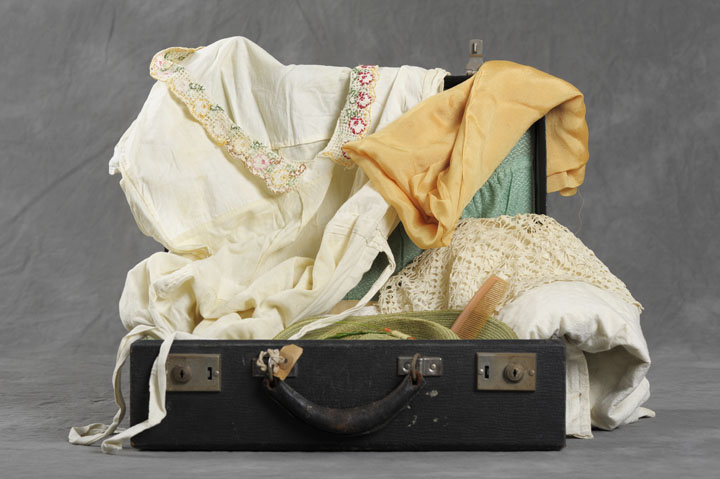
Willard Suitcases – Darby Penney – Photos by Jon Crispin

Jon Crispin Suitcase 2 - http://joncrispin.wordpress.com/

Jon Crispin Suitcase 2 – http://joncrispin.wordpress.com/

Like so many others who have discovered that an ancestor was an inmate at Willard, I read the book The Lives They Left Behind Suitcases From A State Hospital Attic by Darby Penney and Peter Stastny in order to learn what life was like living inside the asylum. I contacted Ms. Penney to ask if my great-grandmother’s suitcase was found in the attic. It wasn’t. The authors were given permission to research the medical records of twelve patients and were allowed to use patient photographs in the book using factitious names. Since I am a descendent of a patient, I assumed that I would be able to receive a copy of my great-grandmother’s medical records and photographs. I was wrong. I learned that I have no right to this information unless my primary care physician needs the health records to diagnose or treat a condition. This explanation was given to me in a letter by the Commissioner of the New York State Office of Mental Health. It makes no sense to me considering that my great-grandmother has been dead for eighty-four years. I wonder if a diagnosis that was made eighty-four years ago would even be relevant today. My point is this: I want to know what happened to my great-grandmother. I want to learn her diagnosis and read about her experiences in a state hospital.

Jon Crispin Suitcase 6 - http://joncrispin.wordpress.com/

Jon Crispin Suitcase 6 – http://joncrispin.wordpress.com/

Ms. Penney is a national leader in the human rights movement for people with psychiatric disabilities. In an email I asked her, “When did the state hospitals go bad?” Her reply was, “It never went bad. Western society’s methods of dealing with people in mental and emotional distress have always been based on punishment and segregation. Anyone who is locked up against their will and kept in isolation is being treated poorly, to my mind.” Ms. Penney and the NYS Archives have the list of the former suitcase owners. Even though it is not a medical record it cannot be released to the public because it would identify former patients. You may contact Ms. Penney to inquire about your ancestor’s suitcase at: community@capital.net. For more information visit The Lives They Left Behind Suitcases From A State Hospital Attic Website. 

Jon Crispin Suitcase 10 - http://joncrispin.wordpress.com/

Jon Crispin Suitcase 10 – http://joncrispin.wordpress.com/

Willard Asylum Cemetery (Veterans Names) Military Section, Seneca County, NY:
http://www.newyorkroots.org/ontario/cems/SenecaCo/Willardceme.htm

Jon Crispin Suitcase 13 - http://joncrispin.wordpress.com/

Jon Crispin Suitcase 13 – http://joncrispin.wordpress.com/

Jon Crispin’s Notebook – Willard Suitcases:
http://joncrispin.wordpress.com/2011/03/18/willard-asylum-suitcase/

http://joncrispin.wordpress.com/2011/07/24/willard-asylum-suitcase-2/
http://joncrispin.wordpress.com/2011/10/04/willard-suitcase-3/
http://joncrispin.wordpress.com/2011/10/07/willard-suitcase-4/
http://joncrispin.wordpress.com/2011/10/16/willard-suitcase-5/
http://joncrispin.wordpress.com/2011/10/23/willard-suitcase-6/
http://joncrispin.wordpress.com/2011/10/31/willard-suitcase-7/
http://joncrispin.wordpress.com/2011/11/11/willard-suitcase-8/
http://joncrispin.wordpress.com/2011/12/05/willard-suitcase-9/
http://joncrispin.wordpress.com/2011/12/27/willard-suitcase-10/
http://joncrispin.wordpress.com/2012/01/13/willard-suitcase-11/
http://joncrispin.wordpress.com/2012/02/06/willard-suitcase-12/
http://joncrispin.wordpress.com/2012/03/03/willard-suitcase-13/

The Willard and Rochester State Hospital Connection

“The raving maniac, the young child, the infirm old man, and the seducer’s victim, were crowded in a building whose remembrance must seem painful.”
– W. H. McIntosh, History of Monroe County, New York

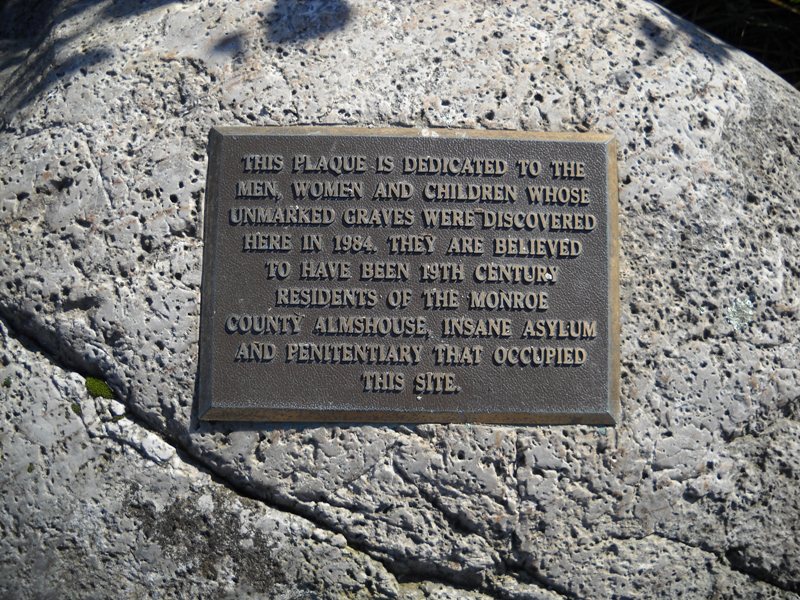
To the west of the entrance of the Vietnam Veterans Memorial of Greater Rochester in Highland Park (1440 South Avenue, Rochester, NY) stand three cream colored wooden arbors with benches, a lovely brick patio, and a small garden. This site, now known as The Remember Garden, marks the old burial ground that was used to bury paupers and criminals in unmarked, anonymous graves during the nineteenth century. In July 1984, approximately 900 human remains were discovered in this unmarked cemetery which was located behind the old Penitentiary. The bodies are believed to be the inmates who lived and died at the Work House (Penitentiary), Alms House, and the Insane Asylum between 1826 and 1863. 284 to 305 remains were re-interred in Mount Hope Cemetery in 1985. The memorial that marks the location of the cemetery in Highland Park was dedicated in May 2009, and the memorial to mark the re-interred remains at Mount Hope Cemetery may be dedicated in the spring of 2012. See 1872 “Bone Yard” The Remember Garden.

Remember Garden, Highland Park

Remember Garden, Highland Park

It is indeed unfortunate that thousands of poor “sane” men, women, and children, who lived and died in the county poor houses and other charitable institutions of our country, were buried in anonymous, unmarked graves; but their final resting places can be marked with engraved headstones. The same rule does not apply for those who were labeled as “insane” which also includes people who were diagnosed with epilepsy. It is virtually impossible for family researchers to obtain the medical records of their ancestors who were incarcerated at these long closed insane asylums because of the federal HIPAA Law which states, The Office for Civil Rights enforces the HIPAA Privacy Rule, which protects the privacy of individually identifiable health information; the HIPAA Security Rule, which sets national standards for the security of electronic protected health information; and the confidentiality provisions of the Patient Safety Rule, which protect identifiable information being used to analyze patient safety events and improve patient safety.” This rule has also been applied to burial ledgers and death records of former NYS Hospitals and Custodial Institutions. Everyone has been forced to sign HIPAA documents at their doctor’s office. Most people interpret this law as one that applies to the living, not the dead. An individual’s right to privacy ends at death but the right of patient confidentiality apparently lasts forever. What is even more confusing is that a few states have interpreted this federal law differently than New York State. SEE NEW HIPAA UPDATE!

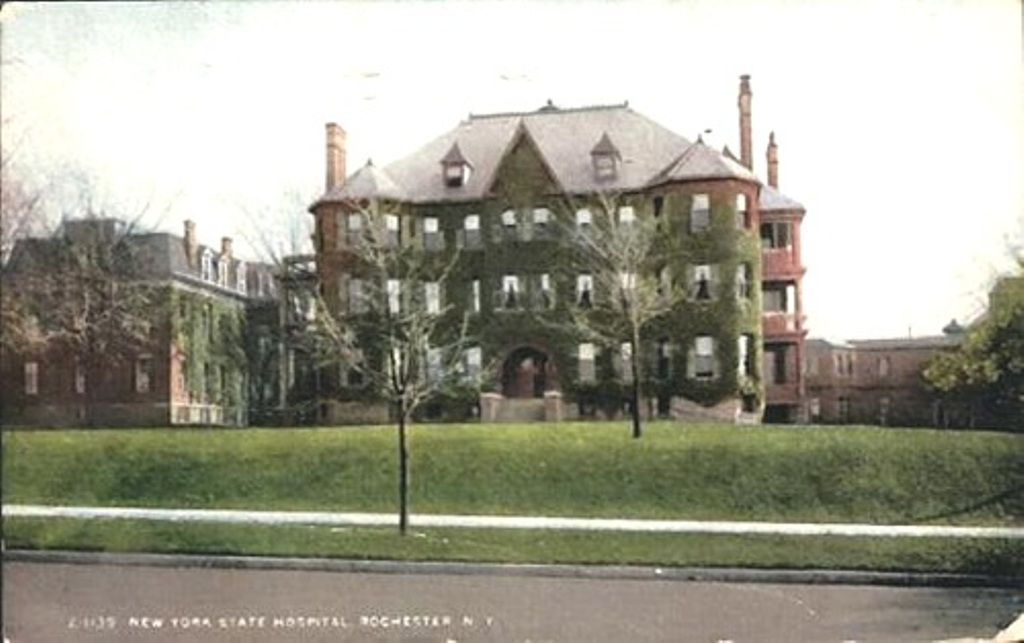
Monroe County Poor House & Rochester State Hospital

Monroe County Poor House & Rochester State Hospital

Washington, Oregon, Massachusetts, and Minnesota have allowed the release of the names of former psychiatric patients buried in anonymous, unmarked graves to the public. In some cases, these states have provided funds for cemetery restoration and engraved headstones. One would presume that if other states have released the names of patients, then New York State should be allowed to do the same. To deny our ancestors this simple remembrance, for all eternity, on the grounds that they were unfortunately and unnecessarily labeled as mentally ill, is unconscionable. The people of the state and the country have a right to know where their ancestors are buried; and the patients should have the right to be remembered with dignity.

Bill S2514 has been introduced to the New York State Legislature by Senator Joseph E. Robach. Let’s keep our fingers crossed that this bill becomes a law.

So, what does Willard State Hospital have to do with Rochester State Hospital? (The main building of the Willard State Hospital was demolished in 1984/85. Some of the buildings currently belong to the NYS Prison System / Willard Drug Treatment Facility).

The Willard Act of 1865 was “An Act to authorize the establishment of a State asylum for the chronic insane, and for the better care of the insane poor, to be known as The Willard Asylum for the Insane.” This law introduced a new policy that “was to relieve the county of their care and devolve it upon the State through the ‘Willard,’ and the State Lunatic Asylum at Utica.” Willard opened its doors on October 13, 1869. From the beginning New York and Kings Counties were exempt from this law; Monroe County quickly followed. “An Act In Relation To The Chronic Pauper Insane” was passed on April 25, 1871. The board of State Commissioners of Public Charities was authorized to hear and determine all applications by the county superintendents of the poor of the counties of New York State. On written application the several counties had to prove to the Legislature that “the buildings and means employed to take care of the chronic pauper insane of such county are sufficient and proper for the time being for such purpose.” Monroe County was exempted from sending their pauper chronic insane to the Willard Asylum about the year 1872.

Willard State Hospital, Main Building, circa 1898.

Willard State Hospital, Main Building, circa 1898.

The Willard Asylum was unique because it was created to end the poor house system of caring for the insane. From 1869 to 1890, an inmate once committed to the facility, was prohibited from being returned to the county poor house unless the county was exempted, or the county did not want that particular patient returned. Willard provided a permanent home for the pauper chronic insane or “incurables” of the state. The term chronic refers to an individual who suffered from insanity for more than one year. Counties that were not exempt from the law were responsible for transporting their pauper chronic insane to Willard and paying the cost of the patients’ care, maintenance, and clothing. Willard was located in the towns of Ovid and Romulus, Seneca County, New York, on the shores of Seneca Lake and is roughly 80 miles from Rochester.

According to The Proceedings of the Board of Supervisors of the County of Monroe, 1871, the only patient who was sent to The Willard Asylum for the Insane by the County of Monroe was Francis J. O’Brien, at the yearly cost of $129.00. The U.S. Federal Census of 1870, which is the first census of the Willard Asylum, shows that Mr. O’Brien was 29 at his last birthday; male; white; born in the state of Michigan; insane. In 1880, he is listed as: 40 years old; married; occupation, physician; born in the state of Michigan; insane; living in the North wing of the main asylum building. The 1880 U.S. Federal Census Schedules of Defective, Dependent, and Delinquent Classes lists him as: residence when at home, Rochester, Monroe; form of disease, Chronic Mania; duration of present attack, 13 years; total number of attacks, 1; age at which first attack occurred, 27; what has been the total length of time spent by him (or her) during life in such asylums, 11 years. In 1900, he is listed as 60 years old; inmate, white; male; married; born in Michigan. His name does not appear on the 1910 Federal Census. Mr. O’Brien died between 1900 and 1910 and spent at least 31 years of his life locked up at Willard as did thousands of New Yorker’s during the last two centuries. We will never know how or when he died, or where he was buried unless current law changes.

The State Care Act passed in 1890. It was An Act to promote the care and curative treatment of the pauper and indigent insane in the counties of this state, except New York, Kings and Monroe counties, and to permit said excepted counties or either of them, in accordance with the action of their respective local authorities, to avail themselves or any one or more of them, of the provisions of this act.The State Commission in Lunacy was given the power to divide the State into hospital districts and dropped the distinction between acute and chronic asylums. This law also renamed state insane asylums to state hospitals. Willard was no longer an asylum for the chronic insane only and was renamed Willard State Hospital which served the counties of Allegany, Cayuga, Genesee, Ontario, Orleans, Schuyler, Seneca, Steuben, Tompkins, Wayne and Yates. The Monroe County Insane Asylum was renamed Rochester State Hospital and served the counties of Monroe and Livingston. On July 1, 1891, Monroe County came into the state system and the asylum was purchased by the state. The New York State poor house system of caring for the insane ceased to exist October 1, 1893, when the State Care system went into effect.

The commonalities of the Willard Asylum for the Insane and The Monroe County Alms House, were they both shared the same architect; Mr. John Rochester Thomas, born on June 18, 1848, at Rochester, New York. According to W. H. McIntosh in his book History of Monroe County, New York: “John R. Thomas, one of our most enterprising young architects, commenced the practice of his profession here in the year 1866, and now ranks with the leading architects of the country. Mr. Thomas has during the past ten years accomplished a very large amount of work. He introduced the Mansard roof, which was first applied to private dwellings. Mr. Thomas has made a specialty of the study of Gothic art, believing it will be the architecture of the future in this country. He has also designed largely for private dwellings in the city and adjoining country, among which is the residence of H. A. De Land, of Fairport, one of the most elegant and costly private residences in western New York. He also designed Rochester Theological Seminary buildings, Sibley Hall, on the University grounds, the Opera House, the Monroe County almshouse, the University of Virginia, at Charlottesville,Virginia, and the New York State Reformatory buildings, at Elmira. In the year 1874, Mr. Thomas received a very honorable appointment from Governor Dix as one of the State architects, and was assigned at once to the charge of the Reformatory at Elmira, which position he now holds.” (1) The choice of Dr. John B. Chapin, first Superintendent of The Willard Asylum for the Insane, choosing Mr. Thomas as the architect of The Willard Asylum for the Insane caused a great deal of controversy in New York State because at the time he was not yet a state architect. The “Mansard” or French roof is prominent in many of Mr. Thomas’s architectural designs.

The differences between Willard and Rochester State Hospitals, was that Willard had its own twenty-five acre cemetery located about a mile down the road from the facility which contains the remains of 5,776 patients buried in anonymous, unmarked graves. The Rochester State Hospital used Mount Hope Cemetery to bury its inmates. I spoke to a very knowledgeable gentleman from the Rochester Office of Mental Health who stated that the address of the Rochester State Hospital was 1600 South Avenue. He said the facility was torn down in the 1960s to make way for the Al Sigl Center. The address of the Al Sigl Center was given a new address by the U.S. Postal Service: 1000 Elmwood Avenue (corner of South Avenue). In the past, I have searched the Mount Hope Cemetery Records looking for family members and had often seen “1600 South Avenue” given as the residence for many people. I always wondered what it was and on occasion I had Googled the address but received no hits. Now I know why, the address no longer exists.

I have transcribed the earliest records: Names: Monroe County Poorhouse, Asylum, Penitentiary, Other Charities 1838 to 1860. If you believe that your ancestor was an inmate who lived and died at The Monroe County Insane Asylum / Rochester State Hospital you can search for them at the Rochester – Mt. Hope Cemetery Records online. Here is a brief description of what you will see if you decide to search the records for yourself: Under the heading “Residence,” a street name will be given with no specific address; or it will list the place where the person died such as: Insane Asylum, Asylum, County House, Jail, etc. (Be aware that there was an Asylum Street in the City of Rochester that as far as I know, had no connection with the Monroe County Insane Asylum). About 1891, you will start to see the words “Rochester State Hospital” under “Residence.” At some point in the 1900s, instead of listing the place of death as Rochester State Hospital the address has been given instead as “1600 South Avenue.” In some instances, the family of the deceased claimed the body and buried them in the family plot. In the case of pauper and indigent insane, the hospital buried them in unmarked, anonymous graves at Mount Hope Cemetery. Some unclaimed bodies were donated by state hospitals to state medical colleges for the advancement of medical science in which case no grave will be found.

At the very least, the location of these graves should be marked in Mount Hope Cemetery with a memorial indicating the final resting place of the patients of The Monroe County Insane Asylum and Rochester State Hospital. Providing individual, engraved markers would be ideal but without the actual death records this will not be possible. The Rochester State Hospital burial records do exist and should be released to the public, along with all former state hospital burial ledgers in a unified, digital, database in order that descendants and caring citizens can find their ancestors and mark the graves of these forgotten souls if they wish to do so. Hopefully, a new bill introduced into the New York State Legislature by Senator Joseph E. Robach will allow the release of the names of these people who have remained anonymous for over one hundred years. I would like to thank Senator Robach and his staff for writing and sponsoring the bill.

As a life-long Rochester area resident, I am proud to live in a community that has provided so many genealogical resources. I am truly grateful for The Friends of Mount Hope Cemetery who have taken the time and effort to assist me on more than one occasion. A few years ago, volunteer Frank Gillespie, who recently passed away in January 2012, helped me locate my great-grandparents’ grave by providing a map and directions. Marilyn Nolte, President of The Friends of Mount Hope Cemetery, has located the section where many of the Rochester State Hospital patients are buried, and she patiently answered numerous questions regarding the older sections of the cemetery, unmarked graves, and the responsibilities of plot owners. I thank them for their dedication, knowledge, and help.

(1) SOURCE: McIntosh, W. H., History of Monroe County, New York; With Illustrations Descriptive Of Its Scenery, Palatial Residences, Public Buildings, Fine Blocks, and Important Manufactories, From Original Sketches By Artists Of The Highest Ability.Philadelphia: Everts, Ensign & Everts, 716 Filbert Street, 1877, Page 142.