Unknown's avatar

About lsstuhler

Linda Stuhler is a Genealogy Geek from Rochester, New York, who loves to find out the facts. She has been researching her family tree for over twenty years and has accumulated an abundance of information on various subjects that she enjoys sharing on her blog at: https://inmatesofwillard.com/. She was responsible for the creation of the New York State Senate Bill S840, initiated in August 2011, which allows for the release of the names, dates of birth and death, of former patients who were buried in anonymous graves in New York State Custodial Institutions. The bill was changed from the original draft to S840A and does not work the way it was intended. It became a law on August 18, 2016, but it did not include provisions for a searchable database available to the public as New York State attorneys and the Office of Mental Health believed that if they did so, they would be sued. She is the author of "THE INMATES OF WILLARD 1870 TO 1900, A GENEALOGY RESOURCE."

Matteawan State Hospital for Insane Criminals & Cemetery

Matteawan State Hospital for Insane Criminals – Men & Women.

1916 Matteawan State Hospital.
Beacon, Dutchess County, New York.
Matteawan State Hospital 7 Names – Find A Grave.

1. South Flank Pavilions-Matteawan

1. South Flank Pavilions-Matteawan

2. Administration Building-Matteawan

2. Administration Building-Matteawan

3. Entrance Hallway-Matteawan

3. Entrance Hallway-Matteawan

4. South Interior Court-Matteawan

4. South Interior Court-Matteawan

5. Matteawan

5. Matteawan

6. Public Kitchen-Matteawan

6. Public Kitchen-Matteawan

7. Laundry Building-Matteawan

7. Laundry Building-Matteawan

8. Boiler House and Dynamo Building-Matteawan

8. Boiler House and Dynamo Building-Matteawan

9. Front View-Matteawan

9. Front View-Matteawan

Twenty-Third Annual Report Of The Medical Superintendent Of The State Asylum For Insane Criminals, Matteawan, N.Y., For the Year Ending September 30, 1892.
[Post-Office, Fishkill-On-The-Hudson.]

OFFICERS OF THE ASYLUM 1892.
Manager:
Hon. AUSTIN LATHROP, Superintendent Of State Prisons.

Resident Officers:
H.E. ALLISON, M.D., Medical Superintendent. 

J. ELVIN COURTNEY, M.D., First Assistant Physician.
LUTHER C. JONES, M.D., Second Assistant Physician.
JAMES F. HOWELL, Steward.
R.B. LAMB, M.D., Resident Clinical Assistant.

REPORT.
Hon. Austin Lathrop, Superintendent of State Prisons:

Sir.— The following pages which, in accordance with the statute, I have the honor to submit, constitute the first annual report issued from this new institution, which was created by act of the Legislature for the relief of the overcrowded asylum at Auburn, and is the thirty-third of a series presented annually since the original establishment of the State Asylum for Insane Criminals.

This new hospital structure of modern architecture, commandingly situated and furnished with every convenience for the care of its inmates, was occupied during the latter part of April of the present year; the first patients having been received by transfer from Auburn on the twenty-fifth of that month. The entire population of the Auburn asylum, a total of 261 patients, were moved into their present quarters and the new asylum organized and put in operation within a period of five days. Fortunately the transfer was made safely, without the slightest accident or any attempt at escape. The buildings and grounds at Auburn, which were occupied for more than thirty years, are now entirely relinquished, and the oldest of asylums for insane criminals is domiciled in these new quarters as its permanent abode.

Owing to the increased accommodations afforded by the opening of these new buildings, we have been able to provide for those patients who had, up to this time, been retained in the various State hospitals awaiting transfer to our custody, and who had previously been refused admission to Auburn for the lack of room. Because of this large and rapid influx the total number of admissions has more than doubled that of any previous year. During the year the various courts of the State have also, to a larger extent than heretofore, committed patients to this asylum directly. The practice, however, still exists of sending patients charged with crime to the general hospitals of the insane, where their presence is objectionable, and whence they are transferred to us under the provisions of chapter 515, Laws of 1884; the superintendents of the various State hospitals applying under this law to justices of the Supreme Court for orders permitting such transfers. We hope, when the scope and character of this institution become more widely known, that commitments in the future will be made to us directly in all cases where the plea of insanity prevails as a defense for criminal acts. It is the purpose of this hospital to care for all insane persons competed or unconvicted, who are charged with crime, whether the disease of insanity is known to exist at the time of arraignment or trial, or subsequently develops while undergoing sentence.”

SOURCE: Documents of the Assembly of the State of New York, One Hundred and Sixteenth Session, 1893, Volume I, Nos. 1 to 6, Inclusive, Albany: James B. Lyon, State Printer, 1893. Pages 203-208.

CLICK HERE TO VIEW THE VIDEO They’re Buried Where? by Seth Voorhees

THE BAD NEWS: Thousands Remain Nameless! 6.15.2015.

THE GOOD NEWS: One Man Is Remembered! 6.14.2015.

Dannemora State Hospital / Prison & Cemetery

Dannemora State Hospital was a state hospital prison.

1916 Dannemora State Hospital.
Dannemora State Hospital Cemetery – Find A Grave.
Photos Of Dannemora – Zach Babbie.
The Village Of Dannemora.

Dannemora 1875 - Clinton Prison - Zach Babbie

Dannemora 1875 – Clinton Prison – Zach Babbie

 It appears that Dannemora State Hospital Cemetery (Clinton Prison) had inscribed headstones. The following link may be an incomplete list.
Dannemora State Hospital Cemetery – Find A Grave.

Clinton Prison 1892 - Zach Babbie

Clinton Prison 1892 – Zach Babbie

 CLICK HERE TO VIEW THE VIDEO They’re Buried Where? by Seth Voorhees

THE BAD NEWS: Thousands Remain Nameless! 6.15.2015.

THE GOOD NEWS: One Man Is Remembered! 6.14.2015.

Syracuse State School & Cemetery

Syracuse State School – New York State Custodial Institution for Intellectually Disabled Children. The children who died at the Syracuse State School are buried at Oakwood Cemetery in Syracuse, New York.

1916 Syracuse State Custodial Institution For Feeble-Minded Children.

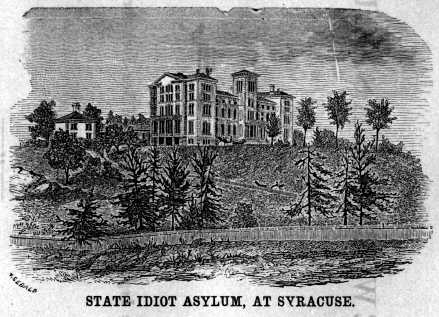
State Idiot Asylum at Syracuse 1858

State Idiot Asylum at Syracuse 1858

“AN ACT making an appropriation for the purchase of grounds for burial purposes for the use of the Syracuse State Institution for Feeble-Minded Children. Became a law February 11, 1896, with the approval of the Governor. Passed by a two-thirds vote. The People of the State of New York, represented in Senate and Assembly, do enact as follows: Section 1. The trustees of the Syracuse State Institution for Feeble-Minded Children are hereby authorized to purchase sufficient grounds, in Oakwood cemetery, at Syracuse, for the burial of four hundred and eight of such inmates of the institution as may die while residing therein; and the sum of nineteen hundred and fifty-eight dollars and forty cents, or so much thereof as may be necessary, is hereby appropriated out of any money in the treasury belonging to the general fund, not otherwise appropriated, payable to the order of the treasurer of the institution, for carrying out the purposes of his act; subject to the approval of the comptroller as to the value of the grounds, and of the attorney-general as to the form and terms of the conveyance thereof. § 2. This act shall take effect immediately.”
SOURCE: General Laws of the State of New York, Volume I, Chapter 16, Page 10, One Hundred Nineteenth Session, January 1, 1896 – April 30, 1896, Google Books

The New York State Asylum for Idiots was authorized by the New York State Legislature in 1851, acting upon a recommendation contained in the 1846 annual report of the New York State Asylum for Lunatics. Hervey B. Wilbur, M.D., was appointed the first superintendent and remained in that position until his death in 1883. First located on rented land in Albany, it admitted its first ‘pupils’ in 1851. The cornerstone was laid in 1854 for a new building in Syracuse, and the institution removed to Syracuse in 1855. After 1855 it was generally known as either the New York Asylum for Idiots or just the State Idiot Asylum, but in 1891 it was officially renamed the Syracuse State Institution for Feeble-Minded Children. In 19?? the name was changed to The Syracuse State Institution for Feeble-Minded Children, and later became just the Syracuse State School. Wilbur collaborated with Edward Seguin, M.D., the originator of the physiological method of training. Maria Montessori was also Seguin’s student and much of the ‘Montessori Method‘ is based on foundations laid by Wilbur and Seguin in Syracuse. In its 85th annual report (1935), the Syracuse State School rightly noted that it was ‘the pioneer institution in the United States for the care and training of mentally deficient children.’ Surgery was done in the old building, and at least one child was born there. The School also operated a farm and a number of satellite cottages. In the 1970s, the Syracuse State School building was torn down and replaced by a residential facility called the Syracuse Developmental Center. With the growing emphasis on community living rather than institutionalization for developmentally disabled persons, no new individuals were placed at SDC and there has been a gradual movement of residents into the community. In early 1998, there were about six persons left. SDC is to be closed, and it is not clear what will happen to the building.”
SOURCE: Upstate Medical University, Health Sciences Library, A Short History of Selected Hospitals in Syracuse

Syracuse State Institution for Feeble-Minded Children

Syracuse State Institution for Feeble-Minded Children

Photograph courtesy of The Museum of disABILITY History

“The first of these institutions, The New York State Asylum for Idiots, was established near Albany in 1851. The idea for such a school had originally been proposed in 1846 by senator Frederick F. Backus, a physician from Rochester. However, because many legislators reserved skepticism about the educability of ‘idiots’ and had concerns over the cost of such an experiment, the measure took five years to pass. These doubts proved to be unfounded, for the students achieved such favorable progress that the school’s Board of Trustees declared, in 1853, that the experiment had ‘entirely and fully succeeded.’ The legislature responded by funding the construction of a new building, which opened in 1855. This building, located in Syracuse, was the first in the United States designed specifically for children with developmental disabilities. Under the dedicated leadership of Dr. Hervey Backus Wilbur, superintendent for the initial thirty-two years of operation, this institution provided inspiration to many other states seeking to establish similar schools of their own.”
SOURCE: Museum Of disABILITY History, Early State Schools in New York by Thomas Stearns, Contributor.

Account of the ceremonies at the laying of the corner-stone of the New York Asylum for Idiots: at Syracuse, September 8, 1854.

Seventh Annual Report of the New-York Asylum for Idiots to the Legislature of the State of New York 1858.

CLICK HERE TO VIEW THE VIDEO They’re Buried Where? by Seth Voorhees
THE BAD NEWS: Thousands Remain Nameless! 6.15.2015.

THE GOOD NEWS: One Man Is Remembered! 6.14.2015.

Rome State School & Cemetery

New York State Custodial Institution at Rome for Intellectually Disabled Children and Adults.

1916 Rome State Custodial Institution For Feeble-Minded Children.
Rome Developmental Center Cemetery Names.
Rome State Custodial Asylum Map.

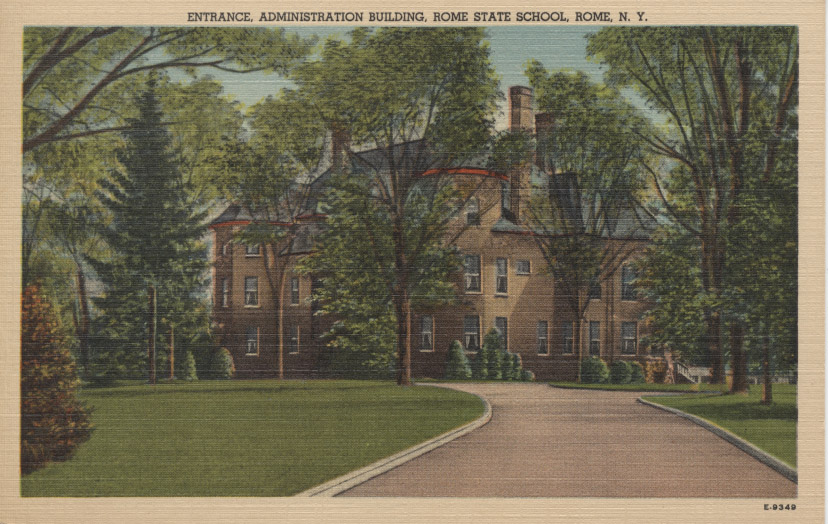
Rome State School

Rome State School

Photograph courtesy of The Museum of disABILITY History

“Although the initial purpose was essentially eugenic in nature, the scope of the institution expanded over the years. Educational training and independent living became central aspects, and several colony homes were established. The New York State Custodial Asylum for Un-Teachable Idiots was established in 1893 to address the growing public need for increased custodial provisions for ‘idiots’ deemed beyond the reach of education.  However, the staff soon realized that these individuals were capable of far more than the name of their institution implied. Led by Superintendent Charles Bernstein, the Board of Managers assumed a philosophy that focused on the recognition that people with disabilities “have a right to experiences and opportunities equivalent to those available to all other citizens.” Over fifty colony homes were established during Dr. Bernstein’s forty year superintendence, providing the people in attendance with many opportunities to live and work in the community.”

Rome Developmental Cemetery – This cemetery appears to be well maintained.
Annual Report of the Board of Managers of the Rome State …, Volumes 1-12.

CLICK HERE TO VIEW THE VIDEO They’re Buried Where? by Seth Voorhees

THE BAD NEWS: Thousands Remain Nameless! 6.15.2015.

THE GOOD NEWS: One Man Is Remembered! 6.14.2015.


Newark State School for Women & Cemetery

New York State School – Newark Custodial Institution for Developmentally Disabled, Childbearing Age Women. February 17, 1932, Begins Accepting Boys.

1878-1885: The Newark State School operated as part of the Syracuse State School.
1885: By statute erected as the State Custodial Asylum for Feeble-Minded Women.
1919: Name changed to Newark State School for Mental Defectives.
1927: Became a part of the Department of Mental Hygiene and name changed to Newark State School.
1932: Accepts boys.

1916 Newark State Custodial Institution For Feeble-Minded Women.
Early State Schools in New York.
State of New York Thirty-Seventh Annual Report of the Board of Managers of the Newark State School for Mental Defectives, 1921 – Through – Fifty-Ninth Annual Report of the Board of Visitors of the Newark State School, at Newark, Wayne County, New York to the Department of Mental Hygiene 1943.

Newark State School 1937

Newark State School 1937

Newark State School 1937-2

Newark State School 1937-2

Newark State School 1937-3

Newark State School 1937-3


Newark State School for Women

Newark State School for Women

Photograph courtesy of The Museum of disABILITY History 

The New York State Custodial Asylum for Feeble-Minded Women was established in 1878 in response to an increasing awareness that almshouses were improper places for ‘feeble-minded’ women. Social reformer Josephine Shaw Lowell led the crusade, with assistance from the State Board of Charities. Lowell delivered several reports before the state legislature expressing her concern that feeble-minded women often disregarded moral and sexual restraint when placed in the undisciplined environment of an almshouse and frequently had illegitimate children who, in turn, became dependent on the state for their welfare. Women of child-bearing age, fifteen to forty-five, were admitted into this institution, in order to “prevent them from multiplying their kind.” (New York State Board of Charities Report, 1879).

CLICK HERE TO VIEW THE VIDEO They’re Buried Where? by Seth Voorhees
THE BAD NEWS: Thousands Remain Nameless! 6.15.2015.

THE GOOD NEWS: One Man Is Remembered! 6.14.2015.

Letchworth Village for the Developmentally Disabled and Epileptics & Cemetery

Letchworth Village – New York State Custodial Institution for Epileptics and the Intellectually Disabled.

1916 Letchworth Village State Custodial Institution For Feeble-Minded and Epileptics.
Letchworth Village Cemetery Names – Find A Grave.
Legend Tripping in Letchworth Village – AbandonedNYC – Will Ellis.

Letchworth Village

Letchworth Village

Photograph courtesy of The Museum of disABILITY History

Letchworth Village was established in 1912 to alleviate overcrowding at the existing state institutions of New York. Because the institution admitted people with developmental disabilities and people with epilepsy, a complex system of classification was established for both living arrangements and the educational training methods. Significant efforts were undertaken to ensure that the institutional atmosphere resembled a calm country village and emphasis was placed on the students’ happiness. Letchworth Village also focused on scientific research and Dr. George A. Jervis received international acclaim for his studies on phenylketonuria (PKU) in the 1930s.”

There is a plaque at the cemetery that has all the names of the patients who are buried there. I do not know if the town or any particular group maintains the cemetery.

CLICK HERE TO VIEW THE VIDEO They’re Buried Where? by Seth Voorhees

THE BAD NEWS: Thousands Remain Nameless! 6.15.2015.

THE GOOD NEWS: One Man Is Remembered! 6.14.2015.


Craig Colony for Epileptics & Cemetery

Craig Colony – New York State Custodial Institution for Epileptics.

1916 Craig Colony State Custodial Institution For Epileptics.
Craig Colony Cemetery Names – Find A Grave.
UPDATE Craig Colony for Epileptics Cemetery – June 2013.

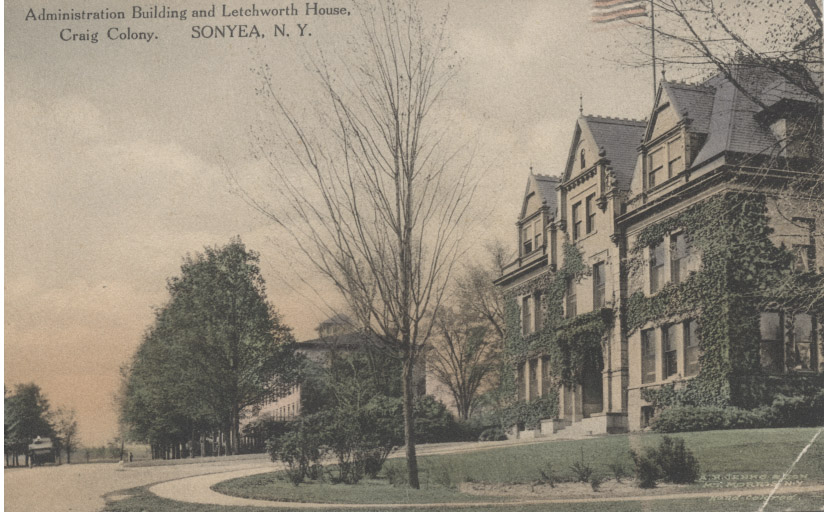
Craig Colony for Epileptics

Craig Colony for Epileptics

Photograph courtesy of The Museum of disABILITY History

The Craig Colony for Epileptics was established in 1894 following the discovery of a promising new method of treatment for people with epilepsy. This method, known as the ‘colony care plan,’ was discovered by Dr. Frederick Peterson, a physician at the Hudson River State Hospital for the Insane. He had observed that the epileptic patients under his care were subjected to conditions that provided little remedy for their illness, and became interested in the search for ways to improve their treatment. In 1886, while on an “inspection tour of foreign asylums,” he came across Bethel Colony in the city of Bielefeld, located in the Westphalia region of Germany. Bethel Colony consisted of several thousand people with epilepsy living and working together to create a self-sufficient community. There were no secret remedies, and no all-healing drugs, there was simply attention paid to a proper diet, proper habits and a therapeutic environment. Most importantly, the inhabitants labored during the day to bring about a healthy physiological fatigue. Physicians believed that this helped exert energy that would otherwise have been released during an epileptic seizure.” (American Journal of Insanity, Vol. 49, 1893).

It appears that Craig Colony had at least some engraved headstones.

CLICK HERE TO VIEW THE VIDEO They’re Buried Where? by Seth Voorhees

THE BAD NEWS: Thousands Remain Nameless! 6.15.2015.

THE GOOD NEWS: One Man Is Remembered! 6.14.2015.

Utica State Hospital & Cemetery

The State Lunatic Asylum at Utica served the ENTIRE STATE OF NEW YORK from 1843 to 1890. After 1890, Utica State Hospital served the counties of Fulton, Hamilton, Herkimer, Montgomery, Oneida, Saratoga, Schenectady, and Warren.
1916 Utica State Hospital.

I believe that “Old Main” had its own cemetery located somewhere on the facility’s grounds. SOME of the deceased patients of Utica State Hospital were buried at Forest Hill Cemetery – Utica, New York.

Utica State Hospital by Roger Luther

Utica State Hospital by Roger Luther

Roger Luther – nysAsylum.

CLICK HERE TO VIEW THE VIDEO They’re Buried Where? by Seth Voorhees

THE BAD NEWS: Thousands Remain Nameless! 6.15.2015.

THE GOOD NEWS: One Man Is Remembered! 6.14.2015.

St. Lawrence State Hospital & Cemetery

St. Lawrence State Hospital served the counties of Clinton, Essex, Franklin, Jefferson, Lewis, Onondaga, Oswego, and St. Lawrence.

1916 St. Lawrence State Hospital.
2014 St. Lawrence State Hospital Preservation Society.

St. Lawrence State Hospital Cemetery Memorial by Colleen Spellecy

St. Lawrence State Hospital Cemetery Memorial by Colleen Spellecy

There appears to be a group already in place that takes care of the St. Lawrence State Hospital Cemetery. They have placed a beautiful memorial in the cemetery and it appears that they will, in fact, let you know if an ancestor is buried there if you write them a letter. In the meantime, please visit St. Lawrence State Hospital Preservation Society.

St. Lawrence State Hospital Memorial 2 by Colleen Spellecy

St. Lawrence State Hospital Memorial 2 by Colleen Spellecy

St. Lawrence State Hospital Cemetery by Colleen Spellecy

St. Lawrence State Hospital Cemetery by Colleen Spellecy

CLICK HERE TO VIEW THE VIDEO They’re Buried Where? by Seth Voorhees

THE BAD NEWS: Thousands Remain Nameless! 6.15.2015.

THE GOOD NEWS: One Man Is Remembered! 6.14.2015.

Rochester State Hospital & Mt. Hope Cemetery

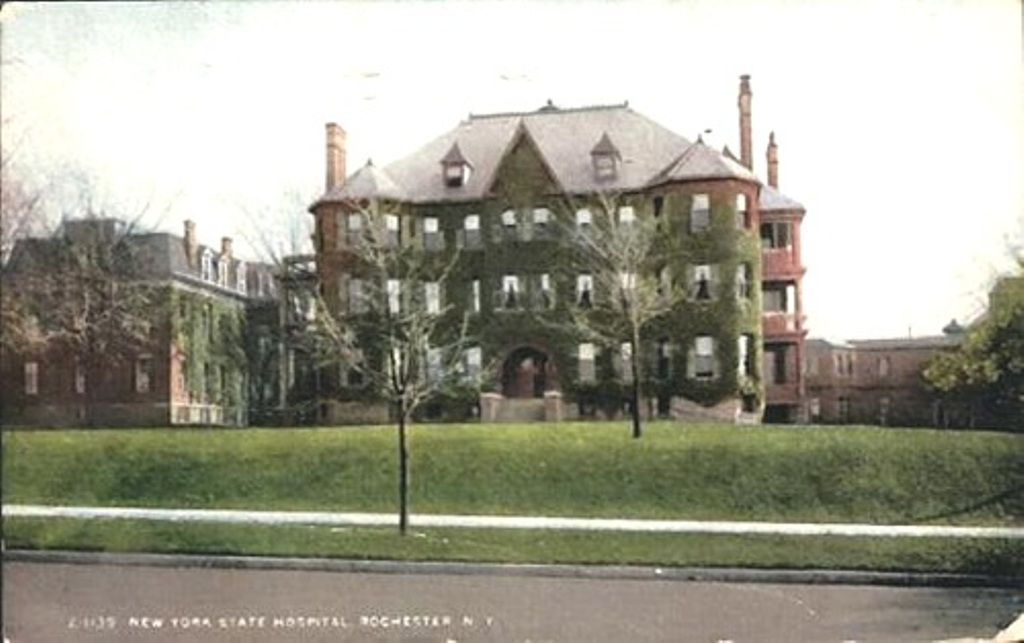
Rochester State Hospital (Rochester, Monroe County, New York), served the counties of Monroe and Livingston. My understanding is that the anonymous graves are located in section Y of Mt. Hope Cemetery.

1916 Rochester State Hospital.
Rochester State Hospital
Rochester State Hospital – OPACITY.
Rochester State Hospital – Rochester, NY – 9.7.2013.
1872 “Bone Yard” The Remember Garden – Rochester, NY – 4.18.2013.
The Willard and Rochester State Hospital Connection – 4.18.2012.
1888 Monroe County Insane Asylum (Names).
https://mcnygenealogy.com/vr/insane-asylum-deaths.htm

Monroe County Poor House & Rochester State Hospital

Monroe County Poor House & Rochester State Hospital

RELATED LINKS & ARTICLES CONCERNING ROCHESTER:

Very interesting article on the use of TREADMILLS in Rochester, New York:
1843 A Christmas Carol – 12.9.2013.

Duffy’s Malt Whiskey Company, Rochester, New York:
1921 Duffy’s Malt Whiskey – Nostrums For Good Health! – 1.29.2014.

Susan B. Anthony:
1860 Susan B. Anthony – 10.19.2012.

Anonymous Burial In Rochester, NY:
Sally Green’s Anonymous Burial – 2.24.2012.

The Friends of Mount Hope Cemetery.
City of Rochester – Mount Hope Cemetery.
City of Rochester, Monroe County, New York.
The University of Rochester’s Connection to “Our Quietest Neighbor” – Rochester’s Hope (Includes Map of Mt. Hope Cemetery from 1885).
1906 Elopements, Suicides & Accidents at New York State Hospitals – 8.2.2012.

CLICK HERE TO VIEW THE VIDEO They’re Buried Where? by Seth Voorhees

THE BAD NEWS: Thousands Remain Nameless! 6.15.2015.

THE GOOD NEWS: One Man Is Remembered! 6.14.2015.