My Story by L.S. Stuhler – July 23, 2012

Featured

I include here my story about trying to obtain my great-grandmother’s medical records and photographs from the Willard State Hospital, along with asking for the release to the public of former patient names; dates of birth and death; and location of graves, in order that these forgotten people, of which there are thousands, may be honored and remembered with dignity. It all began on February 24, 2001, when I found my great-grandmother’s obituary: According to the “PennYan Democrat” newspaper dated August 17, 1928: “PUTNAM, At the State Hospital in Willard, Monday, August 13, 1928, Mrs. Margaret Putnam, aged 76 years. She is survived by one son, Jarvis Putnam, of PennYan. The funeral was held from the Thayer Funeral Home Wednesday afternoon, Rev. W.A. Hendricks officiating. Burial in Lake View cemetery.” 

It took a long time for me to figure out where I should be looking in order to obtain information about my great-grandmother. In 2001, I was unable to find anything on the internet pertaining to this issue which is the main reason I created this blog (July 10, 2011) and wrote the book The Inmates of Willard 1870 to 1900, A Genealogy Resource (December 17, 2011). In 2007, I came across an article about a new book written by Darby Penney, MLS, and Peter Stastney, M.D., entitled The Lives They Left Behind Suitcases From A State Hospital Attic. Wondering if my great-grandmother’s suitcase was among the 400 discovered in an attic of the Willard State Hospital, I contacted Ms. Penney. Unfortunately, it was not among the surviving suitcases. Ms. Penney’s book revealed the practice of burying “mental patients” in anonymous graves. I must admit that I had never heard of this practice before and thought it was extremely cruel. What amazed me most was that no one (that I knew of) had ever tried to rectify this sad, dehumanizing situation. What needs to be acknowledged is none of these well documented facts about the thousands of people buried in anonymous graves at Willard, and all former NYS Hospitals and Custodial Institutions, would ever have come to light without the tireless efforts of Ms. Penney, Dr. Stastney, and Mr. Craig Williams, Curator of History at the New York State Museum at Albany. I also need to thank Laurel Lemke, from the Grave Concerns Association, for sending me the law that she helped to pass in the State of Washington in 2004. Without her help in emailing me the bill, I never would have gotten the attention of Kate Munzinger, Senator Joseph Robach’s Chief of Staff. I met with Ms. Munzinger on August 22, 2011. Senator Robach introduced the bill to the New York State Senate in March 2012.

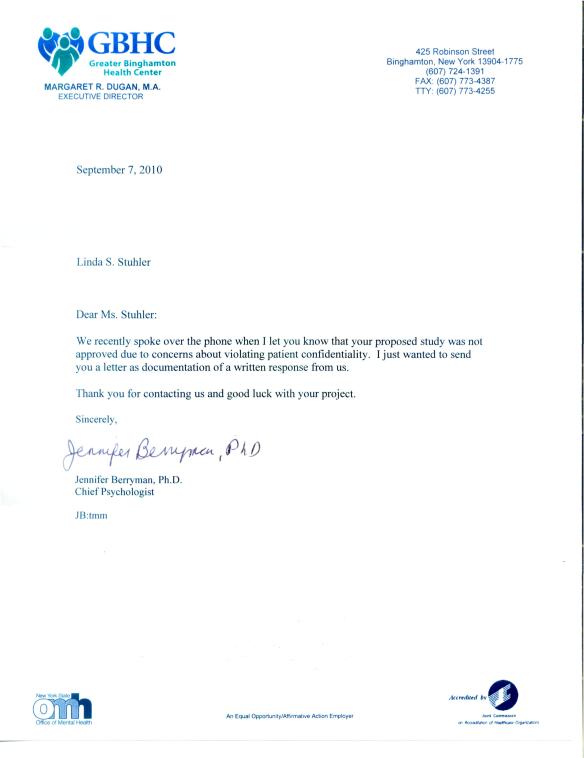
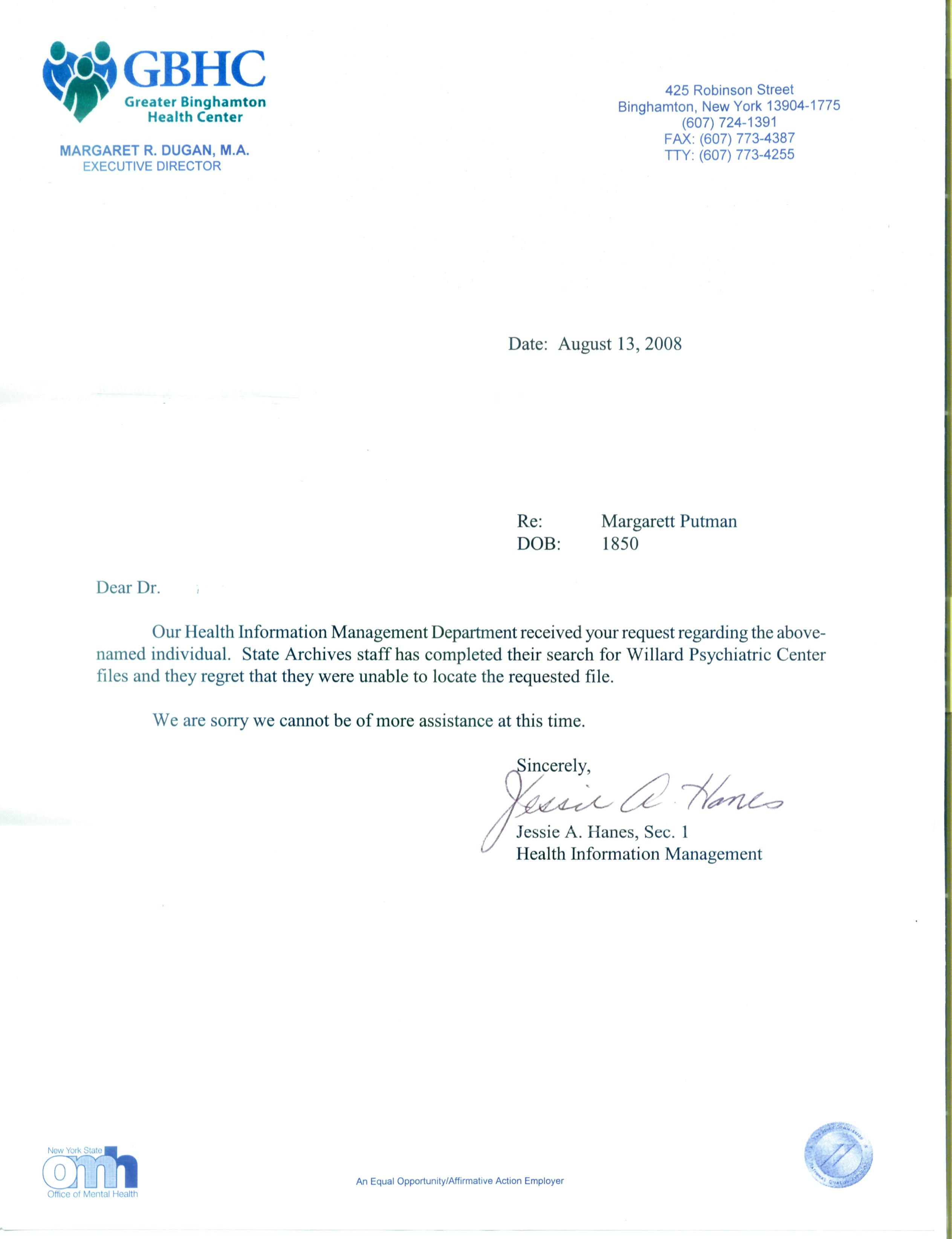
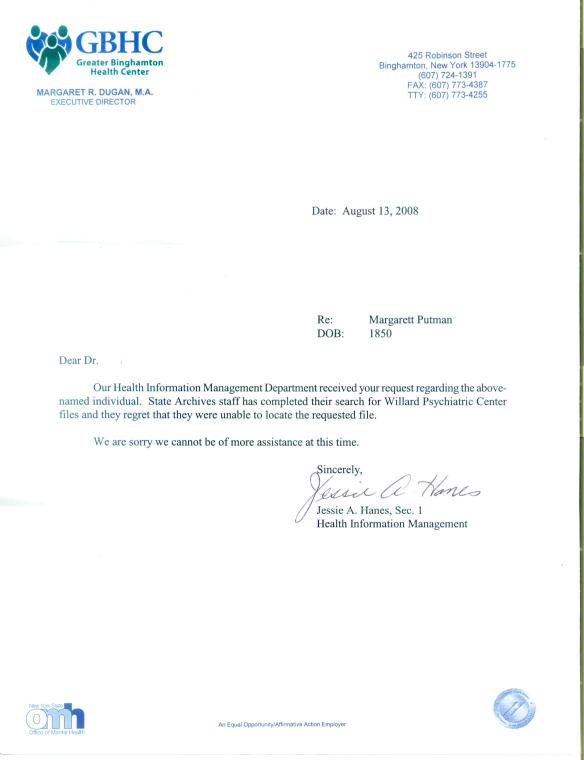
The following response letters, beginning in early 2008, are from everyone that I have contacted over the years. I have not included emails. Unless a modification is made to the present HIPAA Law and New York State Mental Hygiene Laws (See New HIPAA Update and S2514-2013), I and so many others like me, who want to know why our ancestor was committed to a state hospital, will never know the answer. My first response letter is dated April 16, 2008, in response to the original paperwork that my physician and I had sent in early September of 2007 (seven month wait). On August 13, 2008, I was denied a copy of my great-grandmother’s medical records and photographs from the Greater Binghamton Health Center. This three sentence response letter is the explanation given to me after waiting four months, taking the time and effort to speak with them on the phone, obtaining and filling out their required paper work with the help of my physician, and sending in the forms.
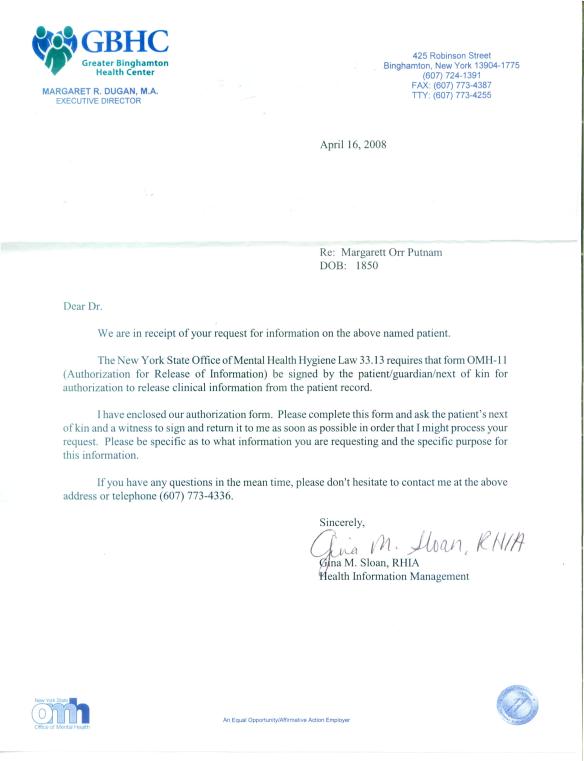
1- GBHC 04.16.2008
1- GBHC 04.16.2008

2 - GBHC 08.13.2008

2 – GBHC 08.13.2008

Besides writing a letter to former New York State Governor Patterson and present Governor Cuomo, both U.S. Senators from New York: Schumer and Gillibrand, State Senators, Congressmen, The Department of Correctional Services, The Commission on Quality of Care and Advocacy for Persons with Disabilities, The Office of Mental Health Counsel, and the State of New York Department of State Committee on Open Government (FOIL), I also wrote a letter to the doctor in charge of the Office of Mental Health Institutional Review Board asking permission to view, record, and publish the burial ledgers – names; dates of birth and death; and location of graves) located and stored at the NYS Archives. After waiting seven months for a response, I was told in an official letter, that my proposed study was not approved due to concerns about violating patient confidentiality. I was also told that I could take the New York State Office of Mental Health to court in order to get the names of former patients and the medical records of my great-grandmother, but seriously, who has the time and the money to go through all of that? Privacy ends at death but apparently patient confidentiality lasts forever.

I went through proper channels to obtain Maggie’s medical records and photographs. I filled out the paperwork, had my doctor and a witness sign the paperwork, and my doctor sent it in. I waited four months for a response and finally my doctor received a letter. I asked for the medical records and any photographs of my great-grandmother. When I received the response from the Greater Binghamton Health Center in August 2008, it stated the staff was unable to locate the requested file. Had I received my great-grandmother’s medical records, I would have been satisfied. Besides being genuinely interested in learning more about Willard, I created this blog for family genealogists like me, frustrated trying to find out if and when their ancestor was a Willard inmate, receiving the runaround obtaining their ancestor’s medical records and photos, and determining whether their ancestor is buried in the Willard Cemetery. The final answer came from the Commissioner of the NYS Office of Mental Health in responding to my inquiry by e-mail on October 25, 2010, which basically stated that publicly identifying former patients may be offensive to some families because of the stigma and repercussions that may follow, for example, in some small towns. I must say that I took offense to his statement because I live in a small town. What exactly was he trying to imply? It appears that we have not moved any further in our tolerance or understanding of people with problems and of people who live in small towns. I must say that my favorite letter is from the Commissioner, dated June 3, 2011, in which he reminds me “that the penalties for violations are very stiff – civil penalties under federal law can carry up to $10,000 per violation.”

Willard’s inmates who in life were incarcerated, forgotten, warehoused, and controlled by the state are once again controlled and intentionally forgotten in death by New York State, the New York State Office of Mental Health, or both. Perhaps they are interpreting the scope of the HIPAA Law incorrectly. The only logical assumption is the protection provided by these laws is not for long dead souls since U.S. Federal Censuses already reveal many of their names; it is for the protection of the descendants.

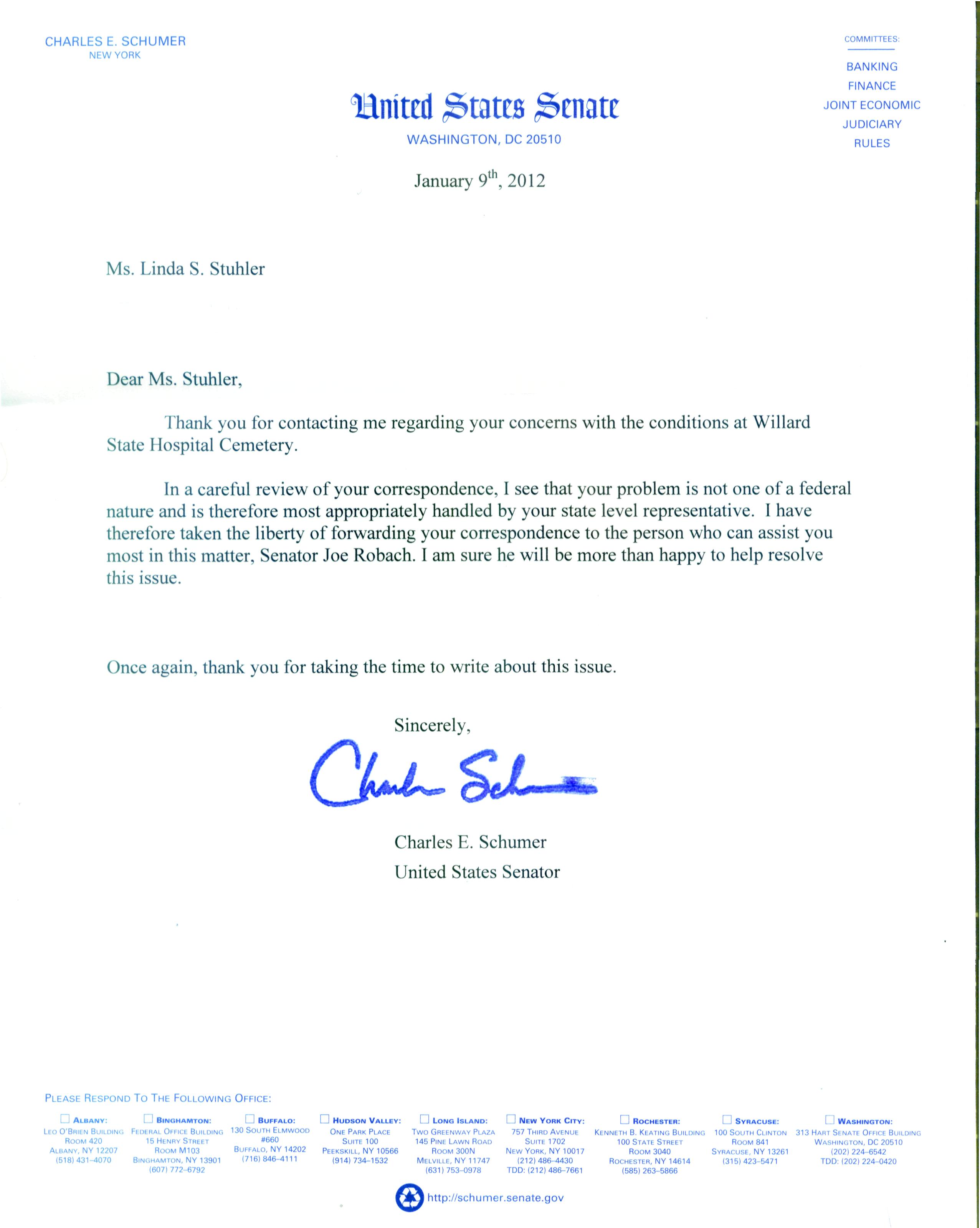
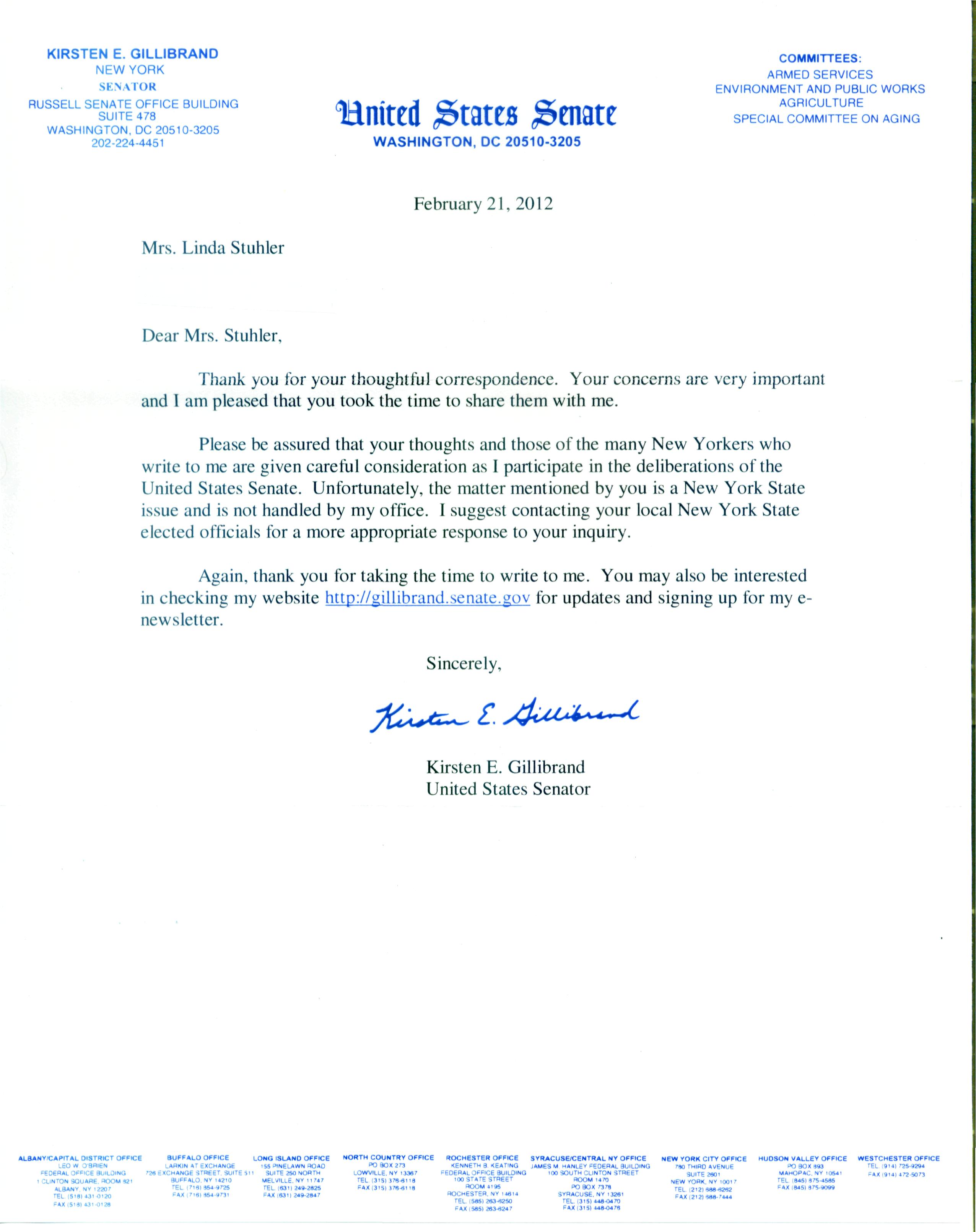
The responses from the Senators are interesting because they state that there is nothing they can do about the situation at Willard. They mention nothing about modifying the HIPAA Law which was one of the questions that I asked them to respond to. My understanding is that they are the only ones who can change or modify this federal law in order that descendants or anyone for that matter, would be allowed to have a copy of these historical medical records. When you’re dead, you’re dead. Who cares if someone looks at 80 year old medical records? The following letters were received by me from Senator Charles E. Schumer, dated January 9, 2012; and from Senator Kirsten E. Gillibrand, dated February 21, 2012. Perhaps this whole ridiculous situation of trying to uncover the identities and opening medical records of people who have been dead for one hundred years lies with the unique interpretation of the federal HIPAA Law by each individual state office of mental health.
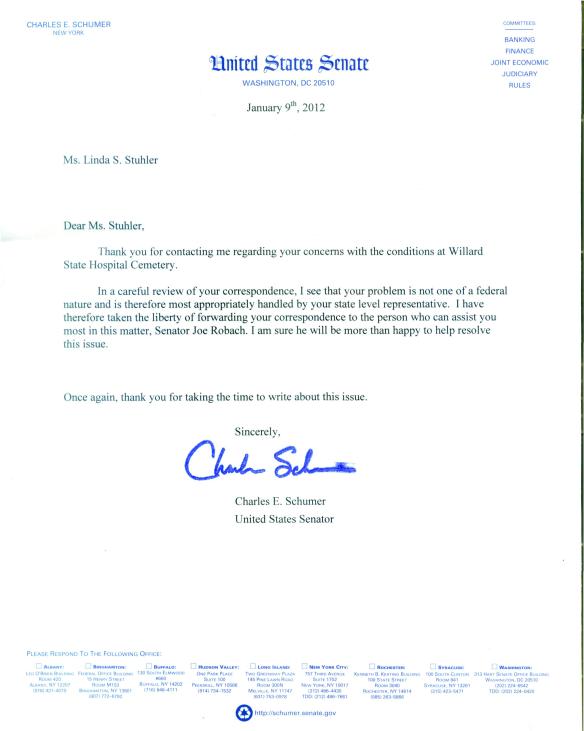
Response Letter Senator Schumer 1.9.2012
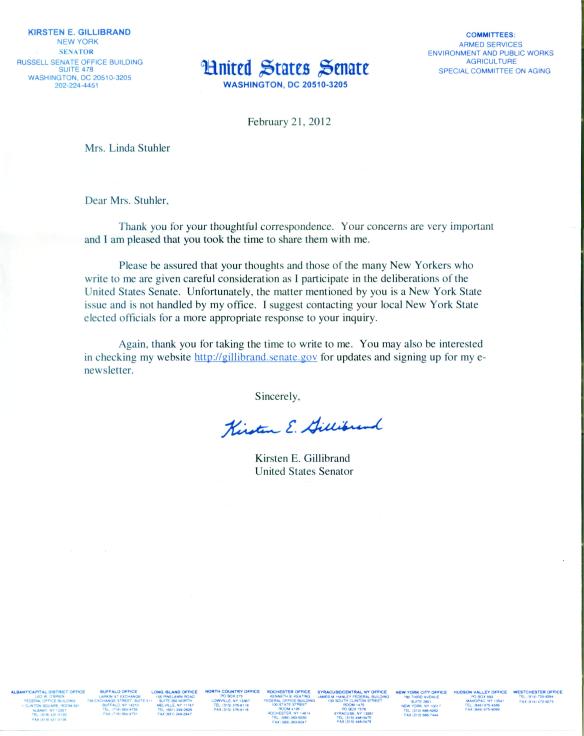
Response Letter Senator Schumer 1.9.2012

Response Letter Senator Gillibrand 2.21.2012
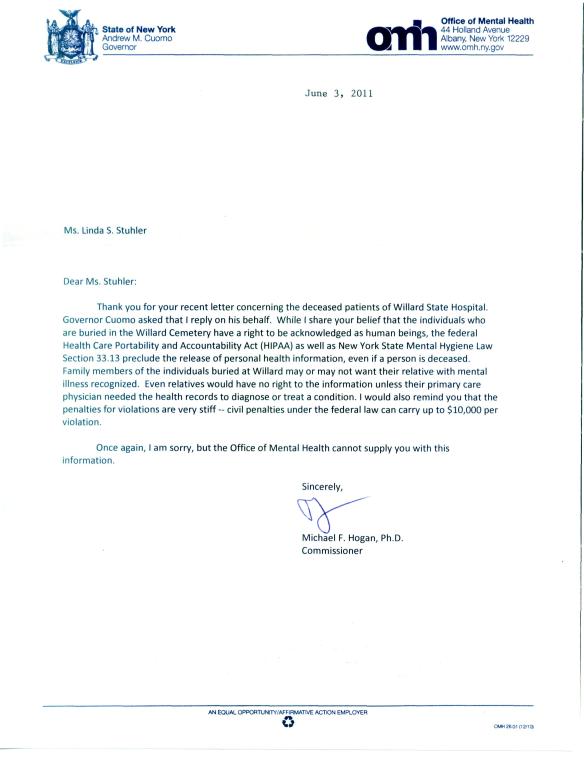
Response Letter Senator Gillibrand 2.21.2012

14 - OMH 06.03.2011

14 – OMH 06.03.2011

13 - GBHC 09.07.2010

13 – GBHC 09.07.2010

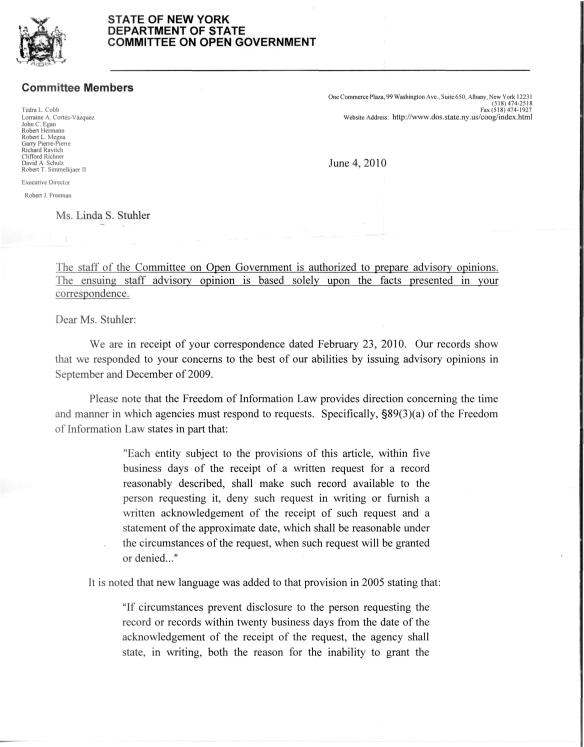
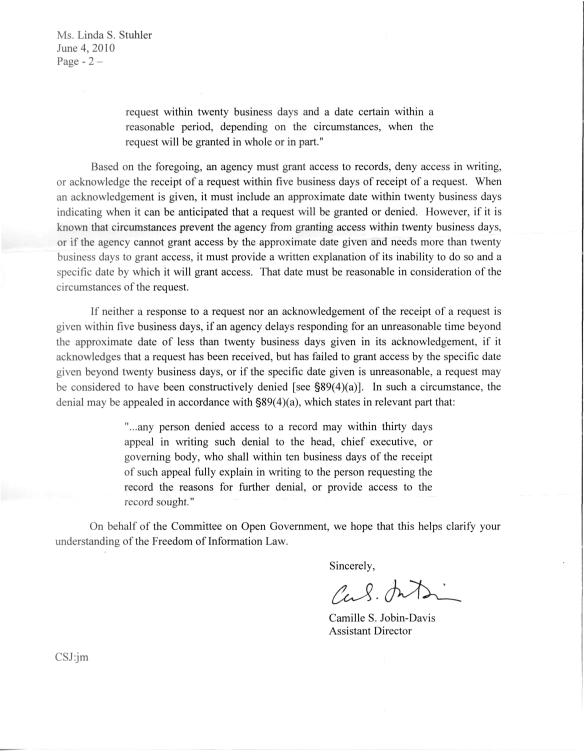
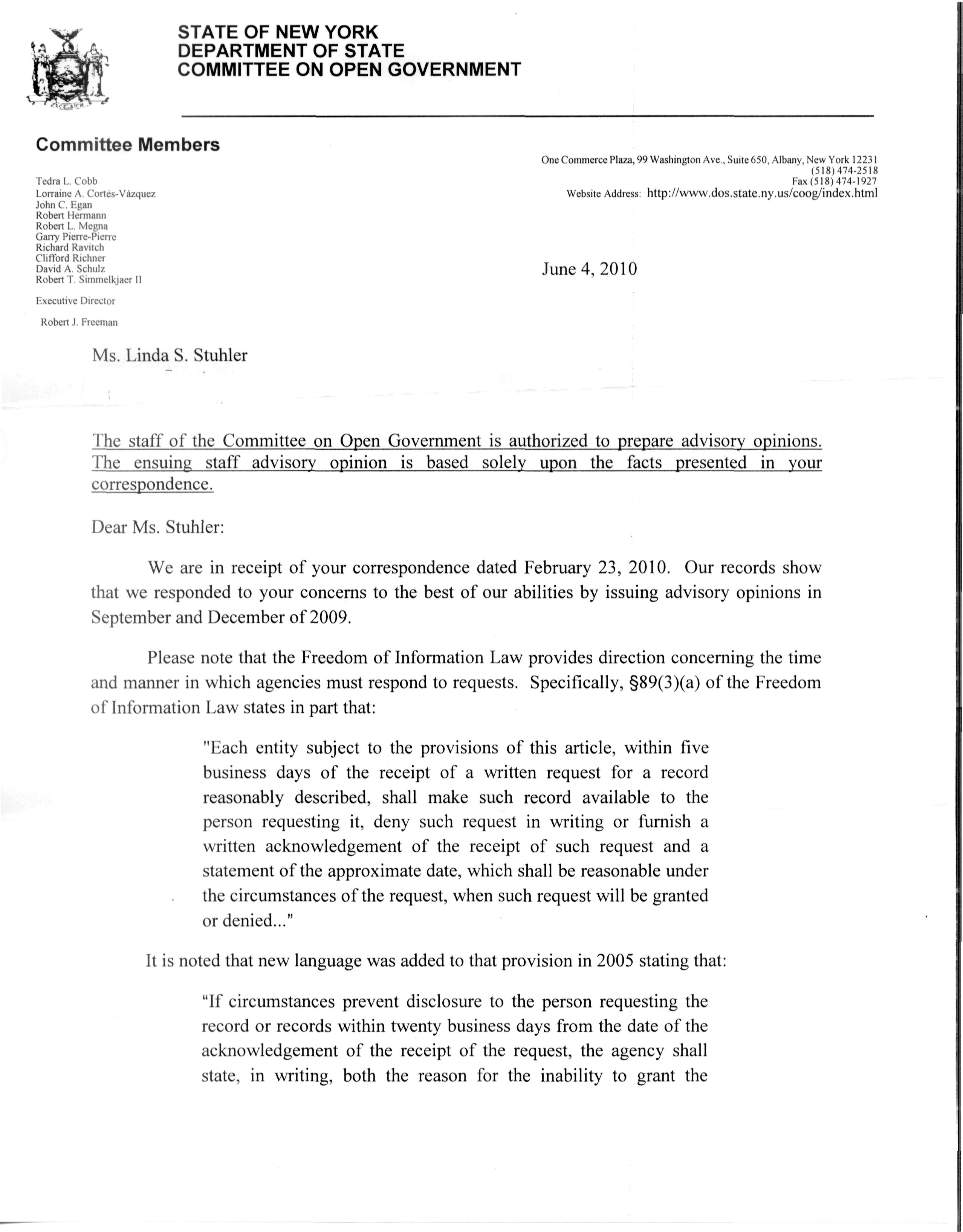
11 - FOIL 06.04.2010-1

11 – FOIL 06.04.2010-1

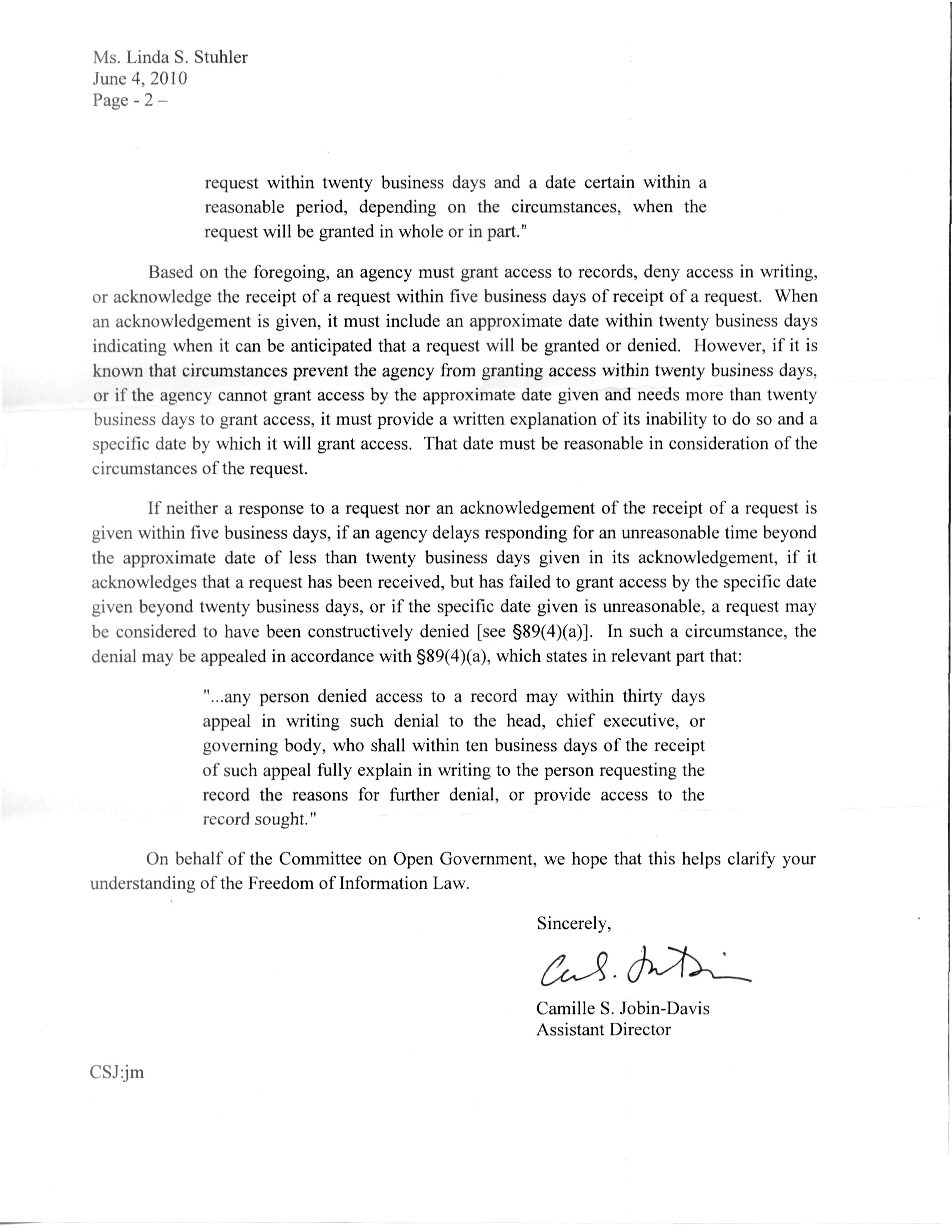
12 - FOIL 06.04.2010-2

12 – FOIL 06.04.2010-2

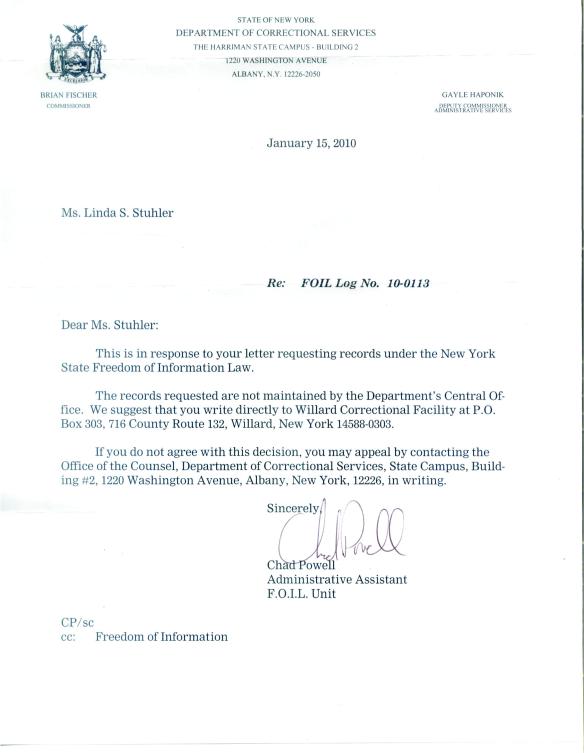
10 - Correctional Services 01.15.2010

10 – Correctional Services 01.15.2010
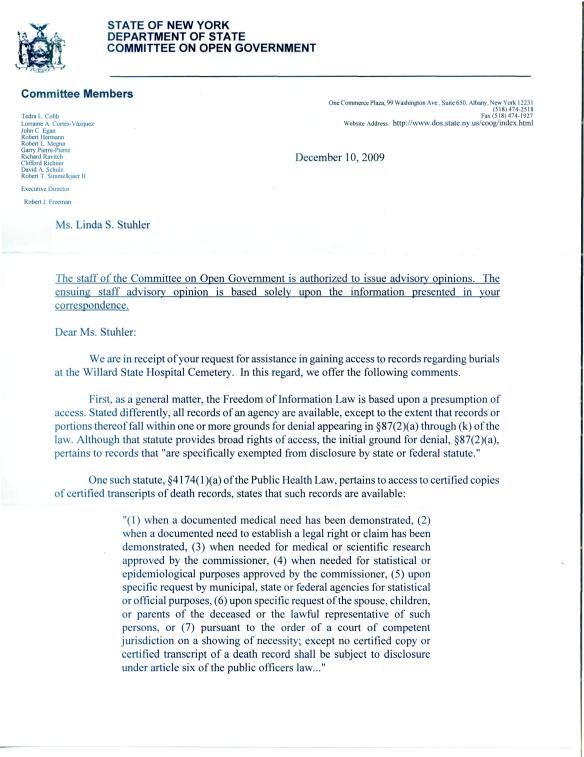
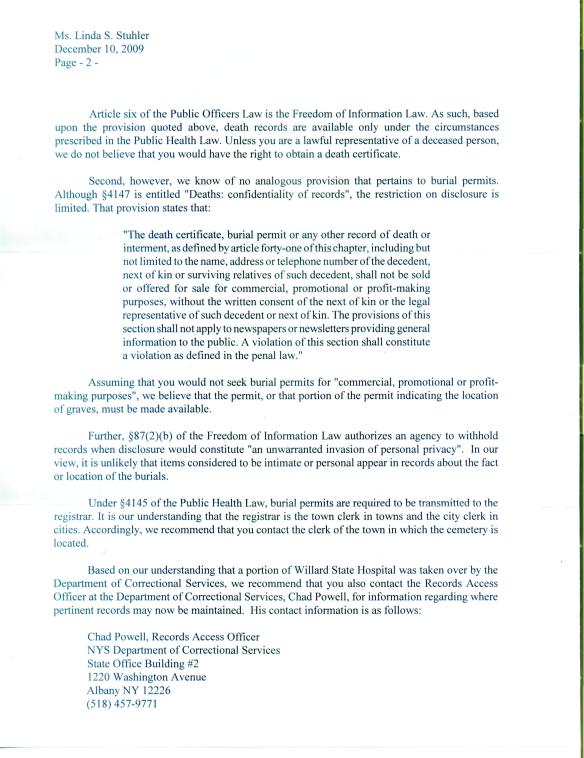
7 - FOIL 12.10.2009-1

7 – FOIL 12.10.2009-1

8 - FOIL 12.10.2009-2

8 – FOIL 12.10.2009-2

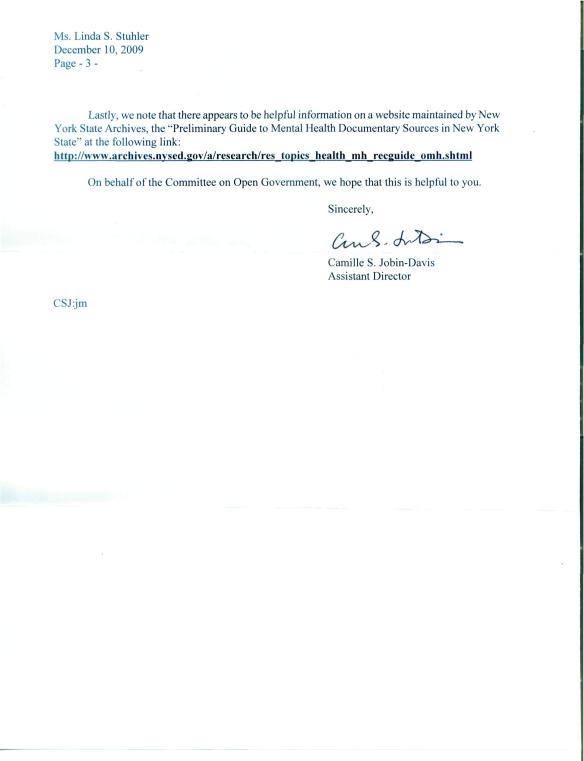
9 - FOIL 12.10.2009-3

9 – FOIL 12.10.2009-3

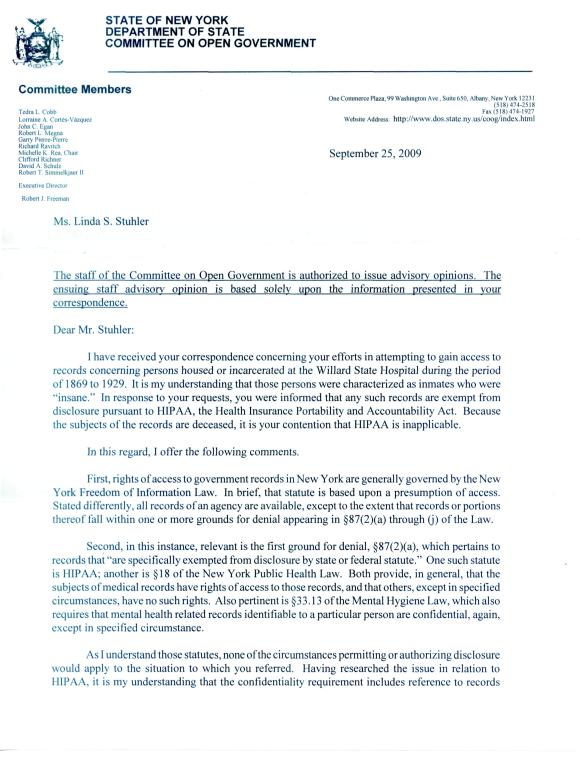
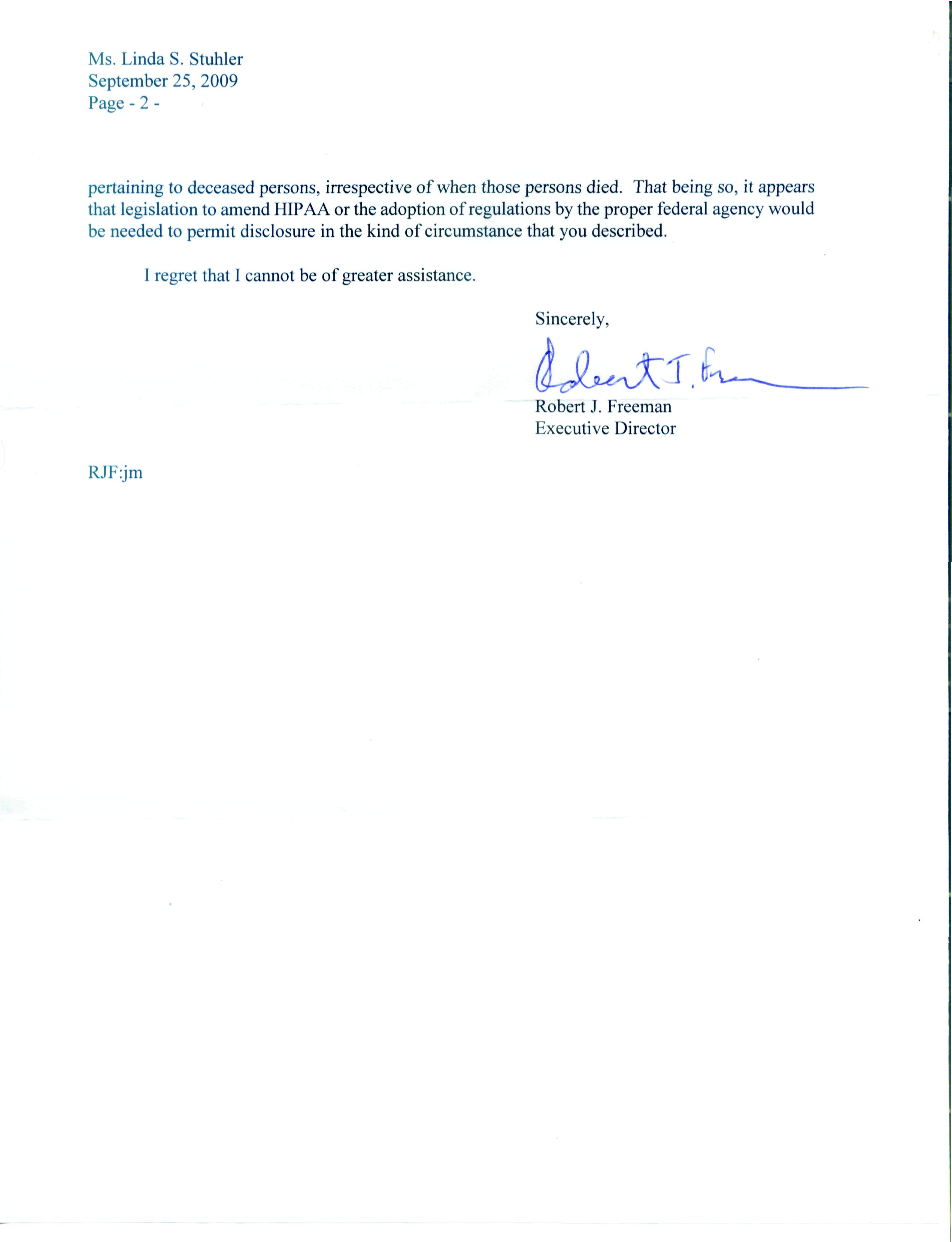
5 - FOIL 09.25.2009-1

5 – FOIL 09.25.2009-1

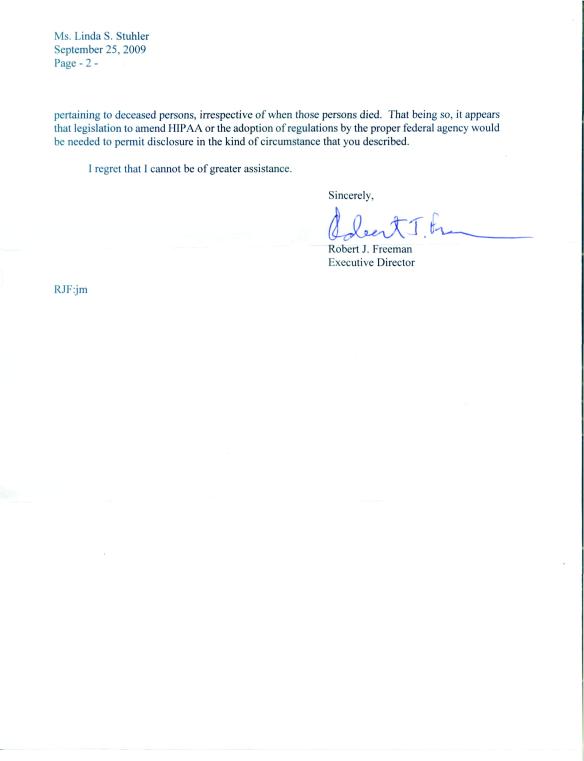
6 - FOIL 09.25.2009-2

6 – FOIL 09.25.2009-2

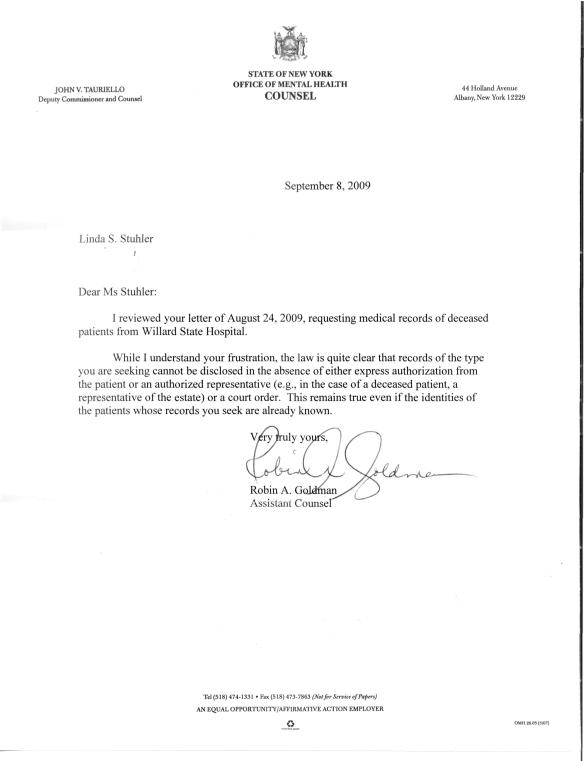
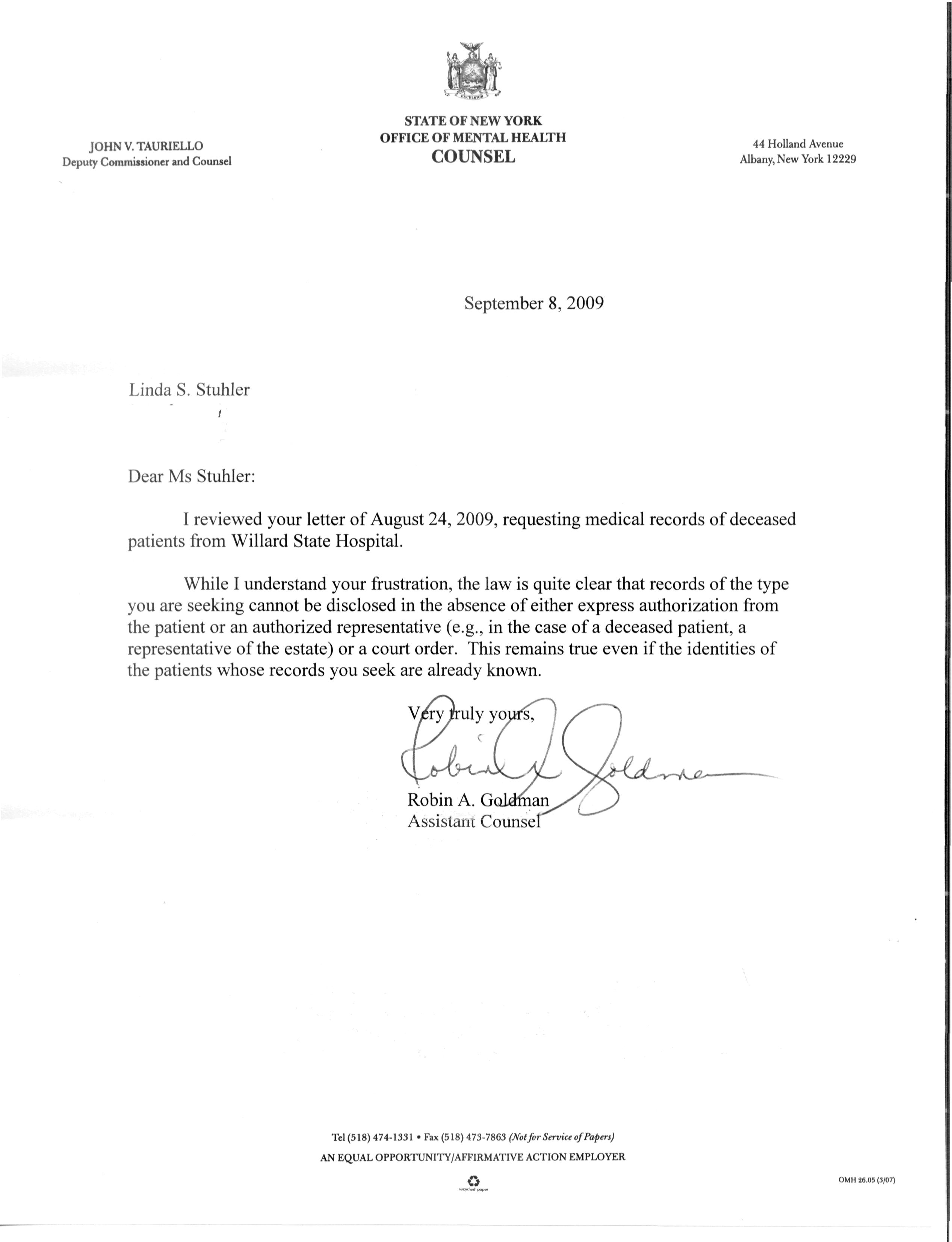
4 - OMH Counsel 09.08.2009

4 – OMH Counsel 09.08.2009

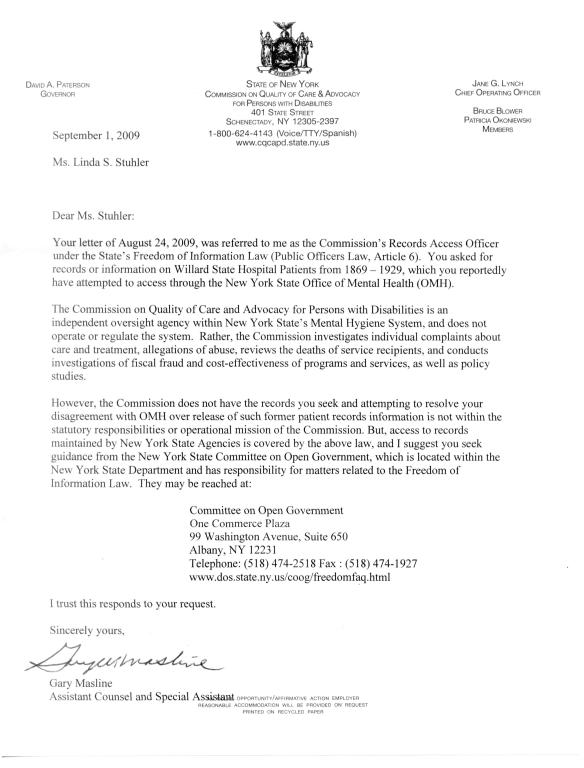
3 - Quality Care Advocacy 09.01.2009

3 – Quality Care Advocacy 09.01.2009

S6805-2011 – S2514-2013 – NY Senate Open Legislation – Relates to patients interred at state mental health hospital cemeteries – New York State Senate

NEW! UPDATED BILL: S2514-2013 – NY Senate Open Legislation – Relates to patients interred at state mental health hospital cemeteries – New York State Senate.

S6805-2011 – NY Senate Open Legislation – Relates to patients interred at state mental health hospital cemeteries – New York State Senate.

A10636-2011 – NY Assembly Open Legislation – Relates to patients interred at state mental health hospital cemeteries – New York State Assembly.

Imagine not being remembered in death because in life you were diagnosed with diabetes, heart disease or cancer. Most people would find this kind of treatment cruel and inhumane but it exists to this day for people who were diagnosed with a mental illness or developmental disability during the nineteenth and early twentieth centuries. This bill is important and necessary in order to restore the dignity and personhood of the thousands of people who were incarcerated and died at former New York State Insane Asylums and Custodial Institutions. When the bodies of the inmates were not claimed by family members, they were buried in anonymous, unmarked graves. They deserve to have their names remembered and available to the public in a searchable database.

The list of these former New York State Hospitals includes but is not limited to: BinghamtonBuffaloCentral IslipCreedmoorDannemoraEdgewoodGowandaHudson RiverKings ParkLong IslandManhattanMatteawanMiddletownMohansicPilgrimRochesterSt. LawrenceSyracuseUtica, and Willard

The Feeble-Minded (Intellectual Disabilities) and Epileptic Custodial Institutions of New York includes but is not limited to: Craig Colony for EpilepticsLetchworth Village for Epileptics & Intellectually DisabledNewark State School for Intellectually Disabled WomenRome State School for Intellectually Disabled Adults & Children, and Syracuse State School for Intellectually Disabled Children. There may be more.

There is no good reason why these long deceased souls need to be punished and stigmatized in death for an illness or disability that they lived with in life. The great majority of these former state hospitals closed in favor of smaller group home settings or changed their names to Psychiatric Centers about 1974. The cemeteries that belonged to these institutions are inactive. I do not understand why anyone would need to have their name withheld from any list until 50 years had passed after their death. This requirement in the bill only serves to feed the stigma. Let’s hope that even with this flaw, it becomes law.

Photo by Roger Luther at www.nysAsylum.com

Photo by Roger Luther at http://www.nysAsylum.com

The Willard Cemetery - Veterans

Veteran’s Graves 5.14.2011

Willard Cemetery 1 - 5.14.2011

Willard Cemetery 5.14.2011

1901 New York State Hospitals

1901 LIST OF STATE HOSPITALS

By 1901, there were thirteen state hospitals for the insane in the State of New York. All these hospitals buried their dead in anonymous, unmarked graves. Some had their own cemetery like Willard State Hospital; others used city and county cemeteries like Rochester State Hospital. Most of these state hospital cemeteries are unmarked, unkempt, and forgotten. None of the thousands of former psychiatric patients’ names have been released to the public. Considering that in 1870, the first patient was buried in the Willard Cemetery, which in the year 2012 covers a span of five or six generations, these people have waited long enough to be remembered. When you release the names, you remove the stigma. The following is a list of most of these long-closed state hospitals; there are more.

1. Utica State Hospital – Counties of Fulton, Hamilton, Herkimer, Montgomery, Oneida, Saratoga, Schenectady and Warren.

2. Hudson River State Hospital – Counties of Albany, Columbia, Dutchess, Greene, Putnam, Richmond, Rensselaer, Washington and Westchester.

3. Middletown State Hospital – Counties of Orange, Rockland, Sullivan and Ulster.

4. Buffalo State Hospital – Counties of Erie and Niagara.

5. Willard State Hospital – Counties of Allegany, Cayuga, Genesee, Ontario, Orleans, Schuyler, Seneca, Steuben, Tompkins, Wayne and Yates.

6. Binghamton State Hospital – Counties of Broome, Chemung, Chenango, Cortland, Delaware, Madison, Otsego, Schoharie and Tioga.

7. St. Lawrence State Hospital – Counties of Clinton, Essex, Franklin, Jefferson, Lewis, Onondaga,Oswego and St. Lawrence.

8. Rochester State Hospital – Counties of Monroe and Livingston.

9, 10. Long Island State Hospital – (Kings Park and Flatbush, Brooklyn) – Counties of Kings, Queens, Nassau and Suffolk.

11, 12. Manhattan State Hospital – (Manhattan and Central Islip) – Counties of New York and Richmond.

13. Gowanda State Homoeopathic Hospital (Collin’s Farm) – Counties of Cattaraugus, Chautauqua and Wyoming.

Additional State Hospitals:

14. Pilgrim State Hospital – Brentwood, Suffolk County, New York

15. Mohansic State Hospital – Yorktown, Westchester County, New York

State Hospitals for the Criminally Insane:

16, 17. Mattaewan and Dannemora State Hospitals


Anonymous Graves In New York

It is indeed unfortunate that thousands of poor “sane” men, women, and children who lived and died in the county poor houses and other charitable institutions of our country were buried in unmarked, anonymous graves, but their final resting places can be marked with an engraved headstone. The same rule does not apply for those who were labeled “insane.” It is frustrating for family researchers who are interested in obtaining information about their ancestors who were incarcerated at one of these long closed insane asylums because of the federal HIPAA Law which states, The Office for Civil Rights enforces the HIPAA Privacy Rule, which protects the privacy of individually identifiable health information; the HIPAA Security Rule, which sets national standards for the security of electronic protected health information; and the confidentiality provisions of the Patient Safety Rule, which protect identifiable information being used to analyze patient safety events and improve patient safety.” Everyone has been forced to sign HIPAA documents at their doctor’s office. Most people interpret this law as one that applies to living individuals, not to people who have been dead for over one hundred years. What is even more confusing is that a few states have interpreted the law differently than New York State. NEW HIPAA Update 2013.

The Inmates of Willard, as well as all former inmates of New York State Hospitals, deserve a cemetery that is clearly marked with a dignified, cemetery appropriate sign. It should be well maintained and treated with respect like any other cemetery as a place where descendants and friends gather to pay respects, lay flowers, or meditate in silence. Some states have released the names of former patients buried in anonymous graves at these long-closed, state owned mental institutions, and they have allowed engraved headstones to be placed on the graves. In some cases, these states have provided funding for the headstones. It is my hope that the names of the patients buried in anonymous graves in cemeteries owned or formerly owned by the State of New York will be made available to the public in a unified, searchable, digital database. If these current laws are not modified, these people will forever remain forgotten and anonymous. After 143 years, the time has come to accept the mistakes of the past and turn a wrong into a right by releasing the names of the people buried at the Willard State Hospital Cemetery and all people buried anonymously in state mental institution cemeteries across America. They have waited long enough.

Thousands of people were incarcerated in state insane asylums during the nineteenth and early twentieth centuries. Anonymous burials are common for state mental institutions across New York State and the country. People genuinely do care and are interested in the way their ancestors were treated, how they died, and where they were buried.

Hopefully bill S2514-2013 will soon become a law and will include provisions for a searchable database available to the public. Interested people need to contact their New York State Senators and Assembly Persons to let them know that this bill needs to become a law so that these forgotten, anonymous souls will finally be remembered. 

The list of these former New York State Hospitals includes but is not limited to: BinghamtonBuffaloCentral IslipCreedmoorDannemoraEdgewoodGowandaHudson RiverKings ParkLong IslandManhattanMatteawanMiddletownMohansicPilgrimRochesterSt. LawrenceSyracuseUtica, and Willard

The Feeble-Minded (Intellectual Disabilities) and Epileptic Custodial Institutions of New York includes but is not limited to: Craig Colony for EpilepticsLetchworth Village for Epileptics & Intellectually DisabledNewark State School for Intellectually Disabled WomenRome State School for Intellectually Disabled Adults & Children, and Syracuse State School for Intellectually Disabled Children. There may be more.