The Changing Face of What is Normal – Jon Crispin – Exploratorium

Congratulations, Jon Crispin! This wonderful exhibit of Jon’s photography of former patient suitcases found in the attic of Willard State Hospital will be displayed at the Exploratorium in San Francisco beginning April 17, 2013.
(Please click on the RED links).

Book Photo 5.20.2013 by Jon Crispin

Book Photo 5.20.2013 by Jon Crispin

I am very proud that The Exploratorium is selling my book! Thank you!

The Changing Face Of What Is Normal, The Exploratorium.

The Changing Face of What is Normal.

Slate.com-Jon Crispin-Suitcases From The Willard Asylum.

NPR Interview with Jon Crispin.

COLLECTORS WEEKLY -Abandoned Suitcases Reveal Private Lives Of Insane Asylum Patients.

What Is The DSM?

According to The American Psychiatric Association, “The Diagnostic and Statistical Manual of Mental Disorders (DSM) is the standard classification of mental disorders used by mental health professionals in the United States. It is intended to be applicable in a wide array of contexts and used by clinicians and researchers of many different orientations (e.g., biological, psychodynamic, cognitive, behavioral, interpersonal, family/systems).”

DSM5

DSM5

I had never heard of The DSM before I began researching the Willard Asylum. I had read many old documents about immigrants who were not allowed to disembark the ship because they were thought to be insane. It made me wonder, how were these people behaving that the authorities and physicians, with their six second examinations, determined that they were insane? I wanted to know, what does it mean to be insane? What is insanity? This is when I first learned about The DSM.

The old adage, “What you don’t know can’t hurt you,” isn’t true. This book affects everyone who lives in the United States. It reminds me of the Dependent, Defective, and Delinquent Census of 1880 (Men, Women), when neighbors were asked by census enumerators if their fellow neighbors were insane. The increase in the “defective classes” rose 155 percent between 1870 and 1880. In 1880, there were 6 general forms of insanity. According to The DSM, there are 13 or more categories divided into over 300 disorders. One hundred-fifty years ago we had asylums to lock people away from society and thankfully, those institutions no longer exist. Today, we have television and internet commercials, medical websites, and The DSM telling us we are ill. We are “abnormal.” We self-diagnose without a physician or psychiatrist. We walk in their offices asking for medication, wanting a magic pill, and telling them our diagnoses. It’s all there at our fingertips, all we have to do is look up what ails us and if we have two or three symptoms, then we must be sick. Are we all mentally ill? Should everyone be medicated? Will we re-build the insane asylums of the nineteenth century? How will this end?

The following is an excerpt from DSM 5 In Distress by Allen Frances, M.D., Psychology Today, December 2012: “Except for autism, all the DSM 5 changes loosen diagnosis and threaten to turn our current diagnostic inflation into diagnostic hyperinflation. Painful experience with previous DSM’s teaches that if anything in the diagnostic system can be misused and turned into a fad, it will be. Many millions of people with normal grief, gluttony, distractibility, worries, reactions to stress, the temper tantrums of childhood, the forgetting of old age, and ‘behavioral addictions’ will soon be mislabeled as psychiatrically sick and given inappropriate treatment.”

(Allen Frances, M.D., was chair of the DSM-IV Task Force and of the department of psychiatry at Duke University School of Medicine, Durham, NC. He is currently professor emeritus at Duke.)

Wayne E. Morrison, Sr. – Pictorial Album of The Willard Asylum 1869 – 1886

On November 9, 2012, I received a beautiful gift from Doug and Jane Anderson at Port City Paranormal. They purchased the book Pictorial Album of The Willard Asylum 1869 – 1886 by Wayne E. Morrison, Sr., and sent it to me because they knew how much I would appreciate and enjoy such a rare piece of history. I cannot thank Doug and Jane enough for being so kind and thoughtful! I hope that one day I will be able to meet them!

Wayne E. Morrison in his printing shop 2009.

Wayne E. Morrison in his printing shop 2009.

According to The Ithaca Journal, published on April 10, 2012: “Ovid: Wayne E. Morrison, Sr., 79 of Ovid, died Friday, April 6, 2012 at his home. He was born in Fairport (NY) a son of the late Earl B. and Grace Yorks Morrison. Mr. Morrison was a printer and publisher for 65 years and was the owner and operator of W.E. Morrison & Co. in Ovid. He was a member of the Fairport and Galen Historical Societies, a former member of the Clyde Fire Dept. and was a past Member of the Ovid Baptist Church. …There was a quote that Mr. Morrison loved that was made by Marianne Nichols. ‘Wayne doesn’t live in the past but the past lives in him.’”

1 - Pictorial Album Of The Willard Asylum 1869 - 1886.

1 – Pictorial Album Of The Willard Asylum 1869 – 1886.

Mr. Morrison’s book is not numbered but is filled with 119 beautiful, historical photographs of The Willard Asylum (Willard State Hospital), the people who worked there, and historical information. He also recorded who took these wonderful photographs. I would like to share with you a few photographs from the first pages of his book. What follows are Mr. Morrison’s words:

“Year after year since 1869, the Willard Asylum has proved an incalculable blessing to thousands of the unfortunate of humanity in the State of New York – a refuge for the chronic insane and upon lands partially in the Towns of Ovid and Romulus, Seneca County, it was the first such institution established in the nation and has been the exemplar from which other states have formed like asylums.

01-The Main Building-Wayne E. Morrison, Sr. 1978

01-The Main Building-Wayne E. Morrison, Sr. 1978

The early photographs of Willard Asylum, published for the first time, are the work of Nelson S. Hopkins, whose brother, Dr. Horace G. Hopkins, was a Resident Officer of the Asylum at the time. The preponderance of his pictures were made in 1886, however some were taken a year earlier, and a few as late as 1892. Some are also credited to Anne Maycock Hopkins, the wife of Dr. Hopkins. They have been preserved by Dr. Robert E. Doran of Geneva, who has in his possession the Hopkins collection in its entirety – more than three hundred fine old pictures.

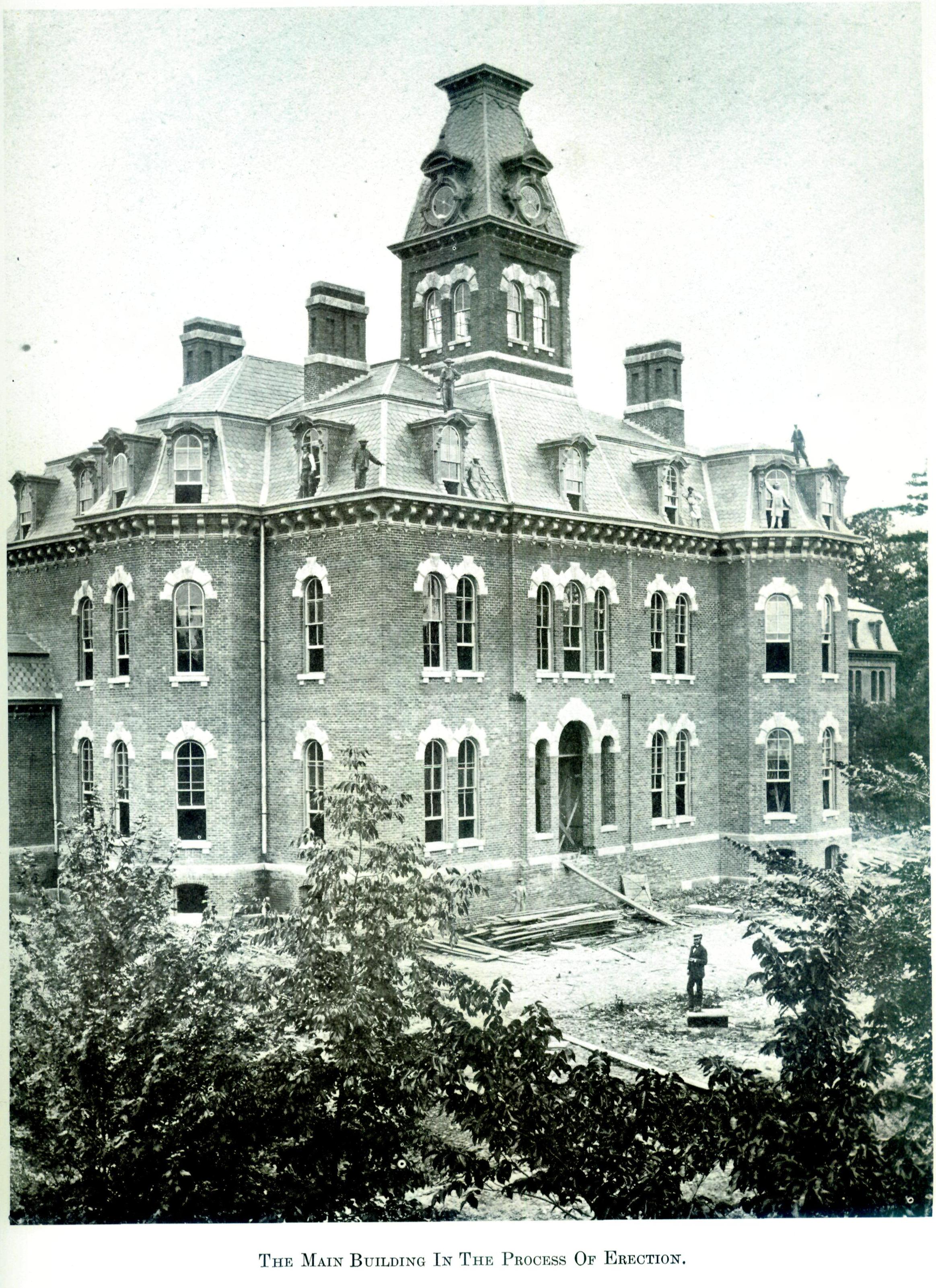
Excepted are the two views in 1869 on the main building in the process of erection taken by Mr. C.V.D. Cornell, photographers, of Waterloo. The front view was loaned by the Willard Asylum Museum, and the rear view by Michael F. Perry, of Ovid. – W.E. Morrison & Co., Ovid, N.Y.”
(Copyright 1978 Wayne E. Morrison, Sr.)

02-The Asylum Medical Staff-Wayne E. Morrison, Sr. 1978

02-The Asylum Medical Staff-Wayne E. Morrison, Sr. 1978

03-The Asylum Officials-Wayne E. Morrison, Sr. 1978

03-The Asylum Officials-Wayne E. Morrison, Sr. 1978

04-The Main Building In The Process Of Erection-Wayne E. Morrison, Sr. 1978

04-The Main Building In The Process Of Erection-Wayne E. Morrison, Sr. 1978

05-The North Wing In Process Of Erection-Wayne E. Morrison, Sr. 1978

05-The North Wing In Process Of Erection-Wayne E. Morrison, Sr. 1978

06-Rear Of The Main Building In Process Of Erection-Wayne E. Morrison, Sr. 1978

06-Rear Of The Main Building In Process Of Erection-Wayne E. Morrison, Sr. 1978

07-The Main Building From The North-West-Wayne E. Morrison, Sr. 1978

07-The Main Building From The North-West-Wayne E. Morrison, Sr. 1978

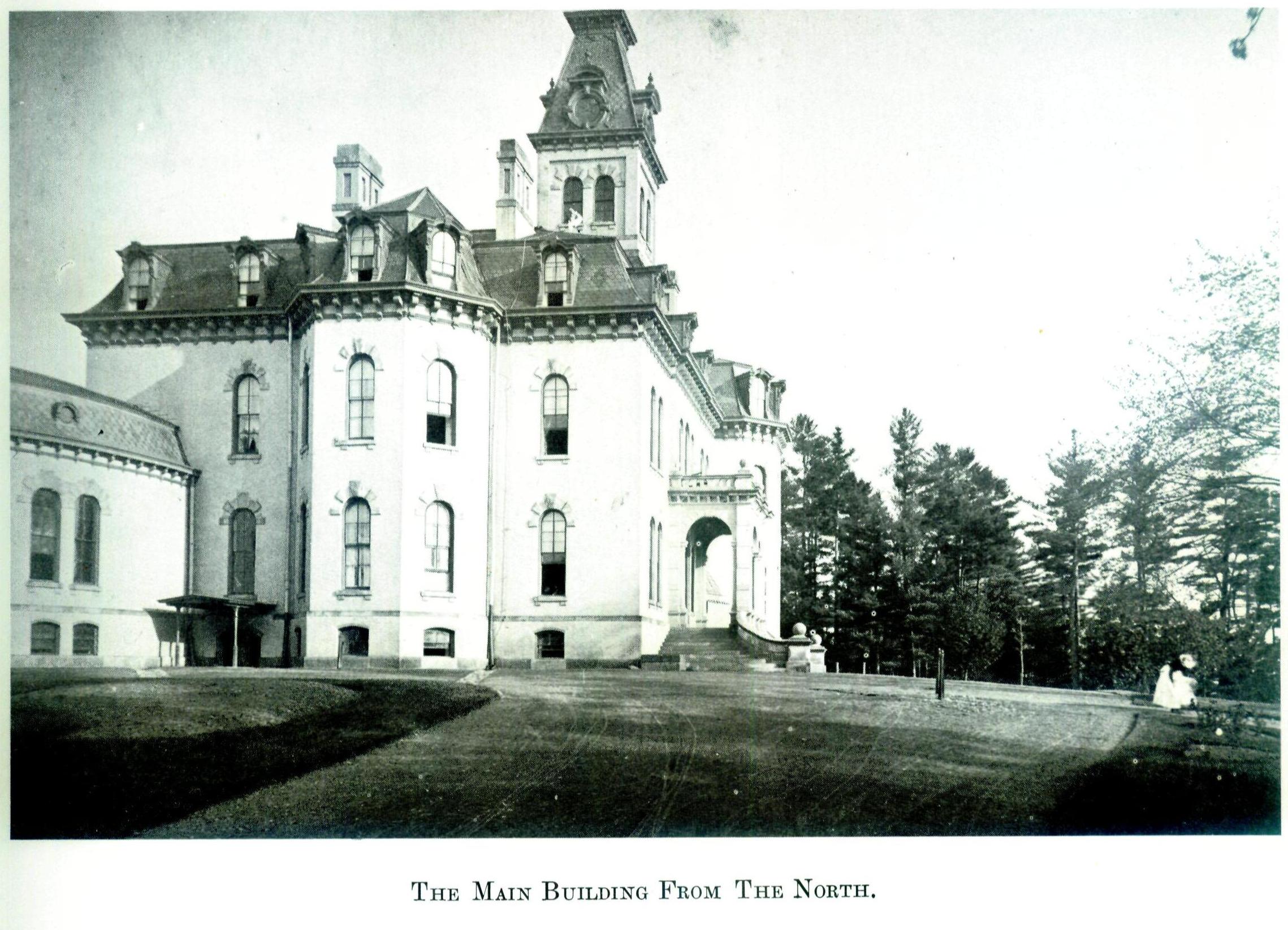
08-The Main Building From The North-Wayne E. Morrison, Sr. 1978

08-The Main Building From The North-Wayne E. Morrison, Sr. 1978

09-The Medical Office-Main Buildiing-Wayne E. Morrison, Sr. 1978

09-The Medical Office-Main Buildiing-Wayne E. Morrison, Sr. 1978

10-The Main Building From The North-Wayne E. Morrison, Sr. 1978

10-The Main Building From The North-Wayne E. Morrison, Sr. 1978

11Group Of Attendants, Detached Building No. 1-Wayne E. Morrison, Sr. 1978

11Group Of Attendants, Detached Building No. 1-Wayne E. Morrison, Sr. 1978

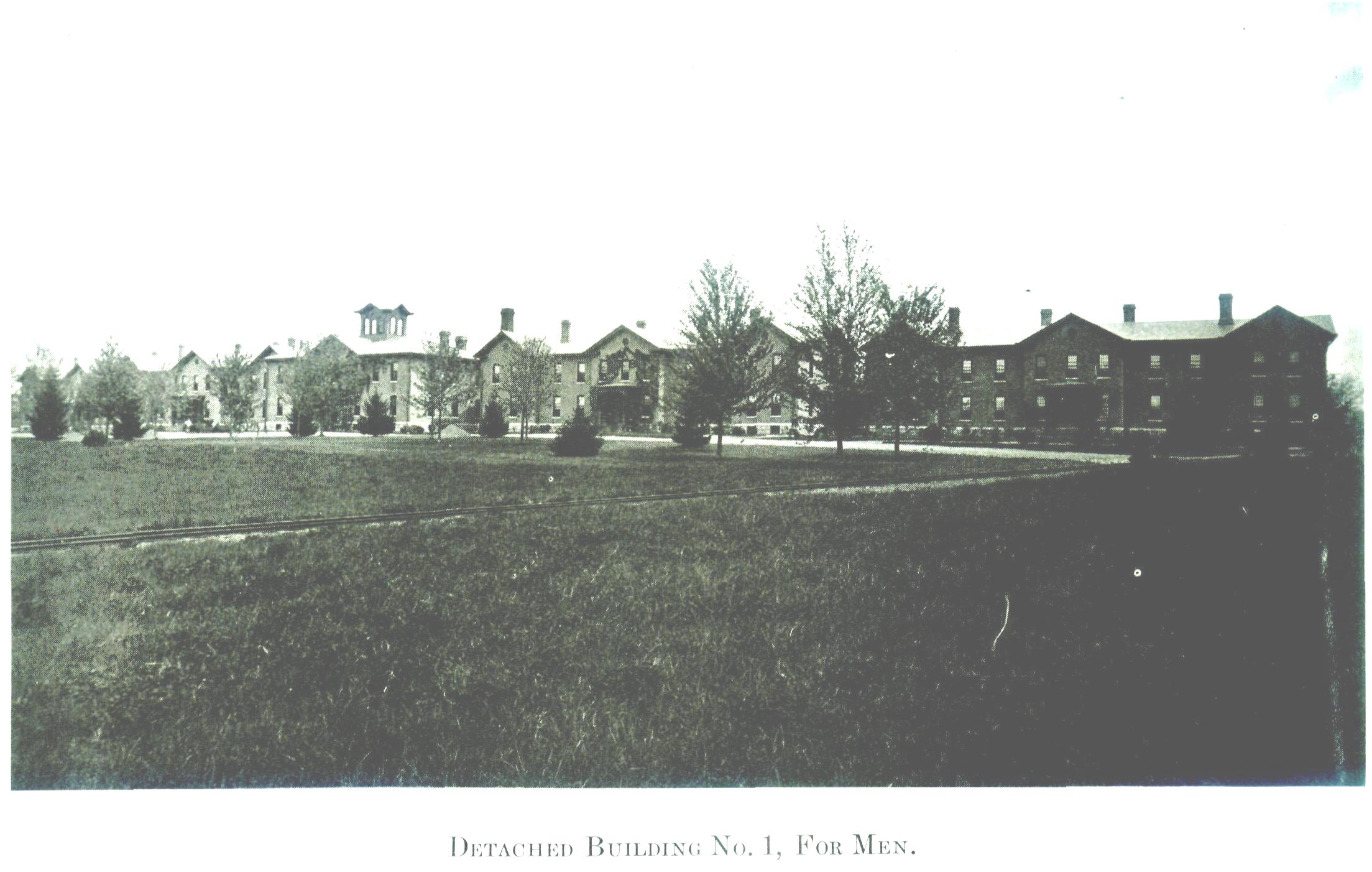
12 Detached Building No. 1, For Men-Wayne E. Morrison, Sr. 1978

12 Detached Building No. 1, For Men-Wayne E. Morrison, Sr. 1978

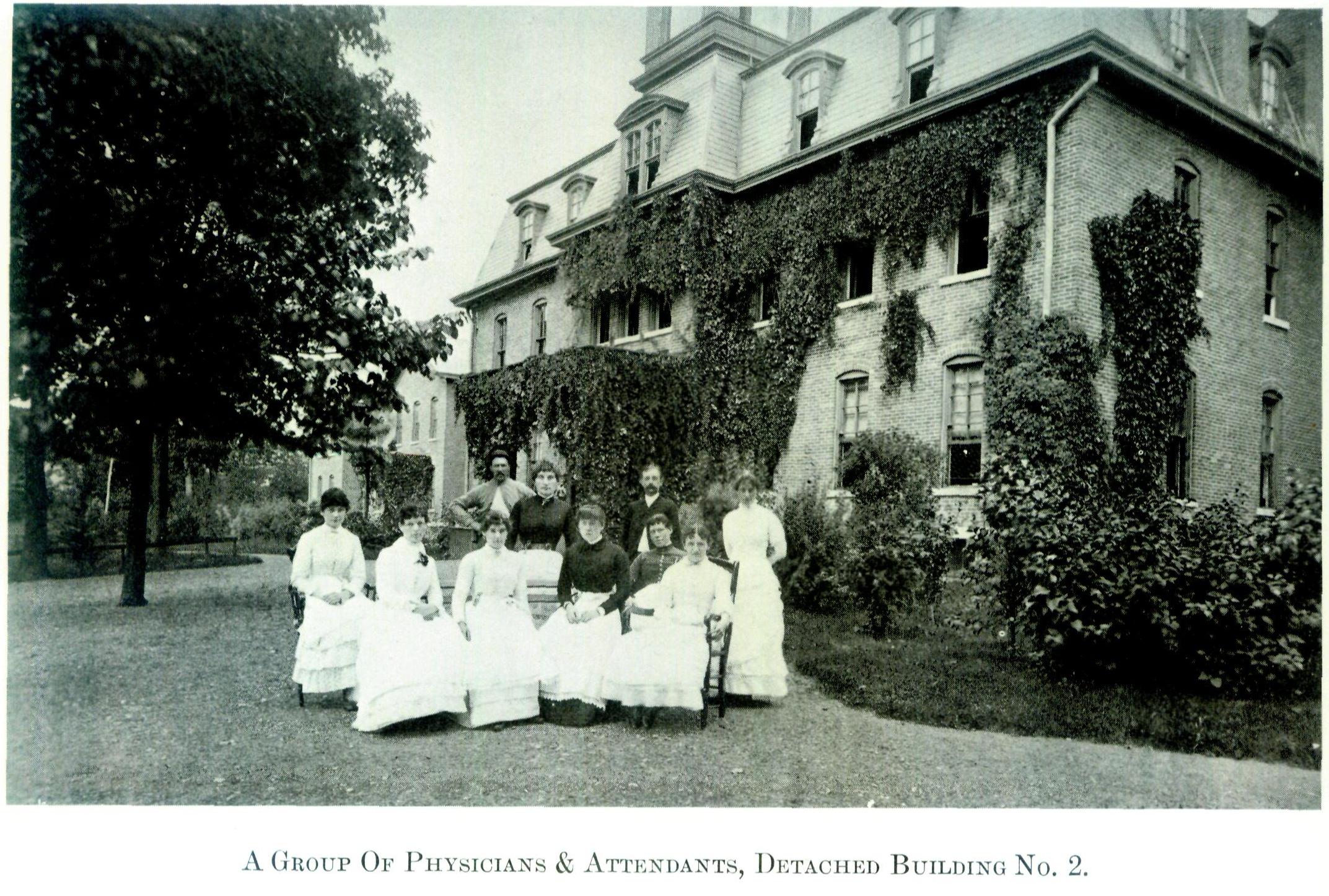
13-A Group Of Physicians & Attendants, Detached Building No. 2-Wayne E. Morrison, Sr. 1978

13-A Group Of Physicians & Attendants, Detached Building No. 2-Wayne E. Morrison, Sr. 1978

14-Detached Building No. 2, For Women-Wayne E. Morrison, Sr. 1978

14-Detached Building No. 2, For Women-Wayne E. Morrison, Sr. 1978

15-Physicians & Attendants, Detached Building No. 3-Wayne E. Morrison, Sr. 1978

15-Physicians & Attendants, Detached Building No. 3-Wayne E. Morrison, Sr. 1978

16-Detached Building No. 3, For Men-Wayne E. Morrison, Sr. 1978

16-Detached Building No. 3, For Men-Wayne E. Morrison, Sr. 1978

17-Supervisor-In-Chief, Attendants & Employees, Detached Building No. 4-Wayne E. Morrison, Sr. 1978

17-Supervisor-In-Chief, Attendants & Employees, Detached Building No. 4-Wayne E. Morrison, Sr. 1978

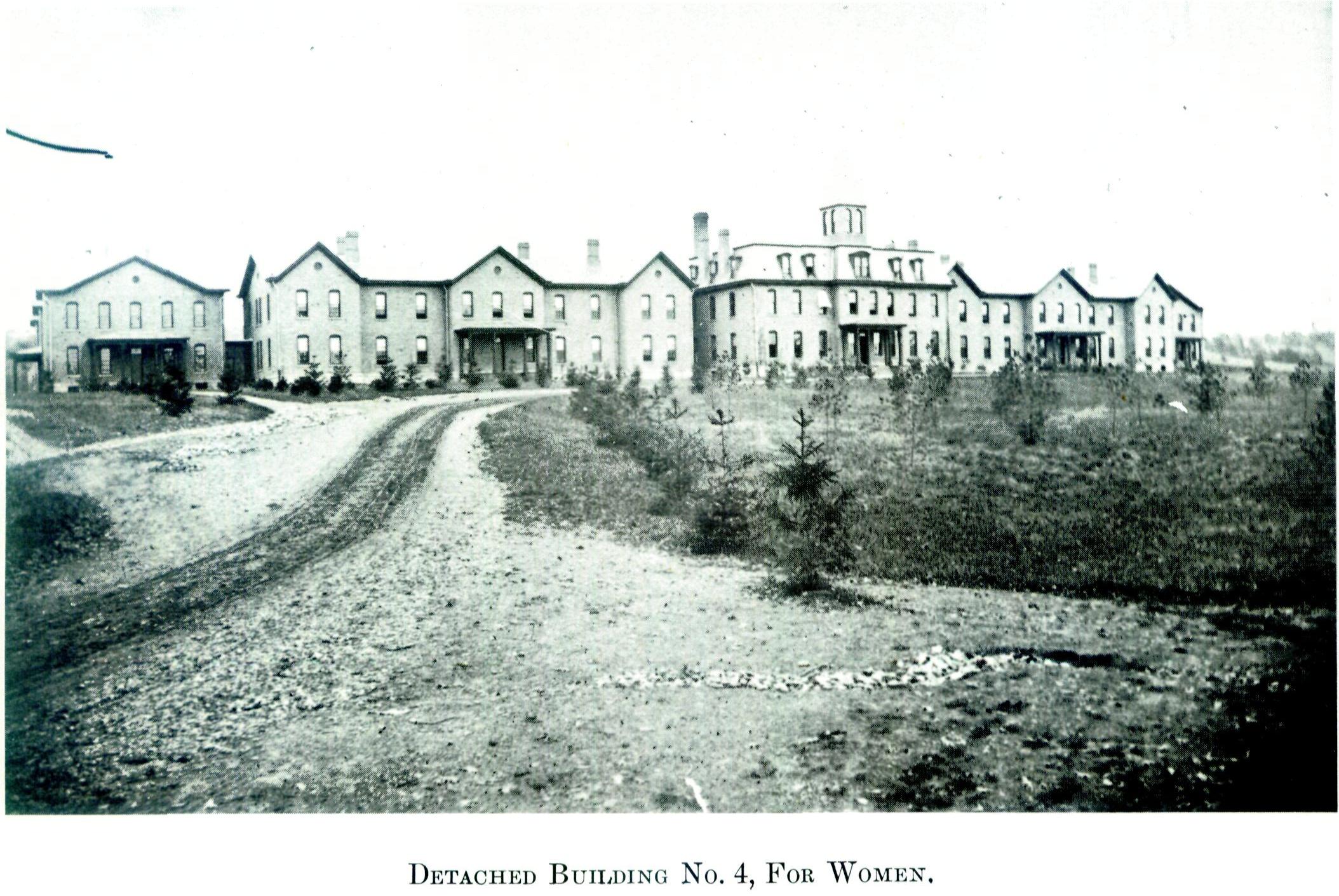
18-Detached Building No. 4, For Women-Wayne E. Morrison, Sr. 1978

18-Detached Building No. 4, For Women-Wayne E. Morrison, Sr. 1978

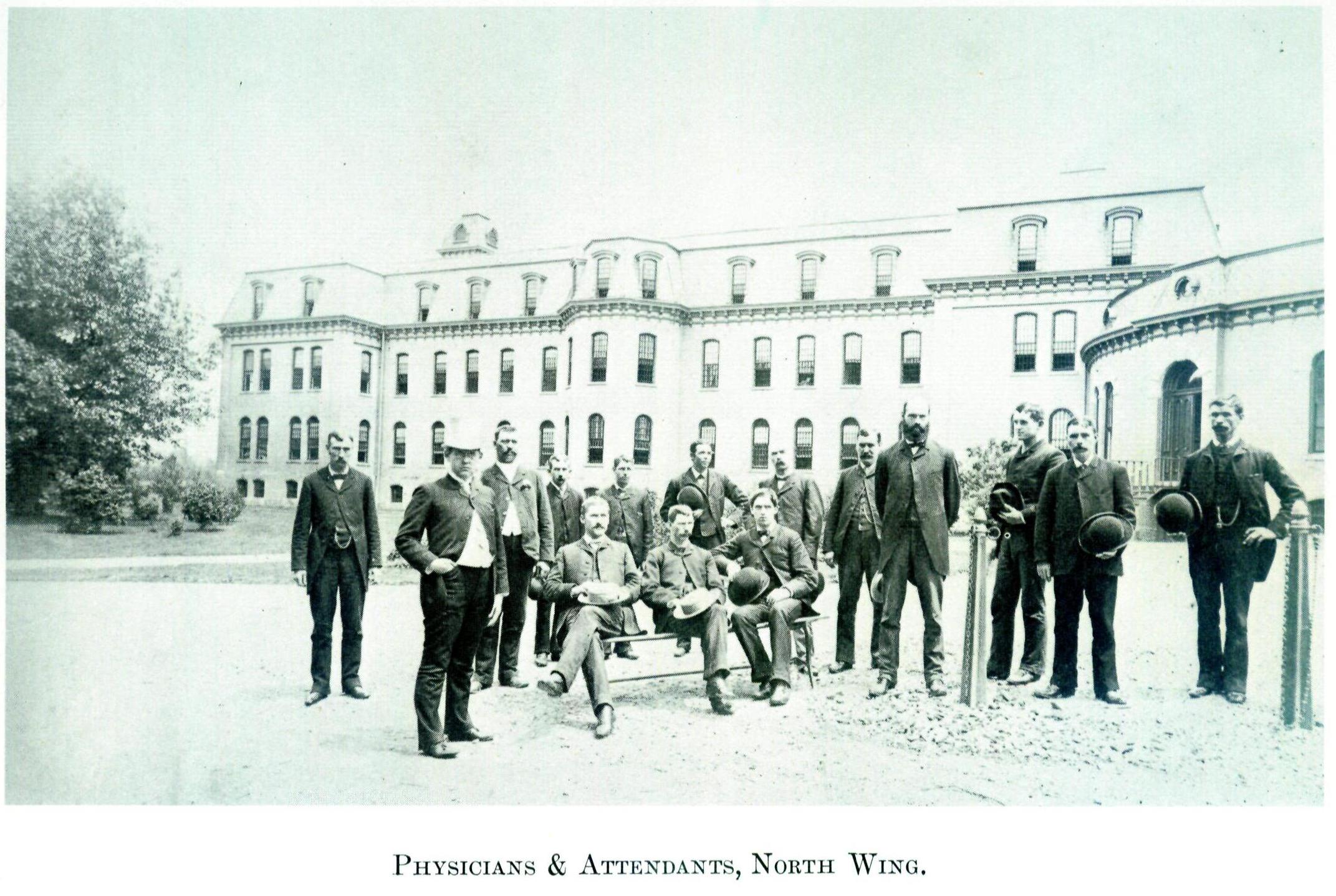
19-Physicians & Attendants, North Wing-Wayne E. Morrison, Sr. 1978

19-Physicians & Attendants, North Wing-Wayne E. Morrison, Sr. 1978

20-The North Wing-Wayne E. Morrison, Sr. 1978

20-The North Wing-Wayne E. Morrison, Sr. 1978

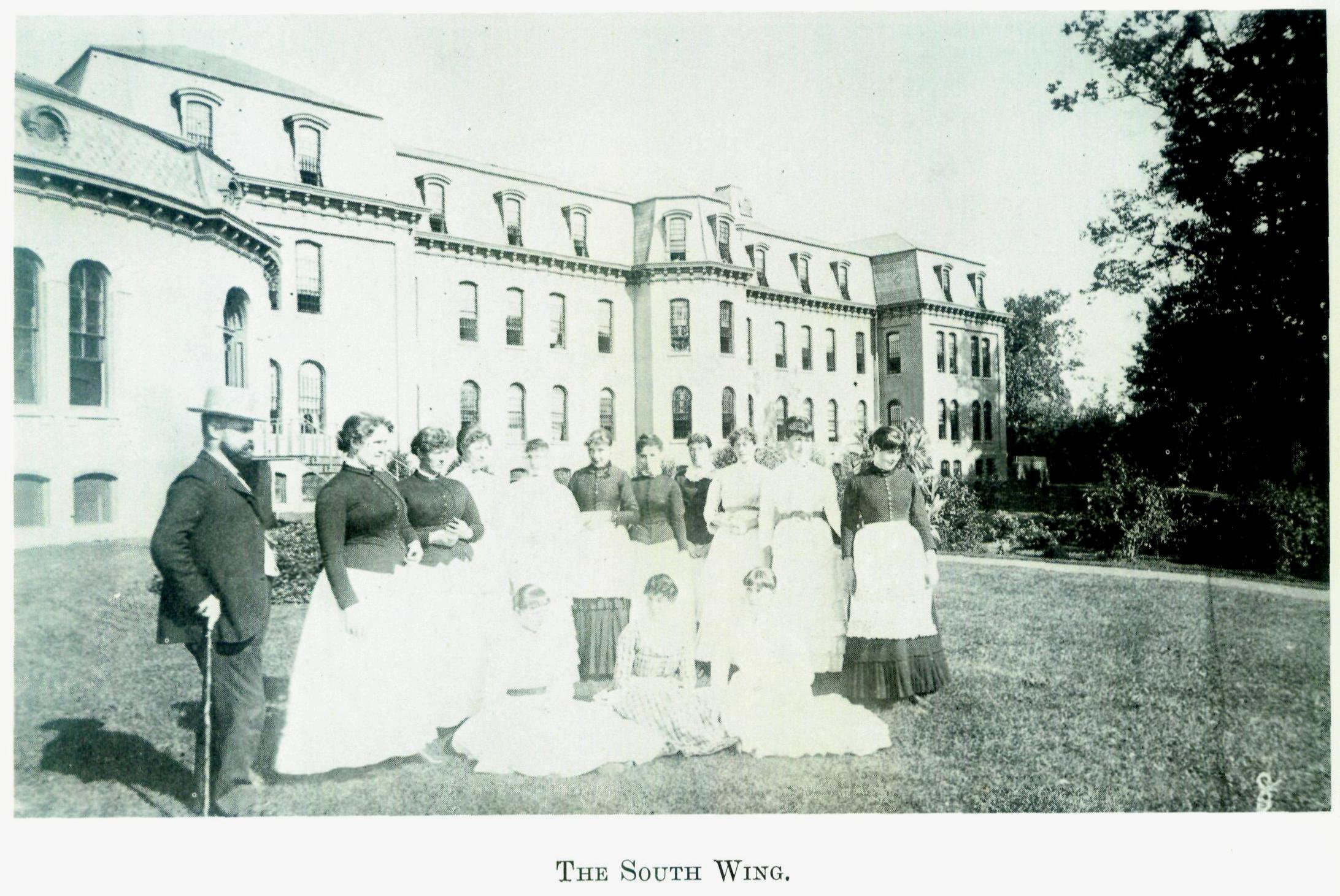
21-The South Wing-Wayne E. Morrison, Sr. 1978

21-The South Wing-Wayne E. Morrison, Sr. 1978

22-Physician & Attendants, South Wing-Wayne E. Morrison, Sr. 1978

22-Physician & Attendants, South Wing-Wayne E. Morrison, Sr. 1978

23-The W.B. Dunning Leaving Willard Landing-Wayne E. Morrison, Sr. 1978

23-The W.B. Dunning Leaving Willard Landing-Wayne E. Morrison, Sr. 1978

27-A View At Willard Landing-Wayne E. Morrison, Sr. 1978

27-A View At Willard Landing-Wayne E. Morrison, Sr. 1978

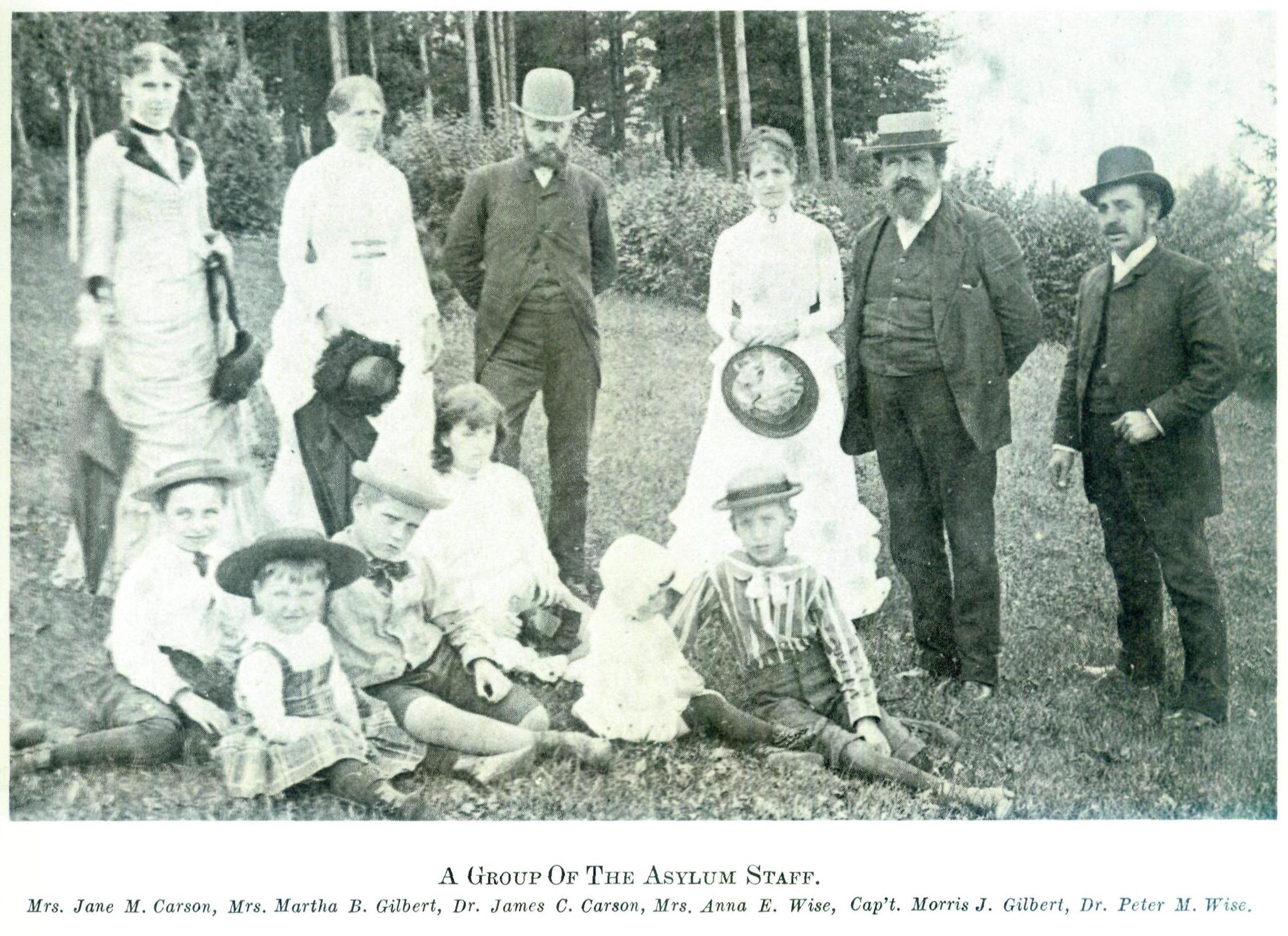
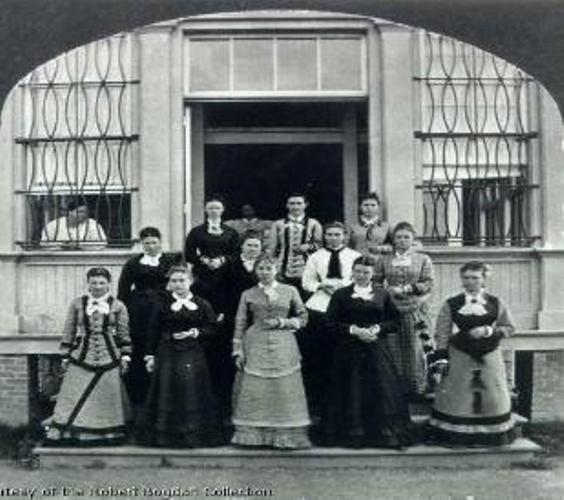
28-A Group Of The Asylum Staff-Wayne E. Morrison, Sr. 1978

28-A Group Of The Asylum Staff-Wayne E. Morrison, Sr. 1978

29-The Onondaga At Willard Landing-Wayne E. Morrison, Sr. 1978

29-The Onondaga At Willard Landing-Wayne E. Morrison, Sr. 1978

30-Cap't & Mrs. Anson Wheeler-Wayne E. Morrison, Sr. 1978

30-Cap’t & Mrs. Anson Wheeler-Wayne E. Morrison, Sr. 1978

Washington State – Grave Concerns Association Model of Memorialization

For the past few years I have tried to get the attention of state and federal lawmakers to pass a law in New York State that would provide for the release of patient names; dates of birth and death; and location of graves, of people who were committed to State Hospitals and Custodial Institutions during the nineteenth and early twentieth centuries who were buried in unmarked or numbered, anonymous graves, whether they be in formerly state, county, or city owned cemeteries. (See My Story) I also asked for a searchable, digital database, available to the public to be included in the bill. On August 22, 2011, I finally got the opportunity to meet with Kate Munzinger, Senator Joseph Robach’s Chief of Staff. Ms. Munzinger took the time to listen to what I was asking for.

Grave Concerns Association

Grave Concerns Association

The reason why I’m blogging about this issue again is because the bill in New York State has not yet become a law. There are caring people in several states who are pushing to get a similar law passed but state and federal representatives will not give them the time of day or they won’t even consider passing such a law because of the misinterpretation of the federal HIPAA Law. I want to help those people in other states by sharing with them what was shared with me. If not for Laurel Lemke, Chair of Grave Concerns Association, I don’t think I would have received the attention of Senator Robach. In 2004, Ms. Lemke and others, had fought for this cause, and managed to amend law 6678 in the State of Washington that allowed for the release of patient names for the purpose of memorialization. She emailed me the bill which I in turn gave to Kate Munzinger, Chief of Staff; Tim Ragazzo, Director of Operations & Legislation; and Senator Joseph Robach. A bill was drafted and introduced to the New York State Legislature in March 2012. The title of the bill is: “An act to amend the mental hygiene law, in relation to patients interred at state mental health hospital cemeteries.”

Western State Hospital, Pierce County, Washington, has 3,218 patients who are no longer anonymous. Grave Concerns Association has raised funds and replaced 1,200 names since 2004. The forgotten have been remembered with dignity. With community fund raising efforts and countless volunteers, inscribed headstones that identify the patient’s name, date of birth and death, have been placed at the graves; and a searchable, digital database has been uploaded to the internet. In contrast, New York State, with 22 or more former state custodial institutions combined has upwards of 11,000 or more people buried in anonymous graves who through no fault of their own have been erased from history. Willard State Hospital alone has close to 6,000 patients buried in anonymous graves.

Sherry Storms, Stacie Larson and Laurel Lemke, Grave Concerns Association, John Lucas, countless volunteers, and the State of Washington deserve to be recognized for their ground breaking, painstaking work, and above all, their model should be copied in every state in the union. The New York State bill is important and necessary in order to restore the dignity and personhood of the thousands of people who were incarcerated and died at former New York State Insane Asylums (later renamed State Hospitals), and State Custodial Institutions (for Feeble-Minded and Epileptic persons). When the bodies of the inmates were not claimed by family members, they were buried in anonymous, unmarked graves. Many of these unclaimed bodies went to medical colleges and pathology labs for the furtherance of medical science. These people deserve to be remembered, and we need to remember what happened to them so that we do not repeat the mistakes of our ancestors.

It is my hope that the State of New York, and all states, will pass similar legislation and follow the Washington State – Grave Concerns Model. They have done a great service for the community and the nation by naming the forgotten; setting up an exemplary, searchable, digital database; and trying their best to remove the stigma of mental illness.

WASHINGTON:
Grave Concerns Association
Volunteer Carla Wutz, descendent of Michael Wutz, updates the data base on the Grave Concerns website.

Grave Concerns Cemetery Database – Version 1.0 – Western State Hospital Historic PatientCemetery
http://www.wshgraveconcerns.org/search-the-database.html

Washington State Archives – Digital Archives

Port City Paranormal – The Ghosts Of Willard Asylum

To quote their website: Port City Paranormal is a team of investigators that, “is dedicated to finding answers to the age old mystery of what lies beyond the grave. We investigate and research unexplained phenomena that includes, but is not confined to; experiences of hauntings, EVP, apparitions, ghost sightings, and a broad range of altered realities.”

Port City Paranormal Logo

Port City Paranormal Logo

Port City Paranormal of Wilmington, North Carolina, was founded by Doug and Jane Anderson. In September 2008, and with the permission of the N.Y.S.D.O.C., they began investigating The Maples which was the first and oldest “cottage style” building that was constructed on the property in 1872. The team returned to Willard in March 2009, and began investigating The Branch, later renamed The Grandview, in 1904. According to the plaque that was placed on the building in 1960 by The New York State Agricultural Society and The Willard State Hospital, “This is the original building of The First State Agricultural College in the United States. Chartered April 15, 1853, Constructed 1859, In Operation 1860 – 61. Undone by war, it was transformed into Willard State Hospital in 1865, and reconstructed and reduced in size in 1886. Here, Ezra Cornell, a trustee, received the inspiration which became Cornell University.” Port City Paranormal also investigated Elliott Hall that was built in 1937.

Port City Paranormal  - Willard Patients

Port City Paranormal – Willard Patients

According to the Port City Paranormal Team, “SWAT trainees bunking in Grandview and Elliott Hall, frequently report ghostly encounters and many refuse to stay in the buildings over night. Cell phones ring, keys repeatedly knocked to the floor, whispering, door knobs turning, screaming, and black shadows have been reported with every new class session.”

To read more about PCP’s extensive investigation of Willard State Hospital, please visit their website & blog!

Port City Paranormal

Port City Paranormal Blog

To learn more about The Willard Asylum for the Insane, buy my book:

The Inmates of Willard 1870 to 1900, A Genealogy Resource

1874 Dr. John B. Chapin

Just to be clear, I have never stated that insane asylums or state hospitals were great places to live; nor have I ever stated that I approve of the incarceration of people who live with a mental illness. I find the subject fascinating and disturbing at the same time, and only wish to share with you the historical views of the nineteenth century, and, on occasion, articles, books, movies, documentaries, photographs, and laws that pertain to the twenty-first century. Thank you for reading!

John Bassett Chapin, M.D., LL.D., was the first Medical Superintendent of The Willard Asylum for the Insane. I finally obtained a photograph of him from the American Antiquarian Society of Worcester, Massachusetts. I also found some articles of interest pertaining to Dr. Chapin from The New York Times.
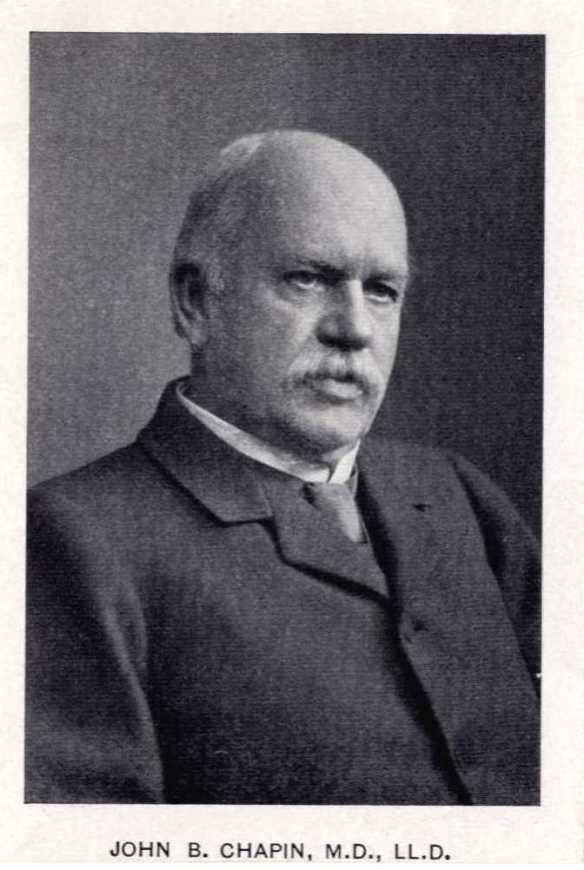
John B. Chapin, M.D., LL.D.

John B. Chapin, M.D., LL.D.

1874 THE PROCEEDINGS

“In connection with the meeting of the Social Science Association, a conference of the Public Boards of Charities in the United States, at which Hon. John V.L. Pruyn, of Albany, presided, was held yesterday morning. There were present Dr. Nathaniel Bishop, New-York; William P. Letchworth, Buffalo; Samuel F. Miller, Delaware County, N.Y., Dr. Charles S. Hoyt, Albany; F.B. Sanborn, General Secretary; Dr. John B. Chapin, of Willard Asylum; Mrs. W.P. Leynde, Wisconsin; Mr. H.H. Giles, Wisconsin, and Mrs. M.R. Pretlee, Connecticut. Dr. Chapin read the following paper on “The Duty of the States Toward Their Insane Poor.”

 THE DUTY OF THE STATES TOWARD THEIR INSANE POOR –
VIEWS OF DR. JOHN B. CHAPIN.

Underlying the initial legislation pertaining to the insane is the apprehension of danger to person and property which may arise from their irresponsible condition. If it is conceded that the safety of the community requires the personal liberty of the insane should be restrained, it follows that an obligation rests upon the State to direct, in its sovereign capacity, that the restraint should be properly and humanely exercised, and the custodial care combined with such remedial measures as will afford the greatest probability of recovery, which the individual in his condition cannot direct intelligently for his advantage. The state of helplessness and dependence which insanity at once produces, excites commiseration and pity, and prompts to sympathetic impulses, which move a community to give them expression in legislative acts for the relief of persons thus unfortunately afflicted. It may be a question whether the exercise of legislative functions to accomplish humanitarian purposes comes strictly within the objects of a Government, when these legislative acts require for their full execution the collection of taxes for objects which it is not alleged will add to the prosperity financially of the State, or enhance appreciably the value of the property of its citizens. Illustrating this view, it may be observed in this connection that taxes for purposes purely benevolent in their character are among the last to be levied and paid with reluctance, while those provided for internal improvements are more freely, and, sometimes, even liberally, voted.

Our whole duty to the insane, as well as to all the dependent classes, may not appear from the nature and objects of human Governments, but it does appear when we consider and accept those higher principles which it was the province of the Divine Master and Teacher to inculcate, the practical application of which distinguishes Christian from pagan civilization.

If, then, the safety of society imposes a necessity of exercising a salutary control over the personal liberty of the insane, then those reciprocal obligations which exist and bind together the members of a community also require that the State should make special provision for the medical treatment and supervision of its insane poor, whose helplessness, dependent condition, and hope of recovery append to our sympathy and higher sense of duty, without which aid they must inevitably seek that last refuge – the refuge which the jail and almshouse afford.

The existing institutions for the care of the insane, whether corporate or erected under State auspices, may be regarded as a recognition of these obligations. If we examine the history of the early efforts to establish each one of these institutions, we will find they had their origin in the hope of improving the condition of the insane poor; that these efforts have been materially aided by “memorials,” petitions,” and official reports, representing the neglected condition of the insane in jails and almshouses, and that the favorable action of Legislatures has seemed to be the direct result of these representations.

In view of the many official recognitions of the claims of the insane poor, what becomes the duty of the States to this class?

Recognizing the fact that the sentiment of a community conforms itself to its written statutes, it is of the first importance that the State, in its sovereign capacity, should clearly define the legal status of an insane dependent in accordance with the principles we have stated. It should not be discretionary with a public officer, before whom a case is presented for action, to send an insane person to an asylum, or to an almshouse and jail. With such formalities as may be deemed requisite, there should be no discretion in the case, but the public officer should in unmistakable language be required by the statute to order the transfer of the insane dependent to a public asylum established and managed upon accepted and approved principles. The insane poor should be removed as far as possible while there, in all that pertains to their daily surroundings and maintenance, from the various baneful influences of political changes, and the mercenary economy which sometimes afflicts localities.

The State institutions should be held strictly to their originally-designed purpose, so that the class for which they were, and are, intended, should have the fullest benefit of the establishment, and not be excluded by any policy of internal administration.

In the earlier history of this subject it was usual to officially designate institutions for the insane as asylums, which conveyed to the popular sense the idea of permanent residence during a state of disability. Latterly it has been the practice of our Legislatures to create establishments for the insane under the name and style of hospitals, which would seem to serve the purpose of a medical idea. No exception ought to be taken to a name did it not come to subserve in practice the purpose of the idea that such institutions were places of temporary abode for patients who were ultimately to find an asylum or refuge elsewhere, when pronounced incurable. Having a firm conviction that this practice has depreciated the value and importance of asylums, we believe the State establishments should be called, and actually become to the insane, asylums or homes, and the practice of discharging and removing incurables to the almshouses be abandoned.

While great additions have been made to our knowledge of the nature of insanity, its proper medical and moral management, we must ask ourselves the question whether the present state of medical science will warrant us in believing the percentage of recoveries will increase. We must regard actual results, and not take counsel of our medical enthusiasm and hopes, and confess that official reports do not justify the belief that this percentage is increasing. This statement should not be made without acknowledging the fidelity and earnestness with which so many members of the profession are laboring in this department of medical research.

Would that we could realize the results that have been hoped for! Much as we love our profession and its noble offices, it is of more importance that the people of the several States be impressed with the results which actual experience develops, and prepared to discharge their whole duty to the large class of incurable insane persons who will remain a life-long public charge, as well as to the recent and curable cases.

To recognize the fact, as we must, that a small portions of the insane poor are well cared for in the existing State asylums, while the mass are provided for in the almshouses, is a sad commentary upon the existing system. To propose that we must erect more hospitals, when we are yearly struggling for appropriations to complete those we have commenced, or to keep those we have erected in a proper state of repair, does not solve the problem, but postpones it.

What our duty may be to the insane poor may be easy to determine for ourselves. If we would witness some results of a scheme of relief it must be adapted to the appreciation of the popular mind, to the pecuniary ability of tax-payers, and have the merit of comprehensiveness.

In reference to the disposition of recent cases with whom the hope of restoration mainly lies, no question can occur. There should be ample asylum accommodation prepared for their prompt treatment. The only question that we think can possibly arise is the proper disposition of the chronic and incurable cases. As we have before stated, it is our opinion that the discharge of incurables from the asylums should cease. We believe it is entirely feasible to attaché to all the asylums supplemental departments in which the tranquil and manageable cases can be made more comfortable than under an almshouse organization and on plans acceptable to tax-payers.

We believe great concessions may be made in the plans, style of architecture, and cost of construction of asylums, so that additional structures will be entered upon with less reluctance. It is not necessary that these structures should be built to endure for ages. It is quite possible and probable that the changes of a single generation may cause a departure from present plans to be highly desirable.

A word is necessary on the subject of the maintenance of the insane, and here, again, we are confronted with the financial aspect of the question. In those States where the expense of maintenance of the insane poor is a direct charge upon the counties or towns, there is a manifest reluctance, except in extreme cases, to transfer them to the State asylums, where the views as to their requirements differ, and the expense is greater than in the county poor-houses. We do not believe the differences which prevail on this point can be reconciled except by positive legislation.

In conclusion, we deem it of the highest importance that entire harmony should exist and be cultivated between the Boards of Public Charities of the several States and the medical profession as to the best policy to be pursued.

On motion, Mr. Sanborn, of Massachusetts; Mr. Giles, of Wisconsin, and Mr. Letchworth, of New-York, were appointed a committee to report a plan for unanimity of action as regards the treatment of the insane.”
SOURCE: Reprinted from The New York Times. Published: May 21, 1874, Copyright @ The New York Times. 

 1880 DISSCUSSING QUESTIONS OF INSANITY.

“PHILADELPHIA, May 27. – The members of the association of Medical Superintendents of American Institutions for the Insane reconvened this morning, in the third day’s session, with Clement A. Walker, Superintendent of the Insane Hospital of Boston, presiding. Previous to the convention being called to order, the Chairman presented to the members of the association Miss Dix, of Trenton, a lady well and favorably known for her extensive philanthropic disposition, having been instrumental in the establishment of a large number of institutions for the insane in America and Europe. Invitations to visit several public institutions were received. Dr. John B. Chapin, of Willard, N.Y., read a paper on “Experts and Expert Testimony in Cases of Insanity,” and the subject was discussed by Dr. Kempster, or Northern Wisconsin; MacDonald, of New-York City, and other members of the association. Dr. R. Gundry, Superintendent of the Maryland Hospital at Catonsville, Md., read a paper on “The Insanity of Critical or Transitional Periods of Life.” In the afternoon the members visited Girard College.”
SOURCE: Reprinted from The New York Times. Published: May 28, 1880, Copyright @ The New York Times.

1906-1907 Elopements, Suicides & Accidents at New York State Hospitals

“The Commission is pleased to report an unusually small number of untoward occurrences at the State hospitals during the year. At the Utica State Hospital a somewhat unusual case was that of a woman patient who, escaping from the institution, found means to reach Albany where she obtained employment as a clerk in a department store. Here her peculiarities were noticed after a few days and her services were discontinued. She also received notice from the mistress of the boarding-house in which she had found domicile that she must look for quarters elsewhere. The excitement which followed these events brought on an attack of considerable violence necessitating her commitment to a local institution for safe keeping. When she became quieter efforts were made to send her to the home of her husband but she declined to consider this, alleging that he was, in the first instance, responsible for her unjustifiable commitment to a hospital for the insane. Through the good offices of a local attorney she consented to return to the Utica State Hospital, upon condition that she would be granted a parole within a short time. As she was able to exhibit considerable self-control she was discharged upon the hospital books within a short time afterward and has not, up to the close of is report, required recommitment. A woman patient at this hospital was paroled by the authorities for the purpose of spending Thanksgiving with her husband at home. Although she had not at any time previously exhibited suicidal tendencies she seized the opportunity thus afforded her to swallow a powerful drug, and although prompt measures were applied she died in a short time.

At the Willard State Hospital a patient secreted binding twine about her clothing and seizing a favorable opportunity hanged herself from the door of a room. At the same institution a male patient died from asphyxiation due to the lodgment of meat in the larynx.

At the Hudson River State Hospital a male patient left the grounds without permission, and was afterward found dead on the railway tracks near the hospital pumping station, his skull having been fractured evidently by contact with the locomotive or cars.

At the Middletown State Hospital a male patient committed suicide by drowning. It appears that he carried a pail of water to his room and held his head far enough in the pail to become asphyxiated. At the same hospital a male patient left the institution without permission or notice and remained for some months about the neighboring counties enlivening the situation at different times by transmitting to the authorities of the institution souvenir postal cards. At the same institution a male patient committed suicide by wading out into a small ice pond in the rear of the institution and lying down in the shallow water until this reached over his head.

At the Rochester State Hospital a woman patient committed suicide by suspension, using a bed sheet, one end of which was attached to the window guard. At the same institution a male patient committed suicide by drowning subsequent to an unsuccessful effort to persuade his wife to remove him from the institution.

At the Kings Park State Hospital a male patient met his death under somewhat unusual circumstances, and the hospital authorities called upon the local coroner to make the usual investigation. The patient’s relatives, not being satisfied with his report, requested the Commissioners to make a special inquiry which was done. Physicians and attendants were placed under oath, and all testimony that could throw light upon the patient’s death was adduced, but nothing was found to contradict the findings of the coroner.

At the Long Island State Hospital a woman patient, while on parole and in the charge of her friends, was accidentally killed by a trolley car.

At the Manhattan State Hospital a woman patient after leaving a dining-room started straight for the river. A nurse went in immediate pursuit and a hospital watchman also tried to intercept the patient, but she outstripped her pursuers and plunged into the river. No trace of her body was afterward discovered. At this same institution a male patient becoming very noisy in a small dormitory to which he had been assigned was attacked by a fellow patient whose rest he had disturbed and struck on the head with a small serving table. The patient died in a few days as a result of the injury. At the same institution a woman patient secured a poisonous drug, died, and upon investigation by the coroner evidences of mercurial poisoning were found. At this institution a male patient was found hanging in the closet in which are usually stored the brooms, polishers, etc., of the ward. The patient had placed a broom handle across the top of two shelves, and with the girdle of his dressing gown about his neck had produced asphyxiation. At this institution a male patient succeeded in throwing himself into the river. His body was taken to the Fordham Hospital, and afterward identified by the institution clothing. Another male patient committed suicide in the same way. At the same institution a woman patient eluded observation while patients were preparing for bed. The premises of the institution were searched throughout the night and the following day, but no traces of her was found. It was supposed she was drowned while attempting to swim the river. A Russian patient, while walking about the exercising court with other patients, eluded observation and rushing to the point of the grounds opposite Hell Gate plunged into the river, and after swimming a few strokes was carried away by the strong tide and soon disappeared. A second patient who had observed the first one escape attempted to throw himself into the river at the same time, but was prevented by the nurse who had started out to overtake the Russian patient.

Owing to the situation of the Manhattan State Hospital on Ward’s Island, it is at all times necessary to detail several attendants to specially guard the river banks and an attendant is also detailed to patrol the river near the shore in a row boat. Almost daily attempts are made to break through this line, but the escapes are relatively few in number. Owing to the proximity of this hospital to the city of New York, and the fact that all occurrences of an unusual character in an institution for the insane are seized upon eagerly by metropolitan dailies, occurrences of this kind are frequently exaggerated as are also injuries received by patients though these may not be actually serious. Charges were made against the Manhattan State Hospital in connection with the somewhat sudden death of a patient named Rodesky. Allegations of cruelty and maltreatment were made by the relatives of this patient, and the managers and the coroner made an investigation of the circumstances attending his death. It appears that he was a bed-ridden paretic and a few days prior to his death, on the thirtieth of July, was found to be suffering from a fracture of the sternum and three fractured ribs. The coroner reported the cause of death as septic poisoning from several large abscesses owing to the patient’s general septic condition. The managers at the close of their special inquiry reported that the patient was not handled in any rough manner.

At the Central Islip State Hospital a male patient who had been given parole of the grounds and was in the habit of taking long walks about the premises was found hanging by the neck in the woods some three miles distant.

At the Gowanda State Hospital two women patients committed suicide by hanging.”

SOURCE: Reprinted from State Commission in Lunacy, Nineteenth Annual Report, October 1, 1906 – September 30, 1907, Albany: J.B. Lyon Company, State Printers, 1908, Pages 39-42.  http://books.google.com/

1917 Willard Maps

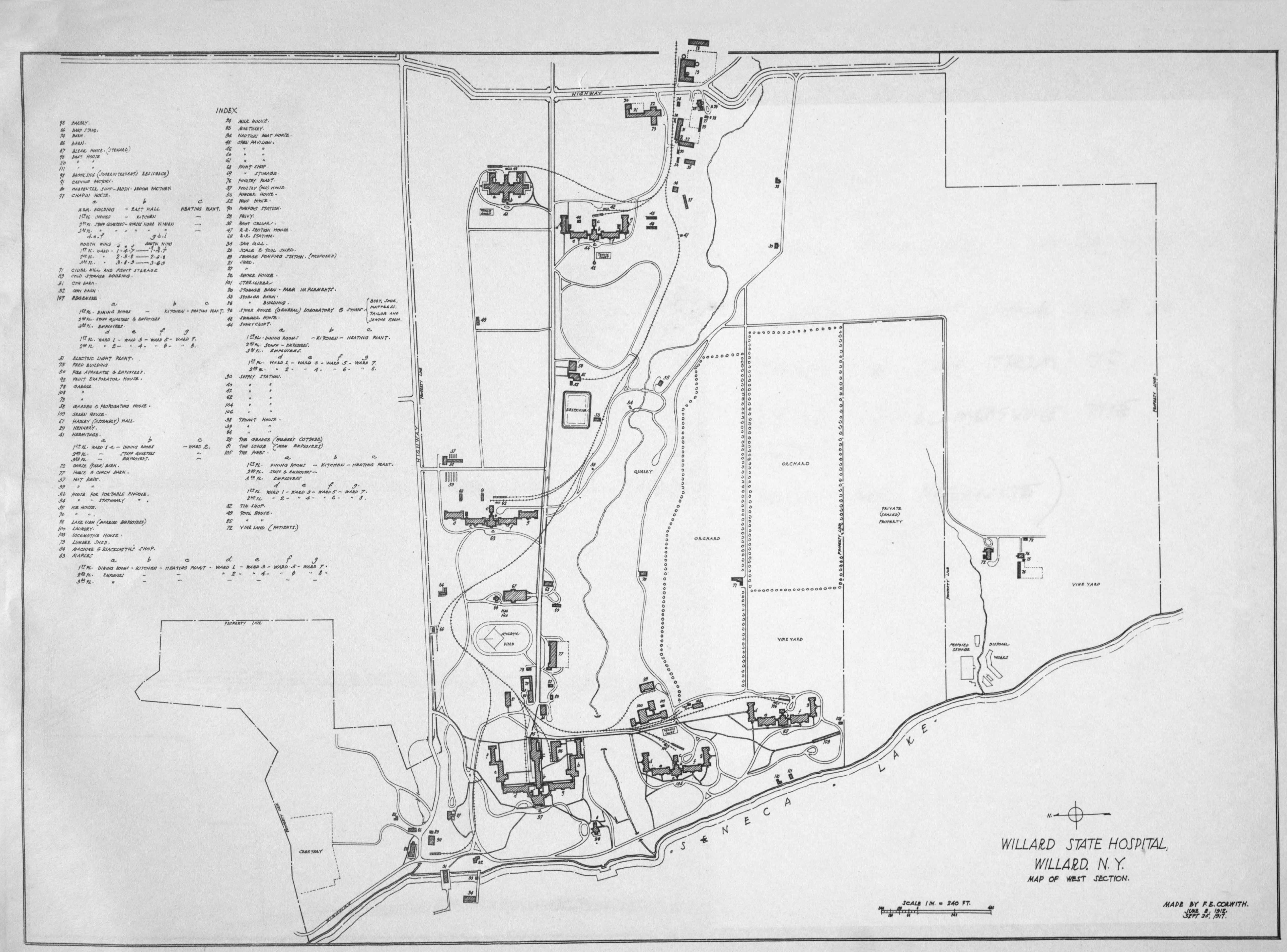
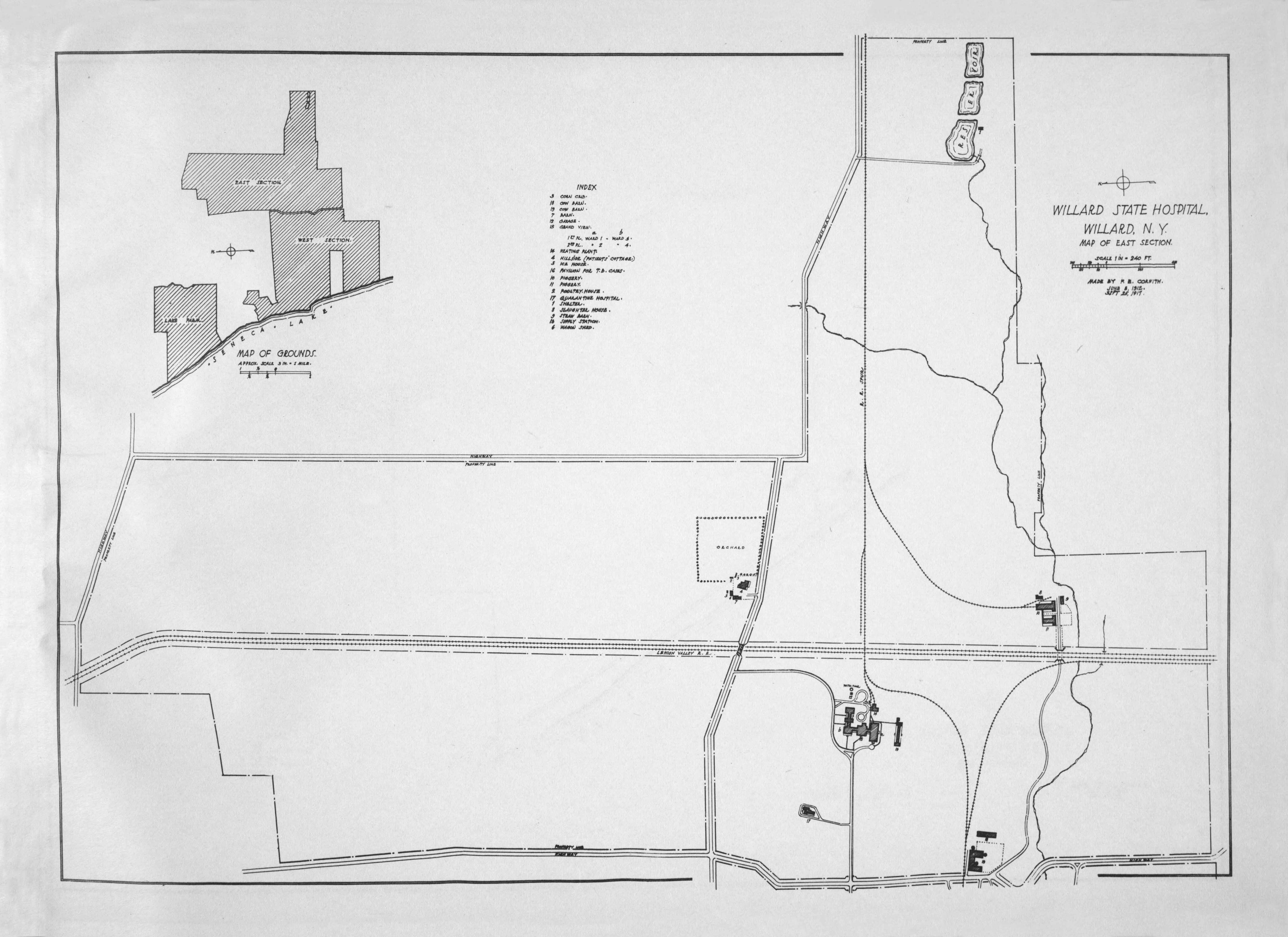
Many months ago, Mr. Craig Williams, Curator of History at the New York State Museum at Albany, sent me copies of two Willard State Hospital Maps from 1917: Willard West and East. I finally had a chance to work on them. As you can see, the complex was quite large, about 1,000 acres. The Branch (Grand View – Old State Agricultural College) is on the Willard East Map located at the bottom of the page. Click on the maps to enlarge. Willard Map Index

Willard Map 1917

Willard Map West 1917

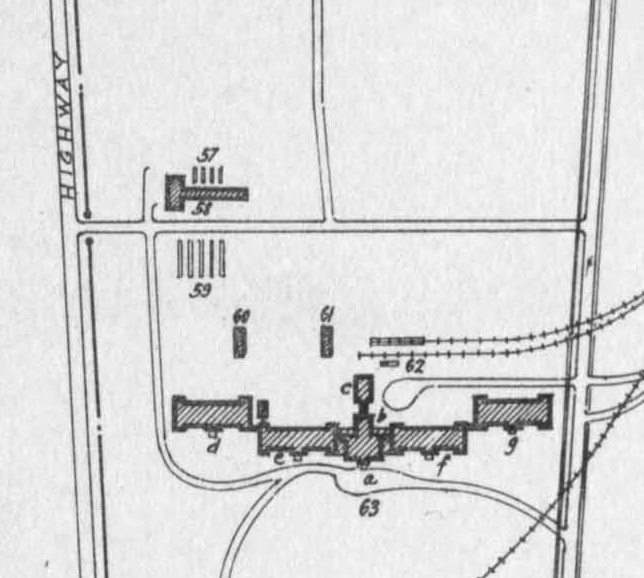
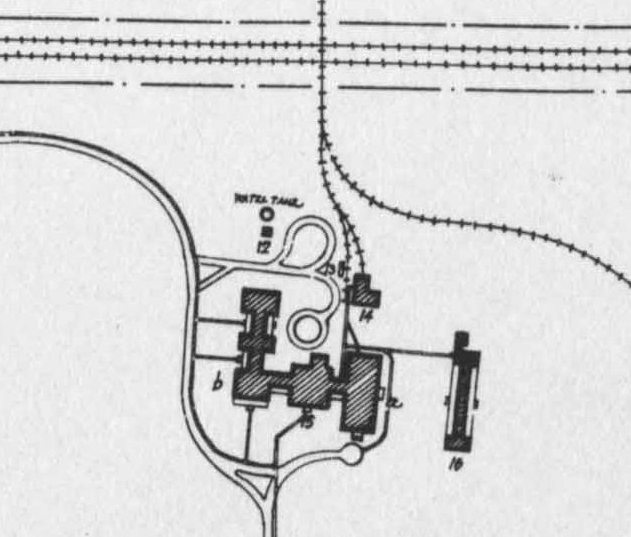
I cropped the map so that you would be able to see the layout of each building. Chapin House is the Main Building. As far as I can tell, Willard was NOT a Kirkbride Building. The Maples was one of the cottages (detached buildings or blocks), that was built differently than the other three cottages.

97 Chapin House (Main Building)

97 Chapin House (Main Building)

63 The Maples (DB1)

63 The Maples (DB1)

105 The Pines (DB2)

105 The Pines (DB2)

44 Sunnycroft (DB3)

44 Sunnycroft (DB3)

107 Edgemere (DB4)

107 Edgemere (DB4)

Willard Map East 1917

Willard Map East 1917

Willard Map East - Grand View (The Branch)

15 Grand View (The Branch)

My Story by L.S. Stuhler – July 23, 2012

Featured

I include here my story about trying to obtain my great-grandmother’s medical records and photographs from the Willard State Hospital, along with asking for the release to the public of former patient names; dates of birth and death; and location of graves, in order that these forgotten people, of which there are thousands, may be honored and remembered with dignity. It all began on February 24, 2001, when I found my great-grandmother’s obituary: According to the “PennYan Democrat” newspaper dated August 17, 1928: “PUTNAM, At the State Hospital in Willard, Monday, August 13, 1928, Mrs. Margaret Putnam, aged 76 years. She is survived by one son, Jarvis Putnam, of PennYan. The funeral was held from the Thayer Funeral Home Wednesday afternoon, Rev. W.A. Hendricks officiating. Burial in Lake View cemetery.” 

It took a long time for me to figure out where I should be looking in order to obtain information about my great-grandmother. In 2001, I was unable to find anything on the internet pertaining to this issue which is the main reason I created this blog (July 10, 2011) and wrote the book The Inmates of Willard 1870 to 1900, A Genealogy Resource (December 17, 2011). In 2007, I came across an article about a new book written by Darby Penney, MLS, and Peter Stastney, M.D., entitled The Lives They Left Behind Suitcases From A State Hospital Attic. Wondering if my great-grandmother’s suitcase was among the 400 discovered in an attic of the Willard State Hospital, I contacted Ms. Penney. Unfortunately, it was not among the surviving suitcases. Ms. Penney’s book revealed the practice of burying “mental patients” in anonymous graves. I must admit that I had never heard of this practice before and thought it was extremely cruel. What amazed me most was that no one (that I knew of) had ever tried to rectify this sad, dehumanizing situation. What needs to be acknowledged is none of these well documented facts about the thousands of people buried in anonymous graves at Willard, and all former NYS Hospitals and Custodial Institutions, would ever have come to light without the tireless efforts of Ms. Penney, Dr. Stastney, and Mr. Craig Williams, Curator of History at the New York State Museum at Albany. I also need to thank Laurel Lemke, from the Grave Concerns Association, for sending me the law that she helped to pass in the State of Washington in 2004. Without her help in emailing me the bill, I never would have gotten the attention of Kate Munzinger, Senator Joseph Robach’s Chief of Staff. I met with Ms. Munzinger on August 22, 2011. Senator Robach introduced the bill to the New York State Senate in March 2012.

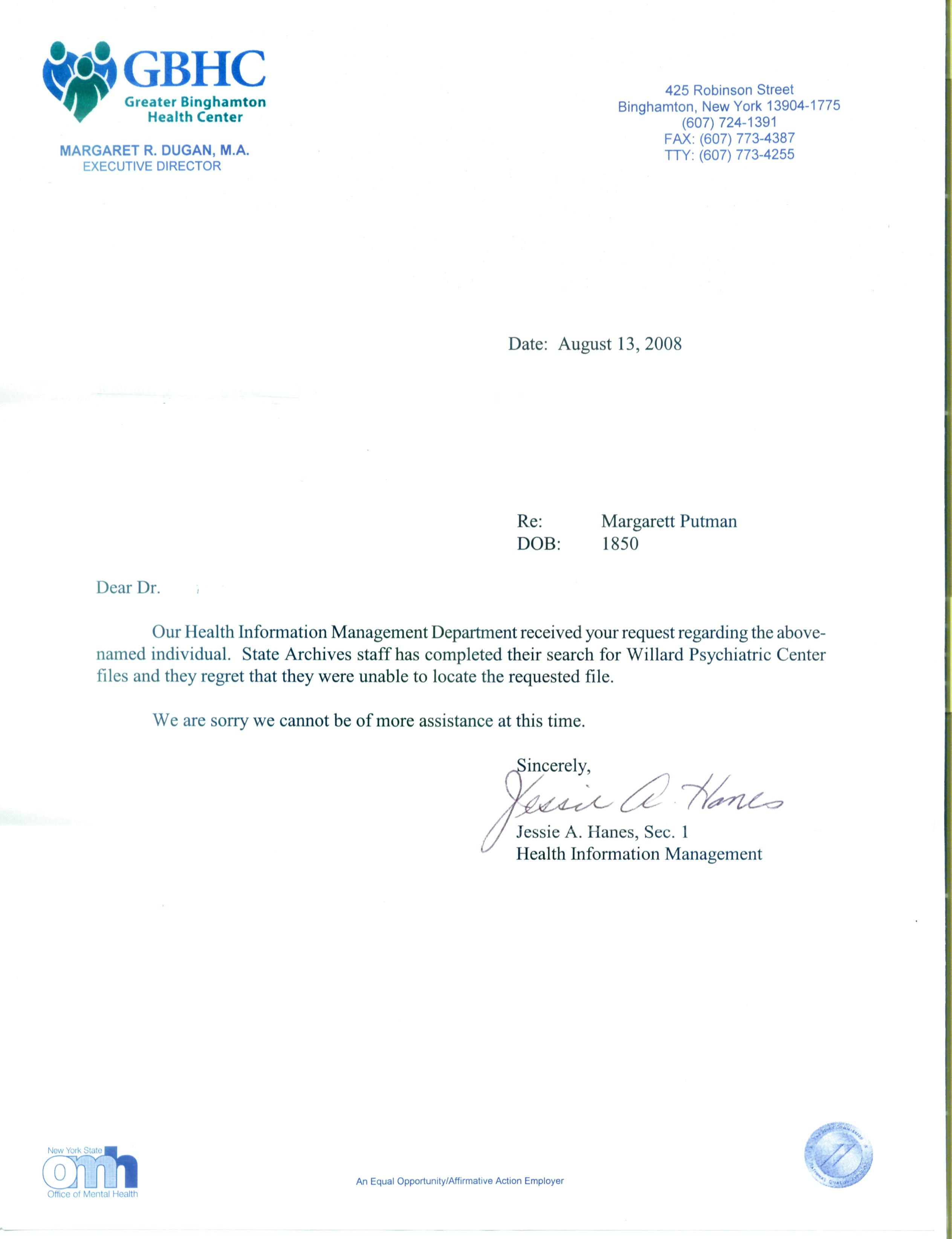
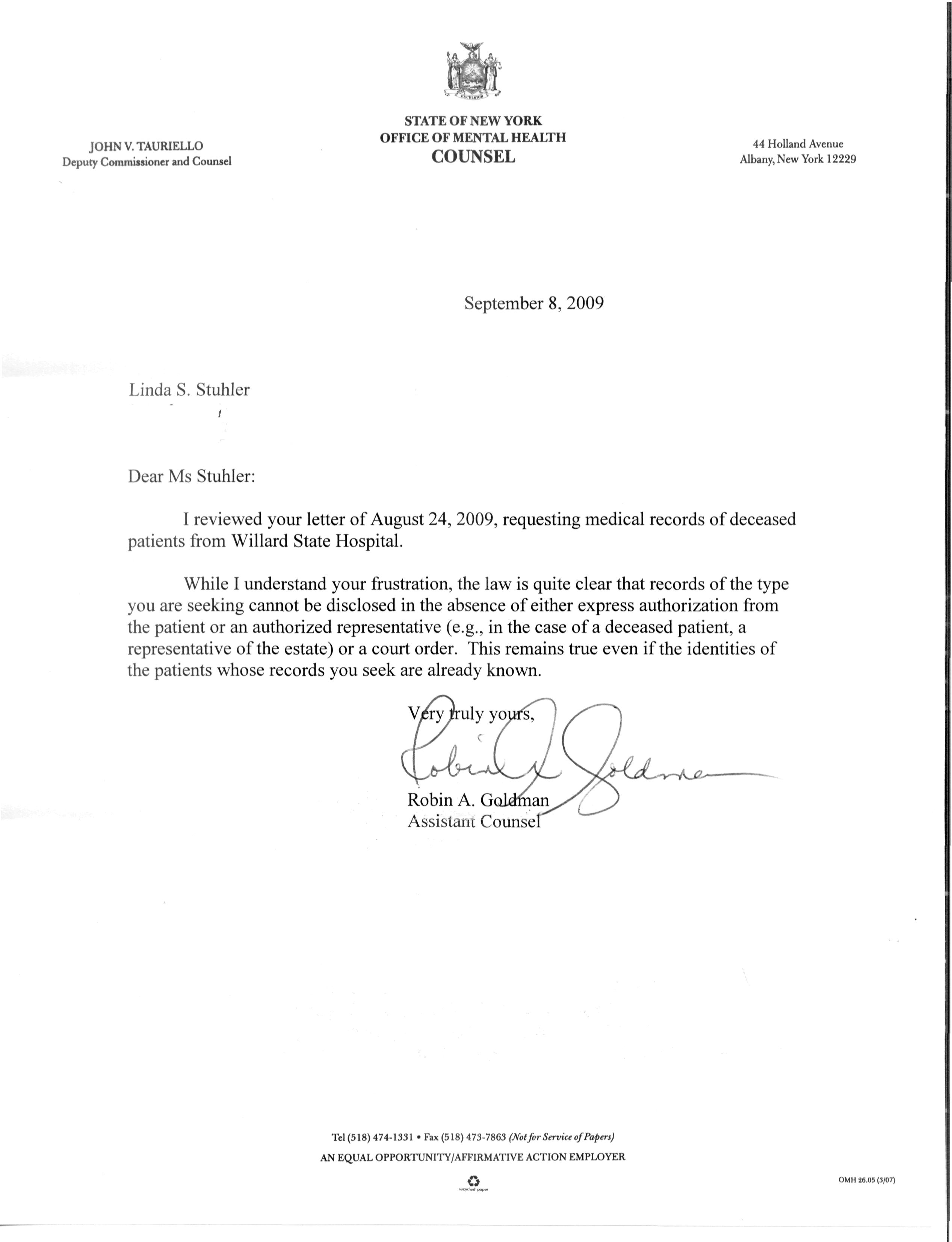
The following response letters, beginning in early 2008, are from everyone that I have contacted over the years. I have not included emails. Unless a modification is made to the present HIPAA Law and New York State Mental Hygiene Laws (See New HIPAA Update and S2514-2013), I and so many others like me, who want to know why our ancestor was committed to a state hospital, will never know the answer. My first response letter is dated April 16, 2008, in response to the original paperwork that my physician and I had sent in early September of 2007 (seven month wait). On August 13, 2008, I was denied a copy of my great-grandmother’s medical records and photographs from the Greater Binghamton Health Center. This three sentence response letter is the explanation given to me after waiting four months, taking the time and effort to speak with them on the phone, obtaining and filling out their required paper work with the help of my physician, and sending in the forms.

1- GBHC 04.16.2008

1- GBHC 04.16.2008

2 - GBHC 08.13.2008

2 – GBHC 08.13.2008

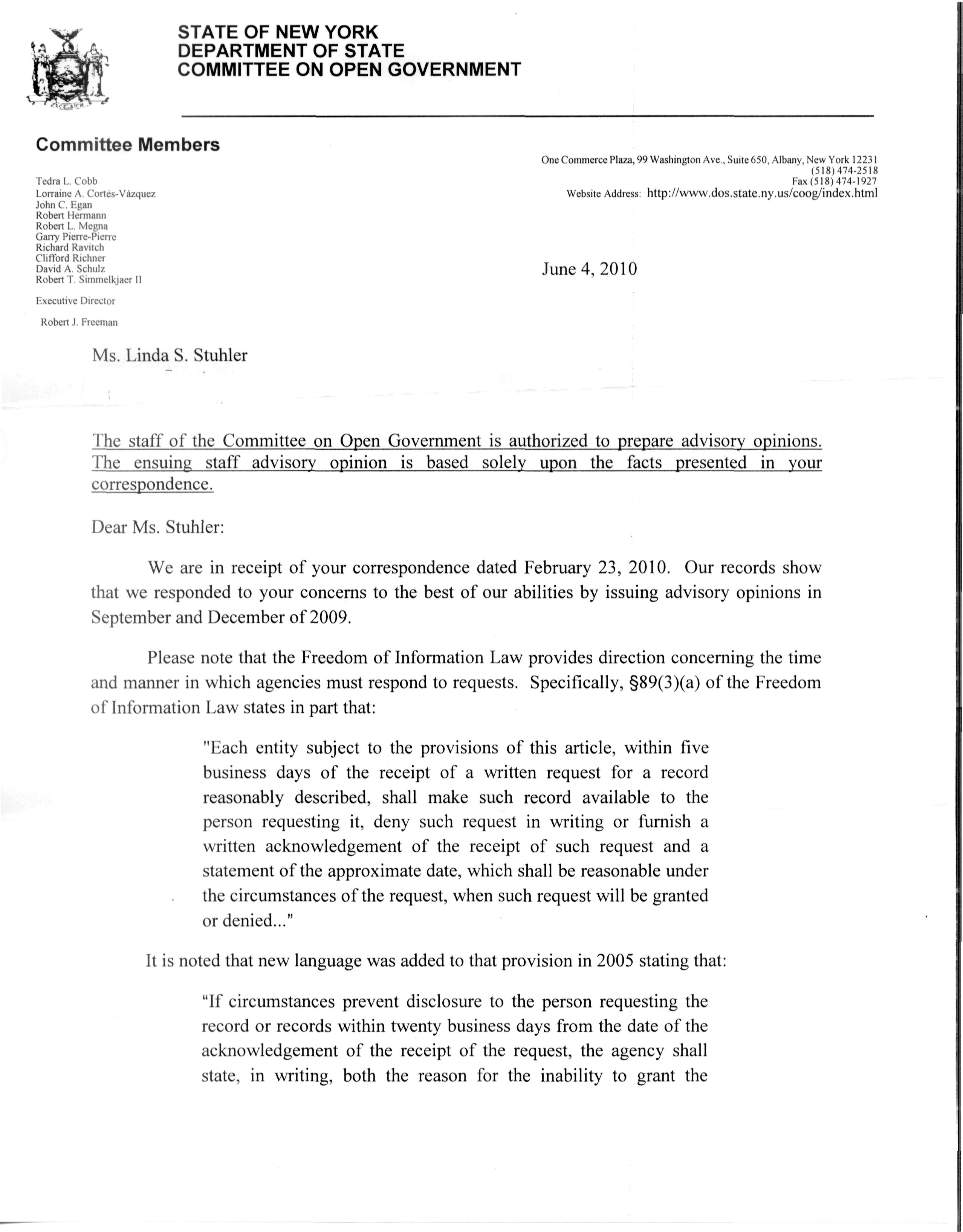
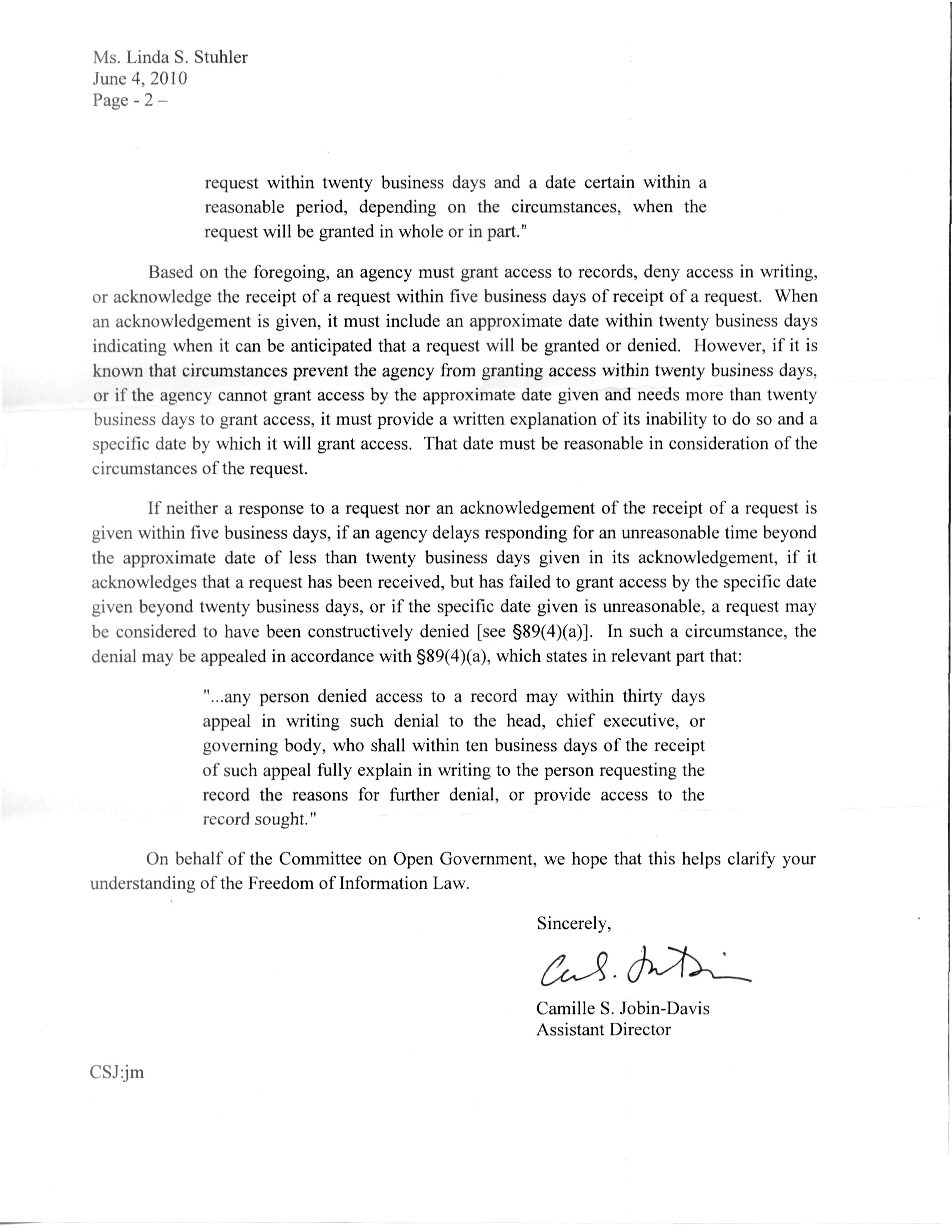
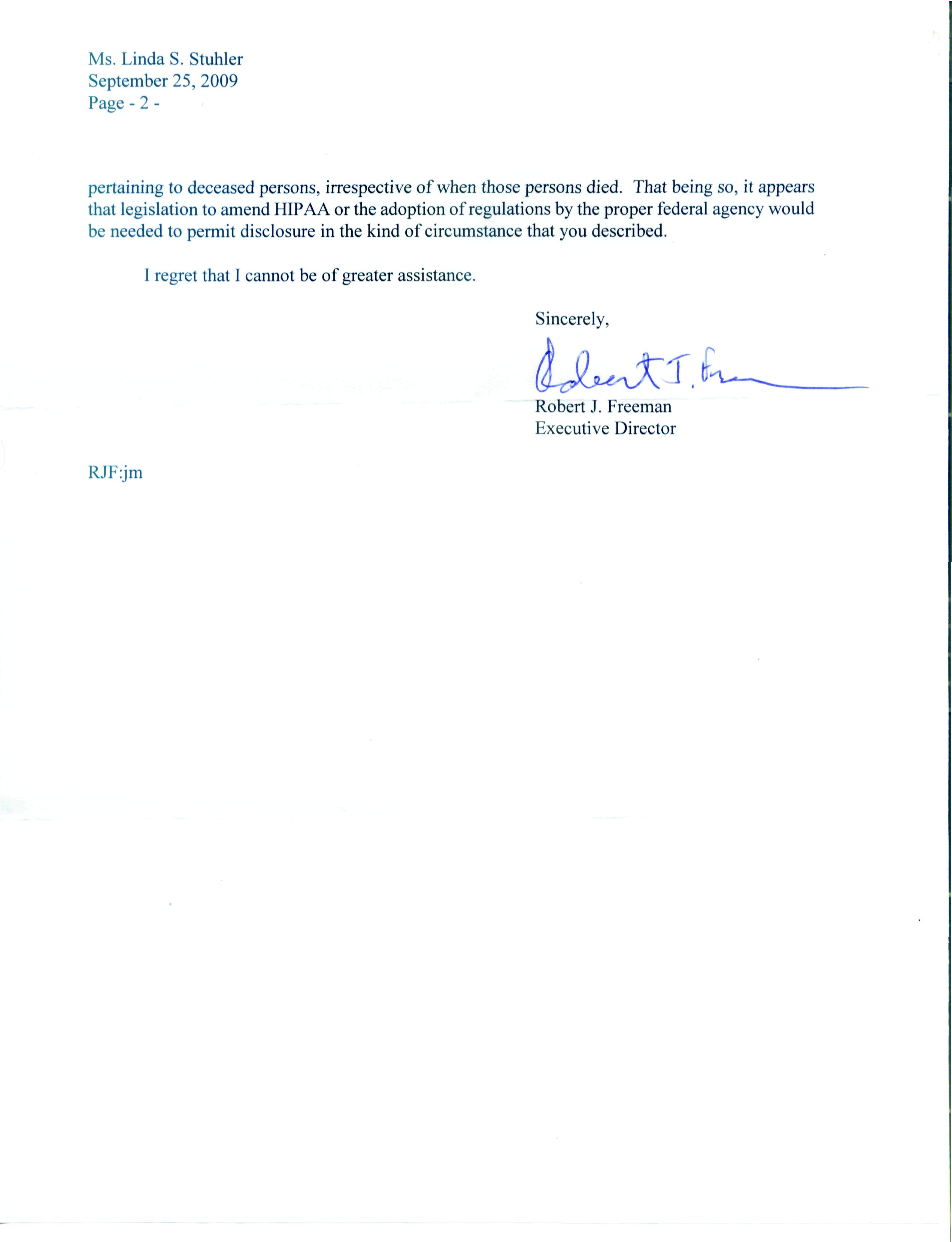
Besides writing a letter to former New York State Governor Patterson and present Governor Cuomo, both U.S. Senators from New York: Schumer and Gillibrand, State Senators, Congressmen, The Department of Correctional Services, The Commission on Quality of Care and Advocacy for Persons with Disabilities, The Office of Mental Health Counsel, and the State of New York Department of State Committee on Open Government (FOIL), I also wrote a letter to the doctor in charge of the Office of Mental Health Institutional Review Board asking permission to view, record, and publish the burial ledgers – names; dates of birth and death; and location of graves) located and stored at the NYS Archives. After waiting seven months for a response, I was told in an official letter, that my proposed study was not approved due to concerns about violating patient confidentiality. I was also told that I could take the New York State Office of Mental Health to court in order to get the names of former patients and the medical records of my great-grandmother, but seriously, who has the time and the money to go through all of that? Privacy ends at death but apparently patient confidentiality lasts forever.

I went through proper channels to obtain Maggie’s medical records and photographs. I filled out the paperwork, had my doctor and a witness sign the paperwork, and my doctor sent it in. I waited four months for a response and finally my doctor received a letter. I asked for the medical records and any photographs of my great-grandmother. When I received the response from the Greater Binghamton Health Center in August 2008, it stated the staff was unable to locate the requested file. Had I received my great-grandmother’s medical records, I would have been satisfied. Besides being genuinely interested in learning more about Willard, I created this blog for family genealogists like me, frustrated trying to find out if and when their ancestor was a Willard inmate, receiving the runaround obtaining their ancestor’s medical records and photos, and determining whether their ancestor is buried in the Willard Cemetery. The final answer came from the Commissioner of the NYS Office of Mental Health in responding to my inquiry by e-mail on October 25, 2010, which basically stated that publicly identifying former patients may be offensive to some families because of the stigma and repercussions that may follow, for example, in some small towns. I must say that I took offense to his statement because I live in a small town. What exactly was he trying to imply? It appears that we have not moved any further in our tolerance or understanding of people with problems and of people who live in small towns. I must say that my favorite letter is from the Commissioner, dated June 3, 2011, in which he reminds me “that the penalties for violations are very stiff – civil penalties under federal law can carry up to $10,000 per violation.”

Willard’s inmates who in life were incarcerated, forgotten, warehoused, and controlled by the state are once again controlled and intentionally forgotten in death by New York State, the New York State Office of Mental Health, or both. Perhaps they are interpreting the scope of the HIPAA Law incorrectly. The only logical assumption is the protection provided by these laws is not for long dead souls since U.S. Federal Censuses already reveal many of their names; it is for the protection of the descendants.

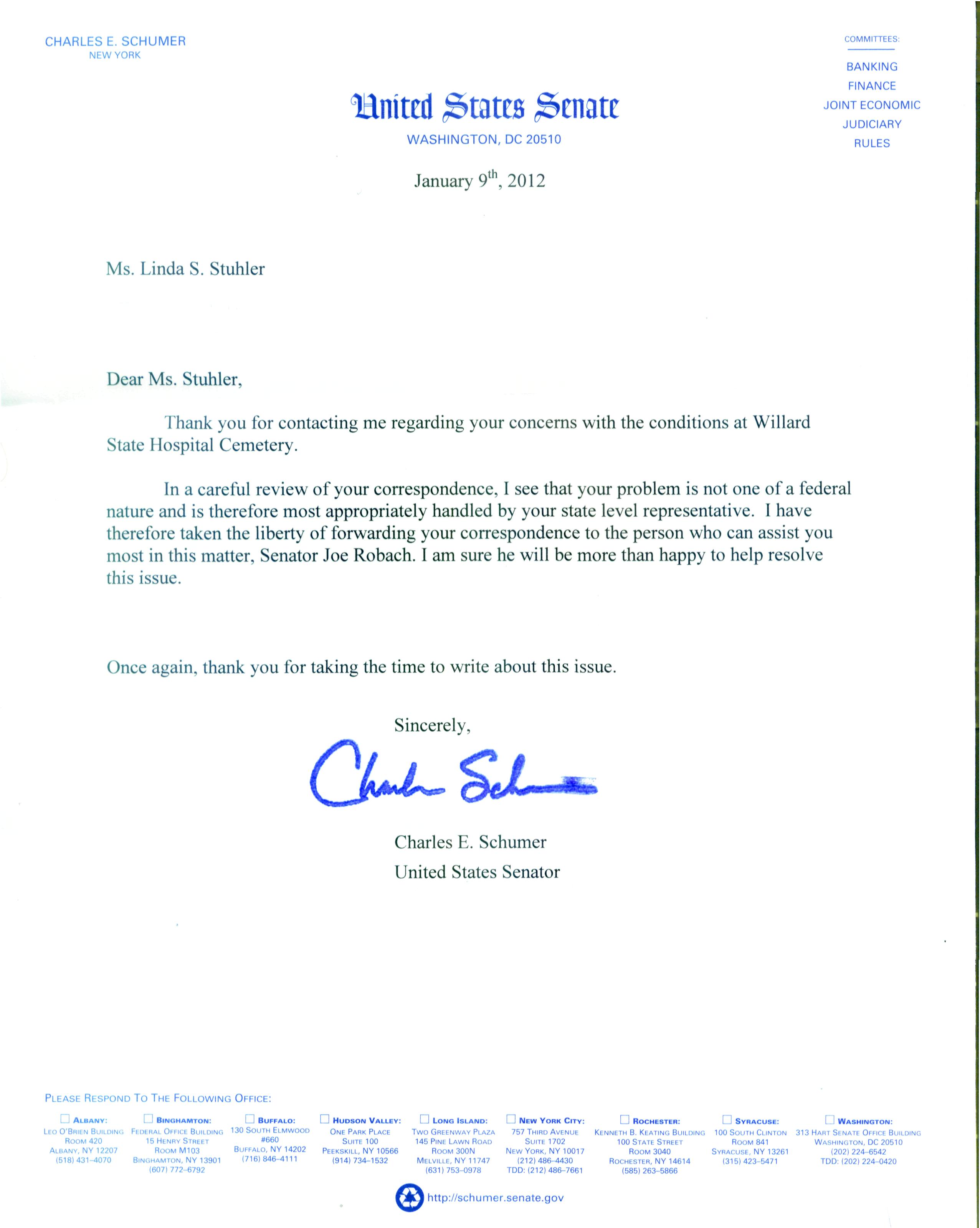
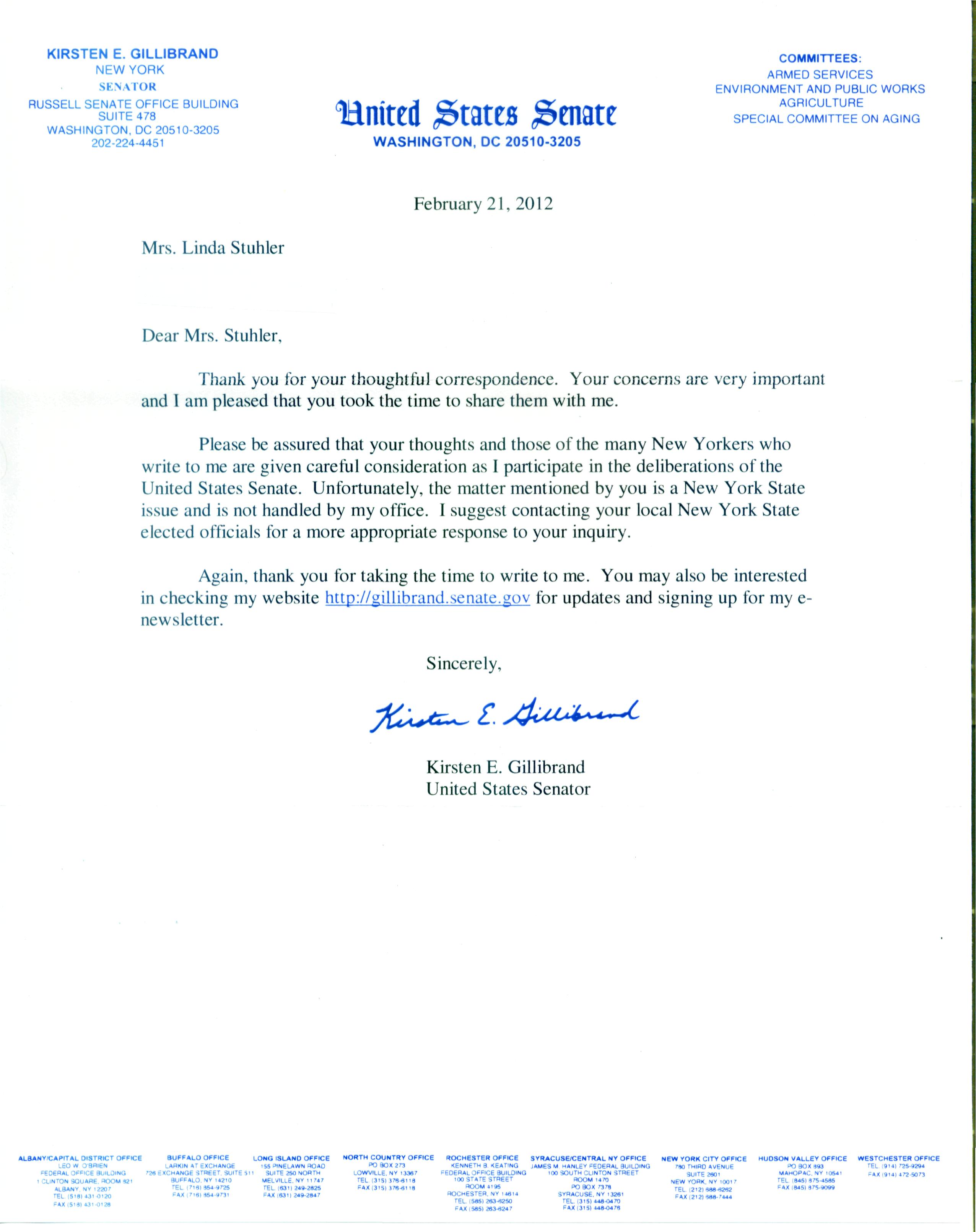
The responses from the Senators are interesting because they state that there is nothing they can do about the situation at Willard. They mention nothing about modifying the HIPAA Law which was one of the questions that I asked them to respond to. My understanding is that they are the only ones who can change or modify this federal law in order that descendants or anyone for that matter, would be allowed to have a copy of these historical medical records. When you’re dead, you’re dead. Who cares if someone looks at 80 year old medical records? The following letters were received by me from Senator Charles E. Schumer, dated January 9, 2012; and from Senator Kirsten E. Gillibrand, dated February 21, 2012. Perhaps this whole ridiculous situation of trying to uncover the identities and opening medical records of people who have been dead for one hundred years lies with the unique interpretation of the federal HIPAA Law by each individual state office of mental health.

Response Letter Senator Schumer 1.9.2012

Response Letter Senator Schumer 1.9.2012

Response Letter Senator Gillibrand 2.21.2012

Response Letter Senator Gillibrand 2.21.2012

14 - OMH 06.03.2011

14 – OMH 06.03.2011

13 - GBHC 09.07.2010

13 – GBHC 09.07.2010

11 - FOIL 06.04.2010-1

11 – FOIL 06.04.2010-1

12 - FOIL 06.04.2010-2

12 – FOIL 06.04.2010-2

10 - Correctional Services 01.15.2010

10 – Correctional Services 01.15.2010

7 - FOIL 12.10.2009-1

7 – FOIL 12.10.2009-1

8 - FOIL 12.10.2009-2

8 – FOIL 12.10.2009-2

9 - FOIL 12.10.2009-3

9 – FOIL 12.10.2009-3

5 - FOIL 09.25.2009-1

5 – FOIL 09.25.2009-1

6 - FOIL 09.25.2009-2

6 – FOIL 09.25.2009-2

4 - OMH Counsel 09.08.2009

4 – OMH Counsel 09.08.2009

3 - Quality Care Advocacy 09.01.2009

3 – Quality Care Advocacy 09.01.2009

1892 The Curious Case of Henry B. LaRue

The following three articles tell the fascinating story of how a wealthy businessman, Mr. Henry B. LaRue, was declared insane, made a pauper charge of Steuben County, and was locked up at Willard State Hospital in 1891 for fifty-two days. His tale is so unbelievable that it would make a great Hollywood movie! It might also explain why The Insanity Law of 1896 (New York State) was created. Although I was able to find the obituary for Miss Jennie O’Neil Potter, I was unable to find out more information about Mr. LaRue and the outcome of the trial. These articles give a wonderful insight as to how easy it was to have someone committed to an insane asylum during the nineteenth century.

1892. Miss Potter A Defendant,
Sued For Damages By An Eccentric Hornellsville Citizen.

Miss Jennie O’Neil Potter, the reader, is a defendant in a suit for damages brought by Henry B. LaRue of Hornellsville. She has not yet been served with a summons, and the exact nature of the suit or the amount of damages claimed cannot be learned. A year ago Henry B. LaRue was a prosperous railroad contractor and inventor, and enjoyed an income of about $6,000. He was often in New-York in the interest of his railroad inventions. Last Spring he attended an elocutionary entertainment given by Miss Potter. He was very much pleased with the entertainment, and became acquainted with the young reader. He invited Miss Potter to visit his wife in Hornellsville, and made arrangements to have her give an entertainment in the Hornellsville Opera House. The invitation was accepted, and Miss Potter went to the LaRue home.

LaRue proposed to become the reader’s manager, and arranged a date for her appearance in the Elmira Opera House. He made the date and commenced advertising Miss Potter without her knowledge or consent. He bought $500 worth of bouquets and hired four lackeys in livery to travel about the city and distribute the bouquets and advertisements of the entertainment. These extravagant preparations and other unusual actions attracted the attention of the authorities and newspapers, and a stop was put to further preparations. Mr. LaRue was induced to return to his home.

Mr. LaRue’s actions in Hornellsville were very eccentric, and he made the arrangements for Miss Potter’s appearance there in such a magnificent manner that every one thought he must be crazy. The night before the Hornellsville entertainment Mr. LaRue went to Elmira and demanded the keys of the Opera House at 3 o’clock in the morning. When they were refused he created a disturbance and was arrested. A few days afterward he was examined by three physicians and declared insane, and was taken to an asylum. Miss Potter gave the Hornellsville entertainment and then returned to New-York. In a few months LaRue was liberated from the asylum and returned home. He has now commenced suit for damages against the editors of several Elmira papers, many Elmira and Hornellsville citizens, the Superintendent of the asylum, and Miss Potter. Miss Potter is quietly evading a summons, and as the summons has not been served she is unwilling to say anything about the suit.” 
SOURCE: Reprinted from The New York Times. Published March 7, 1892. Copyright @ The New York Times.

Thursday, March 10, 1892. Mr. LaRue Wants Justice. He Also Wants Damages Claimed To Be $375,000 For False Imprisonment And Libelous Articles Published.

Mr. Henry B. LaRue of Hornellsville who, about a year ago was arrested at Elmira and locked up as a lunatic, and then committed to the State asylum at Willard, where he remained for fifty-two days before he was released began suits for damages against his abductors for $250,000, and against the Elmira Sunday “Telegram” and Elmira “Gazette” for commenting upon the facts for $125,000.

The Rochester “Democrat and Chronicle” says that: Since his release from the asylum Mr. LaRue has been carefully investigating the motives which led to his arrest. He charges that an attempt was made at Hornellsville to procure a decision that he was insane for the purpose of getting the option for the stock of the Morden Troy and Crossing Company out of his hands, and breaking up the deal at that time. He claims that three reputable physicians called upon him and refused to certify to his insanity alleging he was sane. The arrest at Elmira he ascribes to jealously on the part of one of the defendants at the success he was likely to achieve in the managing the entertainments of Miss Potter and that the arrest was timed so as to break up the two readings arranged for that city, and was instigated by telegrams from Hornellsville, that one of the defendants might himself manage the elocutionist. One of the grounds upon which the two Elmira physicians who saw him a few minutes at the jail at a late hour after his arrest, declared him insane, was that he had adopted a peculiar method of advertising the entertainments to be given by the elocutionist. One of these was the sending of cards of invitation to the best families of Elmira accompanied by a small bouquet. Mr. LaRue explains this by saying that the bouquets were small affairs costing only 5 cents each. Mr. LaRue has retained the services of J. and Q. VanVorhis of this city in all the cases and ex-congressman VanVorhis today stated to a Democrat and Chronicle reporter the facts fully sustained Mr. LaRue’s contention as to his entire sanity. It is nowhere stated that his relations with Miss Potter were otherwise than of a purely business character. While at Hornellsville the elocutionist was a guest at Mrs. LaRue’s. LaRue is a man of strikingly handsome presence and his friends scout the idea of his personal oddities which are said to be no more marked than those of any other business man, being construed into insanity. The summonses in the suits were severed some days ago, but this is the first time the contents of the complaints have been made public.” 
SOURCE: http://www.rootsweb.ancestry.com/~nysteube/this_that/pg2.html, [Rochester Democrat and Chronicle] copied by the Allegany Co. Reporter, Steuben County items mentioned in the Allegany County Reporter, Wellsville, Allegany County, NY, Abstracted by Judy Allen Cwiklinski – Steuben County, NY GenWeb coordinator.

1893. LaRue Wants Satisfaction. 
He Was Arrested As Insane And Made A Pauper Charge.

Rochester, N.Y., April 19, 1893. – At the special term of the Supreme Court to be held at Bath, Steuben County, N.Y., on Monday, April 24, will be called the first of a number of suits brought by Henry B. LaRue against certain newspapers and individuals for libel, abduction, and false imprisonment. The prominence of all the parties concerned, the highly-sensational character of the allegations in the plaintiff’s complaint, and the large damages which he claims, aggregating nearly $500,000, bid fair to make these cases celebrated.

The preliminaries of what is likely to prove a long and expensive litigation have all been arranged, and from the documents in the cases the following allegations are taken: Henry B. LaRue is a resident of Hornellsville, N.Y., and is a wealthy and highly-respected citizen, and as a railway contractor has been identified with many large enterprises. He is a heavy operator in railway switches and frogs, and his business takes him to all parts of the country. Mr. LaRue has a pleasant home and a charming family of three, a wife and two sons.

Among the temporary residents of Hornellsville in the Spring of 1891 was Mrs. Jennie O’Neil Potter, a popular and successful elocutionist. She was, in fact, a guest of Mrs. LaRue, and, having some leisure time on his hands, Mr. LaRue undertook to get up a series of readings for the lady, to be given in the Elmira Opera House on the evenings of April 29 and 30, 1891. He went to Elmira and engaged the Opera House and expended a considerable sum in advertising and other expenses. On this enterprise Mr. LaRue calculated there would be a net profit of $3,200, although he had been quite lavish in his expenditures, and had adopted some unique methods of advertising, which, however effective they might have been, were made one of the grounds upon which he was declared insane by two physicians who saw him in the Elmira Jail after his arrest.

On the day upon which the first reading was to be given, April 29, Mr. LaRue was arrested in Elmira charged with being a lunatic, and on the following day was committed to the State Asylum for Pauper Insane at Willard as a pauper lunatic and his expense charged to the County of Steuben. Here he remained for fifty-two days, until released by the operation of a writ of habeas corpus issued by the Judge of Seneca County, it being shown on this proceeding to the satisfaction of the court that Mr. LaRue was sane at the time of his arrest, and that he was confined without due process of law.

The arrest was commented on by the Elmira Gazette and by the Elmira Sunday Telegram, and subsequently Mr. LaRue brought suits against these newspapers for aggregate damages of $125,000. He also brought a suit for $250,000 damages for kidnapping and false imprisonment, naming as defendants John O. Adsit, Charles G. Hutchinson, William Richtmyer, O.M. Warner, Charles O. Green, William H. Murray, E.B. Yeomans, Roswell R. Morse, Chief of Police Levi Little, Dr. Henry Flood, Dr. I.A. Adams, Mrs. Jennie O’Neil Potter, and Charles W. Pilgrim, the Superintendent of the Willard Asylum.

In his complaint Mr. LaRue alleges that he was arrested without a warrant having been issued; that he was not permitted to have counsel or to communicate with his wife; that he was not arraigned before any Judge, Police Justice, or other judicial officer, and that he was not insane, but was in sound mental and physical health, and had been guilty of no offense whatever. Mr. LaRue also alleges that, although he had abundant means of support, and for many years had had a large income, the defendants falsely charged him with being a pauper and dependent on the County of Steuben for support, and caused him to be confined in an insane asylum for paupers at the expense of Steuben County, all of which he says was done ‘maliciously and for the purpose of humiliation the plaintiff.’

The plaintiff also alleges that at the time of his arrest he was negotiating for the purchase of the stock of the Morden Frog and Crossing Works of Chicago, and was organizing a New Jersey Company to take over the business; that his arrest and incarceration caused him to lose the benefit of this transaction and to lose $100,000 in that one item of business. Mr. LaRue says further that an attempt was made at Hornellsville to secure a decision that he was insane, for the purpose of getting out of his hands the option he held on the Morden Company. At this time, he says, three reputable physicians refused to certify that he was insane. The arrest at Elmira, he alleges, was instigated by jealousy on the part of one of the defendants because of his success in managing the two readings arranged for that city and was caused by a telegram from Hornellsville, so that one of the defendants might himself manage the entertainment. The defendants set up in their answer to the complaint, first the usual general denial of the facts alleged, and as a second defense they allege justification, inasmuch, as they claim that Mr. LaRue was actually insane at the time of his arrest. These cases are to be fought out on their merits. Among the defendants are some of the leading citizens of Elmira, men of wealth and high social and business standing. Some of them are known throughout the State as leaders in politics and as men of prominence in great business enterprises. The attorneys for Mr. LaRue are the Messrs. J. & Q. Van Vorhees of Rochester, while ex-Mayor John B. Stanchfield of Elmira represents the defendants.” 
SOURCE: Reprinted from The New York Times. Published April 29, 1893. Copyright @ The New York Times.

Jennie O'Neil Potter

Jennie O’Neil Potter

Jennie O’Neil Potter.

Miss Jennie O’Neil Potter, the elocutionist, died Tuesday night at St. Luke’s Hospital after a long illness. Death was caused by cancer of the stomach. Miss Potter was twenty-eight years of age, and came to this city from Patch Row, Wisconsin, about ten years ago. She had an ambition to become an elocutionist, and under the patronage of Mrs. William C. Whitney she met with success at private entertainments, and later in public through the recitation of “How Salvator Won.” She afterward went to London, where she was very successful. Last year she returned to this city, and in December was compelled to give up her work and go to St. Luke’s Hospital. Her last public appearance was on the evening of December 5 last, at a charity benefit at St. Thomas’s Church. The funeral will be held to-morrow morning in the chapel of St. Luke’s Hospital.”
SOURCE: Reprinted from The New York Times. Published April 19, 1900, Copyright @ The New York Times.