Unknown's avatar

About lsstuhler

Linda Stuhler is a Genealogy Geek from Rochester, New York, who loves to find out the facts. She has been researching her family tree for over twenty years and has accumulated an abundance of information on various subjects that she enjoys sharing on her blog at: https://inmatesofwillard.com/. She was responsible for the creation of the New York State Senate Bill S840, initiated in August 2011, which allows for the release of the names, dates of birth and death, of former patients who were buried in anonymous graves in New York State Custodial Institutions. The bill was changed from the original draft to S840A and does not work the way it was intended. It became a law on August 18, 2016, but it did not include provisions for a searchable database available to the public as New York State attorneys and the Office of Mental Health believed that if they did so, they would be sued. She is the author of "THE INMATES OF WILLARD 1870 TO 1900, A GENEALOGY RESOURCE."

Binghamton State Hospital & Cemetery

Binghamton Asylum for the Chronic Insane was the second New York State Asylum for the “Chronic Insane” ONLY that opened on October 19, 1881; Willard was the first opening on October 13, 1869. In 1890, ALL NYS Insane Asylums became “state hospitals” and accepted both chronic and acute patients. Binghamton State Hospital served the counties of Broome, Chemung, Chenango, Cortland, Delaware, Madison, Otsego, Schoharie, and Tioga. 

1916 Binghamton State Hospital
Binghamton State Hospital History – nysAsylum – Roger Luther
Binghamton State Hospital – You Tube
Binghamton Asylum Cemetery Records – 1,500 Patient Names.
2014 Roger Luther – Glass Photo Negatives Discovered in Binghamton’s Historic Asylum – 2.18.2014.

Roger Luther has done a fabulous job with photographing many of the abandoned New York State hospitals and cemeteries. Please visit his website at: nysAsylum.com.

Binghamton Cemetery by Roger Luther

Binghamton Cemetery by Roger Luther

Chap. 280. AN ACT to abolish the New York State Inebriate Asylum, and to establish the Binghamton Asylum for the Chronic Insane, and to provide for the management thereof. Passed May 13, 1879; three-fifths being present.

The People of the State of New York, represented in Senate and Assembly, do enact as follows:

Section 1. The institution heretofore established, and now known as the New York State Inebriate Asylum, at Binghamton, is hereby abolished; and all the property and privileges belonging to this State, and now managed and administered by the managers of said inebriate asylum, are hereby transferred and intrusted to the care and management of the Binghamton Asylum for the Chronic Insane, which is hereby established. The governor, by and with the advice and consent of the senate, shall appoint nine citizens of this State as a board of trustees of such asylum for the insane, who shall be divided into three equal classes – the first class to hold office for two years; the second class four years, and the third class six years, from and after the passage of this act, and until their successors are appointed and enter upon the discharge of their duties. The governor is hereby authorized, by and with the advice and consent of the senate, to fill all vacancies hereafter occurring in said board of trustees, either by reason of the expiration of the term of service, or for any other cause.

§ 2. Immediately after the passage of this act, the managers of said inebriate asylum shall begin their preparation to close up the affairs of begin to the same, and shall give free access and opportunity to the agents, mechanics and laborers to be employed by the trustees of said asylum for the chronic insane, to enter upon said property for the purpose of preparing the same for the uses of such insane asylum; and upon the expiration of thirty days from and after the passage of this act, the said managers, their officers, agents, employes and servants, shall vacate such property, and leave the same to the possession, control, and management of the trustees appointed under the first section of this act.”…

SOURCE: Laws of the State of New York, Passed at the One Hundred and Second Session of the Legislature, Begun January Seventh, and Ended May Twenty-Second, 1879, In the City of Albany, Albany: A. Bleecker Banks, Publisher, 1879, Page 368.

Binghamton Cemetery 2 by Roger Luther

Binghamton Cemetery 2 by Roger Luther

CLICK HERE TO VIEW THE VIDEO They’re Buried Where? by Seth Voorhees

THE BAD NEWS: Thousands Remain Nameless! 6.15.2015.

THE GOOD NEWS: One Man Is Remembered! 6.14.2015.

Willard State Hospital & Cemetery

Between 1869 and 1890, Willard Asylum for the “Chronic” Insane served the entire State of New York with the exception of New York, Kings, and Monroe Counties. After 1890, Willard State Hospital served the counties of Allegany, Cayuga, Genesee, Ontario, Orleans, Schuyler, Seneca, Steuben, Tompkins, Wayne, and Yates.


https://inmatesofwillard.com/2022/12/14/willard-cemetery-at-find-a-grave/

1916 Willard State Hospital.
The Branch – Wayne E. Morrison, Sr. – Pictorial Album of The Willard Asylum 1869–1886 – 3.7.2013.
Wayne E. Morrison, Sr. – Pictorial Album of The Willard Asylum 1869–1886 – 1.10.2013.
1886 Hayt’s Corner’s, Ovid & Willard Rail-Road – 1.9.2013.
Captain Morris J. Gilbert, Steward – 3.16.2013.
1917 Willard Maps – 7.25.2012.
The Willard and Rochester State Hospital Connection – 4.18.2012.
1900 Willard State Hospital Steward’s Report.
Obituary 1865 Dr. S.D. Willard.
Obituary 1918 Dr. J.B. Chapin.
Photographs Willard State Hospital circa 1898.
Photographs of Willard State Hospital by Roger Luther.
THE BAD NEWS: Thousands Remain Nameless! 6.15.2015.
THE GOOD NEWS: One Man Is Remembered! 6.14.2015.

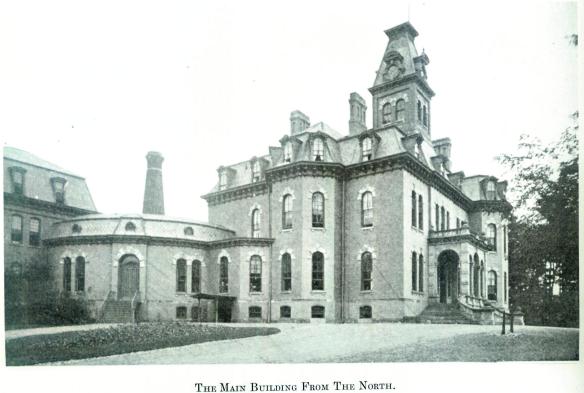
10-The Main Building From The North-Wayne E. Morrison, Sr. 1978

10-The Main Building From The North-Wayne E. Morrison, Sr. 1978

Willard Cemetery Memorial Project

Mental Illness & Prisons

It took 150 years but it appears we have come full circle in the way we treat the mentally ill. 

Ackerman + Gruber | Minneapolis Editorial and Advertising Photographers | 612.293.7175 | mail@ackermangruber.com

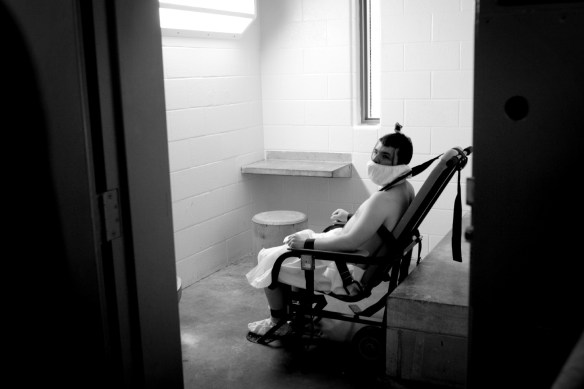
After banging on his cell door for six hours straight with his fist and head, the officers restrained an inmate who was threatening to kill himself. (Ackerman + Gruber | Minneapolis Editorial and Advertising Photographers | 612.293.7175 | mail@ackermangruber.com)

TRAPPED: Mental Illness In America’s Prisons – Feature Video by Jenn Ackerman

No Peace Outside “The Box” For People With Mental Illness In New York’s Prisons by Paul Grondahl 4.25.2013

Mental Illness In California Prisons 4.10.2013

TRAPPED: The Story Of The Mentally Ill In Prison by David Rosenberg 4.1.2013

Prison Or Treatment For The Mentally Ill by Allen Frances, M.D. 3.10.2013

Patients As Prisoners, Jails New Mental Health Institutions CBS News 3.5.2013

Indiana Scrambles To Address Ruling On Mentally Ill Inmates by Tim Evans 1.2.2013

Closing New York State Psychiatric Hospitals Is Dangerous by DJ Jaffe 3.19.2012

Nation’s Jails Struggle With Mentally Ill Prisoner’s NPR 9.4.2011

Deinstitutionalization: A Psychiatric “Titanic” Frontline 1997

Lost Lesson Of Mental Health – New York Times 4.17.1990

State Psychiatric Hospitals Forced To Change Or Close by Dava Sobel 2.10.1981

Notes & Insights from Craig Williams – Willard Cemetery

Here are some wonderful notes, used with permission, from Craig Williams, Curator of History at the New York State Museum at Albany, concerning the burial ledgers of the Willard State Hospital Cemetery, and Ovid Union Cemetery. Mr. Williams is an expert on the history of the Willard Asylum and has always been more than willing to share his vast knowledge on the subject. He has provided me with maps, old photographs, answered my numerous questions, and filled in the gaps with insight that only comes from years of experience. I would like to take this opportunity to recognize and thank Mr. Williams for all the help he has given to me!

NYS Museum Albany album b 154-2 Old Cemetery

NYS Museum Albany album b 154-2 Old Cemetery

“As you know, those records are now among the sealed materials…. sad, since back when they were at Willard, the staff were only to willing to help locate “lost” relatives by using those records… Often overlooked is the section of the Union Cemetery dedicated to Willard. I have a memory of being told that there were over two hundred burials there. I’ve always meant to check with the Cemetery to learn if they have a log of burials. In the inside cover of Willard’s first burial ledger, there is the handwritten note stating – “January 17th, 1876 – Trustees of Union Cemetery at Ovid, N.Y. made deed of lot 161 to Willard Asylum for the Insane. Deed deposited with J. B. Thomas, Treasurer, Consideration, $25. // Ganett W. Freligh, Pred’d’t // John C. Meddick, Treas.” The Willard burials that I know of at Union are along the east center edge, by the main road. The few formally marked (you can see many more depressions) date from the 1980s plus or minus. Could that location be Lot 161? Is there another section at Union where there are older Willard burials? There must have been a period in the 1980s when people were being buried at both cemeteries. I wonder how that was decided?”

“One of the things I noted in the burial ledgers were the fair number of people later removed by family or for other reasons (move to a Catholic cemetery, for instance), maybe a couple dozen over the hundred plus years? The Stock memo says 5,757 burials and there were several burials after that date. The last “regular” burial was on November 18, 1991 (not counting the 2000 burial). As you know, at the very end, there were two burials of lab specimens (including one fetus). From the four manuscript ledgers, I get 5,249 burials (not counting the two above) in the main (“Protestant”) section. The Soldiers Cemetery account shows 106 burials. A few of those (half dozen) may have been counted among the 5,249, being reinterred when that section was set up in April 1885. The last burial there seems to have been done on December 10, 1926. The Jewish cemetery (old and new), first used in January 1932, appears to have 202 burials. The old portion is where the monument now stands. The new is in the far northeast section of the cemetery. Catholic (old and new), first used in January 1959, seems to have 327 (including the 2000 burial of M). Added together, I get 5,884. I did not deduct the burials that were later removed…”

“That first burial ledger has a number of interesting clues. It lists the first burial as being done on 5 January 1870, not long after the Asylum’s opening. This cemetery was (I think) immediately north of the Branch (Grandview)… maybe in what is now parking lot or closer (under?) the current building?… By December 1873 there was already some confusion over the number of burials (85 by that time). In March 1875 a 71-year-old woman was buried, with a place of birth being listed as “Africa.” I note that since in some Upstate cemeteries separate sections were made for African-Americans…never the case at Willard.

The first burial at the new cemetery (on “Risings Hill”) was on July 3, 1875. She is listed as burial 123. On October 16, 1875, the ledger notes that “This day, John Hanlon (Sexton), finished transferring bodies from the old “Cemetery” to the new, on “Risings Hill.” He reports he had removed 119 bodies, and that bodies corresponding to Nos. 7, 27, 64 and 70 had been disinterred. // Alexander Nellis, Jr., Assistant Physician.” That comment on “disinterred” doesn’t actually match the records. They were all placed in “Form 1” (Row 1?)…The July 3rd burial is the first one in Form 2 (Row 2?). Those rows were just north of Mocha’s shed. An implication of the removal to the new cemetery is that the old one had grave markers. Apparently, some things were overlooked. In the third cemetery ledger, in November 1898, there is the note of “Bones taken from new Branch” were put at the west end of Form 2. In 1897 and 1898 there was substantial regrading around the Branch. That work probably exposed the overlooked burial(s?).

The annual report for 1874 discusses the reasoning for the new cemetery. “Experience has demonstrated, that the present location of the cemetery is a bad one, though the most appropriate one on the asylum farm. It is inconvenient because of its distance (remember, the Asylum was still just Chapin Hall), from the nature of the soil, and it also interferes with the enlargement of the upper reservoir, which is indispensably necessary. We therefore desire to change the location. Twenty-five acres of land can be purchased a short distance north…”

“Obviously, the cemetery in the 19th-century only took up a small portion of the hill, the rest was probably used for farm purposes. The first engravings of that north edge of the Asylum land show what might be a bridge going across the ravine, the original entrance not being the current one. The Stock memo states “the current entrance was cut in and established because new more modern day vehicles could not cross the small culvert bridge. The story goes that the village mayor wanted the fire truck to be able to go in a parade down Main Street of Willard and enter the cemetery for ceremonies at the old Civil War cemetery site but could not because the bridge was too narrow. The new entrance was established. While doing this, some landscaping was required and the sharp embankment needed to be made more gradual. In that process, some heavy equipment was used and they proceeded to taper the hillside but had to stop when they began to strike some old grave sites.” The old entrance shows on the facility maps.

Just a couple other items from my notes from the cemetery ledgers. A note was made to the entry for a July 5, 1886, that a glass bottle with a person’s name was placed in the burial alongside the one whose name was so enclosed…. confusing, but implying that such identification practices happened early on. There are at least three references to infants being buried. One was from September 1896 and mentions a “Form A” location at the west end of Form (Row?) 1. Alongside a November 1880 burial entry is the note that the daughter was present at the burial of her mother. In the last ledger, especially from the 1940s on, there are frequent references to amputated limbs being buried in unrelated graves.”

Willard Tour – May 18, 2013

CLICK HERE TO VIEW THE VIDEO They’re Buried Where? by Seth Voorhees

If anyone is interested, a tour of the historic buildings at the former Willard State Hospital and the cemetery will be on Saturday, May, 18, 2013. For more information, please click on the link. Seneca Daily News

Willard Drug Treatment Campus – 7116 County Road 132 – Willard, NY 14588. The cemetery is down the road on the right heading toward Seneca Lake.

Man With Psychosis Recalls Nevada Patient Dumping – ABC News

This is very sad!

Man With Psychosis Recalls Nevada Patient Dumping – ABC News.

More cases found of Nevada busing mental patients out of state by Cynthia Hubert.

Details released about discipline at Rawson-Neal Psychiatric Hospital.

Is history repeating itself?

The Deportation of Insane Aliens 1907

“Lost Luggage, Recovered Lives” by Peter Stastny, MD, and Darby Penney, MLS

The Lives They Left Behind Suitcases From A State Hospital Attic offered a ray of hope for people like me, who had discovered that an ancestor was a former patient who died at Willard State Hospital. I read the book in a day, not being able to put it down. I wanted to know more. I wondered what kind of treatment was given to my great-grandmother, and I wonder to this day. The significance of this book is that no others before Darby Penney and Peter Stastny had ever gone through the patient medical records and personal belongings in order to tell the patient’s side of the story. To learn more, please feel free to download, read, and share “Lost Luggage, Recovered Lives” by Peter Stastny, MD, and Darby Penney, MLS.  

Darby Penney is a leader in the human rights movement for people with psychiatric disabilities. Peter Stastny is a psychiatrist and documentary filmmaker. You may contact Ms. Penney to inquire about your ancestor’s suitcase at: community@capital.net. For more information visit The Lives They Left Behind Suitcases From A State Hospital Attic Website. 

The Lives They Left Behind by Darby Penney & Peter Stastny

The Lives They Left Behind by Darby Penney & Peter Stastny

Within the pages of this book is where I first learned about the anonymous graves at Willard State Hospital Cemetery. Further research led me to the discovery that burying former patients of New York State Hospitals and Custodial Institutions, in numbered, anonymous graves, was not the exception but the rule. As I have stated before, I am a Genealogy Geek who was inspired by Ms. Penney and her book, to get a law passed that will require the NYS Office of Mental Health to release the names; dates of birth and death; and the location of these historic graves, to the public so that these people may be honored and remembered with dignity. Even with the new HIPAA ruling that allows the release of medical records after 50 years from the time of the patient’s death, it appears that the OMH will not comply with the new ruling unless forced to do so. One wonders how and where they got the authority to classify the burial ledgers (cemetery records) in the same category as medical records? Why are the deaths of thousands of people being kept a secret?

Hopefully, the NYSOMH will release historic patient burial information and when they do, it will be a wonderful opportunity to educate the public about what mental illness is; to reassure people that they should not be ashamed; that help is available; and that no one needs to struggle alone. But as of today, they are sticking with “the very fact of one’s mental illness, and receiving professional help for such illness, can, if generally revealed, cause a person to be subjected to prejudice and stigma in one’s personal and professional life.” Does this statement really encourage people to seek help?

“The only exception would be if you believe a patient was buried in one of our cemeteries. If so, then with appropriate family linkage documentation, including birth and death certificates, we could provide you with information on the individual’s burial site.”

One of the first lessons that you learn when researching your family history is that people have common names. In other words, you are not the only person in the world who has your name. Lesson two is, anyone can claim to be anyone’s descendant in order to get a historic copy of a birth, marriage, or death certificate. The state does not know your genealogy, nor do they care because they’re making money on the deal. Note that after spending the money on this documentation, writing a letter, mailing it in, and waiting months for a response from the OMH, they state we could, instead of, we will, provide you with the information.

The following “Frequently Asked Questions” page is posted at NYS Office of Mental Health Last Modified: 11/15/2012.

“Q. Can I get a copy of a birth or death certificate for a family member that was a resident of one of the Office of Mental Health’s facilities?

A. Birth records, death records, and marriage records are considered Vital Records in New York State and generally can be accessed by the public. If you are interested in exploring this option, you can obtain more information on how to obtain these records on the New York State Department of Health’s vital Records website at www.nyhealth.gov

Q. I have been doing genealogy research and have discovered that one of my relatives was a resident at one of the Office of Mental Health facilities. I would like to find out any personal or medical information about them. Can I obtain a copy of these records?

A. The Office of Mental Health is dedicated to the maintenance of privacy and confidentiality of patient information. We feel this is especially true with regard to mental health treatment records. It has long been recognized that the very fact of one’s mental illness, and receiving professional help for such illness, can, if generally revealed, cause a person to be subjected to prejudice and stigma in one’s personal and professional life. We also recognize that effective and lasting psychiatric therapy can take place only in an environment of privacy and trust in which the patient knows that his/her statements will be held in confidence.

New federal regulations that govern the privacy of individually identifying health information, have underscored this requirement. While it has always been our position that a person’s right to confidentiality of clinical information does not change upon his or her death, federal regulations have given us some additional specific guidance on access to records of deceased patients. Therefore, we have recently modified our policy and procedures and require the following before we can provide any information from a deceased patient’s clinical record:

A. Birth records, death records, and marriage records are considered Vital Records in New York State and generally can be accessed by the public. If you are interested in exploring this option, you can obtain more information on how to obtain these records on the New York State Department of Health’s vital Records website at www.nyhealth.gov

B. If you are a family member of the deceased patient and the patient allowed our facility to share information with you while he or she was living, and it is reasonable to assume that the patient did not intend to revoke his or her permission to continue to communicate with you prior to his or her death, we may provide you with basic information about the patient’s condition and circumstances of his or her death, if appropriate.

C. If you are a family member of the deceased patient and the information from the patient’s record is relevant to your own health care, we can release the information to your physician, provided the physician submits a written request to us on your behalf.

D. If you are the executor of the deceased patient’s estate, or if you otherwise have legal authority to act on behalf of the patient or his/her estate, (e.g. you have letters testamentary issued by a court), we can release information to you upon your written request which documents and attests to your legal authority to act on behalf of the deceased patient. We can also release information to you if you obtain and provide us with the written consent from the executor or legal representative of the deceased patient.

E. In all of these cases, we are required to review the record prior to its release to ensure it does not infringe upon the privacy rights of any other individual who may be named in the record.

The only exception would be if you believe a patient was buried in one of our cemeteries. If so, then with appropriate family linkage documentation, including birth and death certificates, we could provide you with information on the individual’s burial site. Requests should be sent to John Allen, Consumer Affairs, NYS Office of Mental Health, 44 Holland Avenue, Albany, NY 12229.”

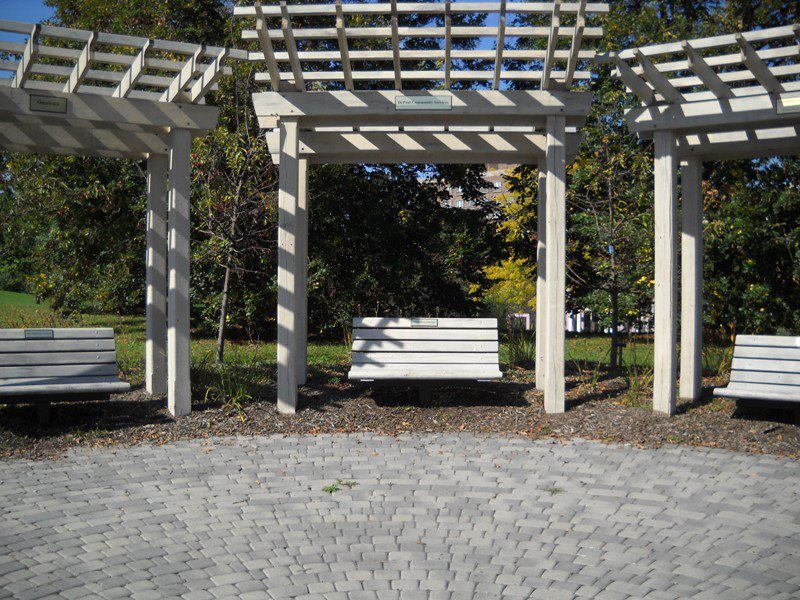
1872 “Bone Yard” The Remember Garden – Rochester, NY

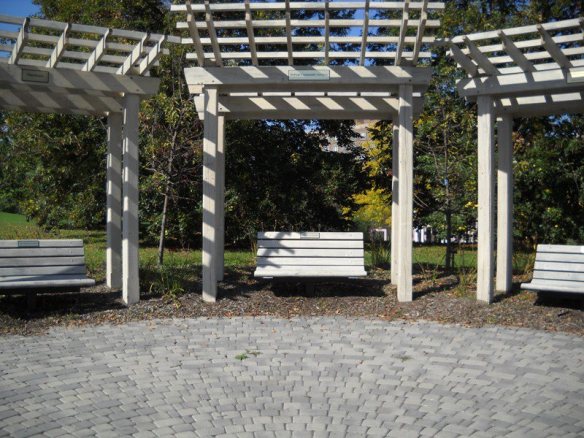
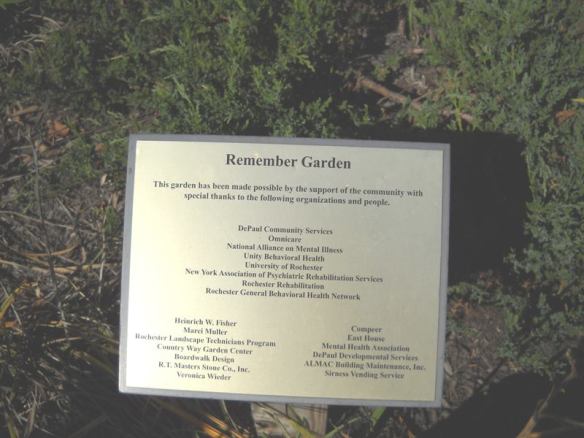
These two documents from the Proceedings of the Board of Supervisors of the County of Monroe, shed a great deal of light on the forgotten cemetery that was uncovered by excavation in Highland Park, Rochester, New York. In July 1984, approximately 900 human remains were discovered; 284 to 305 of these remains were removed, examined, and reinterred in Mt. Hope Cemetery in 1985. Hundreds of remains, many buried on top of another, were left at the sight undisturbed because it was thought that they were buried deep enough. What is most interesting to me is the County Board of Supervisors of 1872 clearly knew that this fenced-in, unmarked cemetery, known as the “bone yard” existed, and was still being used as late as January 8, 1873. It was on that date that the supervisors made a decision to discontinue burying the inmates of the Penitentiary, Alms House, and Insane Asylum in the cemetery that was located behind the Penitentiary. “Resolved, That the Superintendents of the penitentiary, and of the county poor, be and is hereby directed in the future to discontinue the burial of paupers or criminals in the old burying ground attached to the penitentiary, and to have the remains of all such interred in Mount Hope cemetery.” It would appear that although they knew it existed, it was not recorded on any map, or perhaps the map has never been found. Through the passage of time, the cemetery was forgotten. The Remember Garden marks the location where many of the bodies were found and was dedicated in 2009. “Since 2004, the effort to create a living memorial garden, located at the original site in the park, has been coordinated by DePaul Community Services. DePaul Community Services coordinated development, building, planting and maintenance of the garden. The Remember Garden appropriately marks the grave, lending dignity and respect to those buried there, while heightening community awareness to the site and the history of institutionalization. The plantings are predominantly purple, reflecting the official color of Mental Health Awareness. Pinks and blues are also part of the scheme that includes trees, shrubs, perennials, and annuals.”

Even though I know that I will never be credited with making this discovery, I am very proud that I uncovered the “Bone Yard.”

Saturday, December 14, 1872. Board met pursuant to adjournment. Mr. Jeffords in the Chair. Members all present. Minutes of the meeting of the 12th inst. read and approved. Mr. Malone, presented the following report, which was adopted, and on his motion the Clerk was instructed to have the survey recorded in the County Clerk’s office.

To the Board of Supervisors of Monroe County:
Gentlemen:—In compliance with a resolution of your honorable body at the close of the November session, commanding the Chairman of the Building Committee of the new Poor House to cause a survey of the lands occupied by the new Alms House and fix the amount that should be set off for the use of all the County Institutions, I therefore present the following survey of the lands, with the amount to be occupied by the different institutions of that part of the grounds owned by the County lying between the Poor House road and the Cobb’s Hill road, east of South avenue:
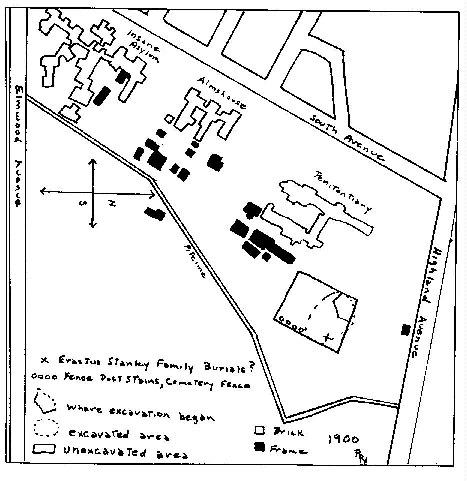
Map of Penitentiary, Poorhouse, Asylum

Map of Penitentiary, Poorhouse, Asylum

(The above map was most likely made at the time of the excavation by the Rochester Museum and Science Center team).

ASYLUM LOT.
Beginning at the east line of South avenue at the south-westerly corner of the Alms House lot, running thence south ninety-nine degrees, east along the southerly line of the Alms House lot fifteen chains and four links to the south-easterly corner thereof; thence south twenty-six decrees, west three chains twenty-five links to the centre of the Poor House road; thence north eighty-eight degrees west along the centre of the said road seventeen chains to the east line of South avenue; thence along the easterly line of said South avenue north twenty-five and one-half degrees east six chains twenty links to an angle; thence north thirty-one degrees east five chains nineteen links to the place of beginning, containing 11.08 acres.

ALMS HOUSE LOT.
Beginning at a point in the easterly line of South avenue, which is thirty-four feet northerly from the range of the northerly end of the new Alms House building; running thence south fifty-nine degrees east at right angles with said South avenue and parallel with the range of the north end of said building, and thirty-four feet distant therefrom, three chains forty-seven links to a point thirty-four feet northerly from the northeast corner of said building; thence south thirty-one degrees west four feet; thence south fifty-nine degrees east two chains six links to the northeast corner of the yard; thence south thirty-one degrees west one chain ninety-seven links to the north side of the privy; thence south fifty-nine degrees east fifty-four links; thence south thirty-one degrees west thirty-nine links; thence south fifty-eight degrees east eight chains forty-eight links to a stake: thence south twenty-six degrees west three chains eighty-seven links to the range of the north line of the Asylum yard; thence north fifty-nine degrees west along said easterly line of South avenue; thence north thirty-one degrees east along said easterly line six chains and forty links to the place of beginning, containing seven and sixteen one-hundredths acres.

Resolved. That the survey herewith presented be fixed as the division of the county lands described above, and that the Penitentiary occupy the residue of the land not contained in the said survey of that portion of the County farm described above.

Resolved. That the Poor House authorities have the right of a driveway across the asylum lands, from the new Poor House to the old Poor House road. Respectfully submitted, P. Malone.” (Pages 188-189)
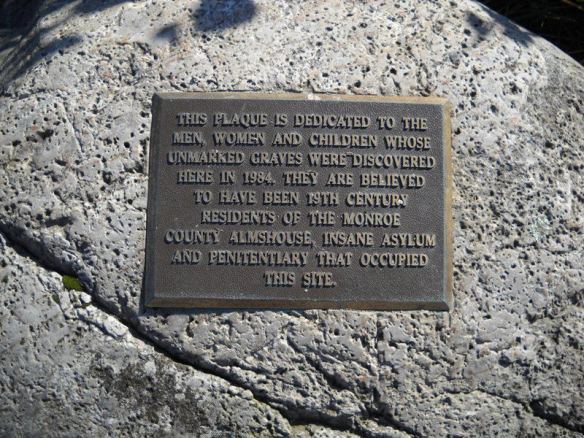
Remember Garden 1

Remember Garden 1

January 8, 1873
Mr. Malone
presented the following report, which was accepted:

CHAPLAIN’S REPORT.
Rochester, Dec. 31, 1872. To the Honorable the Board of Supervisors of Monroe County:
Gentlemen:—The duties of the office of Chaplain of the Monroe county almshouse, to which you did the subscriber the honor to reappoint him in 1871, have been discharged by him during the past year in conducting public worship on Sundays and preaching in the chapel, in visiting and ministering to the inmates both on Sundays and week-days, in the house and in the hospital, in administering in public and in private to such as sought them at his hands, the Christian sacraments, and in services in the chapel and at the grave over the remains of the dead. When the chilly weather of autumn set in, after the pulling down of the large dormitory for men, it became necessary to occupy the chapel as a dormitory, and the public religious exercises in the chapel were suspended; but the visits of the chaplain and his ministries to individuals were continued until he was informed, some time in October by a friend, of the action of your board in making a new appointment. After that his visits were confined to members of his own communion who asked his services.

In consequence, as he has been informed, of an increased charge (eight dollars) for interments of paupers not chargeable to the city, in the public grounds of Mt. Hope, the bodies of those of this class who were friendless, were laid in, what is familiarly known as the “bone yard,” an enclosed lot of the public farm in the rear of the penitentiary. It was not uncommon, in such cases, to make more than one attempt in opening a grave, from the pick and shovels encountering, perhaps transversely, the mouldering coffin of some buried convict or pauper; while in spring and autumn, on a rainy time, the wetness of the ground and water in the grave, added to the pain of dishonoring the ashes of a brother man.
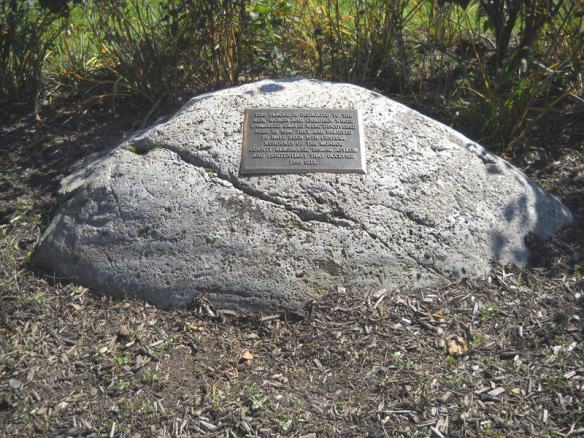
Remember Garden 2

Remember Garden 2

In several instances your chaplain could not deny himself the privilege of procuring at his own expense the interments in Mt. Hope of patients dying in the hospital, whose dependence came of misfortunes and not of crime, and whose sickness and death had been cheered by the solace of Christian baptism and communion. He has ventured to attach to his report a receipt for his outlay in one of these cases, in the confidence that a rich agricultural town will not fail to reimburse him.
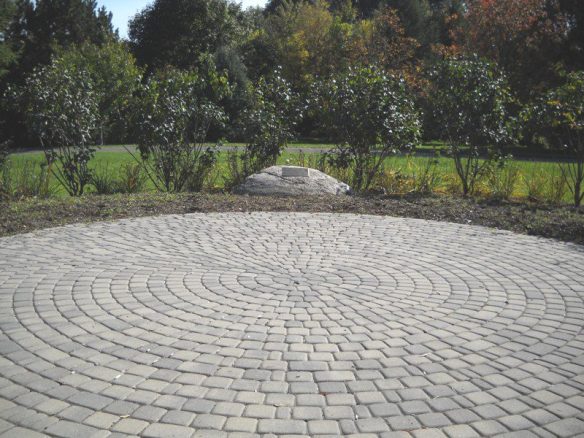
Remember Garden 3

Remember Garden 3

RELIGIOUS SERVICES FOR ROMAN CATHOLICS.
It is well known that a very large proportion of the inmates of your almshouse are foreign born, and that most of these are in religious faith Roman Catholics. It is a part of their education to make much of attendance once on each Lord’s day on the public worship of their church, and it had been customary to indulge many of them in going to the city on Sunday mornings for this purpose. The result from their yielding to the solicitations of appetite or the false kindness of acquaintances, were subversive of the order and discipline of the house, and an effectual remedy was found in the rule laid down and enforced by the present officers forbidding absence on Sundays, in conjunction with an offer of the chapel, at a fixed hour on Sunday, for religious services by a minister of their own faith. Such services were held in consequence in the chapel at an early hour on Sunday mornings, by Father Bupaffe, a Roman Catholic clergyman, of courteous manners and earnest devotion to his work, under appointment from his bishop, beginning in March last, and suspended upon the taking of the chapel for a domitory. The influence of this arrangement upon the discipline and good order of the house has often been attested by the officers in charge.

Your chaplain may be permitted to say in conclusion, that the ties of his sacred calling with inmates of the house who welcomed his services and with some who are still tenants of your hospital and examples of every Christian virtue, and the happy relations and intercourse experienced with all the officers of the institution, having been chief recompenses of his services there.

Respectfully submitted,
J. V. Van Ingen, Chaplain.
Remember Garden 4

Remember Garden 4

Mr. McNaughton moved that the claim of Dr. Van Ingen referred to in his report, amounting to eight dollars, be referred to the chairman of the Alms-House Committee to report thereon. Carried.

Mr. Mack moved that when this board adjourns for the day, it be until Friday morning next at 10 o’clock. Carried.

Upon motion of Mr. Pool, the Messenger was instructed to have the sleighs in readiness at 12 o’clock to-morrow, to convey the members to the alms house.

By Mr. Larkin-
Resolved, That the Superintendents of the penitentiary, and of the county poor, be and is hereby directed in the future to discontinue the burial of paupers or criminals in the old burying ground attached to the penitentiary, and to have the remains of all such interred in Mount Hope cemetery. Laid on the table by consent.” (Pages 211-212)
Remember Garden 5

Remember Garden 5

SOURCES:

Proceedings of the Board of Supervisors of the County of Monroe, for 1872, Rochester, N.Y., Steam Press of Curtis, Morey & Co., Union And Advertiser Office, 1872.

ROCHESTER HISTORY, Life and Death in Nineteenth Century Rochester, Ruth Rosenberg-Naparsteck, Editor, Volume XLV, Nos. 1 and 2, 1985 (Monroe County Almshouse, Pages 12 – 22).

Bodies of Evidence: Reconstructing History Through Skeletal Analysis edited by Anne L. Grauer, (Page 121).

Photographs by L.S. Stuhler

“Breakthrough For Medical Genealogy” by Judy G. Russell – HIPAA 2013

Great article by Judy G. Russell, re-posted with permission. I have contacted the New York State Office of Mental Health asking their position on this new ruling. Hopefully, they will respond soon.

Breakthrough For Medical Genealogy

Posted on April 8, 2013 by Judy G. Russell One For Our Side

There’s been a major breakthrough in records access for those of us with family medical issues that we research in part through our genealogy.

Quietly, without much fanfare, the federal Department of Health and Human Services (HHS) has finally come around to understanding that closing medical records forever, even after the death of the person treated, isn’t the way to go.

It adopted a new set of rules earlier this year, effective just two weeks ago, that opens medical records 50 years after the patient’s death.

The change — first proposed nearly three years ago1 — came in an omnibus Final Rule adoption governing a vast array of issues under the federal Health Insurance Portability and Accountability Act (HIPAA) designed primarily to update personal privacy rules in light of technological changes in medical recordkeeping.2 The rule was adopted in January and became effective on March 26th.

As far back as 2003, archivists had complained to HHS about the old rule, under which personal health information was to be protected forever and only disclosed even after the patient’s death only if the legal representative of the estate authorized it.

In 2005, Stephen E. Novak of Columbia University had quoted from those earlier complaints in an HHS conference, explaining that “certain historical, biographical and genealogical works where the identity of the individual is the whole point could not be written, such as the Pulitzer Prize-winning A Midwife’s Tale, based on the late 18th and early 19th century diary of Maine midwife Martha Ballard.”3

Nancy McCall of the Johns Hopkins Medical Institutions told that same conference that “a number of state archives have acquired the records of defunct hospitals in their states and do not know whether they are covered entities. This is especially important for mental hospitals and TB hospitals that have closed.”4

All of those participating pleaded for clarity — and for access.

The new rule is, finally, the HHS response.

In its rulemaking, HHS recognized the problems inherent in “the lack of access to ancient or old records of historical value held by covered entities, even when there are likely few surviving individuals concerned with the privacy of such information. Archives and libraries may hold medical records, as well as correspondence files, physician diaries and casebooks, and photograph collections containing fragments of identifiable health information, that are centuries old. Currently, to the extent such information is maintained by a covered entity, it is subject to the Privacy Rule.”5

It noted that the “majority of public comment on this proposal was in favor of limiting the period of protection for decedent health information to 50 years past the date of death. Some of these commenters specifically cited the potential benefits to research. A few commenters stated that the 50-year period was too long and should be shortened to, for example, 25 years.”6

Based on its review and the public comments, HHS concluded:

We believe 50 years is an appropriate period of protection for decedent health information, taking into account the remaining privacy interests of living individuals after the span of approximately two generations have passed, and the difficulty of obtaining authorizations from a personal representative of a decedent as the same amount of time passes. For the same reason, we decline to shorten the period of protection as suggested by some commenters or to adopt a 100-year period of protection for decedent information.7

So, as of the 26th of March, HIPAA’s definition of “protected health information” expressly excludes information regarding “a person who has been deceased for more than 50 years,”8 and covered entities need only comply with HIPAA “with respect to the protected health information of a deceased individual for a period of 50 years following the death of the individual.”9

Now the fact that the federal government isn’t standing in the way doesn’t mean that all of us with family health issues can rush out and expect to be given immediate access to those old health records that may tell us so much about things we face today. The feds have never been the only player in the privacy game — state laws may also restrict access to health information.

But it’s a major breakthrough to have the federal government finally move out of the way of access to records of critical importance.


SOURCES

Tip of the hat to Ron Tschippert for alerting The Legal Genealogist to the rule adoption!

  1. Notice of proposed rulemaking, 75 Fed. Reg. 40868, 40874 (14 Jul 2010). 
  2. See “Modifications to the HIPAA Privacy, Security, Enforcement, and Breach Notification Rules Under the Health Information Technology for Economic and Clinical Health Act and the Genetic Information Nondiscrimination Act; Other Modifications to the HIPAA Rules,” 78 Fed. Reg. 5565 (25 Jan 2013), PDF version, U.S. Government Printing Office (http://www.gpo.gov/fdsys/ : accessed 7 Apr 2013). 
  3. Minutes, 11-12 January 2005, Subcommittee on Privacy and Confidentiality, National Committee on Vital and Health Statistics, HHS.gov (http://ncvhs.hhs.gov/ : accessed 7 Apr 2013). 
  4. Ibid. 
  5. “Modifications to the HIPAA … Rules,” 78 Fed. Reg. 5613-5614. 
  6. Ibid., 78 Fed. Reg. 5614. 
  7. Ibid. 
  8. 45 CFR §160.103. 
  9. 45 CFR §164.502(f). 

Oregon State Hospital – Cremains

Honoring the Past – List of Unclaimed Cremains

Mental Health – Portland, Oregon

Maisel Library Of Dust

Maisel Library Of Dust

Oregon State Hospital-New York Times

Oregon State Hospital-New York Times

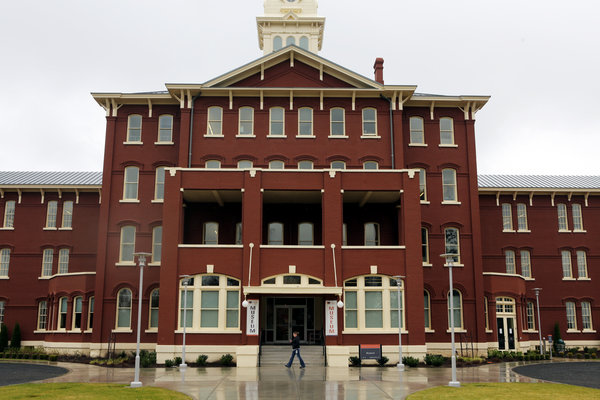
Once a ‘Cuckoo’s Nest,’ Now a Museum – Oregon State Hospital features a museum that pays tribute to the movie “One Flew Over the Cuckoo’s Nest” and explores mental health treatments of the past.