Post-Mortem Photography

In the twenty-first century taking photographs of the dead is considered morbid and appalling. Viewing a dead loved one lying in a nursing home bed or casket is one of those memories that don’t need to be backed up by a photograph. Personally, I have tried to erase those memories from my brain but during the Victorian Era, taking a photograph of the dearly departed was a common practice. The image was meant to be a loving keepsake to memorialize the dead, and in many cases the post-mortem photograph was the only image the family ever had of their loved one. Many photographs feature a dead child in the arms of its mother or father. Some try to show the loved one as if they were still alive, sitting upright in a chair, dressed in their Sunday best, while others show the family member lying on a sofa or bed as if they were only sleeping. Although this ritual seems creepy to us now, 150 years ago, posing the dead for one last beautiful photograph was done with love, dignity, and respect.

The Thanatos Archive

The Thanatos Archive

The Thanatos Archive

Photography was a new technology in the nineteenth century. Two pioneers in the development of photography were Louis Daguerre in 1837 (Daguerreotype), and George Eastman who founded the Eastman Dry Plate Company in 1880. In 1888, Mr. Eastman introduced to the general public the Kodak Camera with the slogan, “you press the button, we do the rest.” On January 19, 2012, Eastman Kodak Company filed for bankruptcy. The photographic giant was replaced with new technology and so we enter the Digital Age. The point is: technology changes our rituals, the way we view ourselves and the world, and the way we live and die.

The history of how we mourn our dead has changed from century to century. The overwhelming grief is still the same but the time allotted to grieve has changed. During the Victorian Era, a widow was expected to wear black for two and a half years after the death of her husband. Today, that same widow would be allowed three days off from work and within a month, she would be expected to “move on” and “get over it.”

What is always interesting to me is how we treat the weakest and most vulnerable among us. I suppose if we don’t have any respect for a certain segment of the population while they are living, we certainly don’t care how they are treated and disposed of after death. What follows are two examples of how the “abnormal” were treated after death in 1897 and 1913. The first article involves the advancement of medical science from PATHOLOGICAL INSTITUTE OF THE NEW YORK STATE HOSPITALS 1897 for the Insane, later renamed the New York State Psychiatric Institute, (Dr. Ira Van Gieson) in 1929; the second highlights indifference at Gowanda State Hospital. Below these are more interesting links including two articles from the United Kingdom in 2006 and 2010 that discuss how “normal” deceased hospital patients were treated.

“There are several things of particular value, but above all it is the brains of the abnormal classes that we want, for one of the future duties of the anthropologist is to determine whether or not, and how, the brains of the insane, the criminal, etc., differ structurally from the normal. We want all the brains, at least all those left after the requirements of pathological research have been satisfied, without discrimination or limit in numbers. Next after the brain, come the anomalies of the various other organs…Many of the patients who die in State hospitals are friendless or paupers, and have to be buried at a comparatively large expense to the State. Such a burial, the Secretary of the Commission in Lunacy kindly informs me, averages in each case about $12. The body is usually given to an undertaker and he disposes of it according to his best convenience. In some instances a medical college secures the cadaver, instead of an undertaker. The fact is, that after such a body is removed from the hospital it is never any more heard of.” (1)

GOWANDA STATE HOSPITAL – The Gowanda Committee visited the hospital August 27, 1913, and made a thorough inspection…The two greatest needs of the hospital at the present time are a new morgue and an addition to the bakery. The place now used for the care of bodies pending burial is a basement room lighted by artificial light, small, and without interior equipment. What autopsies are performed by the medical staff have to be made in this inconvenient place. Whenever several deaths occur within a short interval, it is often necessary to pile them up around the room and friends and relatives are often shocked to find their dead in this unsuitable place. This hospital had forty-two deaths last year. The scientific work at the hospital, as well as the consideration of friends and relatives of patients, demand the construction of a proper place for the care of bodies of patients.” (2)

1. Contributions From The Pathological Institute Of The New York State Hospitals, Ira Van Gieson, Director, Volumes I & II, 1896-1897, Collated for the Pathological Institute by Amalie Busck, Librarian, State Hospitals Press, Utica, N.Y., 1898, Pages 1-18.

2. State of New York State Hospital Commission, Twenty-Fifth Annual Report, October 1, 1912 to September 30, 1913, Transmitted to the Legislature January 29, 1914, Albany: J.B. Lyon Company, Printers, 1914, Page 471.

If we no longer treat the dead with dignity, what hope is there for the living? Daily Mail, UK, June 2006.

Dead body was left on bed next to me for eight hours: Patient tells of horror on packed ward. Mail Online, UK, March 2010.

Columbia University Medical Center – Columbia Psychiatry

Wayne E. Morrison, Sr. – Pictorial Album of The Willard Asylum 1869 – 1886

On November 9, 2012, I received a beautiful gift from Doug and Jane Anderson at Port City Paranormal. They purchased the book Pictorial Album of The Willard Asylum 1869 – 1886 by Wayne E. Morrison, Sr., and sent it to me because they knew how much I would appreciate and enjoy such a rare piece of history. I cannot thank Doug and Jane enough for being so kind and thoughtful! I hope that one day I will be able to meet them!

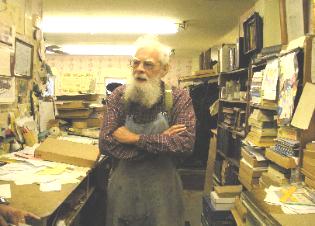
Wayne E. Morrison in his printing shop 2009.

Wayne E. Morrison in his printing shop 2009.

According to The Ithaca Journal, published on April 10, 2012: “Ovid: Wayne E. Morrison, Sr., 79 of Ovid, died Friday, April 6, 2012 at his home. He was born in Fairport (NY) a son of the late Earl B. and Grace Yorks Morrison. Mr. Morrison was a printer and publisher for 65 years and was the owner and operator of W.E. Morrison & Co. in Ovid. He was a member of the Fairport and Galen Historical Societies, a former member of the Clyde Fire Dept. and was a past Member of the Ovid Baptist Church. …There was a quote that Mr. Morrison loved that was made by Marianne Nichols. ‘Wayne doesn’t live in the past but the past lives in him.’”

1 - Pictorial Album Of The Willard Asylum 1869 - 1886.

1 – Pictorial Album Of The Willard Asylum 1869 – 1886.

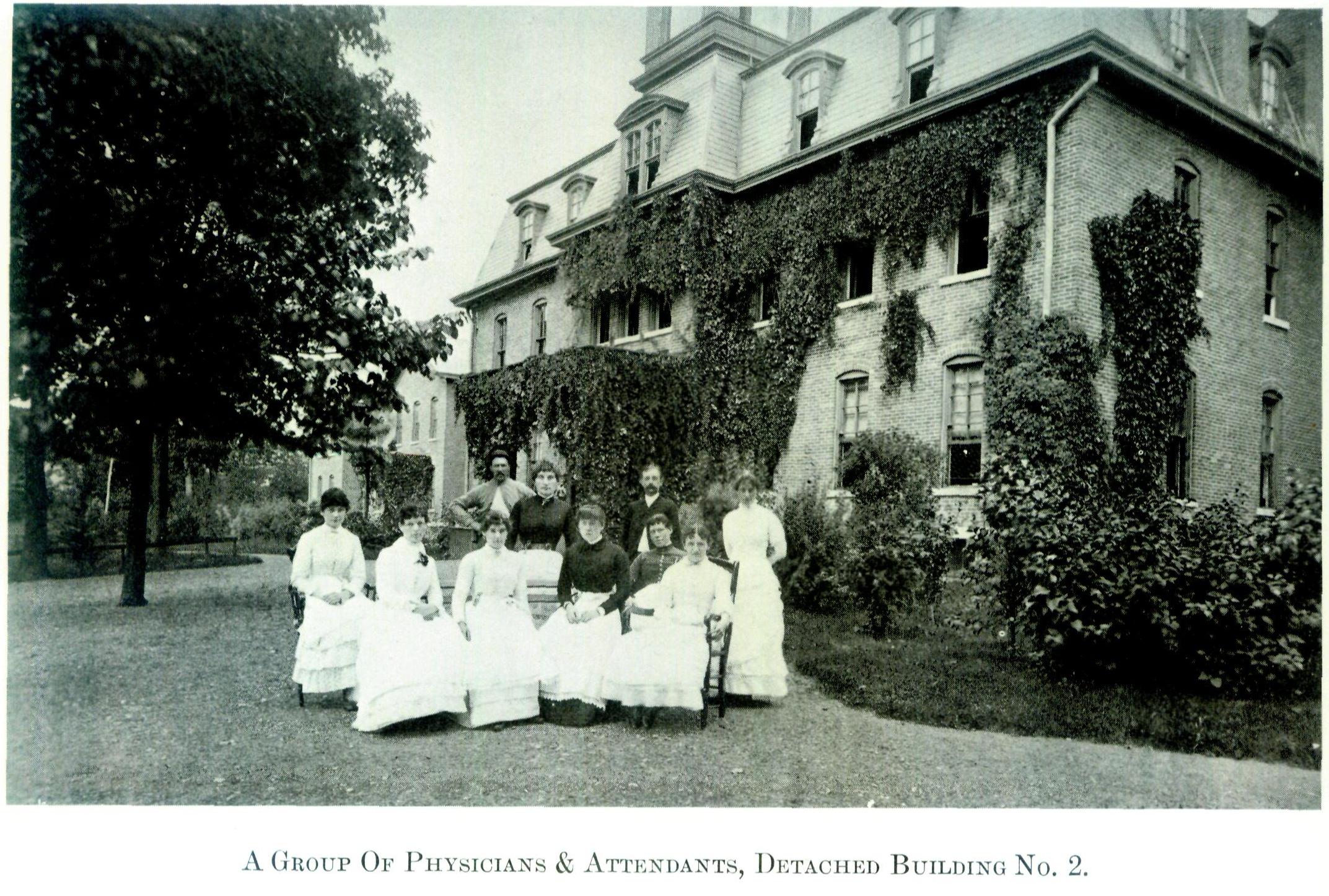
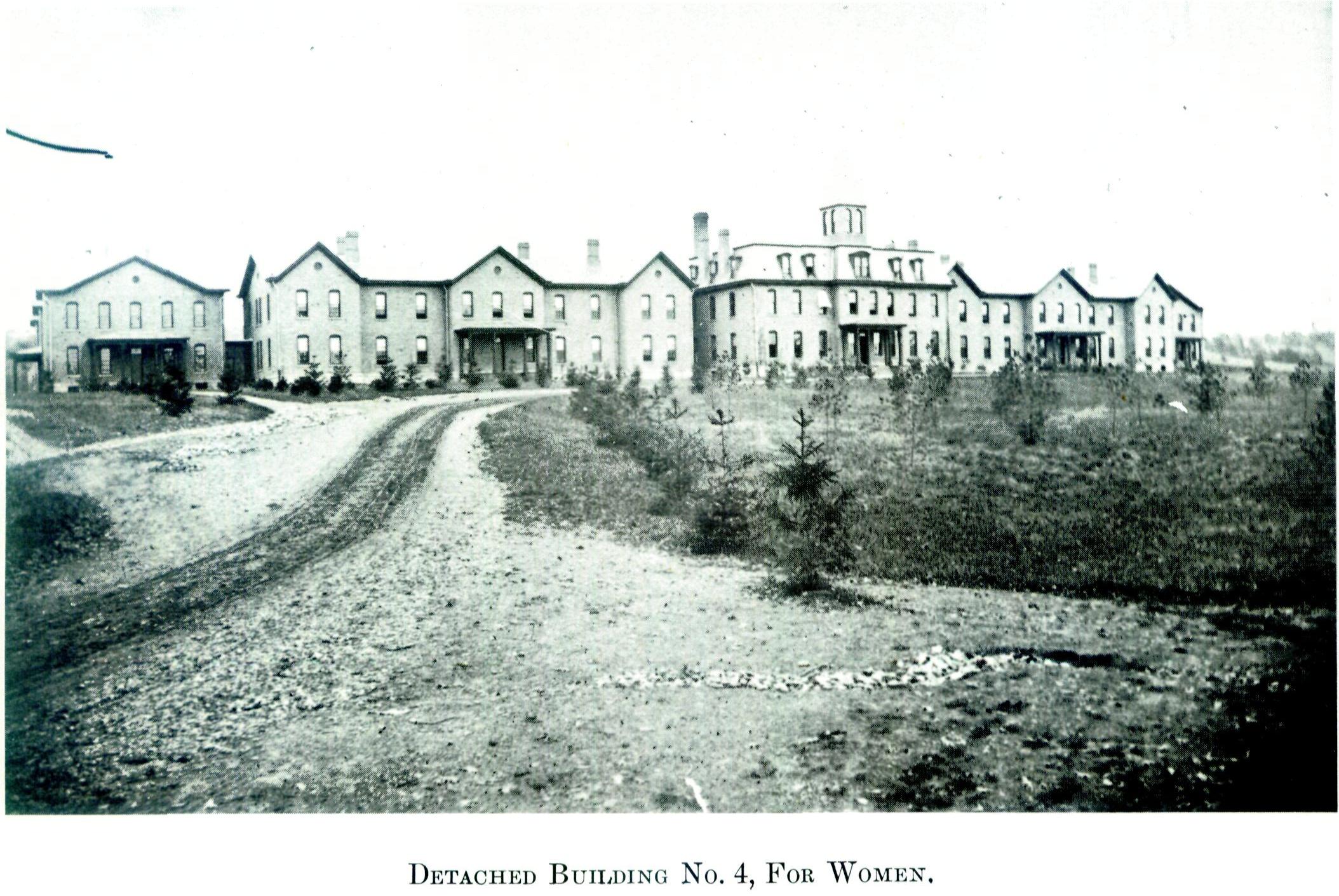
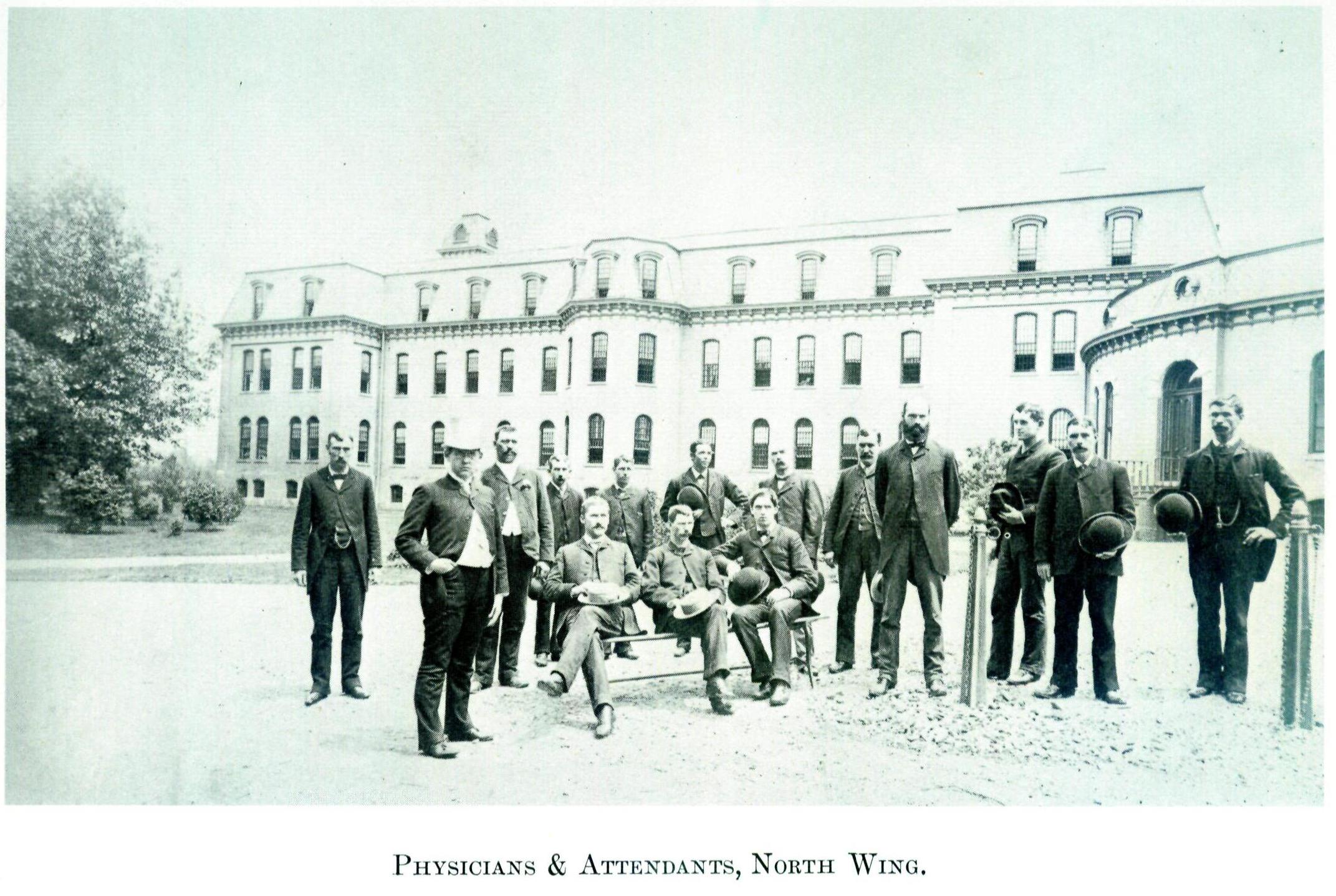
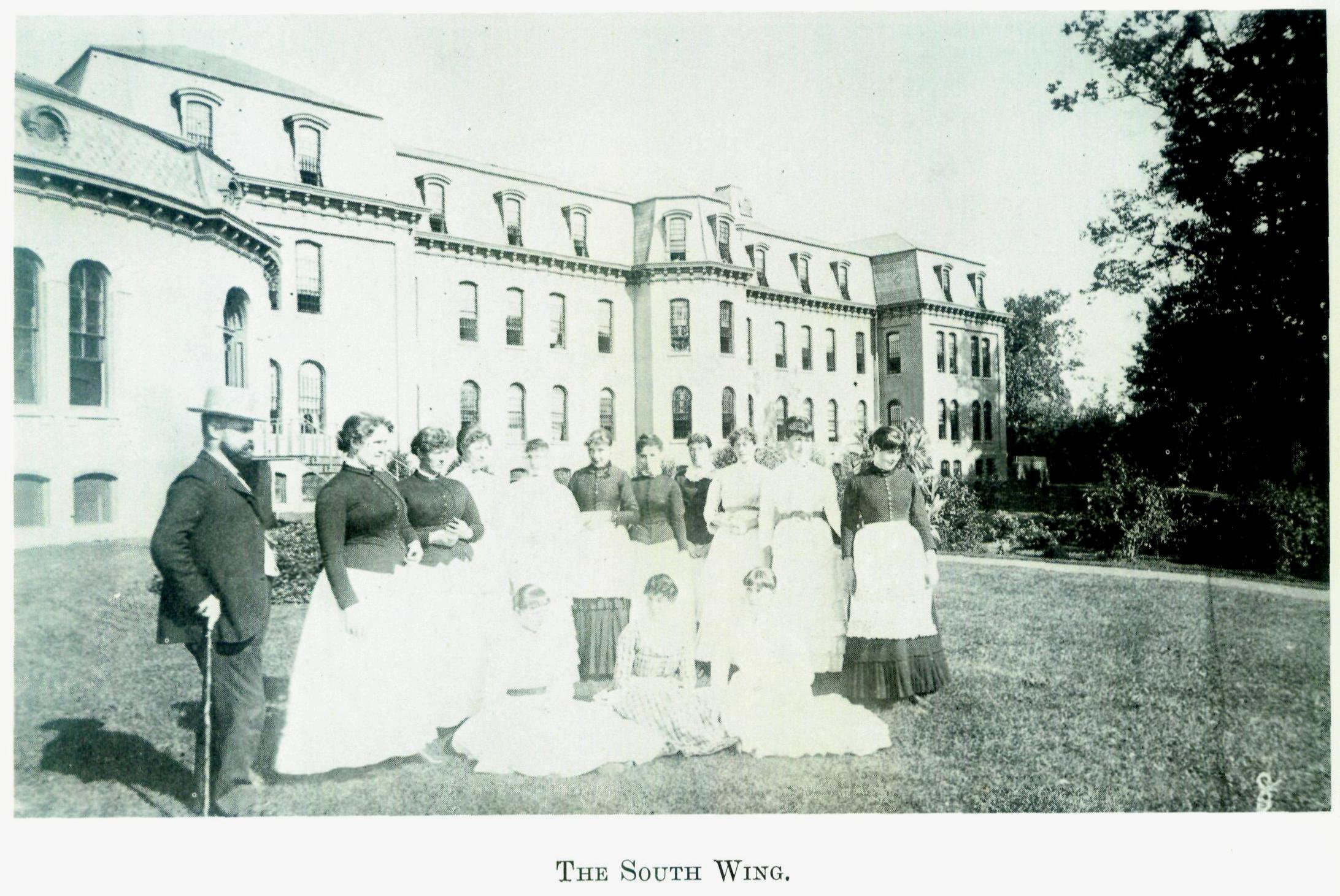
Mr. Morrison’s book is not numbered but is filled with 119 beautiful, historical photographs of The Willard Asylum (Willard State Hospital), the people who worked there, and historical information. He also recorded who took these wonderful photographs. I would like to share with you a few photographs from the first pages of his book. What follows are Mr. Morrison’s words:

“Year after year since 1869, the Willard Asylum has proved an incalculable blessing to thousands of the unfortunate of humanity in the State of New York – a refuge for the chronic insane and upon lands partially in the Towns of Ovid and Romulus, Seneca County, it was the first such institution established in the nation and has been the exemplar from which other states have formed like asylums.

01-The Main Building-Wayne E. Morrison, Sr. 1978

01-The Main Building-Wayne E. Morrison, Sr. 1978

The early photographs of Willard Asylum, published for the first time, are the work of Nelson S. Hopkins, whose brother, Dr. Horace G. Hopkins, was a Resident Officer of the Asylum at the time. The preponderance of his pictures were made in 1886, however some were taken a year earlier, and a few as late as 1892. Some are also credited to Anne Maycock Hopkins, the wife of Dr. Hopkins. They have been preserved by Dr. Robert E. Doran of Geneva, who has in his possession the Hopkins collection in its entirety – more than three hundred fine old pictures.

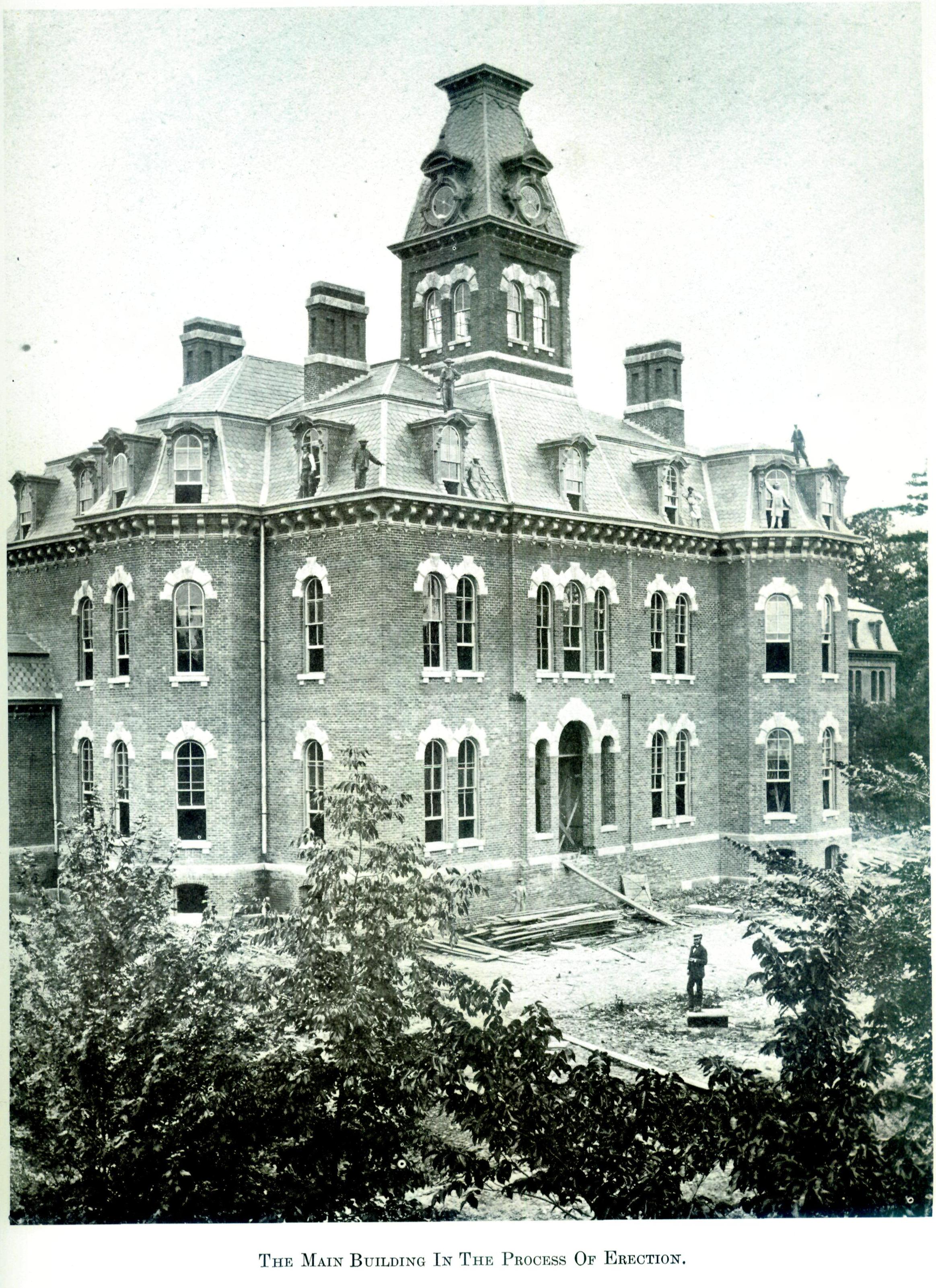
Excepted are the two views in 1869 on the main building in the process of erection taken by Mr. C.V.D. Cornell, photographers, of Waterloo. The front view was loaned by the Willard Asylum Museum, and the rear view by Michael F. Perry, of Ovid. – W.E. Morrison & Co., Ovid, N.Y.”
(Copyright 1978 Wayne E. Morrison, Sr.)

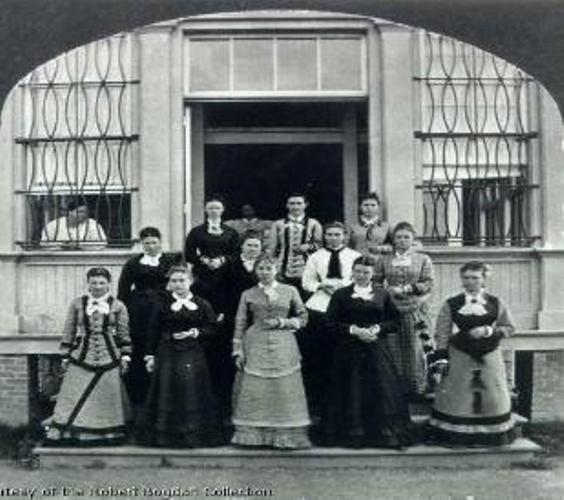
02-The Asylum Medical Staff-Wayne E. Morrison, Sr. 1978

02-The Asylum Medical Staff-Wayne E. Morrison, Sr. 1978

03-The Asylum Officials-Wayne E. Morrison, Sr. 1978

03-The Asylum Officials-Wayne E. Morrison, Sr. 1978

04-The Main Building In The Process Of Erection-Wayne E. Morrison, Sr. 1978

04-The Main Building In The Process Of Erection-Wayne E. Morrison, Sr. 1978

05-The North Wing In Process Of Erection-Wayne E. Morrison, Sr. 1978

05-The North Wing In Process Of Erection-Wayne E. Morrison, Sr. 1978

06-Rear Of The Main Building In Process Of Erection-Wayne E. Morrison, Sr. 1978

06-Rear Of The Main Building In Process Of Erection-Wayne E. Morrison, Sr. 1978

07-The Main Building From The North-West-Wayne E. Morrison, Sr. 1978

07-The Main Building From The North-West-Wayne E. Morrison, Sr. 1978

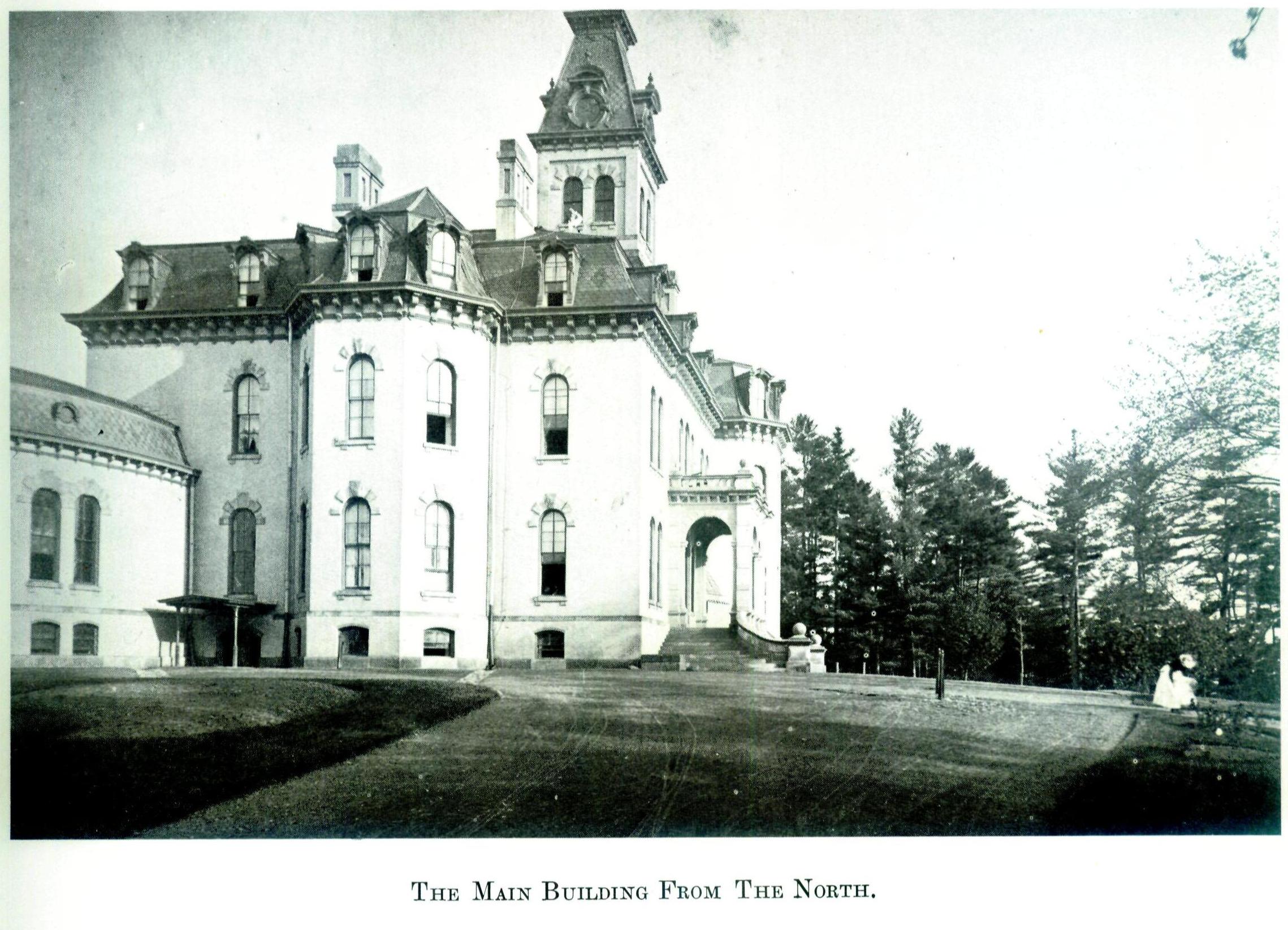
08-The Main Building From The North-Wayne E. Morrison, Sr. 1978

08-The Main Building From The North-Wayne E. Morrison, Sr. 1978

09-The Medical Office-Main Buildiing-Wayne E. Morrison, Sr. 1978

09-The Medical Office-Main Buildiing-Wayne E. Morrison, Sr. 1978

10-The Main Building From The North-Wayne E. Morrison, Sr. 1978

10-The Main Building From The North-Wayne E. Morrison, Sr. 1978

11Group Of Attendants, Detached Building No. 1-Wayne E. Morrison, Sr. 1978

11Group Of Attendants, Detached Building No. 1-Wayne E. Morrison, Sr. 1978

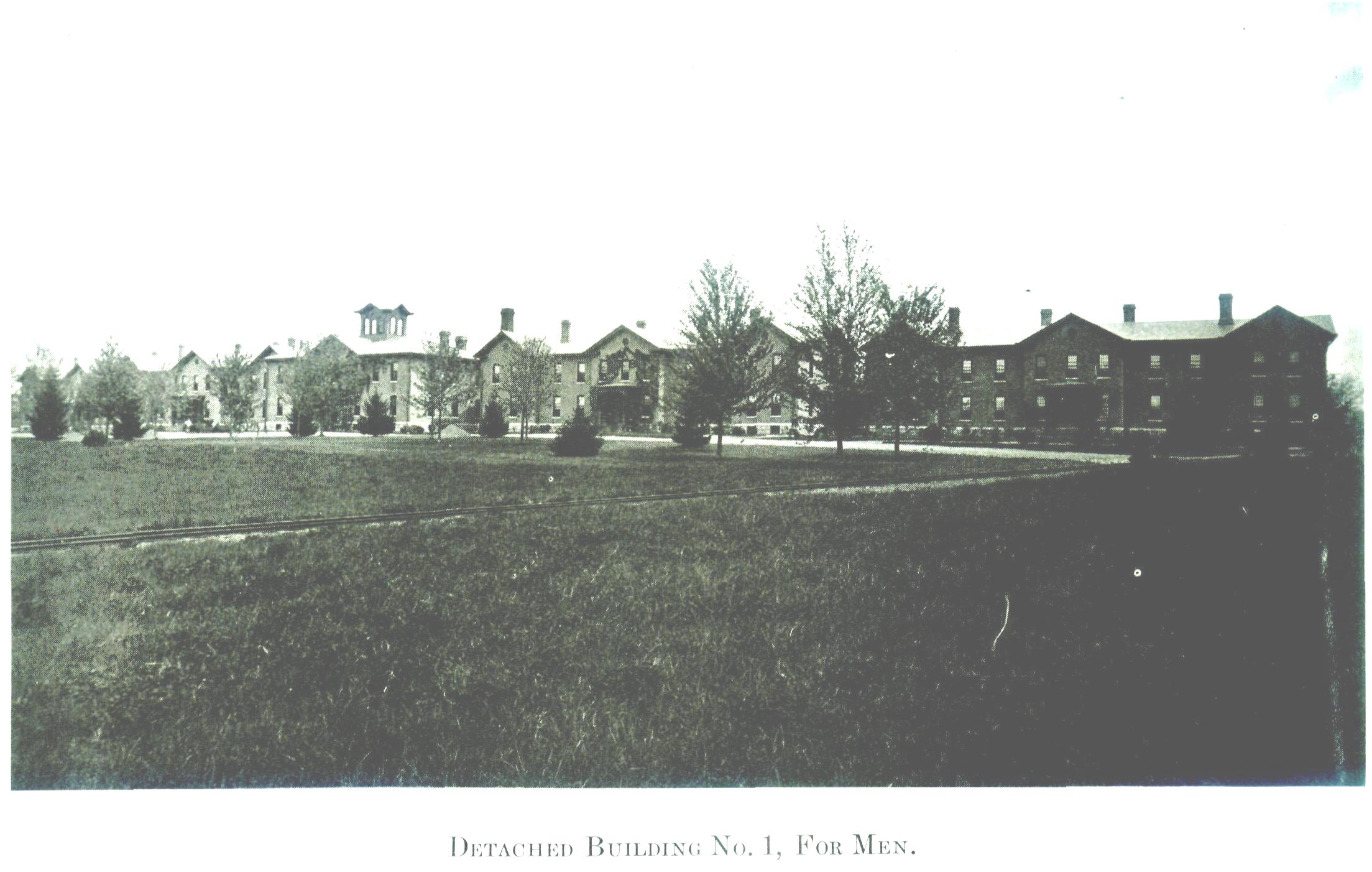
12 Detached Building No. 1, For Men-Wayne E. Morrison, Sr. 1978

12 Detached Building No. 1, For Men-Wayne E. Morrison, Sr. 1978

13-A Group Of Physicians & Attendants, Detached Building No. 2-Wayne E. Morrison, Sr. 1978

13-A Group Of Physicians & Attendants, Detached Building No. 2-Wayne E. Morrison, Sr. 1978

14-Detached Building No. 2, For Women-Wayne E. Morrison, Sr. 1978

14-Detached Building No. 2, For Women-Wayne E. Morrison, Sr. 1978

15-Physicians & Attendants, Detached Building No. 3-Wayne E. Morrison, Sr. 1978

15-Physicians & Attendants, Detached Building No. 3-Wayne E. Morrison, Sr. 1978

16-Detached Building No. 3, For Men-Wayne E. Morrison, Sr. 1978

16-Detached Building No. 3, For Men-Wayne E. Morrison, Sr. 1978

17-Supervisor-In-Chief, Attendants & Employees, Detached Building No. 4-Wayne E. Morrison, Sr. 1978

17-Supervisor-In-Chief, Attendants & Employees, Detached Building No. 4-Wayne E. Morrison, Sr. 1978

18-Detached Building No. 4, For Women-Wayne E. Morrison, Sr. 1978

18-Detached Building No. 4, For Women-Wayne E. Morrison, Sr. 1978

19-Physicians & Attendants, North Wing-Wayne E. Morrison, Sr. 1978

19-Physicians & Attendants, North Wing-Wayne E. Morrison, Sr. 1978

20-The North Wing-Wayne E. Morrison, Sr. 1978

20-The North Wing-Wayne E. Morrison, Sr. 1978

21-The South Wing-Wayne E. Morrison, Sr. 1978

21-The South Wing-Wayne E. Morrison, Sr. 1978

22-Physician & Attendants, South Wing-Wayne E. Morrison, Sr. 1978

22-Physician & Attendants, South Wing-Wayne E. Morrison, Sr. 1978

23-The W.B. Dunning Leaving Willard Landing-Wayne E. Morrison, Sr. 1978

23-The W.B. Dunning Leaving Willard Landing-Wayne E. Morrison, Sr. 1978

27-A View At Willard Landing-Wayne E. Morrison, Sr. 1978

27-A View At Willard Landing-Wayne E. Morrison, Sr. 1978

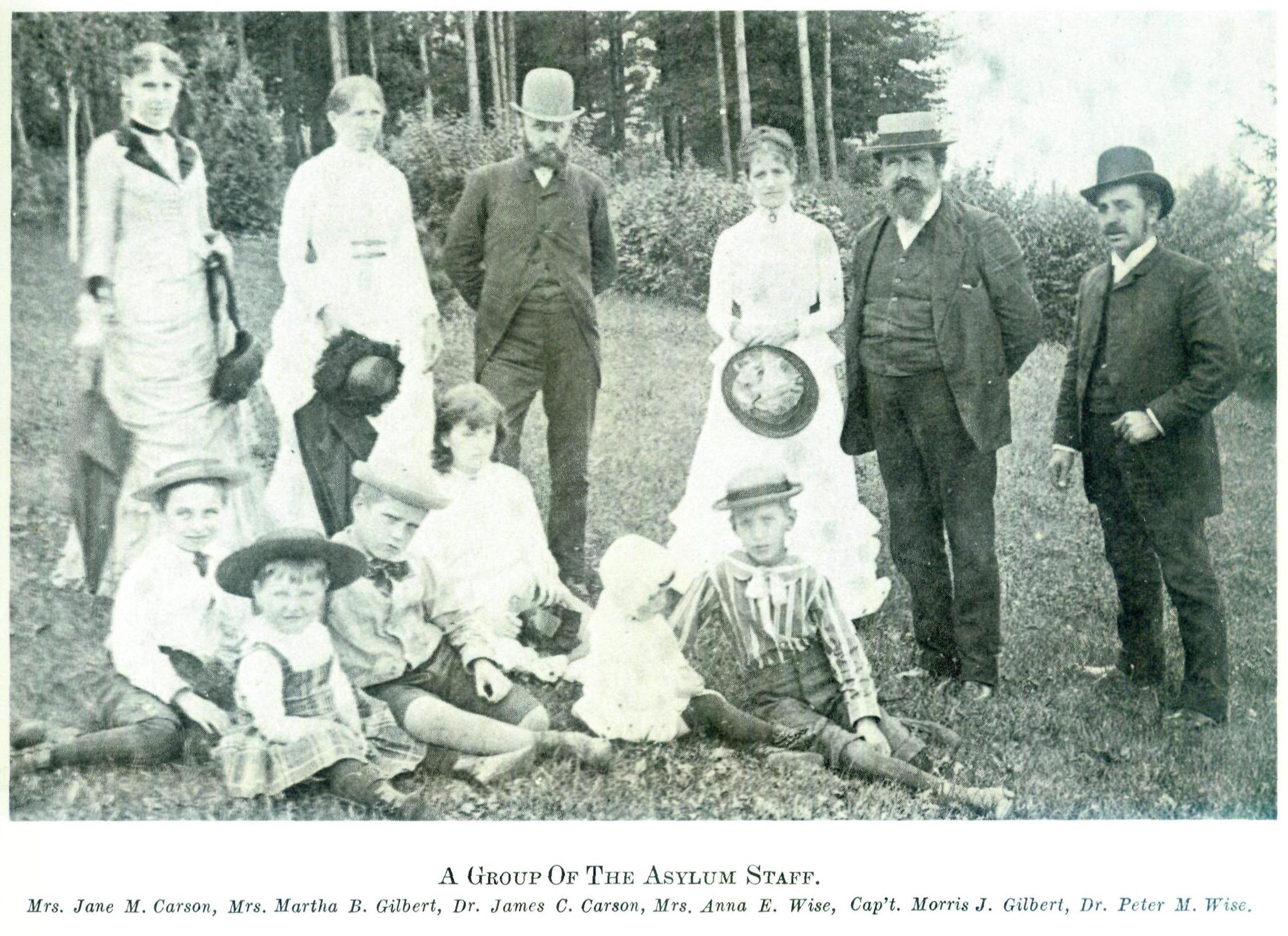
28-A Group Of The Asylum Staff-Wayne E. Morrison, Sr. 1978

28-A Group Of The Asylum Staff-Wayne E. Morrison, Sr. 1978

29-The Onondaga At Willard Landing-Wayne E. Morrison, Sr. 1978

29-The Onondaga At Willard Landing-Wayne E. Morrison, Sr. 1978

30-Cap't & Mrs. Anson Wheeler-Wayne E. Morrison, Sr. 1978

30-Cap’t & Mrs. Anson Wheeler-Wayne E. Morrison, Sr. 1978

1907-1909 New York State Feeble-Minded & Epileptic Institutions (Rome)

Besides having state insane asylums for the mentally ill, New York State had other institutions for the “care and treatment of its mental defectives.” The medical records and places of anonymous burials of these people, many of whom were children, are unavailable to the public. They are: The Syracuse State Institution for Feeble-Minded Children, (New York Times – Syracuse Asylum), Syracuse, Onondaga County, NY, established in 1851; The New York State Custodial Asylum for Feeble-Minded Women, first opened in 1878 as a branch of the Syracuse State Institution for Feeble-Minded Children, but made an independent institution and located at Newark, Wayne County, NY in 1885; Craig Colony for Epileptics, Sonyea, Livingston County, NY, established in 1892; The Rome State Custodial Asylum, Rome, Oneida County, NY, opened May 1, 1894; Letchworth Village, for the care of feeble-minded and epileptic persons, Thiells, Rockland County, NY, established 1911.

The following excerpts and pictures were reprinted from The Annual Report Of The Board Of Managers Of The Rome State Custodial Asylum for the years 1907, 1908, and 1909.
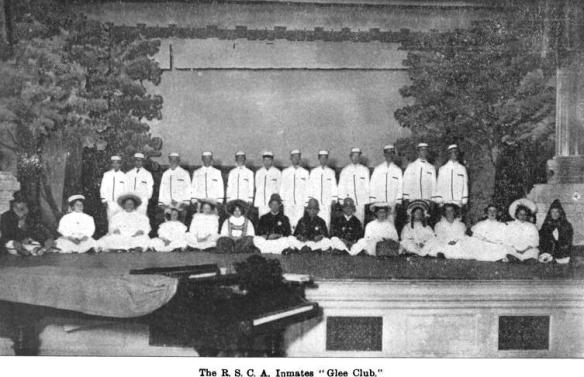
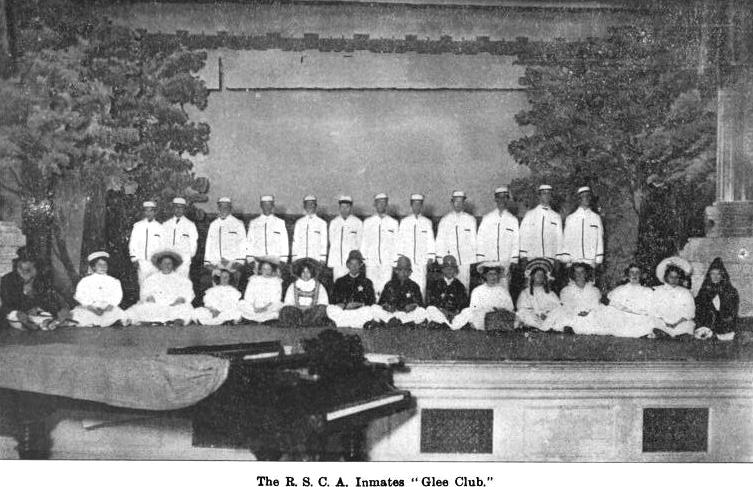
1907 RSCA Inmates Glee Club

1907 RSCA Inmates Glee Club

1907
FUTURE POLICY.
“We again recommend, as did we last year in our annual report, that arrangements be perfected as soon as possible for separating the sexes and removing all the females from this institution, leaving this a colony purely for males, and that we continue to develop our system of farm colonies for the brighter male inmates to the extent of establishing at least ten such farm colonies with 1,000 acres of land. With such extension of farm lands, we are very sure that we would be in a position to produce all the vegetables required for the maintenance of the asylum as well as all the milk and butter required for the institution.

We continue to feel the necessity, more than ever before, for a separate building for the care of the criminal class of feeble-minded, in which such criminal class may be separated from our general population and be taught trades, and receive the benefit which such continuous occupation will afford them, as well as the institution be benefited through the products of their labor in the manufacture of boots, shoes, clothing, brooms, mats, etc.” (26)

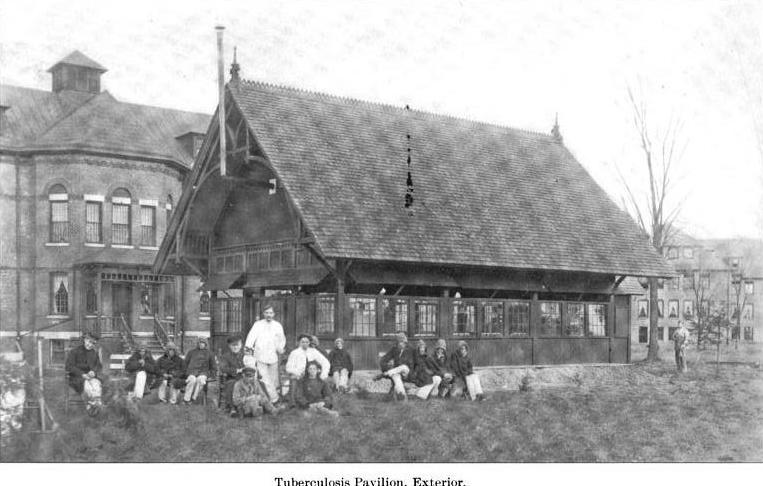
1907 TB Pavilion Exterior

1907 TB Pavilion Exterior

ADMISSIONS.
“The number of admissions during the year, 261, is the largest number by more than 100 that has ever been admitted in any one year’s history of the institution.

The opening of the new ward building J for male inmates, on April 1, 1907, made possible the admission of this large number of cases during the year. Of the number admitted 233 were males and 28 females. It is interesting to note that of the total admissions nearly one-half were under 21 years of age and that 68 were between 16 and 21 years of age, 100 were between the ages of 5 and 16, and 5 below the age of 3. Here again is evidenced the fact that the cases are coming to us at younger ages than heretofore, and this is very desirable as it is during this younger age that most can be done for the feeble-minded, especially the custodial class, toward training them in habits of cleanliness, industry, domestic work, etc.

Of the number admitted during the past year an especially large percentage has been of the more feeble class, as paralytics, with quite a number of cases of tuberculosis, as a result of which we have had more tuberculosis in the institution during the past year than at any time in the previous history of the institution.

Of the admissions this year, 71 came from Greater New York, 61 from county homes, 60 from Syracuse school, 11 from orphan asylums, 9 from reform schools, and 48 direct from their homes.

This tendency of the reform schools indicated above, to transfer their defectives direct to this asylum, again makes it necessary for us to regard the need at this institution for a separate department for the care of the criminal class of feeble-minded separate from our general population. The importance of this can only be fully appreciated through constant daily association with the care of the custodial class of feeble-minded when associated with the criminal classes.

1907 TB Pavilion Interior

1907 TB Pavilion Interior

APPLICATIONS FOR ADMISSION.
We continue to receive, almost every day, applications for the admission of additional cases, and while we stated last year we had 500 applications on file, and during the past year we have admitted 261 cases, still the number of applications on file, for suitable cases for care and treatment here, is over 400, this 400 not including the more than 100 applications which we have received for the admission of epileptics, insane feeble-minded, etc.

However, in this connection, we are of the opinion that were all females to be removed from this asylum, thus creating accommodations here for an additional 300 male inmates in the buildings now occupied by female inmates, and were we to continue our plans for farm colonies for the brighter class of boys to the extent of about 20 per cent, of our population, we will be in a position to accommodate all the applications which we receive for male inmates and thus, when the repairs are completed which are under way at the present time, and the additional repairs contemplated as per our requests for next year of the Legislature, no additional buildings will be required in connection with the main asylum group of buildings for the care of additional cases, with the exception of the separate building of the criminal class as previously referred to.

DISCHARGES AND TRANSFERS.
There were seven males and three females discharged during the year. Of this number four boys were discharged because they were sufficiently improved that they could earn their living and care for themselves outside. Two other boys were discharged to the custody of their families, their parents feeling that they were sufficiently improved that they could be of assistance at home and were practically in a normal condition, and the remaining male was a paralytic and was taken home by his family for home care. Of the females, two were transferred to Newark Custodial Asylum and the other girl was discharged as having been sufficiently improved to be able to properly care for herself and earn her own living.

It continues to be our policy to refuse to discharge all females except as above noted, that is, that no feeble-minded female shall be returned to her family or allowed her freedom after having once been committed to our custody, except that the courts order same, as we believe it should be the policy of the State, after having these cases once committed to its care and custody, that they should retain them, for the protection of society in general and for the economic interests of the State, as well as for the protection of the individual, it having been our experience that when these cases are taken out they are sure to drift into immorality and crime and in the course of a short time application is made to us for their return to the institution, the individual having not only lost all benefit which he had derived from the care, training and treatment here, but also was in much worse condition, both physically and mentally, than when taken away from the institution.

DEATHS.
The death rate during the year was about 4 ½ per cent., there having been 46 deaths, of which number 34 were males and 12 females. The number of deaths from tuberculosis during the year was 10 males and 2 females, this being about the same number as during the preceding year and being about the same percentage of deaths from tuberculosis as the average for the preceding twelve years, that is, about one-third of the deaths is due directly to tuberculosis.

We have had during the year several isolated cases of typhoid fever. However, only one of these cases died and there has been no evidence of the condition spreading or becoming general in nature. The State Board of Health was called upon to assist us in ferreting out the source of infection if possible. However, as the cases were very isolated, no two occurring in one department of the institution and the cases were all confined to inmates, there seemed to be no one source of infection, and as our water supply, milk supply and food supply was free from infection no special importance was placed upon the fact that an occasional one or two isolated cases of typhoid existed in the institution.” (29-32)

ROME STATE CUSTODIAL ASYLUM TRAINING SCHOOL FOR ATTENDANTS FOR MEN AND WOMEN.
“For training attendants in the physical care of the feeble-minded and the physically infirm, and also in the manual, mental, moral and industrial training of the feeble-minded.

The Rome Custodial Asylum is entirely owned and maintained by the State of New York for the care and treatment of feeble-minded and idiotic persons, the following classes being cared for: All of both sexes below the age of seven; all of both sexes between the ages of seven and fourteen who are physically infirm (the ablebodied feeble-minded children who can use language between the ages of seven and fourteen are sent to the Syracuse School for feeble-minded), and cases past the age of fourteen, both sexes, with no further age limit.

The asylum, with its population of 750 (soon to be 1,000) cases, cares for many children, many physically infirm, as cripples, paralytics and bedridden cases, many of the feeble-minded juvenile delinquent class and many adults, among which are a considerable number of the State reformatory classes.

The course of training shall cover two years, of fifty-two weeks each. The first shall be devoted to the training of attendants in all that pertains to the physical care of the physically infirm and mentally enfeebled, and the second year shall be devoted to the training of attendants in the physical, mental, moral and industrial training of the feeble-minded.

For entrance to the school, the applicant shall be twenty-one years of age, and come recommended by two responsible persons who have known the applicant for at least two years, in addition to which the applicant shall file an application, the statements in which are to be sworn to as follows: . . .” (61)

This job paid $20.00 per month for males; $16.00 for females. The hours were: 6:15 AM to 6:00 PM and 6:15 AM to 7:30 PM, on alternating days with one hour off duty every afternoon.

SOURCE: Thirteenth Annual Report Of The Board Of Managers Of The Rome State Custodial Asylum At Rome, N.Y., For The Year Ending September 30, 1907, Adopted At Annual Meeting December 2, 1907, Transmitted To The Legislature February 12, 1908, Albany, J.B. Lyon Company, State Printers, 1908, Pages 26, 29-32, 61.
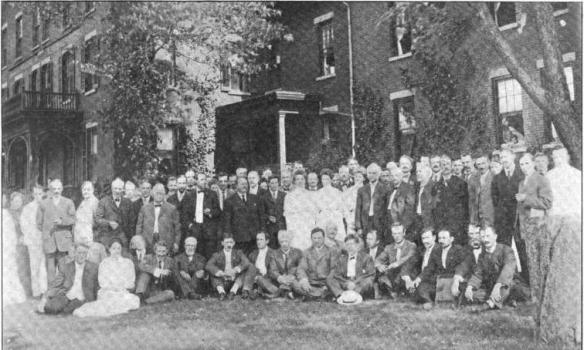
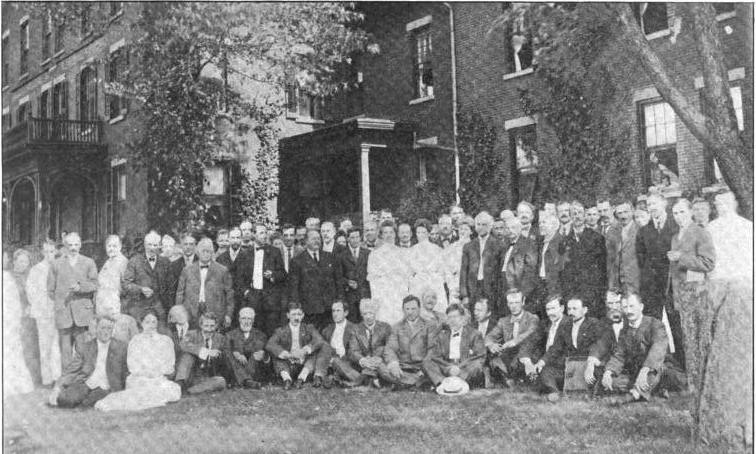
1908 The American Association for the Study of the Feeble-Minded. In Session at the Asylum June 22 – 25, 1908

1908 The American Association for the Study of the Feeble-Minded. In Session at the Asylum June 22 – 25, 1908

1908-2 Employees Building

1908-2 Employees Building

1908-3 Bailey Farm Colony
1908-3 Bailey Farm Colony

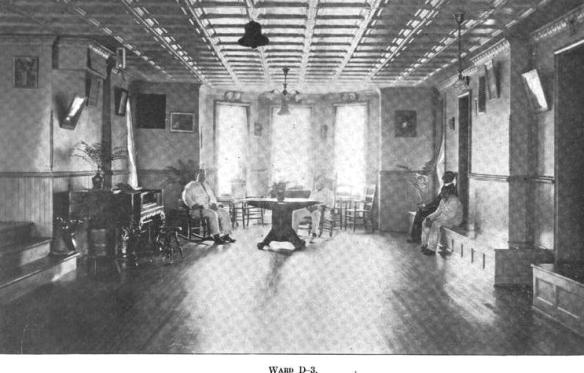
1908-4 Ward D-3
1908-4 Ward D-3

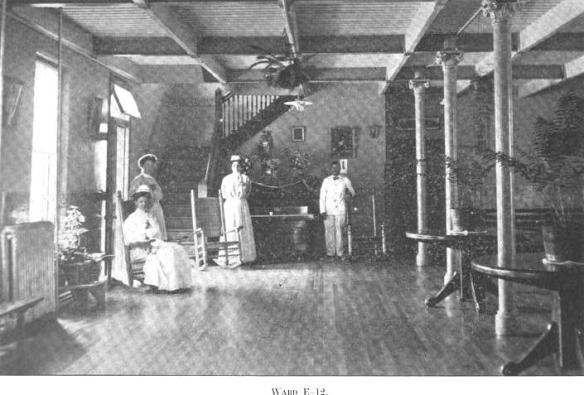
1908-5 Ward E-12

1908-5 Ward E-12

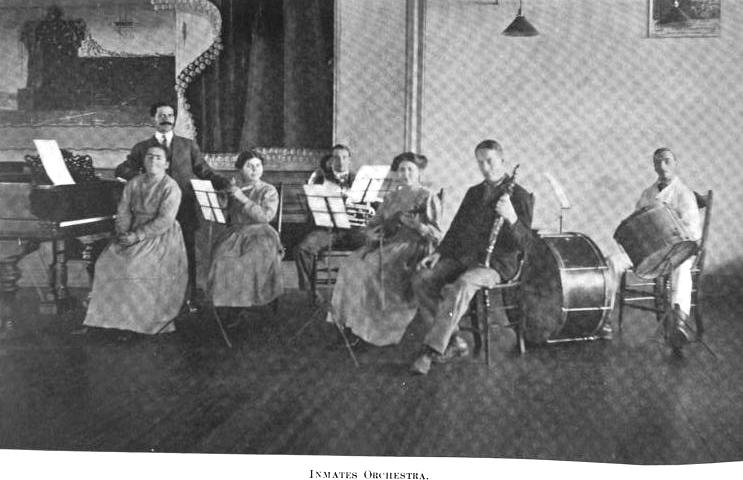
1908-6 Inmates Orchestra

1908-6 Inmates Orchestra

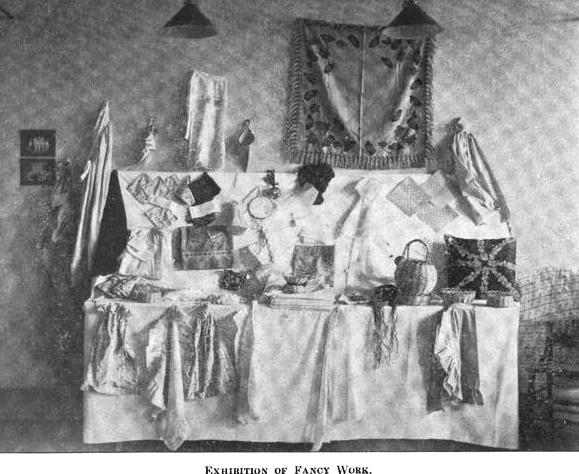
1908-7 Exhibition Of Fancy Work

1908-7 Exhibition Of Fancy Work

1909
SEPARATION OF SEXES.
“The separation of the sexes is one of the greatest, if not the greatest, move that can be made in the direction of economy in management of this asylum, both from the standpoint of a reduced per capita cost of maintenance as well as the betterment of the service. Such separation will allow the inmates the whole freedom of the buildings and grounds, and thus they will require much less supervision when at work or at play to keep them from encroaching on the grounds occupied by the opposite sex, (no fence or partition can prevent the passing of notes or conversation which leads to secret meetings and planned escapes).
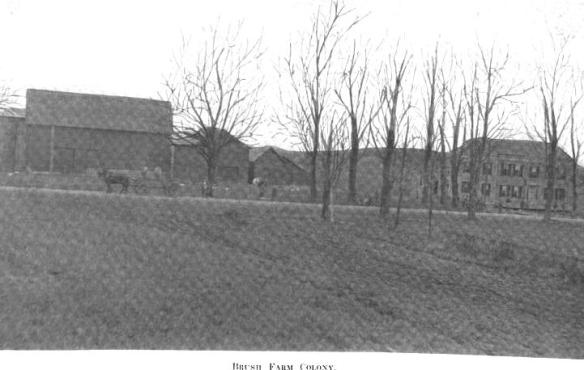
1909-8 Brush Farm Colony

1909-8 Brush Farm Colony

Such freedom for the inmates allows of their greater usefulness in doing errands, also in being left to work alone at tasks which they can well do with no supervision. And, too, this freedom from constant supervision, thus throwing the inmate on his own resources and calling into play his own judgment, better qualifies him for the next task, as I have had many opportunities of observing (notwithstanding the overdrawn observation frequently stated that the feeble-minded have no judgment. True, they apparently have none when they are never allowed to use it, and they will continue to show none so long as some supervisor continues to constantly judge for them).

1909-9 Bailey Farm Colony

1909-9 Bailey Farm Colony

Some one may suggest that the damage to property and morals resulting from lack of constant supervision will more than offset any saving that may result in salaries, but to this I say we seldom see a feeble-minded boy when given a suitable task become destructive or meddlesome, even if he is not closely supervised, and I daily see boys at the farm colonies left in the fields to plow, harrow, plant, hoe, etc., with the farmer only occasionally calling around to direct and supervise, and it is seldom indeed that such boys do damage or injury.
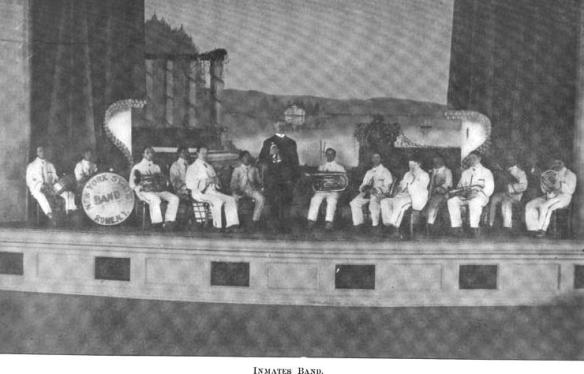
1909-10 Inmates Band

1909-10 Inmates Band

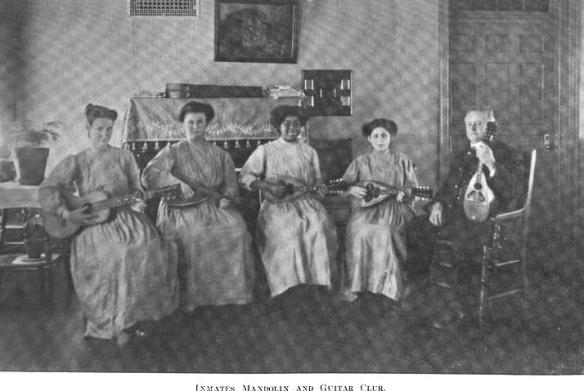
Amusements and entertainments have been continued during the year as usual, and all this is made possible through the liberal response received to our annual holiday appeal to relatives and friends of inmates. Such funds have allowed us to place pianos on all the wards and to furnish a liberal supply of music for the band and orchestra as well as an occasional new musical instrument, as mandolins, guitars, horns, violins, etc., for the use of the patients, and I take this opportunity of thanking in behalf of the inmates all who have thus showed their especial interest in the asylum and its work.
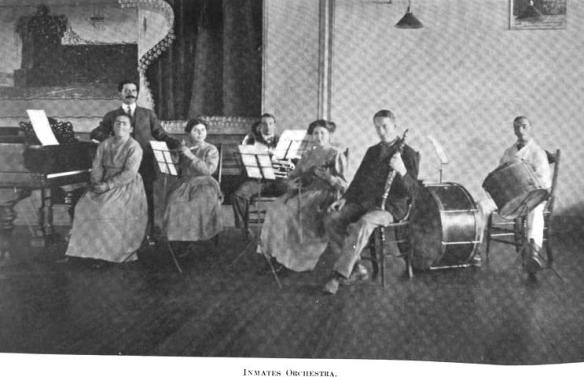
1909-11 Inmates Orchestra

1909-11 Inmates Orchestra

I wish to again express my appreciation of the loyal support accorded me by my associate officers and employees, and to most sincerely thank the members of the Board for their continued interest and devotion to the uplift of humanity as exemplified in the work of this asylum.

Respectfully,
CHARLES BERNSTEIN, Superintendent.” (26-28)

SOURCE: Fifteenth Annual Report Of The Board Of Managers Of The Rome State Custodial Asylum At Rome, N.Y., For The Year Ending September 30, 1909, Adopted At Annual Meeting December 6, 1909, Transmitted To The Legislature January 12, 1910, Albany, J.B. Lyon Company, State Printers, 1910, Pages 26-28.
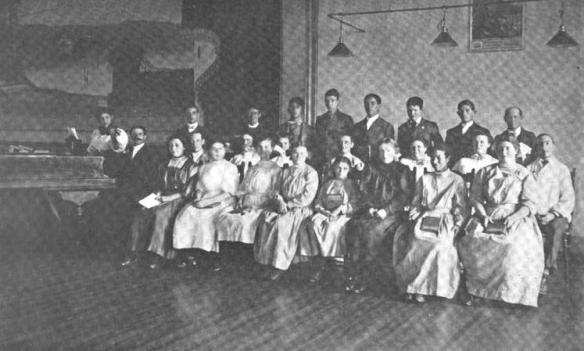
 

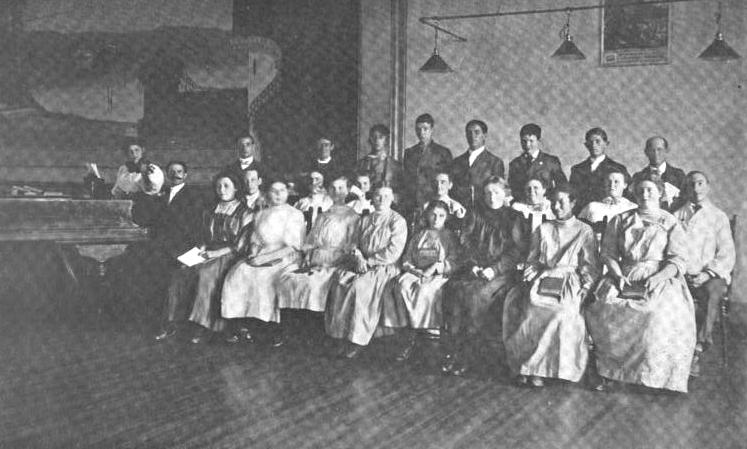
1909-12 Inmates Choir
1909-12 Inmates Choir

1909-13 Inmates Mandolin and Guitar Club

1909-13 Inmates Mandolin and Guitar Club

1909-14 Boys Kindergarten

1909-14 Boys Kindergarten

1909-15 Physical Training

1909-15 Physical Training

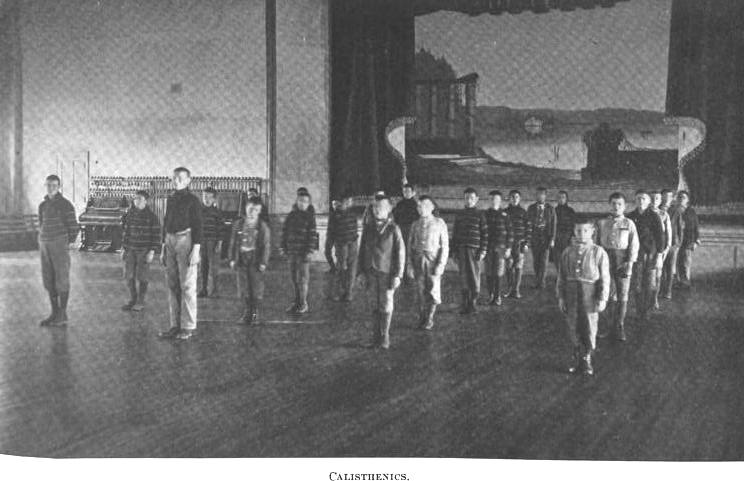
1909-16 Calisthenics

1909-16 Calisthenics

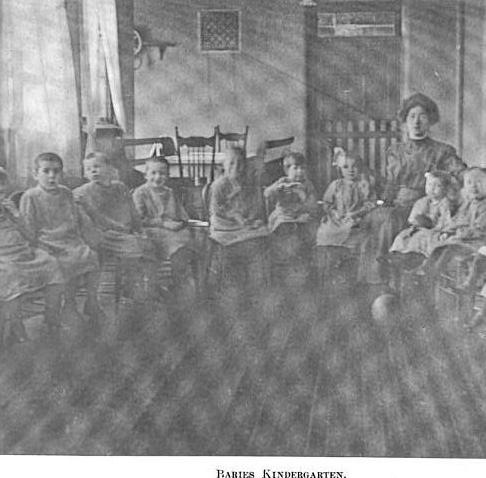
1909-17 Babies Kindergarten

1909-17 Babies Kindergarten

1909-18 Primary School Work

1909-18 Primary School Work

1909-19 Grammar School Work
1909-19 Grammar School Work

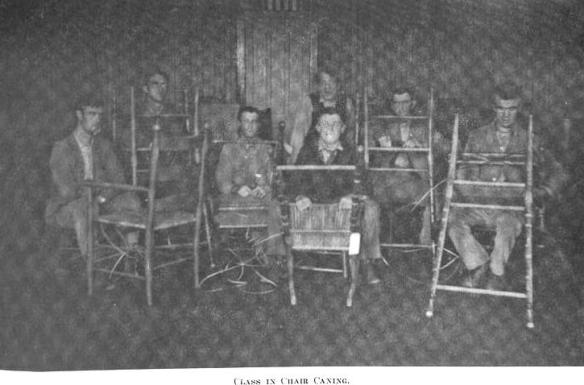
1909-20 Class In Chair Caning

1909-20 Class In Chair Caning

1909-21 Primary Sewing

1909-21 Primary Sewing

1909-22 Primary Sewing

1909-22 Primary Sewing

1909-23 Sewing Class
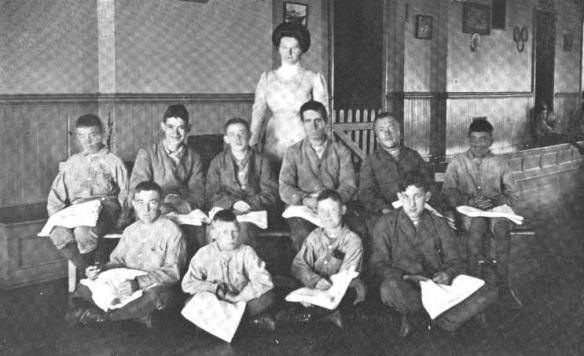
1909-23 Sewing Class

1909-24 Sewing Class

1909-24 Sewing Class

1909-25 Class In Ironing

1909-25 Class In Ironing

Photographs:
SOURCE: Thirteenth Annual Report Of The Board Of Managers Of The Rome State Custodial Asylum At Rome, N.Y., For The Year Ending September 30, 1907, Adopted At Annual Meeting December 2, 1907, Transmitted To The Legislature February 12, 1908, Albany, J.B. Lyon Company, State Printers, 1908.

SOURCE: Fourteenth Annual Report Of The Board Of Managers Of The Rome State Custodial Asylum At Rome, N.Y., For The Year Ending September 30, 1908, Adopted At Annual Meeting December 7, 1908, Transmitted To The Legislature March 2, 1909, Albany, J.B. Lyon Company, State Printers, 1909.

SOURCE: Fifteenth Annual Report Of The Board Of Managers Of The Rome State Custodial Asylum At Rome, N.Y., For The Year Ending September 30, 1909, Adopted At Annual Meeting December 6, 1909, Transmitted To The Legislature January 12, 1910, Albany, J.B. Lyon Company, State Printers, 1910.

Museum Of disABILITY great resource!

Port City Paranormal – The Ghosts Of Willard Asylum

To quote their website: Port City Paranormal is a team of investigators that, “is dedicated to finding answers to the age old mystery of what lies beyond the grave. We investigate and research unexplained phenomena that includes, but is not confined to; experiences of hauntings, EVP, apparitions, ghost sightings, and a broad range of altered realities.”

Port City Paranormal Logo

Port City Paranormal Logo

Port City Paranormal of Wilmington, North Carolina, was founded by Doug and Jane Anderson. In September 2008, and with the permission of the N.Y.S.D.O.C., they began investigating The Maples which was the first and oldest “cottage style” building that was constructed on the property in 1872. The team returned to Willard in March 2009, and began investigating The Branch, later renamed The Grandview, in 1904. According to the plaque that was placed on the building in 1960 by The New York State Agricultural Society and The Willard State Hospital, “This is the original building of The First State Agricultural College in the United States. Chartered April 15, 1853, Constructed 1859, In Operation 1860 – 61. Undone by war, it was transformed into Willard State Hospital in 1865, and reconstructed and reduced in size in 1886. Here, Ezra Cornell, a trustee, received the inspiration which became Cornell University.” Port City Paranormal also investigated Elliott Hall that was built in 1937.

Port City Paranormal  - Willard Patients

Port City Paranormal – Willard Patients

According to the Port City Paranormal Team, “SWAT trainees bunking in Grandview and Elliott Hall, frequently report ghostly encounters and many refuse to stay in the buildings over night. Cell phones ring, keys repeatedly knocked to the floor, whispering, door knobs turning, screaming, and black shadows have been reported with every new class session.”

To read more about PCP’s extensive investigation of Willard State Hospital, please visit their website & blog!

Port City Paranormal

Port City Paranormal Blog

To learn more about The Willard Asylum for the Insane, buy my book:

The Inmates of Willard 1870 to 1900, A Genealogy Resource

“Out Of The Shadows” – Patricia E. Deegan

I found a very interesting silent movie that I wanted to share with you. It is posted on YouTube by Dr. Patricia E. Deegan and is entitled “Out of the Shadows.” It was filmed at Utica State Hospital in the 1920s.

Out Of The Shadows – Part One

Out Of The Shadows – Part Two

Out Of The Shadows – Part Three

Willard Suitcases – Darby Penney – Photos by Jon Crispin

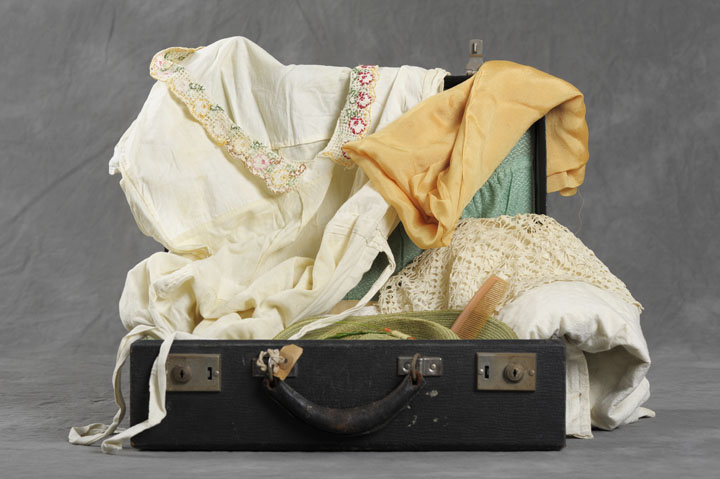
Jon Crispin Suitcase 2 - http://joncrispin.wordpress.com/

Jon Crispin Suitcase 2 – http://joncrispin.wordpress.com/

Like so many others who have discovered that an ancestor was an inmate at Willard, I read the book The Lives They Left Behind Suitcases From A State Hospital Attic by Darby Penney and Peter Stastny in order to learn what life was like living inside the asylum. I contacted Ms. Penney to ask if my great-grandmother’s suitcase was found in the attic. It wasn’t. The authors were given permission to research the medical records of twelve patients and were allowed to use patient photographs in the book using factitious names. Since I am a descendent of a patient, I assumed that I would be able to receive a copy of my great-grandmother’s medical records and photographs. I was wrong. I learned that I have no right to this information unless my primary care physician needs the health records to diagnose or treat a condition. This explanation was given to me in a letter by the Commissioner of the New York State Office of Mental Health. It makes no sense to me considering that my great-grandmother has been dead for eighty-four years. I wonder if a diagnosis that was made eighty-four years ago would even be relevant today. My point is this: I want to know what happened to my great-grandmother. I want to learn her diagnosis and read about her experiences in a state hospital.

Jon Crispin Suitcase 6 - http://joncrispin.wordpress.com/

Jon Crispin Suitcase 6 – http://joncrispin.wordpress.com/

Ms. Penney is a national leader in the human rights movement for people with psychiatric disabilities. In an email I asked her, “When did the state hospitals go bad?” Her reply was, “It never went bad. Western society’s methods of dealing with people in mental and emotional distress have always been based on punishment and segregation. Anyone who is locked up against their will and kept in isolation is being treated poorly, to my mind.” Ms. Penney and the NYS Archives have the list of the former suitcase owners. Even though it is not a medical record it cannot be released to the public because it would identify former patients. You may contact Ms. Penney to inquire about your ancestor’s suitcase at: community@capital.net. For more information visit The Lives They Left Behind Suitcases From A State Hospital Attic Website. 

Jon Crispin Suitcase 10 - http://joncrispin.wordpress.com/

Jon Crispin Suitcase 10 – http://joncrispin.wordpress.com/

Willard Asylum Cemetery (Veterans Names) Military Section, Seneca County, NY:
http://www.newyorkroots.org/ontario/cems/SenecaCo/Willardceme.htm

Jon Crispin Suitcase 13 - http://joncrispin.wordpress.com/

Jon Crispin Suitcase 13 – http://joncrispin.wordpress.com/

Jon Crispin’s Notebook – Willard Suitcases:
http://joncrispin.wordpress.com/2011/03/18/willard-asylum-suitcase/

http://joncrispin.wordpress.com/2011/07/24/willard-asylum-suitcase-2/
http://joncrispin.wordpress.com/2011/10/04/willard-suitcase-3/
http://joncrispin.wordpress.com/2011/10/07/willard-suitcase-4/
http://joncrispin.wordpress.com/2011/10/16/willard-suitcase-5/
http://joncrispin.wordpress.com/2011/10/23/willard-suitcase-6/
http://joncrispin.wordpress.com/2011/10/31/willard-suitcase-7/
http://joncrispin.wordpress.com/2011/11/11/willard-suitcase-8/
http://joncrispin.wordpress.com/2011/12/05/willard-suitcase-9/
http://joncrispin.wordpress.com/2011/12/27/willard-suitcase-10/
http://joncrispin.wordpress.com/2012/01/13/willard-suitcase-11/
http://joncrispin.wordpress.com/2012/02/06/willard-suitcase-12/
http://joncrispin.wordpress.com/2012/03/03/willard-suitcase-13/

Paranormal State – The Ghosts of Willard Asylum

Paranormal State – The Asylum – Parts 1 & 2

I saw this episode of Paranormal State starring Ryan Buell, on A & E a few months ago, and since I am interested in the history of The Willard Asylum for the Insane (Willard State Hospital), I wanted to share it with you. Yes, I do believe that every person has a soul, and I do believe in the possibility that some souls may be stuck here on earth in a place where they don’t want to be, for whatever reason.

I wanted to share this episode because it shows a panoramic view of the Willard Cemetery which is a disturbing 25 acres of anonymous, unmarked graves; only the veteran’s graves are marked. The video also shows the original State Agricultural College Building which was turned into “The Branch,” and later renamed “The Grandview,” which held over 200 mild, insane, female patients (the basement of this building is shown quite a bit with its rounded, brick arches).

Willard was unique because it was built for the “pauper chronic insane” population of New York State and opened on October 13, 1869 (not 1866). Willard’s main building or “Chapin House,” named after Dr. John B. Chapin, the first physician superintendent of Willard, no longer stands as it was demolished around 1984/85. The group of red buildings with boarded up windows is one of four “cottage style” buildings that made Willard different from other state hospitals because they could segregate patients (over 200 patients in each group of 5 buildings), and expand the hospital in an economic (cheap) way to serve the needs of the state.

This cemetery has been blessed numerous times but the people who are buried there still remain anonymous.

Part One

Part Two

To learn more about The Willard Asylum for the Insane, buy my book:

The Inmates of Willard 1870 to 1900, A Genealogy Resource

The Inmates Of Willard 1870 to 1900 / A Genealogy Resource

The Inmates Of Willard 1870 to 1900 / A Genealogy Resource